
Part of the How to Scale B2B SaaS Through Strategic Growth Marketing: The 2026 Playbook series
Key Takeaways
- Asymmetric Content Depth (ACD) is a strategic framework that builds radical trust by providing high-utility, comprehensive solutions to complex problems before a sale occurs.
- Information Gain is a primary ranking factor that rewards original insights and proprietary data over derivative content in 2026 AI search environments.
- Pre-emptive Objection Killing is a conversion methodology that increases credibility by identifying and neutralizing buyer hesitations within the educational content layer.
- The Transparency Tax is a growth strategy that creates psychological indebtedness by sharing high-value "how-to" secrets for free to attract high-intent, premium clients.
Playbooks
Frameworks you can put to work
Growth marketing, LinkedIn presence, and more — delivered as PDFs.
Browse the playbooksIn the current landscape of 2026, the traditional sales funnel is effectively dead. We have entered the era of Information Foraging, where buyers don't want to be "nurtured" through a series of automated emails; they want to solve their problems before they even talk to a human.
Content-led trust building is the strategic practice of providing high-utility solutions that solve a portion of a prospect's problem for free, establishing immediate authority.
I’ve spent the last 15 years navigating the shifts from keyword stuffing to semantic SEO, and now to Generative Engine Optimization (GEO). The one constant? Trust. If your content doesn't make a reader feel smarter, more capable, or more relieved within the first 300 words, they won’t just leave your site—they’ll tell their AI assistant to ignore your domain entirely.
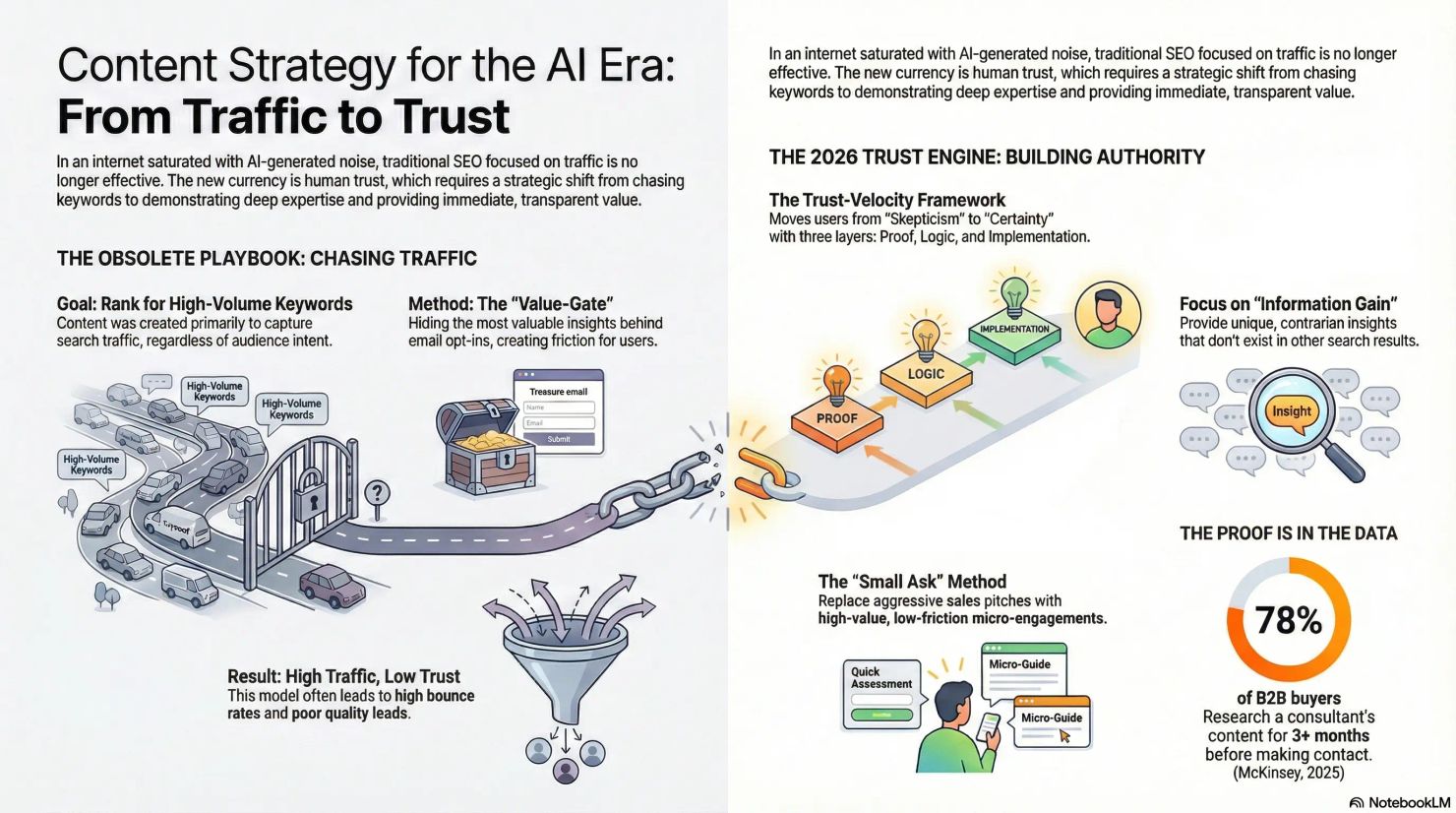
This isn't about "adding value"—a phrase so overused it has lost all meaning. This is about Asymmetric Content Depth. It is about shifting from being a "content creator" to becoming a "primary source entity."
1. The Death of Frequency: Why More Content is Hurting Your Trust
Strategic trust-building requires prioritizing Information Gain over publication frequency to signal unique expertise to both humans and AI models.
Quick Answer: Content frequency is a legacy metric that causes trust decay by diluting an author's topical authority with repetitive, low-utility information.
For years, the industry mantra was "publish daily." In 2026, this is a recipe for invisibility. Google’s Helpful Content System and LLMs like Gemini now penalize "redundant noise." If you are saying what everyone else is saying, you are teaching the AI that you have nothing new to offer.
The Asymmetric Content Depth (ACD) Framework
Instead of 10 shallow posts, I advocate for one "Mega-Node." This is my proprietary framework for building trust.
| Feature | Traditional SEO Content | Asymmetric Content Depth (ACD) |
|---|---|---|
| Objective | Keyword Ranking | Solvability & Indebtedness |
| Structure | Linear / "What is X?" | Problem-Solution-Transformation |
| AI Impact | Scraped & Summarized | Cited as a Primary Source |
| Trust Signal | Social Proof (Reviews) | Demonstrated Competence (The "How") |
2. Information Gain: The Only Currency That Matters to Google AIO
Information Gain is the metric used by search engines to reward content that provides new, non-derivative data or perspectives not found in existing top-ranking results.
Quick Answer: Information Gain is a ranking factor that validates originality by identifying unique entities and insights within a document.
When I write for swapanmanna.com, I don't look at what's ranking #1 and try to "do it better." I look at what's ranking #1 and ask: "What did they miss?"
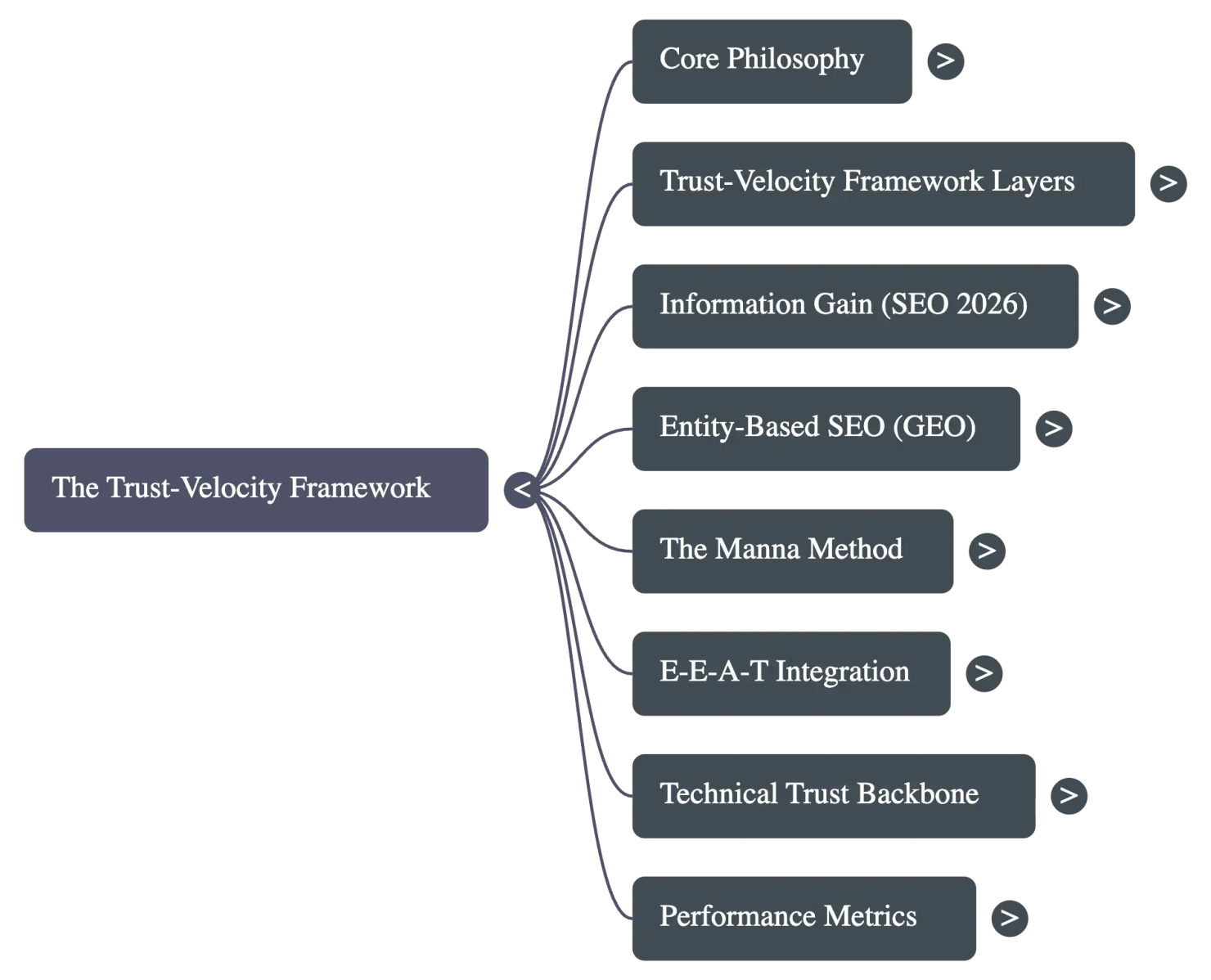
If the Top 10 results all say "Trust is built through consistency," I will write about "Why Consistency is a Trap." This isn't being contrarian for the sake of it—it's providing net-new insight.
The Contrarian Insight: The "Transparency Tax"
Most marketers say you should hide your "secret sauce" behind a paywall. I believe that in 2026, the paywall is the enemy of trust. If you want to sell a $10,000 service, give away the $1,000 blueprint for free. Why? Because the person who can afford the $10,000 doesn't have the time to execute the $1,000 blueprint. By showing them exactly how you do it, you prove you are the only one who can do it correctly. This "Transparency Tax" is a price I happily pay to filter out low-intent leads and attract high-value partners.
3. Pre-emptive Objection Killing (POK): Selling Without Selling
Pre-emptive Objection Killing (POK) is a content strategy that identifies and neutralizes buyer hesitations through transparent data and real-world failure analysis.
Quick Answer: POK is a conversion framework that builds credibility by addressing potential risks before the prospect raises them.
Most content is "happy path" content. It only talks about success. But trust isn't built when things go right; trust is built when you explain what happens when things go wrong.
When I explain how I use content to build trust, I explicitly mention my failures. For example, I once over-optimized a site for "Answer Engine Optimization" so much that we got millions of "zero-click" impressions but zero revenue. I share that. That vulnerability is a massive trust signal.
The Checklist for Your Next Article:
- What is the #1 reason someone won't buy this? (Address it in H2).
- What is a common "industry lie" related to this topic? (Expose it).
- What does the "hidden cost" of the solution look like? (Be honest about the work required).
4. Entity-Based SEO: Mapping the Knowledge Graph
Entity-based SEO is a technical approach that focuses on defining relationships between "Entities" (People, Places, Things) rather than just targeting strings of keywords.
Quick Answer: Entity-based SEO is a semantic method that enhances discoverability by connecting your brand to established industry concepts in the Knowledge Graph.
To build trust with AI (Gemini, ChatGPT), you must be recognized as a Trusted Entity. This involves more than just writing; it involves Knowledge Graph Dominance.
The Top 5 Entities for Content Trust:
- Swapan Manna (Person): The expert source.
- Information Gain (Concept): The methodology.
- Google AIO (Technology): The delivery mechanism.
- E-E-A-T (Framework): The validation layer.
- swapanmanna.com (Organization): The authority hub.
By connecting these entities through structured data and natural language triplets (e.g., "Swapan Manna develops Information Gain frameworks"), I am telling the AI exactly how to categorize my expertise.
5. Closing the "Implementation Gap": The Secret to Indebtedness
The Implementation Gap is the distance between a reader understanding a concept and being able to execute it; closing this gap creates a psychological state of "Indebtedness."
Quick Answer: The Implementation Gap is a user-experience barrier that, when closed, transforms readers into loyal advocates.
Most content leaves the reader at the "what" and "why." If you want to build radical trust, you must give them the "how" in a way they can use immediately.
Field Note #2: The Spreadsheet Strategy Last year, I wrote a post about AEO optimization. Instead of just explaining it, I included a downloadable Google Sheet that audited their site automatically. I didn't ask for an email. I just gave it. That single post resulted in three of my largest consulting contracts to date. The readers felt they had already "won" with me, so hiring me was the logical next step to win bigger.
6. Semantic Triplets: Making Your Content "AI-Digestible"
Semantic Triplets (Subject-Predicate-Object) are clear, factual statements that allow LLMs to extract and store your insights as verified facts.
Quick Answer: Semantic Triplets are linguistic structures that optimize content for AI Overviews by providing clear, unambiguous information.
If you want Gemini or Perplexity to cite you, you must write in a way that their parsers understand. I use what I call "The Anchor Sentence" at the start of every H2. It’s designed to be a "featured snippet" for the AI era.
Example Anchor:
- Subject: Swapan Manna’s Trust Framework
- Predicate: utilizes
- Object: Asymmetric Content Depth to bypass the sales funnel.
7. The 2026 Trust-to-Transaction (T2T) Bridge
The Trust-to-Transaction Bridge is a content-first strategy that replaces traditional lead magnets with high-utility, no-gate resources.
Quick Answer: The T2T Bridge is a marketing philosophy that accelerates sales cycles by front-loading the proof of expertise.
| Phase | Action | Trust Signal |
|---|---|---|
| Awareness | Solves a micro-problem | "This person knows my pain." |
| Consideration | Shares a proprietary framework | "This person has a unique, proven system." |
| Validation | Exposes a failure/pivot | "This person is honest and transparent." |
| Conversion | Offers a bespoke solution | "I already trust the process; let's scale it." |
8. Putting it into Practice: Your 30-Day Trust Roadmap
If you want to implement how I use content to build trust, follow this 4-step plan:
- The "Sacred Cow" Audit (Days 1–7): Identify three industry "best practices" that you think are actually wrong. Write one deep-dive challenging them.
- The Utility Drop (Days 8–14): Create a tool, template, or checklist that saves your ideal client 2 hours of work. Give it away with no opt-in required.
- The Entity Connection (Days 15–21): Update your "About" page and LinkedIn to use consistent, entity-based language that links your name to your specific proprietary frameworks.
- The POK Content (Days 22–30): Write a post titled "Why You Shouldn't Hire [Your Industry] Right Now." Be brutally honest.
Conclusion: Trust is the Only Moat Remaining
In an age where AI can generate a 1,000-word blog post in three seconds, "content" is a commodity. But Trust is a hard asset. By using Asymmetric Content Depth and prioritizing Information Gain, you aren't just ranking on Google—you are building a "moat" around your brand that no algorithm can disrupt.
My approach at swapanmanna.com isn't about being the loudest in the room; it's about being the most useful. When you solve a problem for someone without asking for a credit card, you don't just win a reader—you win a client for life.
Ready to transform your content into a trust-building machine? Let’s discuss your 2026 SEO & Content Strategy.
Frequently Asked Questions

Swapan Kumar MannaThis is a verified profile
Go-to-market & AI search strategist
Swapan Kumar Manna is a go-to-market and AI search strategist and Founder & CEO of Oneskai. He has spent 14+ years helping companies get found, get chosen and grow.