
Part of the How to Build Thought Leadership Buyers Actually Trust series
Building a personal brand on LinkedIn and X means publishing a narrow point of view consistently until your name signals specific expertise. Research shows 71% of B2B buyers trust thought leadership over traditional marketing (Edelman/LinkedIn), and LinkedIn's algorithm now rewards dwell time and early engagement over raw post frequency.
Key Takeaways
- LinkedIn's algorithm weights dwell time above reactions — posts held for 61+ seconds see roughly 15.6% engagement versus 1.2% for posts skimmed under 3 seconds.
- The first 60-90 minutes after posting largely decide a post's total reach on LinkedIn.
- 71% of B2B buyers say thought leadership content proves vendor understanding better than product marketing does (Edelman/LinkedIn, 2025).
- Personal accounts on X consistently out-engage brand accounts; treat a company handle as an amplifier, not the primary voice.
- 3-4 high-quality LinkedIn posts a week beats daily filler — consistency over months matters more than any single post's performance.
Playbooks
Frameworks you can put to work
Growth marketing, LinkedIn presence, and more — delivered as PDFs.
Browse the playbooksMost founders treat LinkedIn like a résumé and X like a vent channel. Neither gets them anywhere. Meanwhile, a CEO with 5,000 LinkedIn connections can out-reach a company page with 300,000 followers, according to LinkedIn's own platform data, because people trust people, not logos.
Building a personal brand on LinkedIn and X means publishing consistently in your own voice, on a narrow set of topics, until your name becomes shorthand for a specific kind of expertise. It works because buyers now research the person before they research the product: Edelman and LinkedIn's 2025 B2B Thought Leadership Impact Report found 71% of B2B buyers say thought leadership content is more effective than traditional marketing at proving a vendor understands its category.
I've run this experiment on my own accounts and watched a dozen founder clients run it on theirs. The pattern holds: sporadic posting gets ignored, and a narrow, consistent voice compounds. This piece covers what to post, where, how the two platforms actually reward different behavior, and the mistakes that quietly stall almost every founder's account before it gets any traction.
Key Takeaways
- LinkedIn's algorithm now weights dwell time above reactions — posts held for 61+ seconds see roughly a 15.6% engagement rate versus 1.2% for posts skimmed in under 3 seconds, per platform-behavior research cited by SocialBee and Teract.
- The first 60–90 minutes after you post are the ones that decide your reach; LinkedIn samples early reactions before deciding whether to distribute further.
- 71% of B2B buyers say thought leadership content proves vendor understanding better than product marketing does (Edelman/LinkedIn, 2025).
- Personal accounts on X consistently out-engage brand accounts. Treat your company handle as an amplifier, not the primary voice.
- 3–4 high-quality LinkedIn posts a week beats daily filler; consistency over 90 days matters more than any single post's performance.
What Is a Personal Brand on LinkedIn and X?
A personal brand on LinkedIn and X is the recognizable point of view you build by publishing original commentary, frameworks, and experience under your own name rather than your company's. It differs from a company page because it carries a face, a voice, and, critically, a track record people can scroll back through and verify.
This isn't new advice. What's changed is the mechanics. LinkedIn's feed now ranks for “relevance, expertise, clarity, and engagement quality” rather than raw reaction counts, and X has shifted toward rewarding threads and video over single-line hot takes. The strategy that worked in 2021, post daily and chase likes, actively hurts you now if the content underneath it is thin.
Why This Matters for Founders in 2026
The business case isn't abstract anymore. Edelman and LinkedIn's most recent B2B Thought Leadership Impact Report found 58% of business decision-makers now spend at least an hour a week reading thought leadership content, up from roughly half the year before. That's an hour of attention buyers are choosing to spend on someone's actual thinking instead of a vendor's pitch deck.
It also changes who gets the meeting. The same research found more than 75% of decision-makers who said a piece of thought leadership prompted them to research a company ended up doing business with that company at a rate near 23%. And 70% of C-suite buyers said a piece of thought leadership had, at least occasionally, made them question whether to keep working with an existing supplier. That means silence isn't neutral. If you're not publishing, a competitor's founder is quietly making your buyers second-guess you.
I've seen the inbound-versus-outbound math play out directly. Founders who publish specific, opinionated posts consistently generate warmer inbound than any cold outreach campaign I've run for a client. The DM that starts with “I've been reading your posts” closes faster than one that opens with a pitch, because half the trust-building happened before the call.
None of this replaces a GTM motion. It compounds one. A personal brand doesn't shorten your sales cycle by itself, but it does make every other motion (outbound, paid, partnerships) convert better, because prospects arrive pre-sold on your credibility.
The Signal Ladder Framework
Most founders fail at personal branding because they publish one type of content and wonder why growth stalls. I use a simple structure with clients called the Signal Ladder: four content types, each doing a different job, posted in a deliberate ratio rather than randomly.
Rung 1: Position posts (the foundation, ~40% of output)
These state a specific, defensible opinion about your category. Not “AI is changing SaaS,” that's a generic observation anyone could write. Something closer to “Most SaaS onboarding flows fail because they optimize for feature discovery instead of first-value speed.” Position posts are what get you found by people who don't know you yet, because they're the ones that get saved and shared into group chats.
Rung 2: Proof posts (~25% of output)
Position without proof is just an opinion. Proof posts show the work: a before/after, a number that moved, a mistake you made and what it cost. These are harder to write because they require you to be specific about outcomes, which is exactly why they carry more weight than generic advice. “We cut trial-to-paid conversion friction by removing 9 of 14 onboarding fields” reads as credible in a way “streamline your onboarding” never will.
Put this into practice
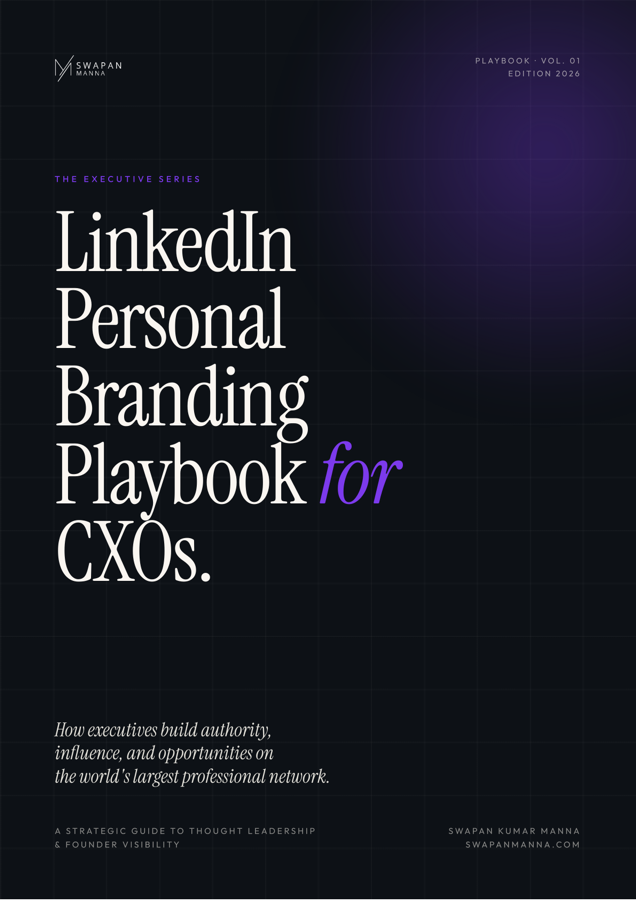
LinkedIn Personal Branding Playbook for CXOs
A strategic guide to thought leadership, founder visibility, and pipeline that follows — written for CEOs, CMOs, and founders who refuse to be invisible on the world's largest professional network.
Rung 3: Conversation posts (~20% of output)
Genuine engagement with what other people in your space are saying: quote-posting with real added perspective, commenting substantively on posts from peers, asking a sharp question publicly. This rung is where the algorithm rewards you disproportionately, because comments and replies are read as stronger signals than passive likes on both platforms.
Rung 4: Personal posts (~15% of output)
The human layer: a lesson from a failure, a values statement, something from outside work that still says something about how you think. Used sparingly, these humanize the other three rungs. Used too often, they turn your feed into a diary nobody subscribed to.
The ratio matters more than any individual post. A feed that's 100% position posts reads as preachy. A feed that's mostly personal posts never builds authority. Weighted the way the Signal Ladder suggests, each post type sets up the next one. Proof backs up your positions, conversation builds relationships with the people whose posts you want to be seen next to, and personal posts keep the whole thing from feeling like a content calendar.
LinkedIn vs. X: How the Two Platforms Actually Differ
Treating LinkedIn and X the same way is the single most common mistake I see. They reward different behavior, attract different audiences, and punish different sins.
| Dimension | X (Twitter) | |
|---|---|---|
| Primary audience | B2B decision-makers, peers, potential hires | Founders, builders, journalists, fast-moving niche communities |
| Best content format | Long-form posts (1,200–2,000 characters), documents/carousels, native video | Threads (5–10 posts), single sharp takes, video clips |
| What the algorithm rewards | Dwell time, comments in the first 60–90 minutes, document/carousel completion | Replies, reposts with commentary, video watch time |
| Posting cadence that works | 3–4 high-quality posts per week | 2–3 posts per day (mix of value, reply, and thread) |
| Tone that performs | Structured, credible, framework-driven | Direct, faster, more willing to take a side |
| Where the real conversation happens | The comment section under your post | The reply thread and quote-posts |
| Time to build a real audience | 6–9 months of consistent posting for a niche B2B following | Faster follower growth, slower trust-building without consistent threads |
The practical implication: write your best thinking once, then adapt the packaging. A framework that runs as a 1,500-character LinkedIn post with a supporting graphic can become a 7-tweet thread on X. Same idea, different pacing, because X readers bail faster if the payoff is delayed.
Common Mistakes Founders Make
Posting without a point of view. “Excited to announce...” posts and generic industry commentary blend into the feed. If a competitor could post the exact same thing under their name, it's not building your brand. It's building noise.
Chasing follower count instead of the right followers. A LinkedIn audience of 5,000 engaged operators in your buyer persona outperforms 50,000 followers who never comment, never DM, and never buy. Vanity metrics feel good and mean almost nothing for pipeline.
Disappearing after a slow week. The algorithm doesn't hold a grudge, but your audience's habit does. Three weeks of silence after a burst of daily posting resets the relationship you'd built. Consistency beats intensity: 3 solid posts a week for a year beats 20 posts in one manic month followed by silence.
Ignoring the comments section. Replying within the first two hours after you post generates meaningfully more engagement than replying the next day, because the algorithm is still deciding whether to distribute the post further. Founders who post and disappear are leaving reach on the table.
Writing for everyone. “Entrepreneurs” is not an audience. “First-time SaaS founders past $10K MRR trying to fix churn” is. The narrower and more specific your stated audience, the more that audience recognizes themselves in your posts and the harder they engage.
Treating the company page as the main channel. Company pages are useful for job posts and press. They are not where trust gets built. Personal accounts consistently out-perform brand accounts on engagement, and buyers say they trust individual voices over corporate ones. Put your best thinking on your own name first, then have the company page amplify it.
Frequently Asked Questions
Final Thoughts
Personal branding on LinkedIn and X isn't a marketing side quest. For a founder, it's one of the highest-leverage things you can do with an hour a week, because it compounds in a way paid acquisition never does. The mechanics matter less than the discipline: pick a narrow lane, publish real opinions backed by real specifics, show up in the comments, and give it the better part of a year before judging the results.
Start smaller than feels ambitious. One sharp position post a week, for two months, will teach you more about what your audience wants than any content calendar template. If you want the deeper framework behind this, see how to build thought leadership buyers actually trust. And if you want a second pair of eyes on your positioning before you start, that's a conversation worth having.
Written by Swapan Kumar Manna — AI Strategist and SaaS Growth Consultant with 14+ years scaling B2B SaaS across APAC. Connect on LinkedIn @swapanmanna.
Put this into practice
LinkedIn Personal Branding Playbook for CXOs
A strategic guide to thought leadership, founder visibility, and pipeline that follows — written for CEOs, CMOs, and founders who refuse to be invisible on the world's largest professional network.

Swapan Kumar MannaThis is a verified profile
Go-to-market & AI search strategist
Swapan Kumar Manna is a go-to-market and AI search strategist and Founder & CEO of Oneskai. He has spent 14+ years helping companies get found, get chosen and grow.