Part of the Modern SEO Strategy: How to Rank in Google and AI Search series
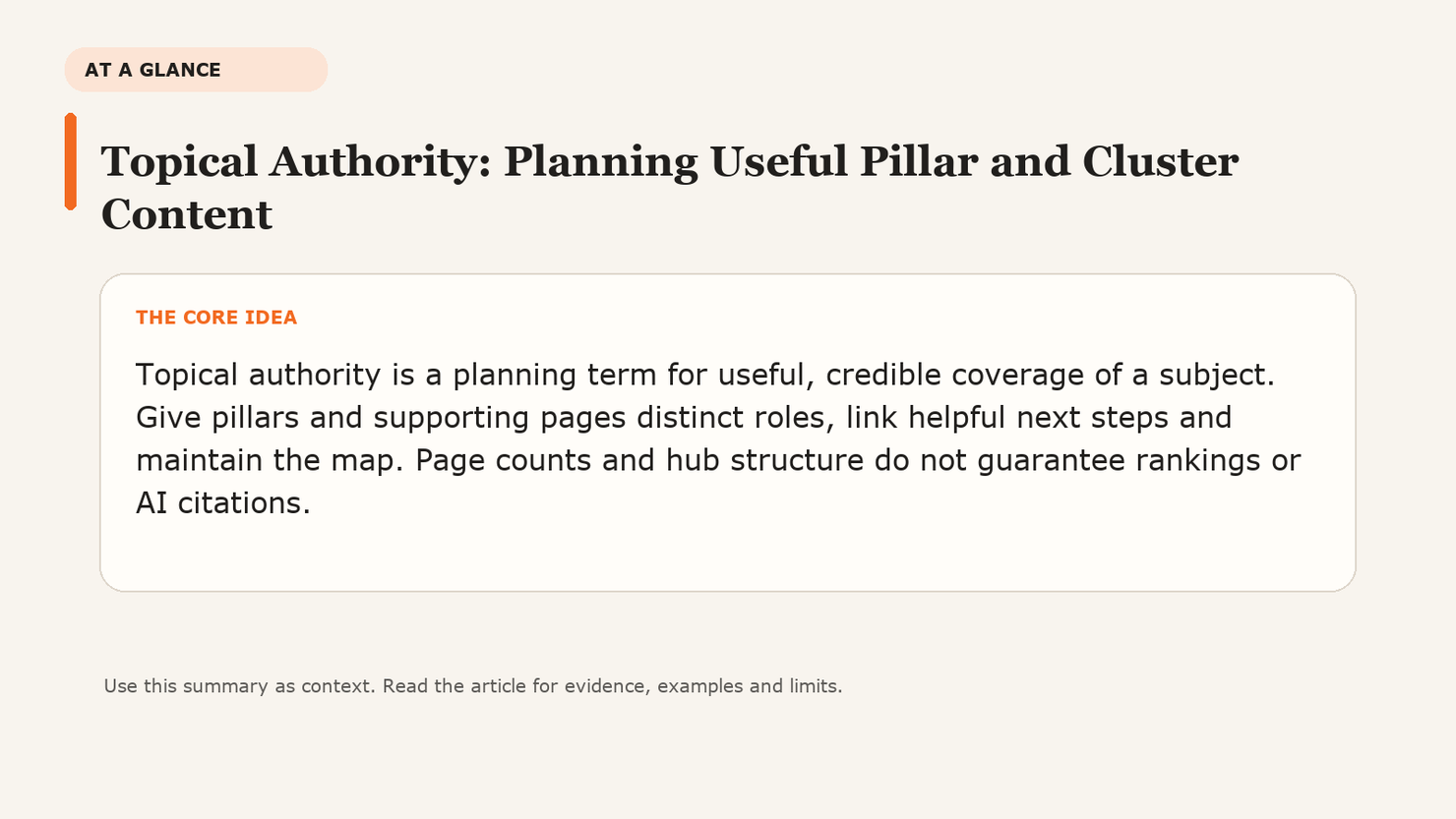
Topical authority is a planning term for useful, credible coverage of a subject. Give pillars and supporting pages distinct roles, link helpful next steps and maintain the map. Page counts and hub structure do not guarantee rankings or AI citations.
Key Takeaways
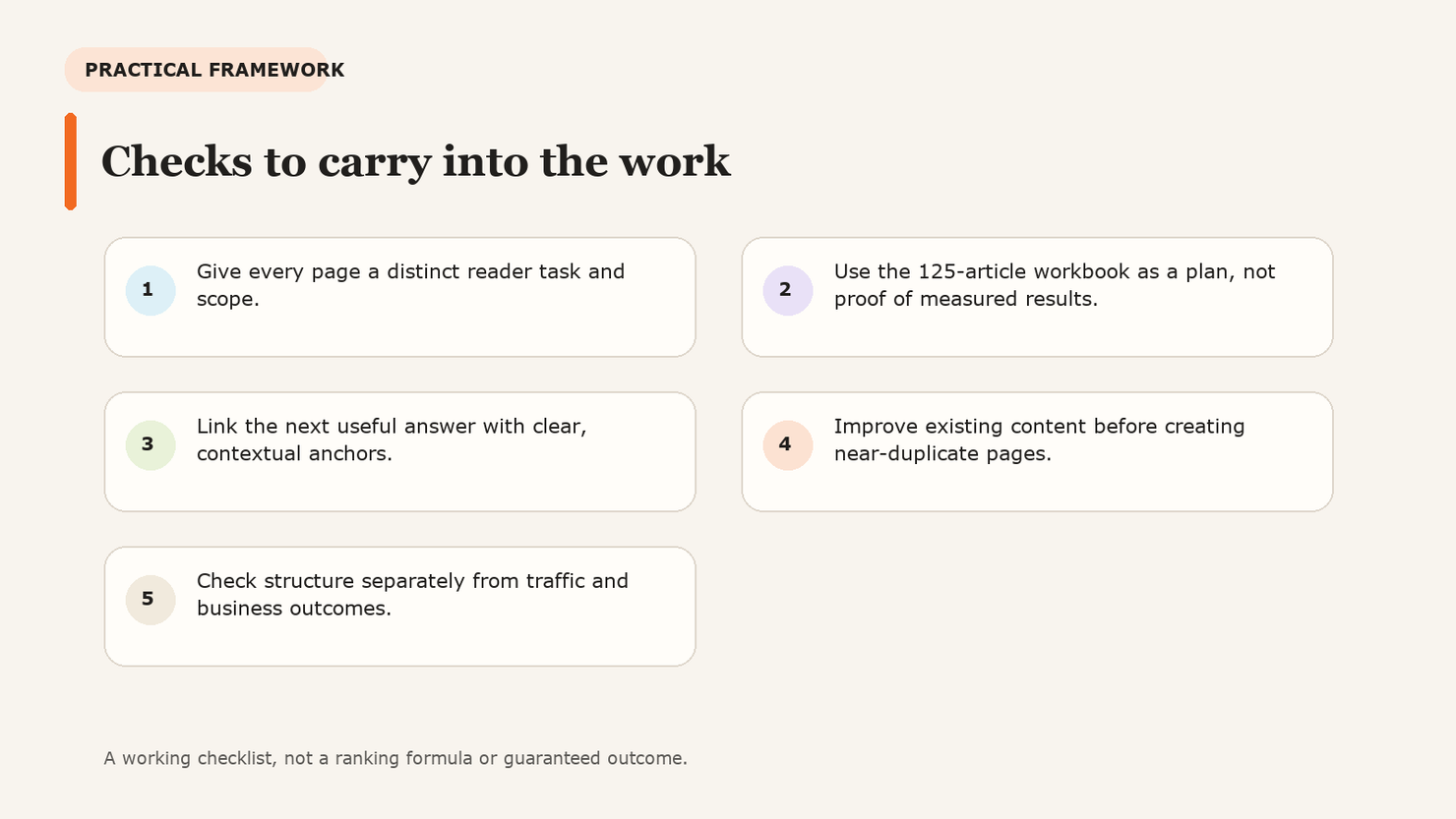
- Give every page a distinct reader task and scope.
- Use the 125-article workbook as a plan, not proof of measured results.
- Link the next useful answer with clear, contextual anchors.
- Improve existing content before creating near-duplicate pages.
- Check structure separately from traffic and business outcomes.
In this articleShowHide
Playbooks
Frameworks you can put to work
Growth marketing, LinkedIn presence, and more — delivered as PDFs.
Browse the playbooksA content plan can look complete and still leave readers moving between pages that repeat the same advice. The missing piece is often a clear role for each page and a useful path between them.
Topical authority, as a planning term, means building a credible body of useful content around a subject. A pillar-cluster model can help organize that work: a broad guide gives readers context, focused articles resolve narrower questions, and internal links connect the next useful step.
This is a design approach, not a Google authority score or a promise that every new post will rank faster. The structure helps only when the pages earn their place through clear answers and sound evidence.
My recommendation is to plan around reader decisions before dividing the subject into keywords. Then give each page one main job. The result should feel like a useful guide to the subject, rather than a large folder of similar articles.
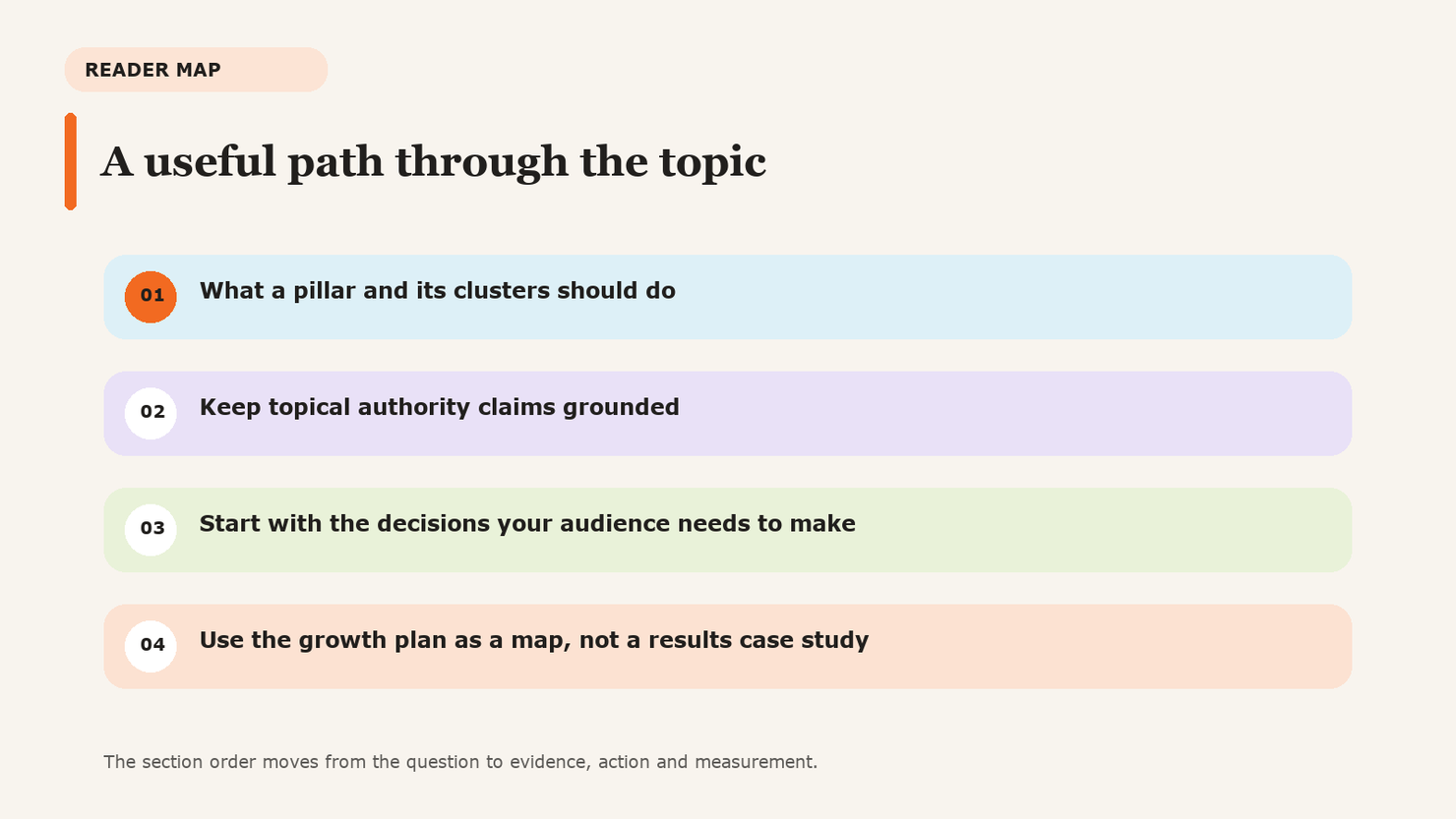
What a pillar and its clusters should do
A pillar page explains a broad subject and helps readers find the part that matters to them. It should provide a useful answer on its own. It does not need to contain every detail from every supporting article.
A cluster page goes deeper on a distinct question. It might explain a process, compare options or help someone fix a specific problem. Readers should understand why that page exists alongside the pillar.
The relationship is editorial first. An internal link can make it visible, but it cannot create a useful distinction between two pages that say the same thing. Start with the scope, then build the links.
There is no universal number of pages that makes a cluster complete. Nor should a fixed word count decide whether a guide is strong. The question is whether the intended audience can get the answers they need at an appropriate depth.
Keep topical authority claims grounded
Google's people-first content guidance asks whether a site has an intended audience and a clear focus. It also asks whether its content provides useful information beyond the obvious. Those are good tests for a topic plan.
They do not establish that a particular hub-and-spoke layout earns a fixed traffic lift. A connected site can still contain weak pages. A useful standalone page can still serve its audience well.
Google's ranking systems guide describes ranking systems that work mainly at the page level, alongside some site-wide signals. Avoid the claim that Google has stopped ranking pages and only ranks topics or whole sites.
I would use topical authority as a standard for what the team covers well, not as a number to chase. Ask whether readers can learn the subject, check the claims and make better choices. Then measure actual search and business outcomes separately.
Start with the decisions your audience needs to make
Choose a subject tied to your work and the people you can help. A broad topic such as marketing may be too loose to guide useful choices. A more focused area gives the team a clearer boundary.
For each audience, list the tasks that come before, during and after a decision. A team planning organic growth may need to choose priorities, check site access, decide what to write and judge the results. Those tasks can shape the pages better than a list of close keyword variants.
Then review existing content. Some tasks may already have strong pages. Others may need a section added to a current guide. A gap in the spreadsheet is not proof that the site needs another URL.
Write a short scope for each proposed page. Include the reader, the question, the useful contribution and what belongs elsewhere. That last boundary helps prevent two articles from growing into the same guide over time.
Use the growth plan as a map, not a results case study
The current growth workbook for this site contains 125 planned articles across ten pillars: ten cornerstone articles and 115 supporting articles. Those counts describe the plan. They do not mean that all pages are live or that the structure has produced a measured traffic gain.
The subjects range from the future of search and modern SEO to content strategy, brand building and revenue systems. That breadth makes clear boundaries especially important. Without them, several pillars could repeat the same advice about AI visibility or growth.
The Modern SEO pillar offers a useful example. Its broad guide covers the strategy. One supporting page focuses on brand identity, another on the value a draft adds, another on bot access and another on structured data. Each addresses a different part of the work.
The topic-cluster article you are reading has another role: deciding how those pages fit together. It should not become a full bot guide or an entity SEO tutorial. The search intent article has its own role too, going deeper on how to map queries to tasks.
This distinction is the main lesson from the plan. A large count is easy to display. A clear reason for each page takes more care, and is more useful when the team starts writing and maintaining the content.
Design links around the reader's next question
Internal links help people move through the subject. They also help Google find pages and understand relationships. Google's link best practices recommend crawlable links with concise, relevant anchor text and useful context.
In a pillar, link to a supporting article when the reader needs more detail than the overview should provide. In that supporting article, link back where the broader context helps. These are useful defaults, rather than a rule to repeat the same link in every opening paragraph.
Connect sibling pages when there is a real next step. A page on structured data may point readers toward site-access checks if they cannot confirm what Google receives. It does not need to link to every other article in the cluster.
Use anchor text that tells readers where they are going. A label such as “check crawler access” is clearer than a vague “read more.” Avoid packing extra keywords into the anchor or adding links simply to reach a quota.
Do not make each cluster a sealed silo. If another pillar holds the best answer to the next question, link across to it. The reader's task matters more than keeping every path inside one category.
Decide whether to create, improve or combine a page
Before commissioning a new article, compare its main task with the pages already in the plan and on the site. If two briefs serve the same reader with the same answer, reconsider the split.
A separate page makes sense when it needs a distinct treatment. An overview and a detailed implementation guide can coexist when each serves a clear purpose. Two guides with different titles but nearly the same advice need a closer review.
Improving an existing page may be the best next step. Add missing evidence, a worked example or a clearer decision rule where it helps. Do not create a new page simply because the keyword uses a slightly different phrase.
Google's AI search guidance warns against creating separate content for every possible search variation primarily to manipulate rankings. It favors useful, distinctive content. Apply that principle when deciding how far a cluster should expand.
If pages need to be combined, review their current value and links before changing URLs. A plan-level merge is not permission to remove a live page without checking the effect. Keep URL changes as a separate, deliberate task.
Publish in a useful order and maintain the paths
Start with the pages that give the audience the most useful route through the subject. A pillar and a few strong supporting answers can provide that route without waiting for the full plan to be complete.
Keep draft-only destinations out of reader-facing links. When a supporting page goes live, review the relevant part of the pillar and nearby articles. Add the link where it improves the explanation, and check that the destination works.
Treat those checks as part of publication, not a task that will somehow happen later. Assign someone to review links and scope when content changes. The workbook can record the intended relationships, while the live site needs to reflect only pages that actually exist.
An article may also outgrow its original brief. When that happens, check whether it now repeats a sibling or leaves a gap in the pillar. The structure needs care as the subject changes, not just when the first pages are launched.
Measure whether the architecture is helping
First check the parts you control: each page has a clear task, important public pages have useful incoming links and readers can reach the next relevant answer. These checks establish a working structure, not search success.
Then review performance by page and by related group. Look at the queries bringing visitors, the pages receiving clicks and the actions people take afterward. Keep leads or other meaningful outcomes alongside traffic so the review stays tied to the site's purpose.
If traffic changes after a cluster update, record what else changed. New content, demand, technical fixes and search updates can all affect the result. A before-and-after chart alone does not prove that the link structure caused the gain.
Start with one pillar in your content audit. Give every page a one-sentence job, mark repeated answers and trace the next useful link. Fix those gaps before adding another batch of topics. A smaller, clearer map is a better place to build from than a plan whose pages have no distinct purpose.
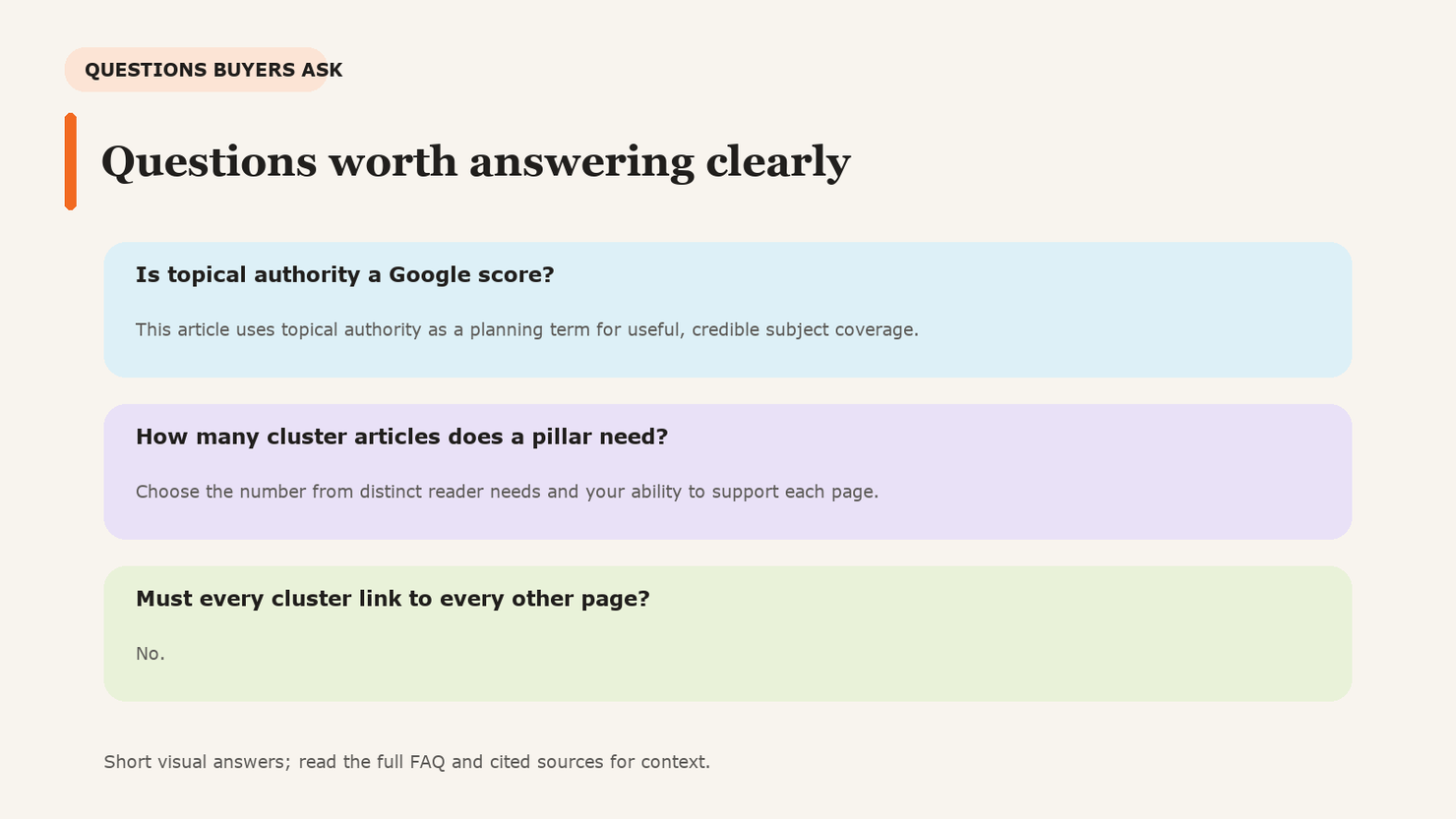
Frequently Asked Questions
Is topical authority a Google score?
How many cluster articles does a pillar need?
Must every cluster link to every other page?
Does this site have 125 live articles in the growth plan?

Swapan Kumar Manna is a go-to-market and AI search strategist and Founder & CEO of Oneskai. He has spent 14+ years helping companies get found, get chosen and grow.