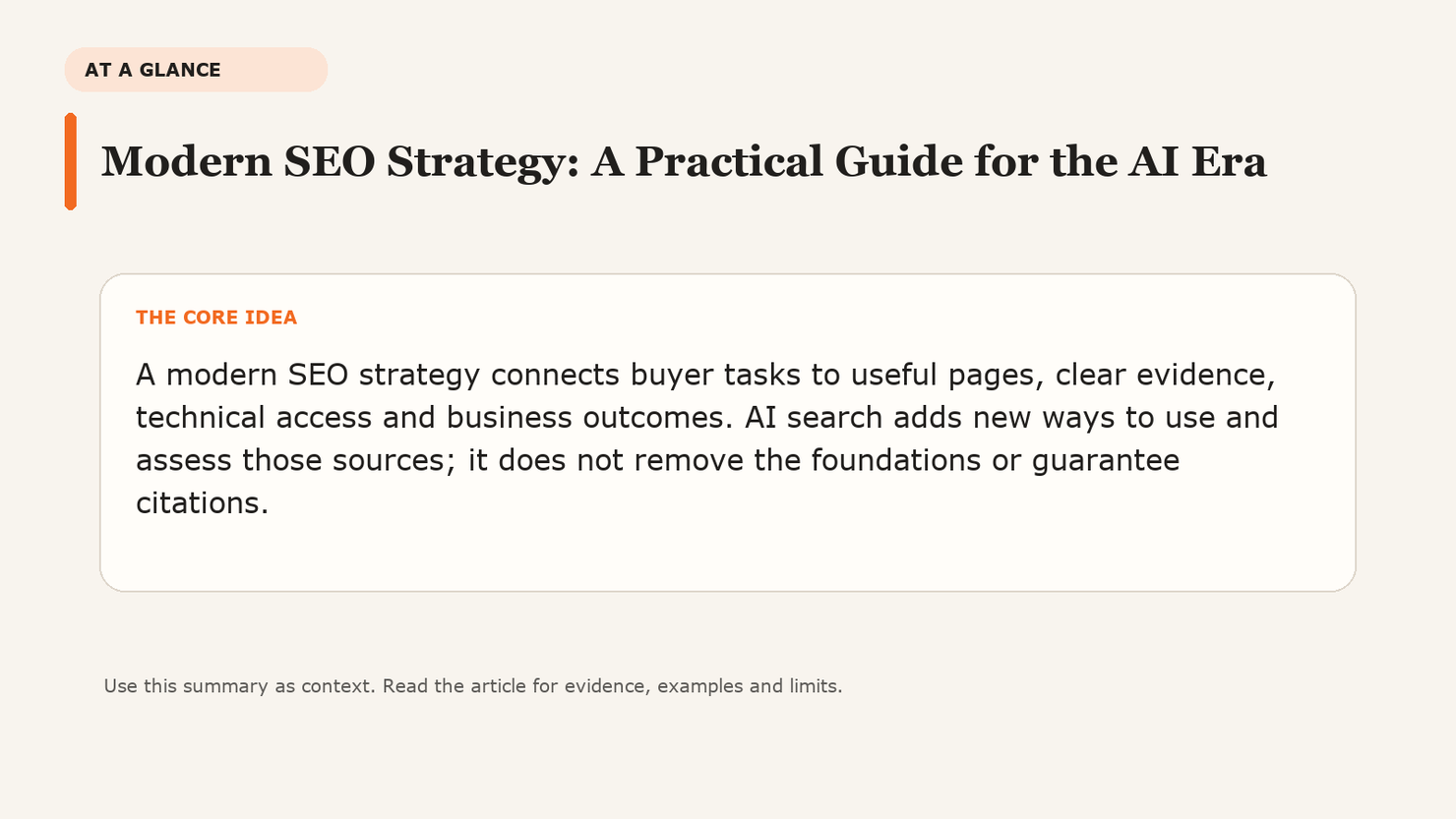
A modern SEO strategy connects buyer tasks to useful pages, clear evidence, technical access and business outcomes. AI search adds new ways to use and assess those sources; it does not remove the foundations or guarantee citations.
Key Takeaways
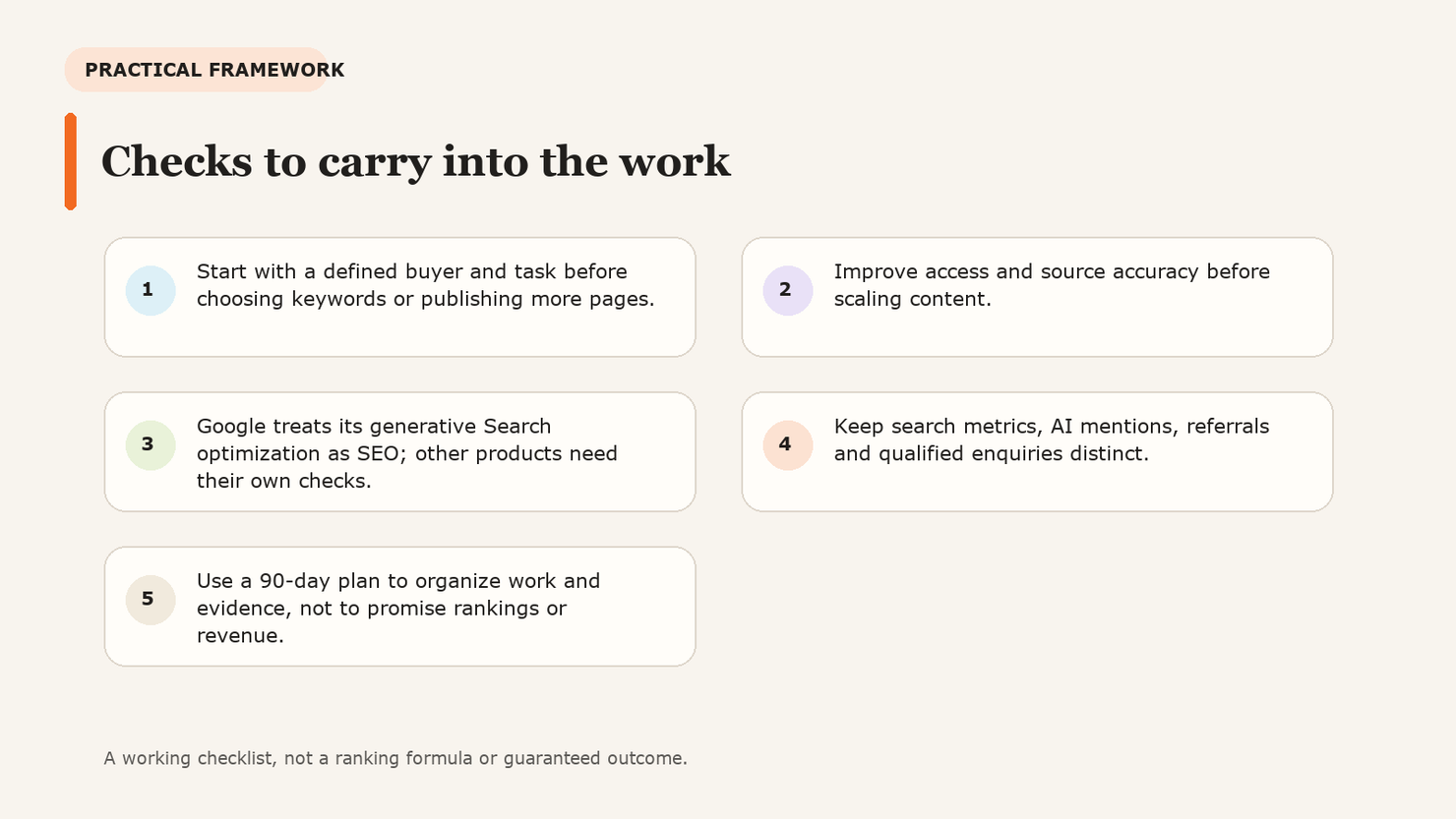
- Start with a defined buyer and task before choosing keywords or publishing more pages.
- Improve access and source accuracy before scaling content.
- Google treats its generative Search optimization as SEO; other products need their own checks.
- Keep search metrics, AI mentions, referrals and qualified enquiries distinct.
- Use a 90-day plan to organize work and evidence, not to promise rankings or revenue.
Playbooks
Frameworks you can put to work
Growth marketing, LinkedIn presence, and more — delivered as PDFs.
Browse the playbooksA search report can look healthy while the business feels stuck. More pages rank, impressions rise, and the content team meets its target. Yet the sales team still hears the same objections, and qualified enquiries barely move.
That gap is where an SEO strategy should start. The job is to help the right people find useful information, understand your offer, and take a sensible next step. Rankings and visits help you judge parts of that work. They do not define the whole outcome.
Modern SEO adds another question: can your content remain useful when a search product answers before someone visits? Google AI Overviews and AI Mode make that question relevant, but they do not remove the need for sound pages, clear facts, and a working website.
My view is that SEO in the AI era needs a tighter link between buyer needs and the work a team chooses to do. Fix access problems. Answer real questions with evidence. Connect the pages that help a decision. Then measure progress without treating every visit or mention as a sale.
This guide turns those principles into a practical plan for SEO leads, content teams, and B2B founders. For the wider change in discovery across search and assistants, start with my future of search guide.
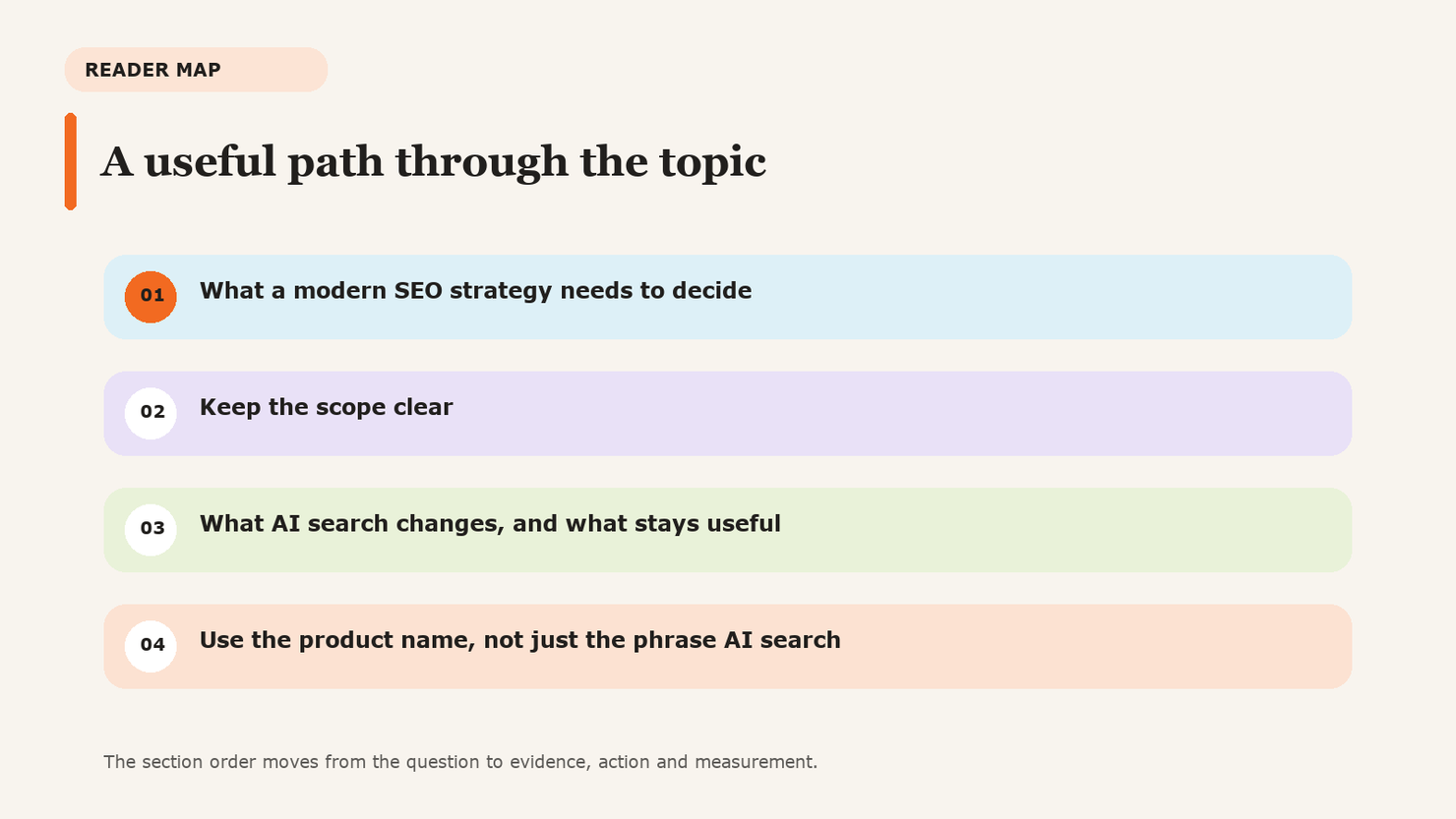
What a modern SEO strategy needs to decide
An SEO strategy is a set of choices about the audience, questions, pages, resources, and outcomes your team will prioritize. It should explain why the work matters to the business and how you will judge it. A list of keywords or a publishing calendar is one input, not the strategy itself.
A useful plan answers five connected questions. Who should find us? What are they trying to do? Which page should help? What evidence can we offer? What should happen next? If those answers are vague, more content will spread the uncertainty across more URLs.
Consider a hypothetical company that sells reporting software to small finance teams. It might target a broad query about dashboards and attract students, job seekers, and enterprise analysts. That traffic could be useful for some businesses, but it may do little for a product built for a narrow group.
A better starting point is the task its buyers face: closing the month with data from several systems. That leads to questions about setup, data checks, access rights, pricing, and the time needed to move. The team can now choose work that helps a real buying decision.
I would write the first page of the strategy in plain English. Name the buyer, their task, the product's fit, the main gaps in the site, and the next quarter's priorities. If a colleague outside the SEO team cannot follow it, the plan needs another pass.
Keep the scope clear
This guide covers the broad system. Entity SEO, structured data, search intent, technical access, content refresh, and digital PR each deserve deeper work. The pillar's role is to show how those parts fit, so the team can choose where to go next.
That also helps avoid competing pages. A broad SEO strategy guide should introduce technical access, while a detailed crawler guide explains how to check it. Both can be useful without trying to answer the same query at the same depth.
What AI search changes, and what stays useful
Google's guide to generative AI search optimization says its AI search features draw on core Search ranking and quality systems. From Google's perspective, work often called AEO or GEO is still SEO. That statement applies to Google Search; it does not describe every assistant's source selection.
The practical change is the range of ways a page can help. A buyer may visit a guide, read an answer with a supporting link, or use a search response to decide what to investigate next. A useful source can matter even when its role is smaller than a full page visit.
Google's AI features documentation explains that AI Overviews and AI Mode may issue related searches to build an answer. This is often called query fan-out. A detailed question can draw on several sources rather than a single page that matches the exact wording.
That is a reason to cover a buyer's task well. It is not a reason to create a new article for every slight question variation. One strong setup guide may answer several related needs if it includes the right facts and clear sections.
There is also a limit to what you can control. You can improve a source, its access, and its accuracy. You cannot require a search system to cite it or describe your brand as the best option. Treat selection as an outcome to observe, not a setting you can switch on.
Use the product name, not just the phrase AI search
Google Search, ChatGPT, Copilot, Perplexity, and Gemini are different products. A report called AI visibility should name the products and questions it checks. Otherwise a rise in one place can hide a gap in another.
For this SEO strategy, Google organic search is the main focus. Other products add useful checks where your buyers use them. Keep those checks specific, and avoid building a plan around an assumed universal AI ranking formula.
Start with buyer tasks before keyword lists
Search intent is the need behind a query. A person asking about finance dashboards may want a definition, a template, a software comparison, or help fixing an existing report. The words alone do not always tell you which task matters.
Start with the questions your team already receives. Speak with sales, support, customer success, and product staff. Read the messages you are allowed to use, remove private details, and group the questions by the decision they help someone make.
A support question about importing a file may expose a gap in product docs. A sales question about whether a plan includes audit logs may need a clear feature page. A founder's broad question about reporting costs may suit an educational guide with a worked example.
Keyword research then helps you understand how people describe those needs. Use demand estimates as context, and check the search results for the kinds of pages being shown. A large number beside a keyword does not establish that the searcher is a good fit for your business.
My preference is to map each important task to one primary page. Add supporting pages when the reader needs a distinct answer, a different format, or more depth. This keeps the plan focused while allowing the site to grow.
Build a task map the whole team can use
For each task, record the reader, the question, the page that should help, the missing facts, and the next step. Keep the fields short enough that someone will maintain them. A complicated sheet that no one updates is a poor source of truth.
For the finance software example, the task might be checking whether the product can support a month-end process. The page needs details about data sources, checks, access, and limits. The next step could be reading a setup guide or booking a relevant demo, depending on the reader's readiness.
The same map makes overlap easier to spot. If three proposed articles share the same reader, question, and next step, ask whether they should become one stronger page. A change in headline does not create a new need.
Review the site before adding more pages
An existing page may already have useful content, links, and a clear role. Replacing it with a new URL can create needless work. Start by reviewing what is there and deciding what deserves to be kept, improved, combined, or removed.
Read the page as a buyer would. Does it answer the question in the title? Does it explain the offer accurately? Are important limits missing? Is the next step clear? Check the page's performance, but do not let a traffic chart stand in for this review.
A page with modest traffic may answer a question that comes up late in valuable deals. A page with many visits may serve an audience the company does not sell to. Both facts matter when you choose where to spend time.
I would create a short inventory of the most important pages first. Include product and service pages, pricing, comparisons, setup guides, and a few major educational guides. This is often more useful than spending the first month scoring every old blog post.
Separate a content gap from a page gap
A missing answer does not always require a missing URL. If the pricing page lacks a plan limit, add the fact there. If a setup guide lacks a data check, improve that guide. A new article should have a reason to exist beyond covering another keyword.
Use a distinct page when the need is substantial enough to deserve it. A detailed guide to moving from a legacy system may need its own examples and steps. A single sentence about supported file types usually belongs in the page that explains the move.
This makes the site easier to maintain. When a feature changes, the team can update the right source instead of searching through several loosely related posts that all make different claims.
Make sure important pages can be reached and read
Technical SEO protects the work you put into content. It asks whether the right pages can be found, fetched, understood, and considered for search. A polished guide has little chance to help through search if the site blocks access to it by mistake.
Begin with a few important URLs and use evidence from the site, Search Console, and your technical team. Check the response, indexing status, visible content, and intended page version. Expand the review when a problem appears across a whole type of page.
I would avoid starting with a long list of tool warnings sorted only by their color. A blocked pricing page and a minor issue on an old event page do not have the same business impact. Prioritize by the affected page, the need it serves, and the reach of the problem.
Crawling and indexing are different checks
Google's robots.txt guidance distinguishes controlling crawl access from keeping a page out of search. A blocked URL can still appear if Google learns about it elsewhere. A robots rule is not the same as an indexing instruction.
This matters during audits. If a page has a noindex instruction, the team should establish whether that is intended. If crawling is blocked, the team should check why. Removing every restriction without understanding its purpose can expose pages that were meant to stay private or out of search.
Ask for a clear decision for each important page: should it be public, should search engines access it, and should it appear in search? The checks follow from those choices. Keep private information behind proper access controls rather than treating robots.txt as security.
Check the content that systems can actually see
A page may look complete in your browser while important text depends on a script or a user action. Google's JavaScript SEO guidance explains how it processes JavaScript pages and what can prevent content from being rendered or indexed.
For a marketer, the useful test is straightforward: can the important answer and links be found in the inspected page? Give a developer a specific missing element and a sample URL. “Fix JavaScript SEO” is much harder to act on than “the plan limits are absent from the inspected pricing page.”
Do not assume every crawler can process the site like Google or like your browser. If another search product matters to the plan, review its access guidance separately. This is a technical check, not a reason to rewrite all content in a special AI style.
For example, OpenAI's crawler documentation distinguishes its search crawler, OAI-SearchBot, from GPTBot, which concerns potential model training. A choice about training access should not be mistaken for a choice about search access. Your hosting controls also need to match the access you intend to allow.
Keep page versions consistent
A site can expose several URLs for much the same content. Google's canonical guidance describes ways to signal the preferred version, including redirects and canonical links. These signals help with duplicate pages; they do not turn weak content into a strong answer.
When you review a page, check whether the version people reach matches the version the team intends to maintain. Look for old URLs, mixed signals, and links that send readers to a stale copy. Give migrations special care, because an otherwise useful page can be lost during a route or template change.
A small site may need only a few corrections. A large site with filters, product variants, or many location pages may need a broader design decision. The size of the fix should follow the evidence, not the size of the audit export.
Create content that adds something a buyer can use
A page can be accurate and still add very little. It may repeat common advice, use broad claims, and leave the reader with the same unresolved question. More headings do not fix that gap.
Google's helpful content guidance emphasizes original value, reliable information, and a satisfying experience for the intended reader. I would turn that into a practical editorial question: what can someone decide or do after reading this page that they could not do before?
For our finance software example, a generic article about saving time is unlikely to help much. A clear sample of a month-end workflow could show which tasks the tool supports, where a person must check the data, and when the product is a poor fit.
Useful evidence does not always require a large research budget. It could be a real product screen, a documented test, a worked calculation with stated assumptions, or a clearly explained view from a qualified person. Use the material you have permission to share, and say what it can and cannot prove.
Separate facts, examples, and recommendations
Readers should be able to tell whether a claim comes from product docs, research, a real test, or your judgment. Label a hypothetical example as such. If you quote a study, explain the sample and scope instead of turning one number into a rule for every market.
First-person advice can make an article clearer. “I would review the pricing page first” is a recommendation. “This change increased sales for my clients” is a claim about experience and results, and it needs evidence. The two should not be treated as interchangeable.
I also prefer claims that describe fit over claims that declare universal superiority. A product may suit a small team that needs a quick setup and be a poor choice for a complex enterprise process. That distinction helps a buyer make a better decision and gives a comparison something concrete to explain.
Write direct answers with enough context
Put the useful answer near the question, then explain the conditions, evidence, and steps. If the answer is “yes, on these plans,” say which plans and what the limit means. Do not make the reader scroll through a history of the topic to find a basic fact.
This is good editorial practice, not a guaranteed way to earn a citation. Short paragraphs, clear headings, and examples help a person read the page. They should serve the subject and reader rather than a rule that every paragraph must contain a fixed number of words.
An answer may need a diagram, a table, or a short video. Choose the format that reduces effort for the reader, and keep essential facts clear in the page text. A screenshot of a dense table is a poor substitute for information someone can read and check.
Make the business and its offer easy to understand
Entity SEO is often used to describe work that clarifies who or what a page is about. For a business, start with consistent, accurate descriptions of the company, its product, and the people responsible for the content. This is useful to readers before it is a technical exercise.
Check whether the home page, product pages, About page, author details, and relevant public profiles agree. A product described as finance reporting in one place and general project software in another may leave buyers unsure about its purpose.
Use the same care with plan names, feature descriptions, and supported uses. Facts can become inconsistent when different teams publish at different times. Assign an owner to the source material and make it easy for writers to check the current version.
I would not treat this as a search trick that makes every assistant understand a brand perfectly. It is a way to reduce avoidable ambiguity. Accurate pages give readers and systems a better source to work with, while selection and interpretation remain outside your control.
Use structured data where it has a clear role
Structured data describes content in a format systems can process. Choose markup that fits the page and the relevant supported feature. Google's structured data guidelines require it to represent the page accurately and make clear that eligibility does not guarantee a rich result.
A markup test is one part of the check. Read the visible page too. If an event date, product fact, or author detail is wrong on the page, packaging it in structured data does not make it trustworthy.
Be wary of promises that adding a schema type will secure AI recommendations. Start with the current feature requirements and a real use case. Keep the markup and content aligned when the source facts change.
Build a topic structure that follows the decision
A pillar page introduces a broad subject. Cluster pages answer narrower questions in more detail. The value is the relationship between the needs and the pages, not the presence of a large cluster diagram in a slide deck.
For a reporting product, a broad guide might explain how to build a reliable month-end process. Supporting pages could cover data checks, setup, access rights, and common errors. Each should give the reader a useful reason to move from one page to the next.
Use internal links where they help that journey. Link from the broad guide to the deeper answer, and from the deeper answer back to useful context. A pricing page may also need a link to plan limits; a setup guide may need a link to a supported data source.
My guide to topic clusters and pillar content explores that structure in more detail. Here, the main strategic rule is to give each page a clear job and connect it to the next relevant question.
Do not judge topical authority by page count alone. A large set of near-identical posts can create more maintenance work without making the site more useful. Build depth where you have genuine knowledge and a reader need worth serving.
Earn attention with work worth referring to
Links and public mentions should have a reason to exist beyond the SEO report. A useful research finding, a clear technical guide, a thoughtful view, or a well-documented product example can give another person something worth discussing.
I would start with the audiences that already care about the problem: trade writers, relevant communities, partners, and subject experts. Ask what they need to understand, then share work that helps. An outreach list is more useful when it is based on relevance than on a site score alone.
If you publish research, explain the method and limits. If you offer expert commentary, stay within the area you know. If a partner covers a joint project, make the relationship clear. Good digital PR can build useful awareness even when a placement does not produce a link.
Avoid turning this into a promise that every mention lifts rankings or AI visibility. Those outcomes need to be observed. Google's spam policies also address link schemes and scaled content abuse. Buying signals that pretend to be earned is a poor foundation for a durable strategy.
The same caution applies to programmatic SEO. Repeated page structures can serve a real need when each page has useful, distinct information. They become a problem when the team generates large numbers of thin pages to capture every query variation.
Before scaling a page type, review a small sample. Can someone use the page to complete a task? Is the underlying data accurate? Who owns updates? If those answers are weak, scale will multiply the weakness.
Protect the experience after the click
A search visit is an opportunity to help, not the end of the job. If the page is slow, hard to use on a phone, or crowded with overlays, the reader may never reach the evidence you worked to create.
Google's page experience guidance discusses Core Web Vitals and the broader experience of using a page. Good scores do not guarantee a top ranking. The reason to improve the page is also that readers deserve a site they can use.
Check the main action yourself on the devices your audience uses. Read a comparison, open a supporting guide, and try the form. Notice whether navigation, labels, or layout make the next step harder than it should be.
For a B2B site, the next step should match the question. A reader learning a basic concept may want another guide. A buyer checking an integration may want current docs or a relevant demo. Showing the same aggressive sales prompt on every page can ignore those differences.
I would treat content and conversion work as a shared review. A page should attract the right reader, help them understand, and offer a useful next step. A higher conversion rate among poor-fit visitors can still create more work for sales.
Measure search performance and business value separately
Keep a few views that answer different questions. Search data shows where the site appears and how people reach it. Site analytics shows what visitors do next. Sales or CRM records show whether enquiries become useful conversations and opportunities.
Google's Search Console performance guidance explains metrics such as clicks, impressions, click-through rate, and position. Use them to inspect patterns for relevant pages and queries. A site-wide average can hide very different outcomes across topics, devices, and markets.
Google reports appearances in AI Overviews and AI Mode within overall Web search performance, according to its AI features documentation. Do not label a broad rise or fall in that report as an isolated AI effect. The report does not, by itself, establish why a person clicked or stayed in search.
For B2B reporting, I would group pages by the needs they serve. Compare awareness guides, product education, and decision pages rather than blending them into one traffic total. The groups can have different jobs and different useful next steps.
My B2B SaaS SEO content strategy guide covers the link to pipeline in more detail. The central point here is to agree with sales on what counts as a qualified enquiry before celebrating a rise in form submissions.
Keep AI answer checks honest
If the team reviews AI answers, use a defined set of relevant questions and record the product, date, and test conditions. Check whether the brand appears, whether a page is cited, and whether the description is accurate. These observations are useful but do not represent every user's experience.
A brand mention is not a visit, and a citation is not a recommendation. A qualified referral is not proof that the assistant caused the whole deal. Keep those distinctions visible when leadership asks how the work is paying back.
You can also ask buyers how they found and assessed the company. Treat their answers as another source of evidence with its own limits. Memory, several touchpoints, and incomplete tracking can all leave gaps. It is better to report a clear partial view than an exact-looking number built on guesses.
Maintain useful pages as the offer changes
Content refresh should begin with a reason. A product changed, a link broke, a source became outdated, or readers are asking a question the page fails to answer. Changing the date alone does not resolve any of those problems.
Assign an owner to important pages and note what should trigger a review. Pricing, feature limits, integration details, and setup instructions may need attention whenever the product changes. A broad educational guide may need less frequent review, provided its facts and advice remain sound.
When performance falls, check several possible causes before editing. Demand may have changed, a page may have lost access, the search results may look different, or the content may no longer suit the task. The first response should be diagnosis, not a blanket rewrite.
Keep a simple change record. Note what changed, why it changed, and when the team plans to review the result. This will not prove causation, but it helps prevent the team from making several changes and then guessing which one mattered.
Some pages should be combined or removed. Make that decision with their purpose, traffic, links, and replacement in view. Have the technical team plan redirects where needed. A cleanup that breaks useful paths is not a successful refresh.
Turn the strategy into a practical 90-day plan
The following is a suggested operating plan, not a promise that search results will improve within 90 days. Its purpose is to make work visible, build evidence, and leave the team with a manageable system.
Days 1–30: establish the needs and the baseline
Choose one audience and a small set of valuable buyer tasks. Review the pages that should answer them, inspect their access, and record the current search and business data. Include sales and product staff so the content plan reflects real questions and current facts.
Agree on the first few gaps to fix. A missing plan limit, a blocked guide, and an unclear comparison may be better starting points than ten new posts. Give each item an owner and a clear description of what success means.
By the end of this stage, the team should have a task map, a short page inventory, an evidence list, and a prioritized set of fixes. These are working tools. They should be clear enough for the next person to use without another presentation.
Days 31–60: improve the pages that matter most
Fix access problems and improve a small group of important pages. Add missing facts, useful examples, and links to the next relevant answer. Create new pages only where the task map shows a distinct need.
Review content with someone who knows the product or subject. Check the published page, not just the text in a document. Test links, page layout, and the main next step. A correct draft can still become a confusing page after it enters a template.
Make room for distribution where it has a clear audience. A useful guide may deserve a partner share, expert discussion, or support-team reference. Record what you did so later reviews have context.
Days 61–90: review, learn, and set the next priorities
Compare the current evidence with the baseline, allowing for reporting delays and changes in demand. Look at relevant page groups, qualified enquiries, and any defined AI answer checks. Distinguish a change you observed from a cause you can establish.
Ask whether the improved pages answer buyer questions better, even where search results are still uncertain. Note which work can continue, which needs more evidence, and which should stop. Use that review to choose the next set of tasks.
The output should be a clearer next-quarter plan and a team that can maintain the work. SEO needs continued judgment. A short sprint is useful when it builds that capacity, rather than leaving behind a large queue no one understands.
An SEO and AI-readiness audit you can use
Start with the page set linked to your most important buyer tasks. Use the table below as a first-pass worksheet. For each row, record the evidence, the affected pages, an owner, and a next action. A failed check should lead to a specific task rather than a vague score.
| Review area | Question to answer | Useful evidence |
|---|---|---|
| Buyer fit | Does this page serve a real audience and task? | Customer questions and the task map |
| Access | Can intended search systems reach and read it? | Page inspection and access checks |
| Content | Is the answer accurate, useful and distinct? | Product facts, sources and reader review |
| Structure | Can the reader find the next relevant answer? | Internal links and page relationships |
| Experience | Can someone read the page and complete its next step? | Device checks and form tests |
| Measurement | Can we judge progress without mixing unlike outcomes? | Search, site and CRM data with stated limits |
Do not add these checks into a single number unless the number has a clear purpose. A good score for readable content cannot compensate for an important page being blocked. A working form cannot compensate for an offer that attracts the wrong buyer.
For the hypothetical finance software company, the first review might reveal a readable guide but no clear answer about data checks. The next task is to add verified details and connect the guide to setup docs. The audit has now produced work someone can complete and inspect.
This is the standard I would apply to any SEO strategy: the plan should improve a useful page, solve a real obstacle, or help the team make a better decision. A dashboard full of activity is not enough.
Keep the foundations, improve the choices
Modern SEO works best as a connected system. Buyer questions guide the pages. Evidence makes the answers useful. Technical access protects discovery. Links help people move through the subject. Measurement and maintenance keep the work aligned with the business.
AI search adds new places to observe that system and new ways for a source to be used. It also makes accuracy and clear context worth checking more carefully. The practical response is to improve the work you can control and be precise about the outcomes you cannot promise.
Start with the audit worksheet above. Pick the most important unresolved buyer task, inspect the page that should help, and give the next useful change an owner. That is a concrete first step toward a strategy your team can run.
Frequently Asked Questions
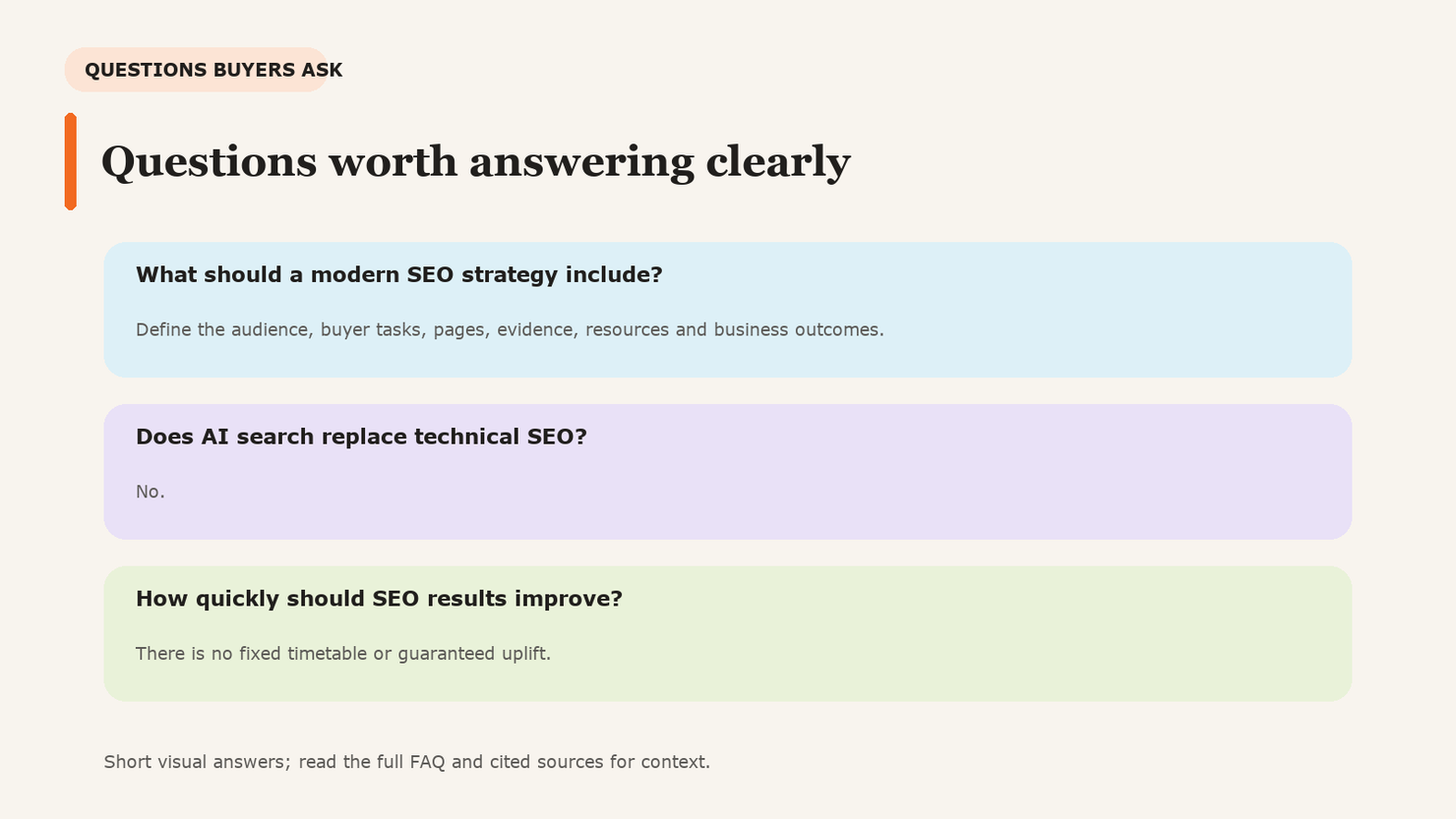
What should a modern SEO strategy include?
Does AI search replace technical SEO?
How quickly should SEO results improve?
Should every buyer question become a blog post?
How do I measure SEO when AI Overviews appear?
Does adding structured data guarantee AI citations?
Frequently Asked Questions
What should a modern SEO strategy include?
Does AI search replace technical SEO?
How quickly should SEO results improve?
Should every buyer question become a blog post?
How do I measure SEO when AI Overviews appear?
Does adding structured data guarantee AI citations?
In this series
Every article in the Modern SEO Strategy: A Practical Guide for the AI Era series.

Swapan Kumar Manna
Go-to-market & AI search strategist
Swapan Kumar Manna is a go-to-market and AI search strategist and Founder & CEO of Oneskai. He has spent 14+ years helping companies get found, get chosen and grow.