Part of the The Future of Search: How Discovery Works When Answers Replace Rankings (2026 Guide) series
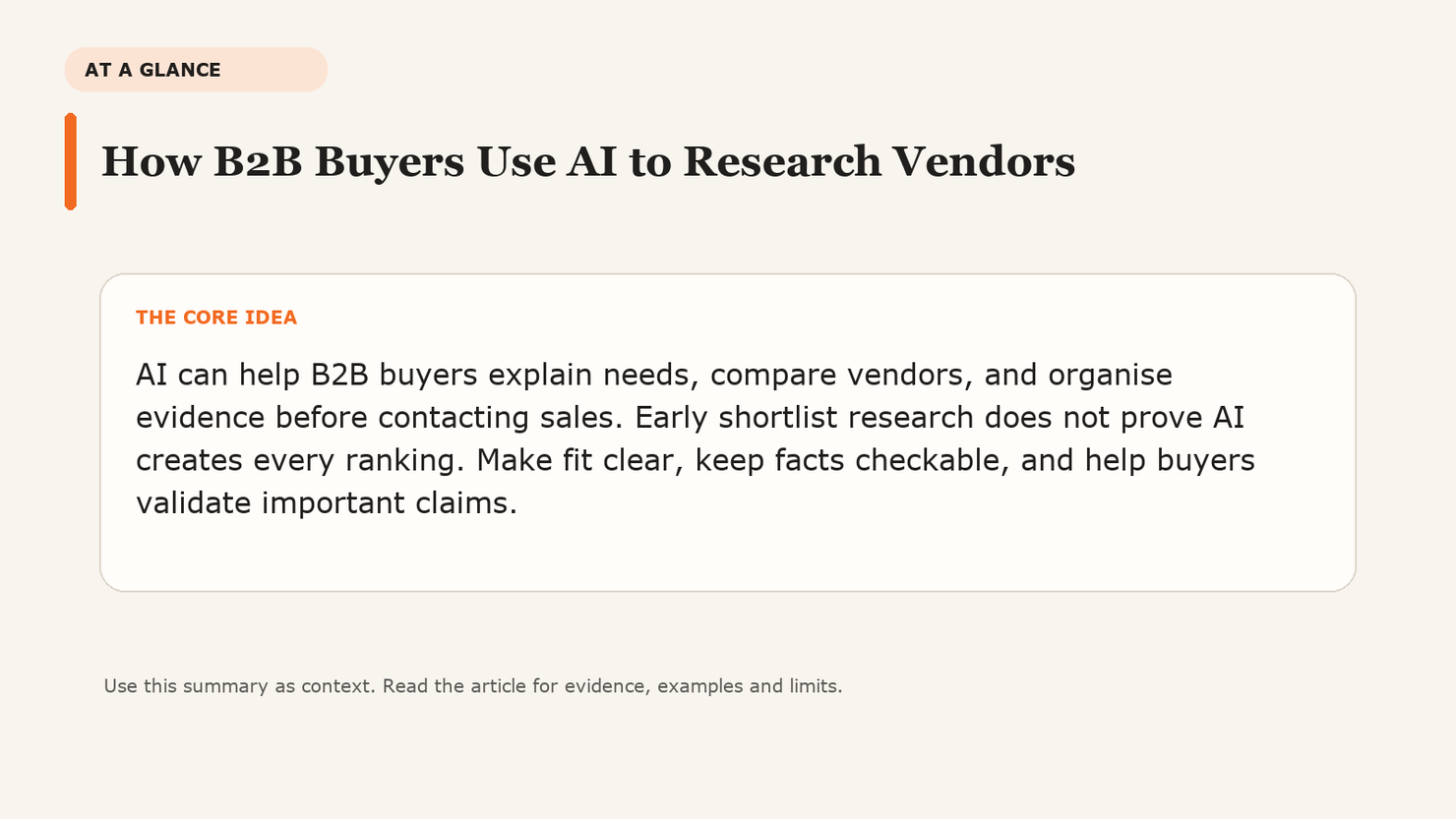
AI can help B2B buyers explain needs, compare vendors, and organise evidence before contacting sales. Early shortlist research does not prove AI creates every ranking. Make fit clear, keep facts checkable, and help buyers validate important claims.
Key Takeaways
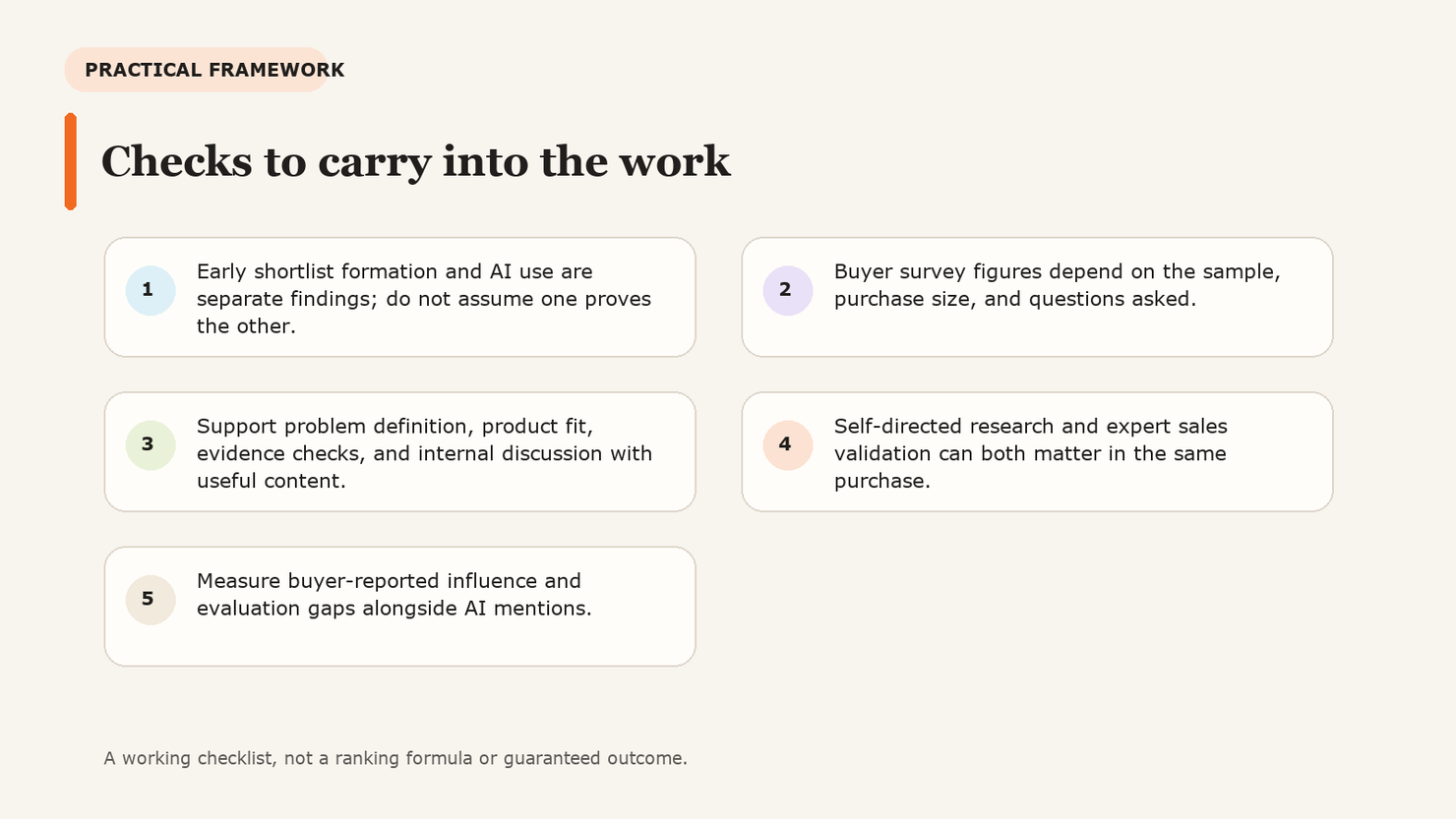
- Early shortlist formation and AI use are separate findings; do not assume one proves the other.
- Buyer survey figures depend on the sample, purchase size, and questions asked.
- Support problem definition, product fit, evidence checks, and internal discussion with useful content.
- Self-directed research and expert sales validation can both matter in the same purchase.
- Measure buyer-reported influence and evaluation gaps alongside AI mentions.
Playbooks
Frameworks you can put to work
Growth marketing, LinkedIn presence, and more — delivered as PDFs.
Browse the playbooksB2B buyers can use AI to explain a problem, compare vendors, and turn scattered information into a shortlist. By the time they contact sales, they may already have a view about who fits and who does not.
For a marketing team, the job is to help that early judgment rest on clear facts. Buyers need to understand your offer, check its limits, and carry useful evidence into a conversation with colleagues.
AI is one part of this journey. Prior experience, peer advice, reviews, and direct research still matter. This guide builds on the future of search and discovery, focusing on how to support the work buyers do before your sales team hears from them.
What the research says about early shortlists
In its 2025 Buyer Experience Report, 6sense found that 94% of surveyed buyers ranked their shortlist before engaging sellers. It also reported 94% using large language models during the buying process. Those are separate findings: they do not show that AI created those rankings.
The main study covered nearly 4,000 respondents across North America, APAC, and EMEA. Participants had made purchases of at least $25,000 in the previous two years; the median purchase was between $200,000 and $300,000. That context matters before applying the figures to a low-cost software subscription.
G2's April 2025 survey covered 1,169 B2B decision-makers across those regions. It reported that 29% started research through platforms such as ChatGPT more often than Google. This points to a meaningful research channel, not a universal replacement for search.
These are reported behaviours from different studies, with different questions and samples. I would use them to challenge a sales-first content plan. I would not combine them into one adoption rate or claim that every business buyer now starts in a chatbot.
A useful journey begins with the buyer's task
Think about a hypothetical operations lead choosing an expense tool for a company of eighty people. They need to reduce manual work, support two currencies, and connect with the finance system.
They might first ask an AI tool what requirements to consider. Next, they could ask for options, compare named products, and read source pages to check details. A colleague may bring a vendor they have used before.
This is an illustrative path, not a fixed sequence from a study. People can return to earlier questions, split the work across a team, or skip steps when they know the category well.
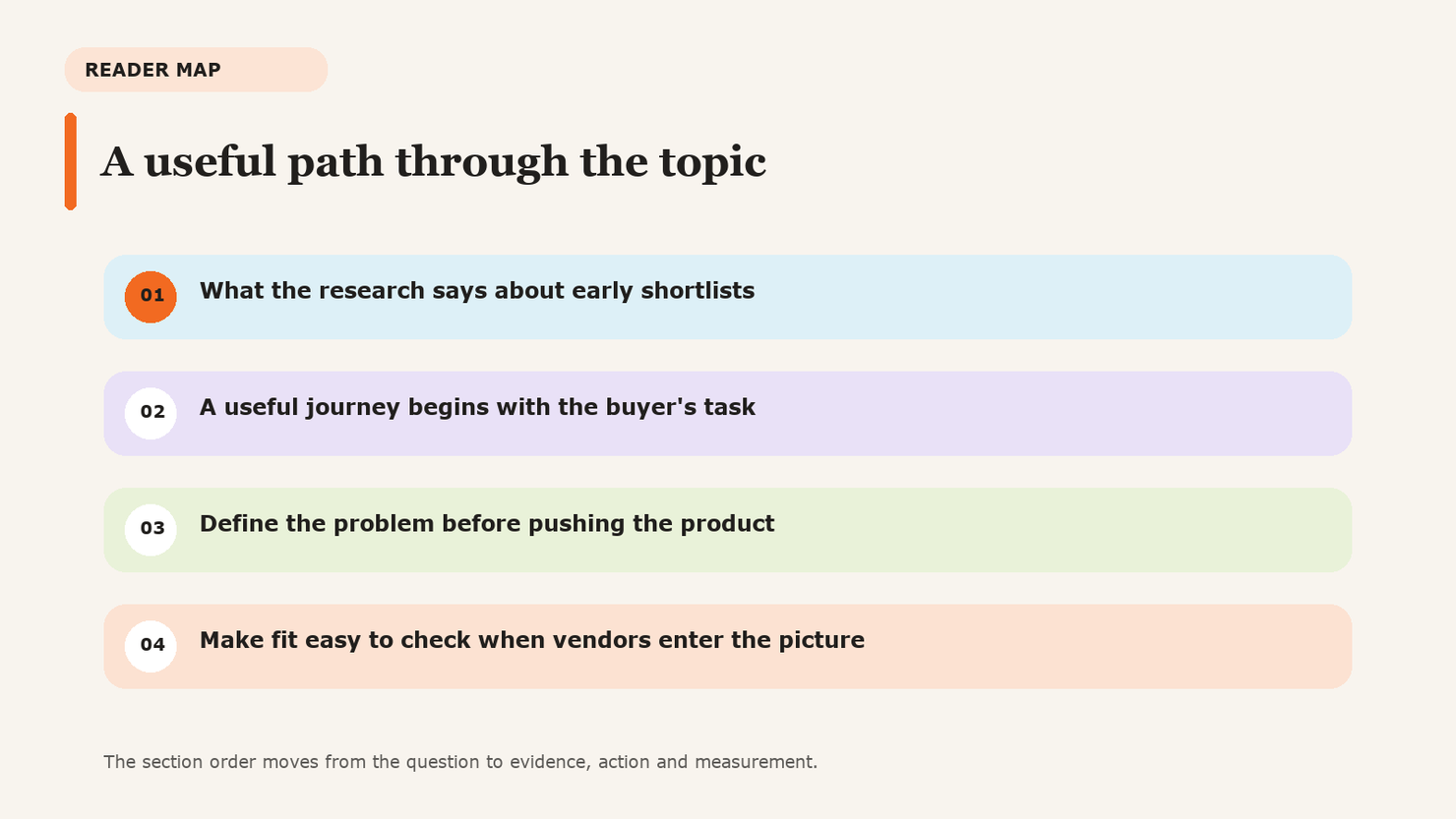
I would plan content around four tasks: define the problem, establish fit, test the evidence, and build internal support. Each task needs a different kind of answer. That gives the content team a more useful brief than “write something for AI search.”
Define the problem before pushing the product
Early research may be about how to solve a problem rather than which vendor to buy. Our operations lead could ask how to reduce delays in expense claims or what causes repeated rework.
A useful guide would explain the process, common causes, and choices available. It might show when better rules can help and when a new tool is worth considering. That makes the advice useful even to someone who is not ready to buy.
I would include a simple example with clear assumptions. If the example uses an eighty-person company, say so. Avoid presenting made-up time savings as proof of what customers achieve.
The goal is to help the buyer frame the decision well. If they leave with a clearer view of the problem, your content has done something valuable before a product comparison begins.
Make fit easy to check when vendors enter the picture
Once buyers compare options, broad claims become less useful. “Built for growing teams” does not answer whether a product handles two currencies or works with their finance system.
Put those facts in clear, current pages. Explain whether an integration is native, requires another tool, or needs custom work. Name the plan that includes it and describe any limits that could affect the choice.
An honest comparison should use the same criteria for each option. If you cannot verify a rival's capability, say what is unknown and link to the relevant source. Do not turn a lack of information into a claim that the feature is absent.
For the expense tool, the comparison could cover currency support, approval rules, data export, and setup needs. Those details help a buyer test fit. Repeating the product's name across many pages does not answer the question.
Give readers a way to verify the answer
AI can produce a neat comparison that misses a condition. It might treat an add-on as included, use an old price, or confuse support for a currency with support for a local tax rule.
The buyer needs access to the facts behind the summary. Keep product pages and support guides aligned. Add dates where the information changes, and explain the basis of any figures.
A customer story should make its scope clear: who used the product, what they changed, how the result was measured, and what else may have affected it. A result from one team is useful evidence, but it is not a promise for every customer.
I would also give readers a clear way to ask about missing details. A direct question about an integration should reach someone who can answer it. Forcing a full demo before sharing a basic fact can make the evaluation harder.
Put this into practice
The GTM Funnel Playbook
How B2B teams find, win and keep customers, with a 90-day action plan. Seven funnel stages, one owner each, from the revenue number to the clients you keep.
Rep-free buying does not mean buyers reject expertise
Gartner's May 2026 release reported a survey of 645 B2B buyers conducted in August and September 2025. In that sample, 45% said they used generative AI during a recent purchase, and 69% preferred to validate AI-generated insights with sales reps.
Those figures describe different behaviours and preferences. They support a mixed journey: buyers can value self-directed research and still want help with a decision that carries risk.
My recommendation is to let buyers do routine learning on their own, then make expert help useful when they ask for it. Sales should be ready to check a claim, explain a limit, or resolve a question that public content cannot answer.
In our example, a rep could confirm how the expense tool handles a specific finance setup. That conversation should build on the buyer's research rather than restart with a generic tour.
Help the internal champion explain the choice
The person doing the research may not approve the purchase. They need to explain the choice to finance, IT, and the people who will use the tool.
Give them material they can share without rewriting it. A clear plan summary, setup guide, and evidence page can help different colleagues check their concerns. Keep the claims consistent across those materials.
For the expense tool, finance might care about exports and total cost. IT may need details about access and data handling. Staff may want to know how much effort a claim takes.
I would organise this content around those real questions. It need not become a separate landing page for every role. A well-structured evaluation guide can cover related needs and point to deeper material where required.
Review the journey before adding more articles
Choose one important use case and inspect the content a buyer would find. Start with their questions rather than the keywords your team wants to rank for.
For each question, check whether the answer is public, accurate, and easy to understand. Note where a buyer must guess, where two pages disagree, and where the next step is unclear.
Then prioritise the gap that could change the decision. A missing plan limit may matter more than another broad introduction to the category. Fixing that gap also helps sales give a more precise answer.
Google's guidance for its AI Search features keeps SEO relevant and emphasises useful original content. I would treat buyer clarity as the editorial standard, with sound site basics supporting discovery. No content format guarantees a place in an AI shortlist.
Measure what buyers tell you, alongside what tools show
A chatbot mentioning your brand is a useful observation. It does not prove that a real buyer saw the answer, placed you on a shortlist, or chose you because of it.
Ask prospects where they looked and what influenced the choice. Let them name several sources, including prior experience. Ask whether they already had a preferred vendor when they made contact.
Review wins and losses for the questions that mattered. If buyers repeatedly misunderstand a plan, that is a content gap you can act on. If they discover a limit late, improve how early the limit appears.
Keep prompt checks consistent enough to compare over time, and inspect what the answer says about your product. An accurate explanation of fit is more useful than a flattering mention that sets the wrong expectation.
The practical goal is to earn a fair evaluation before the first call and help buyers validate it afterwards. Clear answers, checkable evidence, and a useful sales conversation work together toward that goal.
For more practical guides on search, AI, and growth, join The Agentic Pivot newsletter.
Frequently Asked Questions
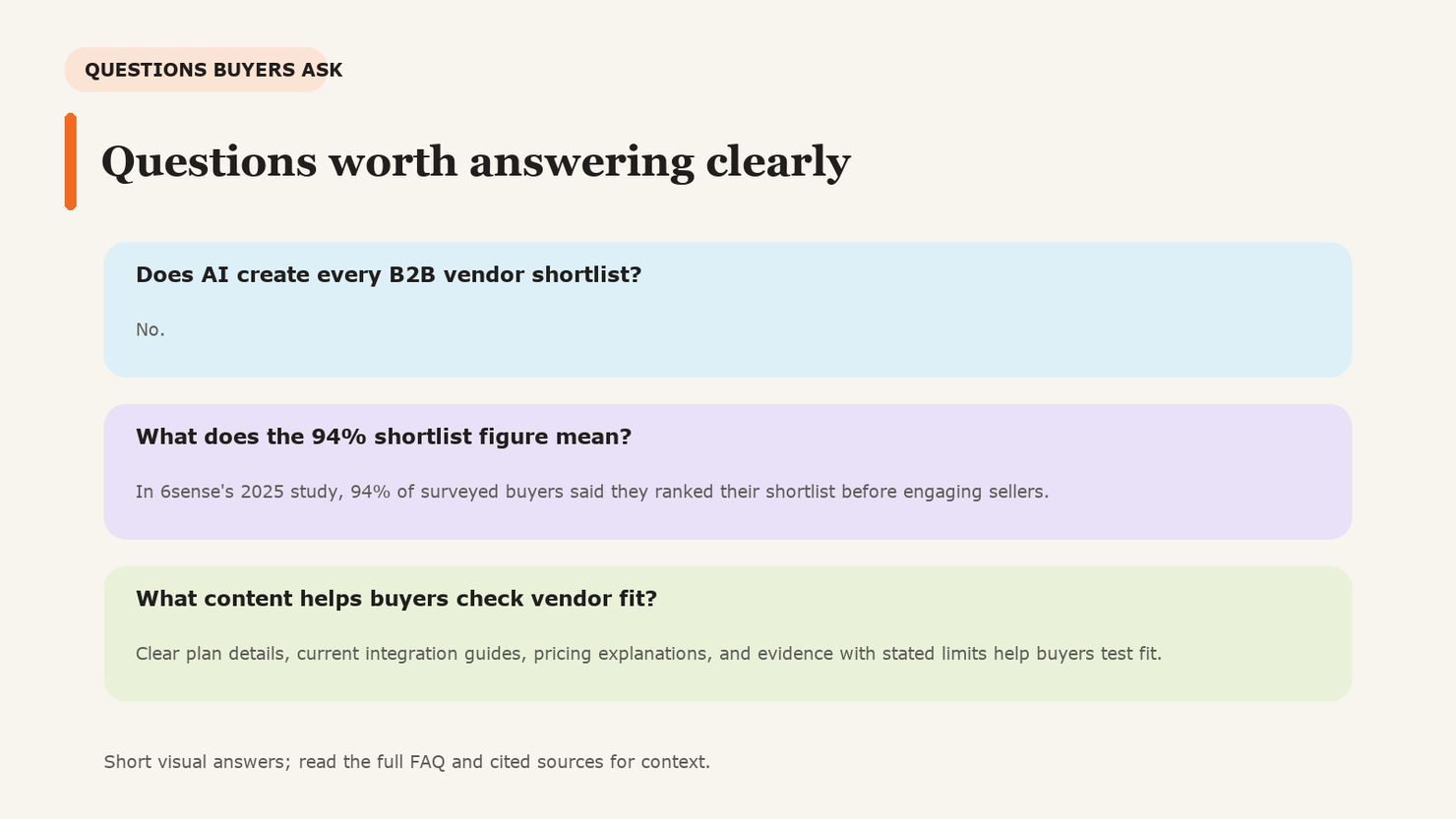
Does AI create every B2B vendor shortlist?
What does the 94% shortlist figure mean?
What content helps buyers check vendor fit?
Does AI research remove the need for sales?
Put this into practice
The GTM Funnel Playbook
How B2B teams find, win and keep customers, with a 90-day action plan. Seven funnel stages, one owner each, from the revenue number to the clients you keep.
Frequently Asked Questions
Does AI create every B2B vendor shortlist?
What does the 94% shortlist figure mean?
What content helps buyers check vendor fit?
Does AI research remove the need for sales?

Swapan Kumar Manna
Go-to-market & AI search strategist
Swapan Kumar Manna is a go-to-market and AI search strategist and Founder & CEO of Oneskai. He has spent 14+ years helping companies get found, get chosen and grow.