Part of the Revenue Operations: How to Stop Revenue Leaks Between Teams in 90 Days series
An MQL is a lead marketing judges worth sales' attention; an SQL is one sales has checked and agreed to pursue. Neither is pipeline. Define each stage with evidence and an owner, track MQL to SQL rate by cohort, and target accepted leads and pipeline, not MQL volume.
Key Takeaways
- Marketing qualifies interest (MQL); sales qualifies a real buying need (SQL).
- Score fit and intent separately, and give every rejected lead a reason from a fixed list.
- Calculate MQL to SQL rate by cohort and source; compare with your own trend, not a generic benchmark.
- Replace MQL volume targets with accepted-lead rate and pipeline from target accounts.
In this articleShowHide
Playbooks
Frameworks you can put to work
Growth marketing, LinkedIn presence, and more — delivered as PDFs.
Browse the playbooksAn MQL (marketing-qualified lead) is a lead marketing judges worth sales' attention, based on fit and engagement. An SQL (sales-qualified lead) is a lead sales has checked and agreed to pursue as a likely deal. The difference is who decides and on what evidence: marketing qualifies interest, sales qualifies a real buying need.
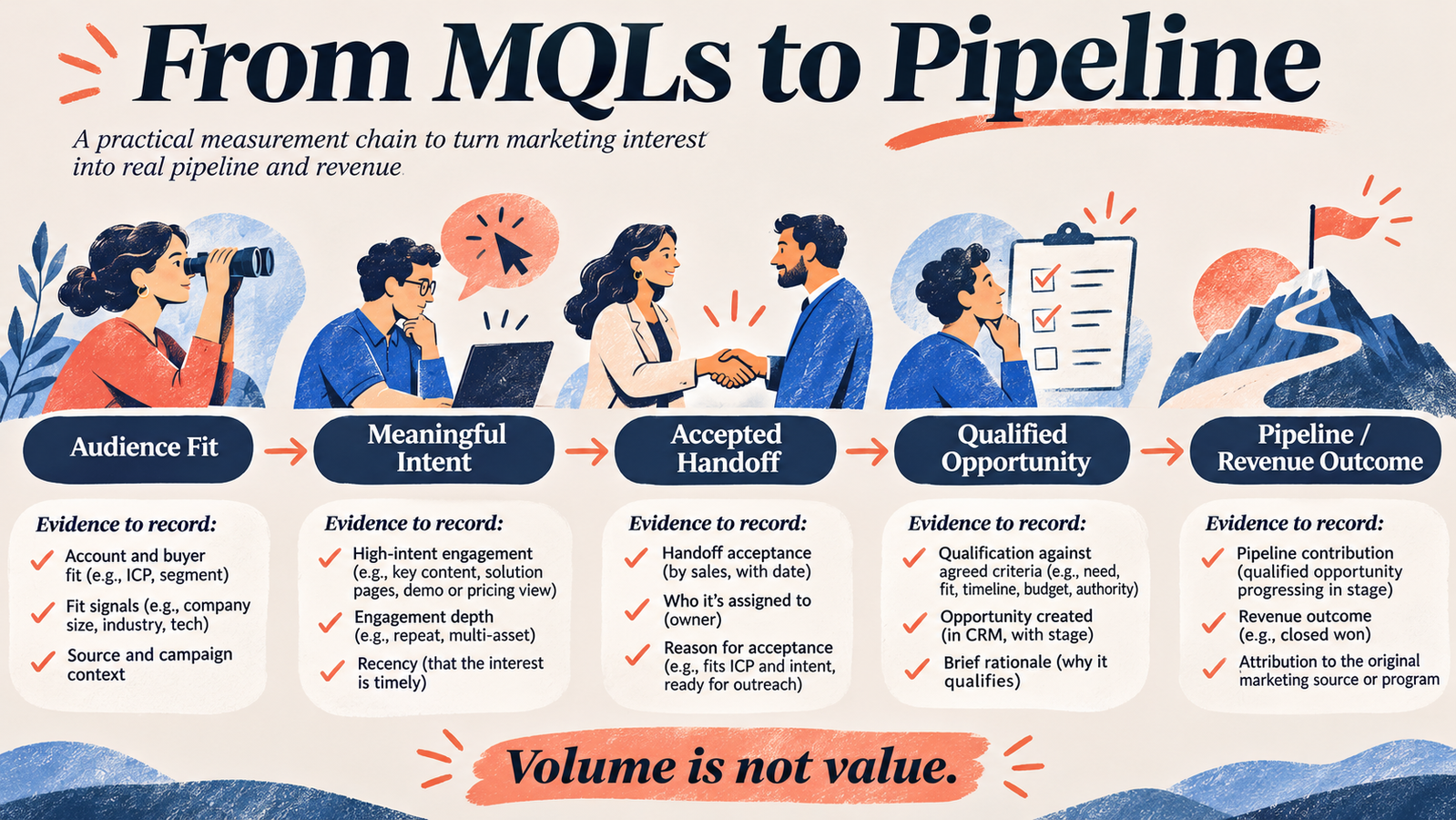
Neither label is pipeline. This guide shows the difference at a glance, the full stage chain from MQL to revenue, how to calculate the MQL to SQL conversion rate without fooling yourself, and the pipeline metrics worth tracking instead of MQL counts. It is part of the revenue operations series.
MQL vs SQL at a glance
| MQL | SQL | |
|---|---|---|
| Who decides | Marketing, using agreed rules | Sales, after checking the lead |
| Based on | Fit (right company and role) plus engagement | A confirmed need, authority to act and a reason to act now |
| Typical evidence | Pricing-page visits, a webinar, a content download from a target account | A discovery call, a stated problem, a buying timeline |
| What happens next | Routed to sales, or nurtured | Worked as an opportunity |
| Measured by | Volume and accepted-lead rate | Opportunities, pipeline value and win rate |
Between the two, many teams add an SAL (sales-accepted lead): sales has agreed to work the lead but hasn't qualified it yet. That middle step matters, because it is where you learn whether marketing's definition matches what sales will actually follow up.
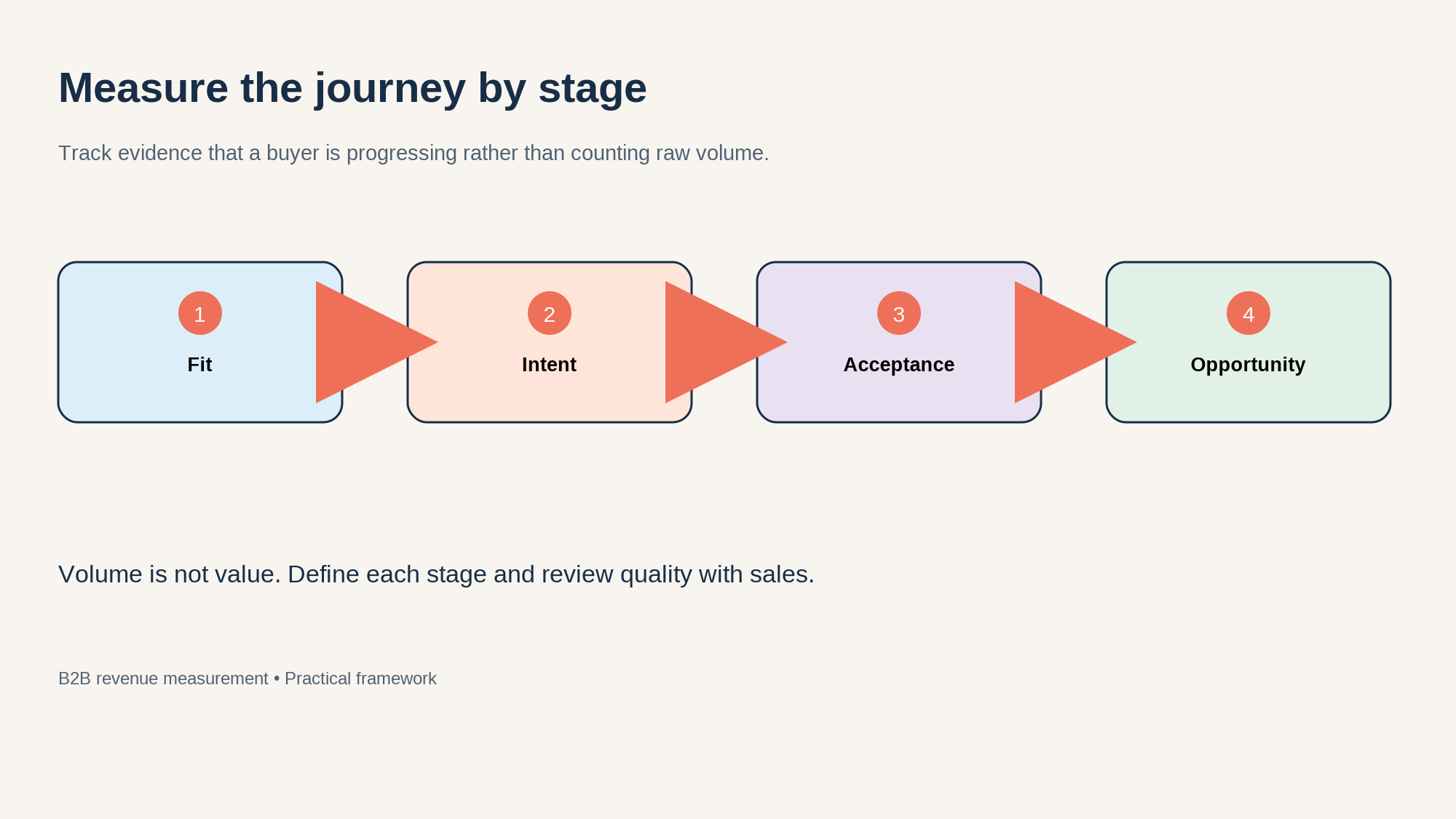
The stage chain from MQL to revenue
Write each stage down with the evidence that moves a lead into it and the person who decides. If a stage doesn't trigger a different action, merge it with the next one.
| Stage | Enters when | Decided by | Next action |
|---|---|---|---|
| MQL | Fits the buyer definition and shows meaningful intent | Marketing rules (scoring or criteria) | Routed to a named rep with context |
| SAL | Sales accepts the lead within the agreed time | Assigned rep | First human contact |
| SQL | Discovery confirms need, authority and timing | Rep, checked by the manager | Opportunity created in the CRM |
| Opportunity | A deal with a value, a stage and a next step | Rep | Worked through the sales stages |
| Won or lost | The buyer decides | Rep records the outcome and reason | Reason read in the monthly review |
How to define an MQL that sales will accept
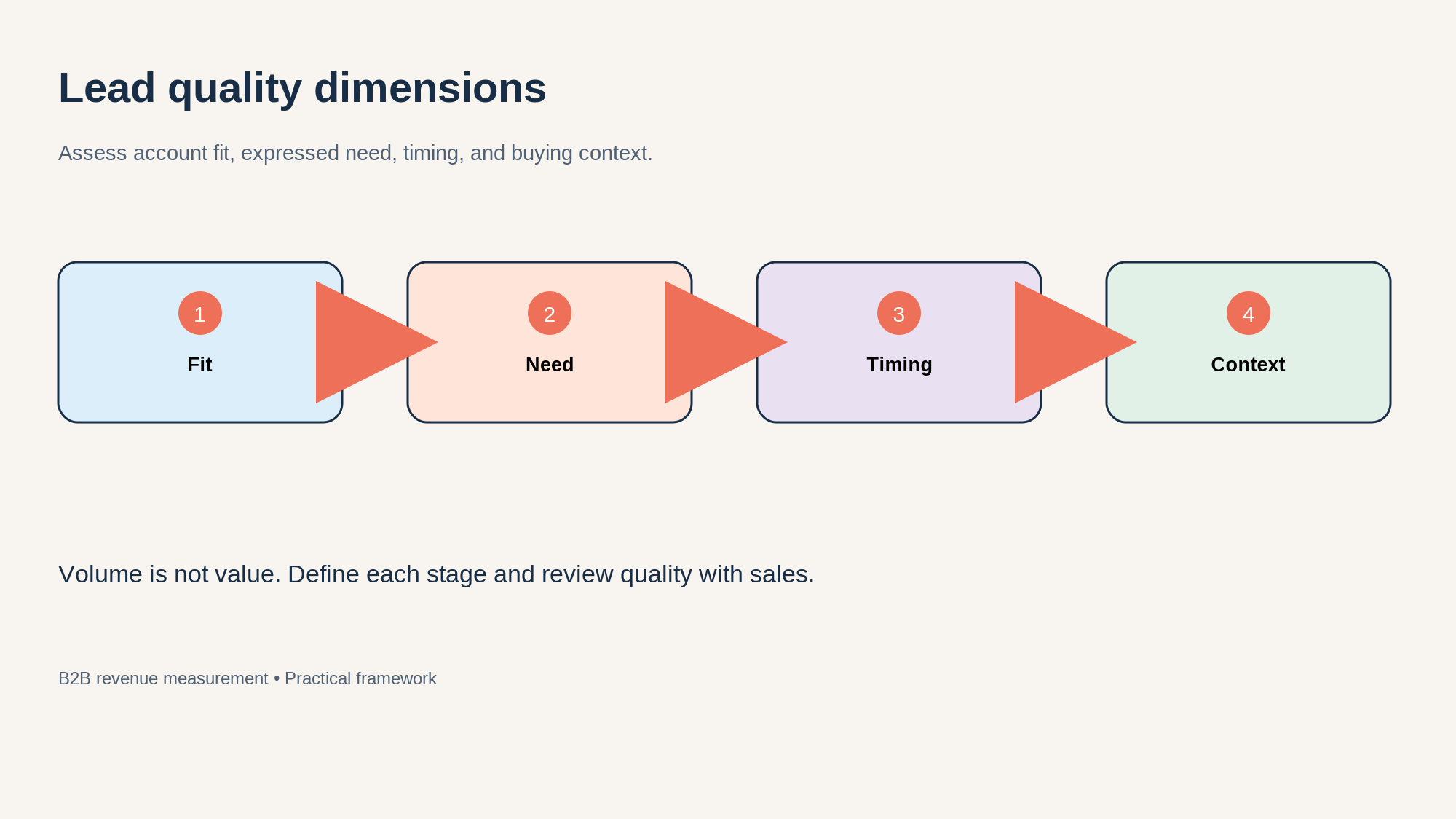
Score fit and intent separately. Fit asks whether this company and person could buy: size, industry, role, situation. Intent asks whether they are trying to solve the problem now: a demo request, repeat visits to pricing, a reply to outreach. A lead with high intent and poor fit wastes a sales call; a lead with perfect fit and no intent belongs in nurture, not in a rep's queue.
| Fit criteria (who) | Intent signals (now) |
|---|---|
| Company size and revenue band | Demo, pricing or contact request |
| Industry and situation you serve | Several visits to pricing or comparison pages |
| Role in the buying decision | Reply to an outbound or nurture email |
| Disqualifiers: students, vendors, competitors, wrong market | A question that names a problem and a timeline |
Pro tip: keep two scores, not one blended number. When a single score hides fit and intent together, nobody can tell why a lead qualified, and sales stops trusting the score. Build the fit side from your ideal customer profile, and remember that one contact rarely buys alone: look at the buying committee at the account.
How sales should accept or reject a lead
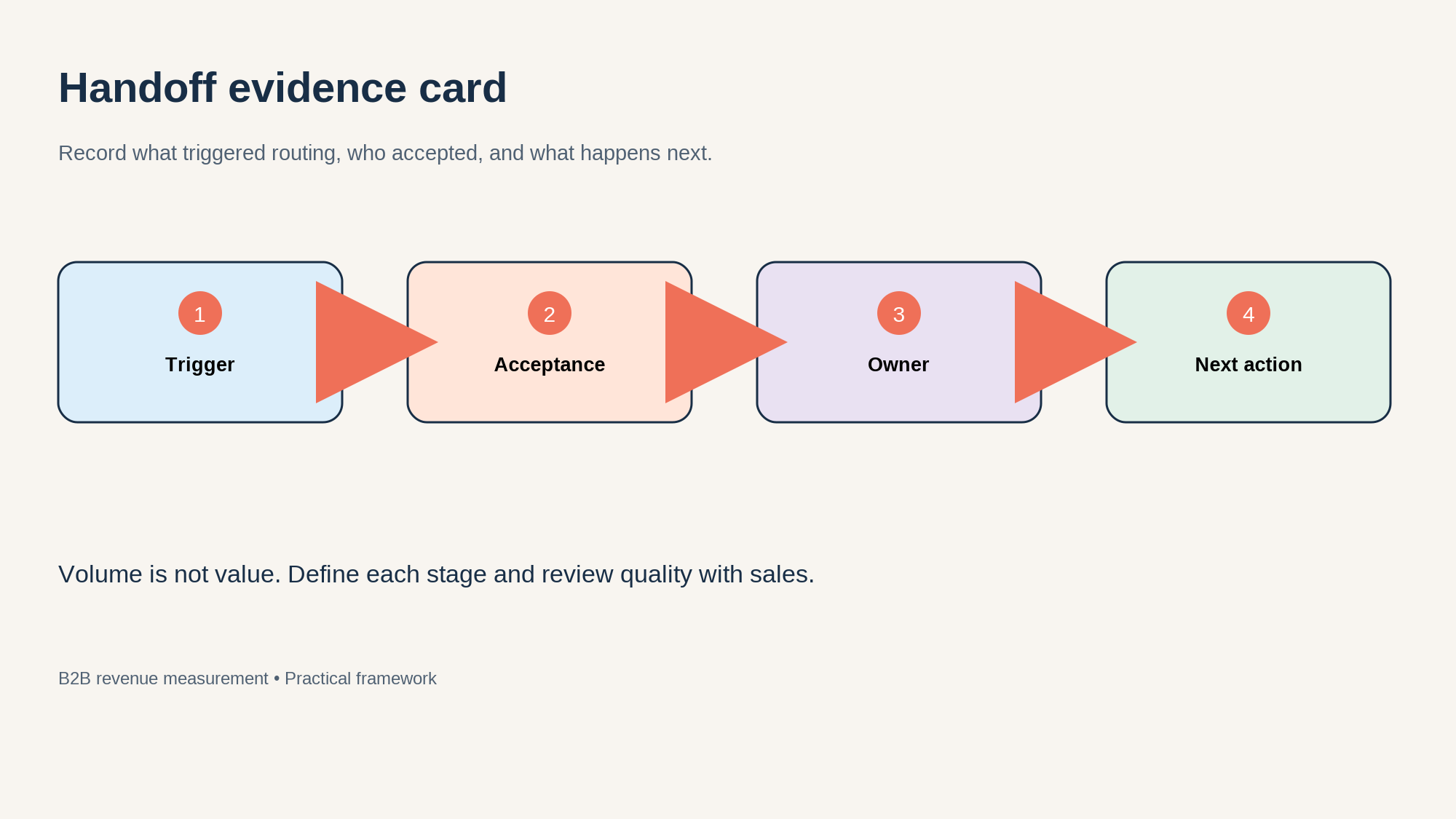
Every lead marketing hands over gets a decision within an agreed time: accepted, or rejected with a reason from a fixed list. Free-text reasons can't be counted; a short pick-list can. A starting list:
- Wrong fit: the company or role is outside the buyer definition.
- No need yet: right buyer, no current problem or timeline (return to nurture).
- Already in a deal: an open opportunity exists at the account.
- Unreachable: no response after the agreed number of attempts.
- Bad data: fake, duplicate or incomplete details.
Rejected leads go back to marketing, not into a void, and the reasons are read every month. Put the time limits and the list in the handoff agreement described in sales and marketing alignment, and make the first response fast; speed to lead shows how.

Put this into practice
The GTM Funnel Playbook
How B2B teams find, win and keep customers, with a 90-day action plan. Seven funnel stages, one owner each, from the revenue number to the clients you keep.
MQL to SQL conversion rate: how to calculate it
MQL to SQL conversion rate = SQLs that came from this period's MQLs ÷ MQLs created in the period × 100. Count by cohort: follow the MQLs created in March until they convert or age out, rather than dividing March's SQLs by March's MQLs, which mixes leads from different months.
There is no universal good rate. Published benchmarks vary widely because every company defines an MQL differently, so a figure without its definition tells you little. Compare your rate with your own trend, split by source, and expect it to rise when you tighten the MQL definition, even if MQL volume falls.
A worked example (hypothetical)
A company creates 400 MQLs a month. Sales accepts 160 (a 40% accepted-lead rate) and qualifies 60 as SQLs: an MQL to SQL rate of 15%. To "grow demand", marketing loosens the MQL rule and reports 800 MQLs the next month. Sales still accepts about 160 and qualifies about 60. The MQL count doubled, the MQL to SQL rate halved to 7.5%, and pipeline didn't move. Reps spent the extra time rejecting leads.
That is why MQL volume is a poor target on its own: it is the one number marketing can raise without changing revenue.
Pipeline metrics to track instead of MQL counts
| Metric | How to calculate | What it tells you |
|---|---|---|
| Accepted-lead rate | SALs ÷ MQLs | Whether marketing's definition matches sales' judgement |
| MQL to SQL rate (by source) | SQLs from the cohort ÷ MQLs in the cohort | Which sources produce real buyers |
| Pipeline per accepted lead | Opportunity value created ÷ SALs | How much each accepted lead is worth |
| Pipeline from target accounts | Opportunity value at accounts on the target list | Whether the work reaches the right companies |
| Win rate by source | Won deals ÷ closed opportunities | Which sources become revenue |
| Time to SQL | Median days from MQL to SQL | Where leads wait, and whether follow-up is fast |
Report these from one source, usually the CRM, with the definitions written next to the numbers. Use the free Sales Pipeline Calculator to work backwards from the revenue target: enter the target, average deal size, sales cycle, the share of leads that qualify and your win rate, and it returns the pipeline to build and the leads and opportunities needed each week. To judge whether that pipeline is worth what it costs to win, see the LTV:CAC ratio.
Pro tip: add these fields to the lead or contact record so every metric above can be reported without spreadsheets:
Source (first and most recent)
Fit result (meets definition: yes / no)
Intent signal (what triggered the MQL)
MQL date
Assigned owner
Accepted or rejected (date)
Rejection reason (pick-list)
SQL date
Opportunity ID and value
Outcome and lost reason
If the data lives in several tools, revenue data architecture covers how to connect them, and CRM strategy covers keeping reps entering it.
Use attribution, but don't treat it as proof
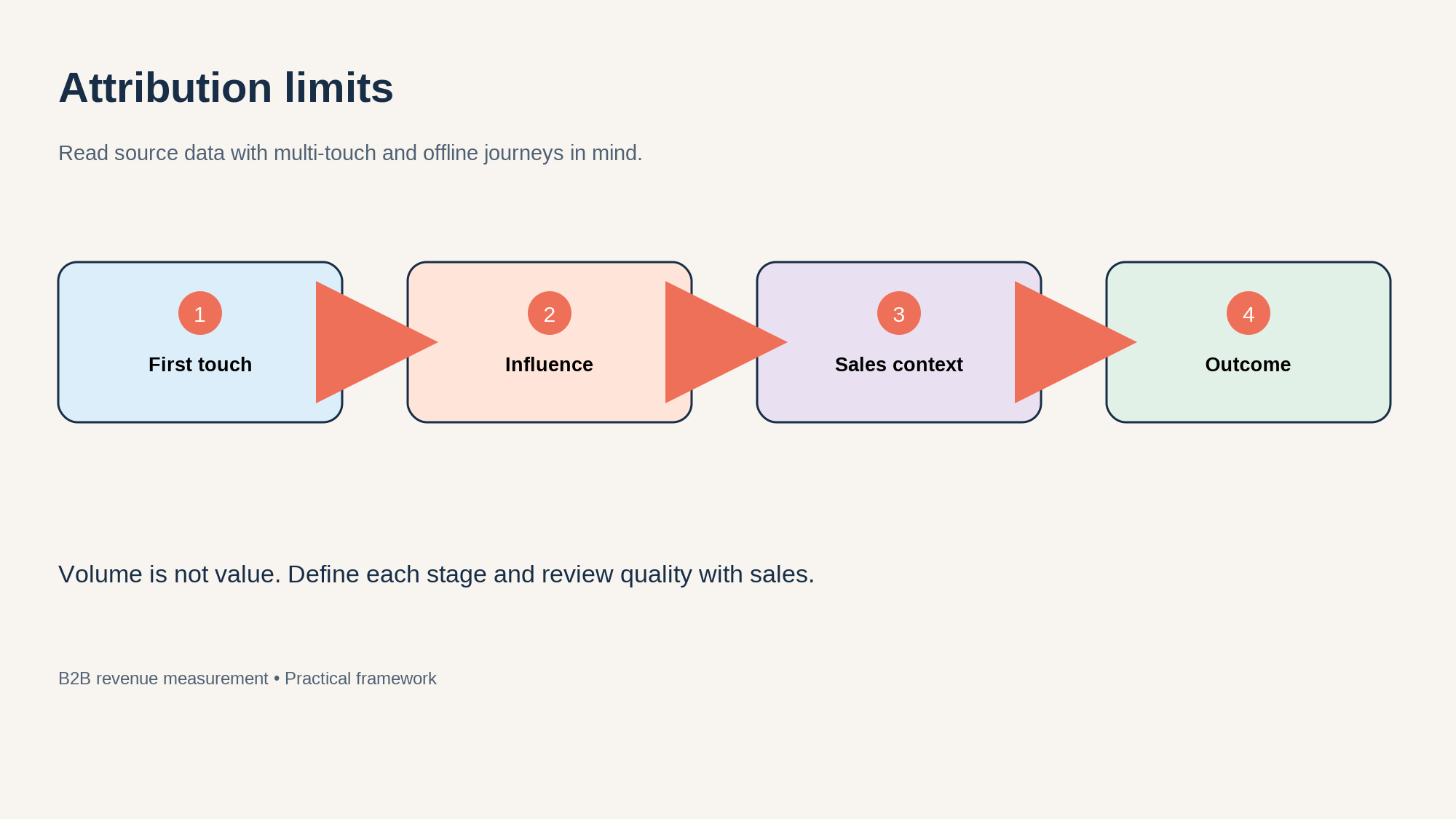
Attribution models share out credit by rule. First touch shows the first recorded source, last touch the latest tracked interaction, and multi-touch spreads credit across selected touches. Each answers a narrow question. None sees the conversations buyers have privately, in communities or offline, so "influenced pipeline" is not the same as pipeline marketing caused.
State the model, the time window and what the data can't see beside every attributed number. When a budget decision needs to know what caused a result, run a test: pause or add a channel for a set period, or compare similar regions or segments.
Where to start
- Trace the last 30 MQLs from source to outcome and note where each stopped.
- Agree the fit criteria, intent signals and rejection reasons with sales, and write them down.
- Add the stage fields above to the CRM and build one report with the six metrics.
- Replace the MQL volume target with accepted-lead rate and pipeline from target accounts, and review both monthly.
If you want help rebuilding the funnel and its measures as part of a wider go-to-market system, see the 90-Day GTM Build.
Frequently Asked Questions
Frequently Asked Questions
What is the difference between an MQL and an SQL?
What comes between an MQL and an SQL?
How do you calculate MQL to SQL conversion rate?
What is a good MQL to SQL conversion rate?
Should B2B companies stop using MQLs?
Does attribution prove marketing caused revenue?
Put this into practice
The GTM Funnel Playbook
How B2B teams find, win and keep customers, with a 90-day action plan. Seven funnel stages, one owner each, from the revenue number to the clients you keep.

Swapan Kumar Manna is a go-to-market and AI search strategist and Founder & CEO of Oneskai. He has spent 14+ years helping companies get found, get chosen and grow.