Part of the The Future of Search: How Discovery Works When Answers Replace Rankings (2026 Guide) series
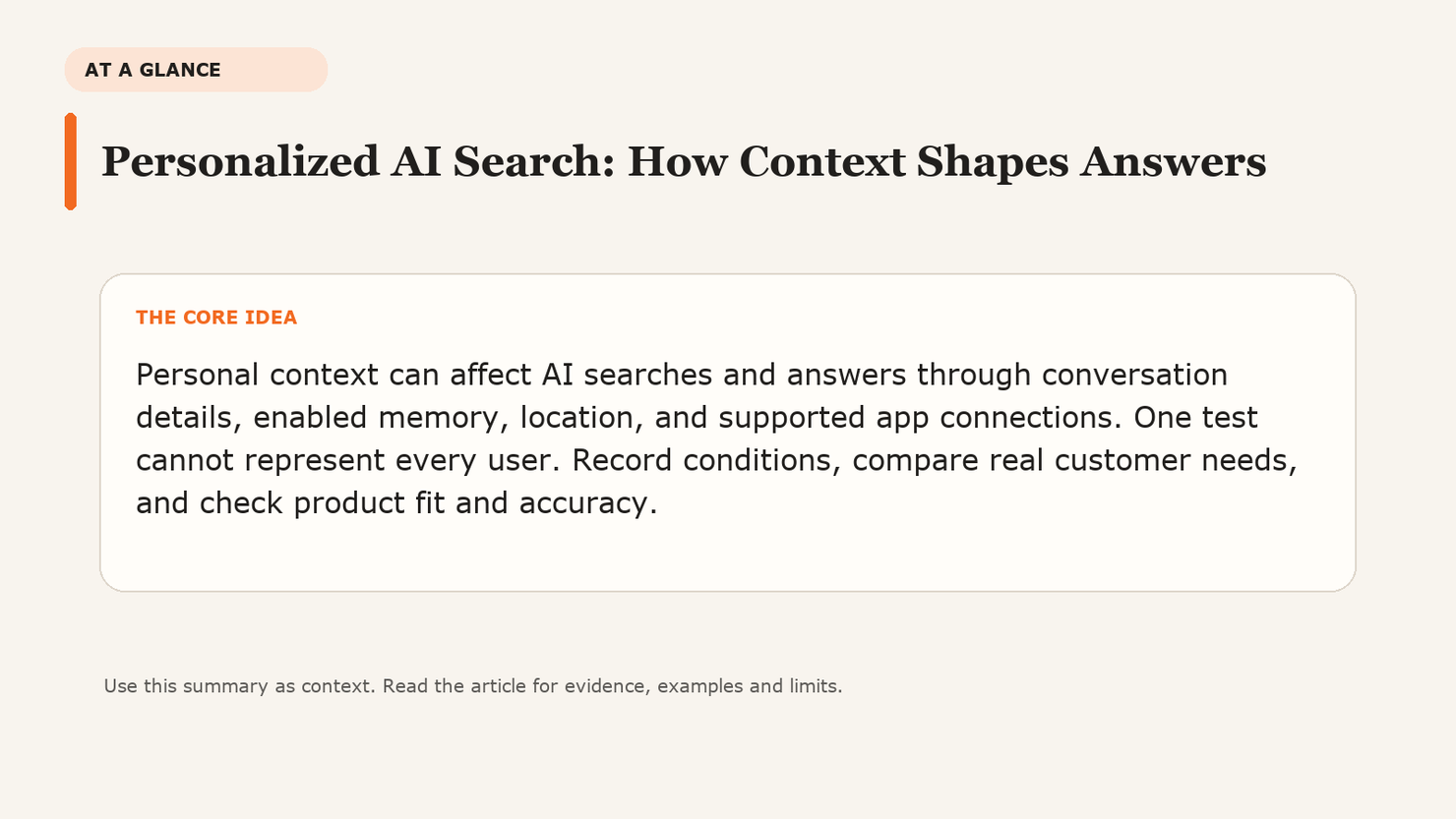
Personal context can affect AI searches and answers through conversation details, enabled memory, location, and supported app connections. One test cannot represent every user. Record conditions, compare real customer needs, and check product fit and accuracy.
Key Takeaways
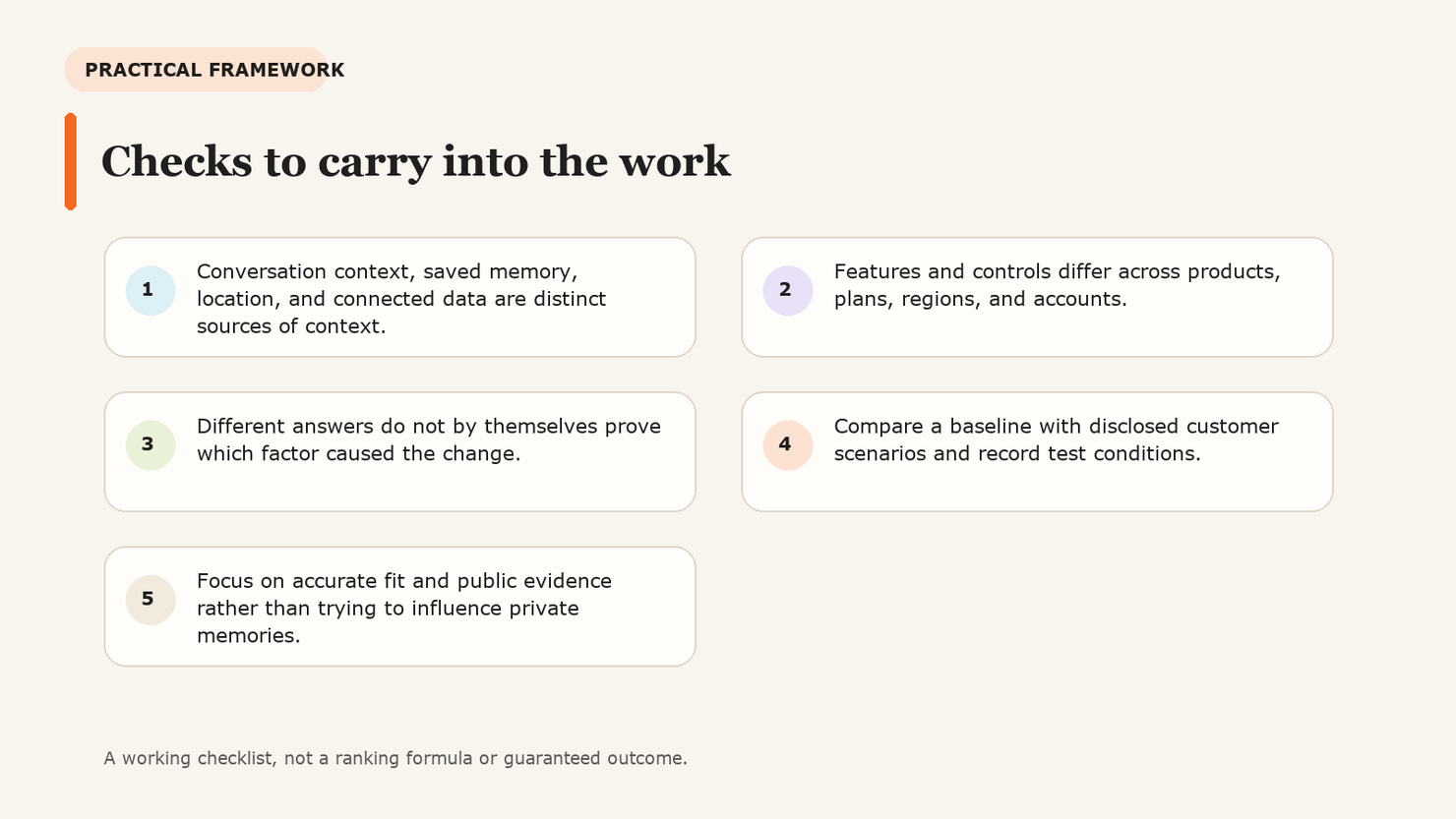
- Conversation context, saved memory, location, and connected data are distinct sources of context.
- Features and controls differ across products, plans, regions, and accounts.
- Different answers do not by themselves prove which factor caused the change.
- Compare a baseline with disclosed customer scenarios and record test conditions.
- Focus on accurate fit and public evidence rather than trying to influence private memories.
Playbooks
Frameworks you can put to work
Growth marketing, LinkedIn presence, and more — delivered as PDFs.
Browse the playbooksPersonalized AI search uses details about a person to shape a search or answer. A system may use the chat, saved preferences, location, or a connected app. This depends on the product and its settings.
For marketers, the practical issue is that the visible question may not be the whole question. Two people can ask similar words while bringing different needs and settings. A brand may be useful to one and a poor fit for the other.
That does not mean every answer is unique or that all rankings have disappeared. A single test is only one observation. This guide continues my broader article on search and discovery. I explain how personal context can change an answer and how to test for it without overclaiming.the future of search and discovery, focusing on what personal context changes and how to assess visibility without overstating what you know.
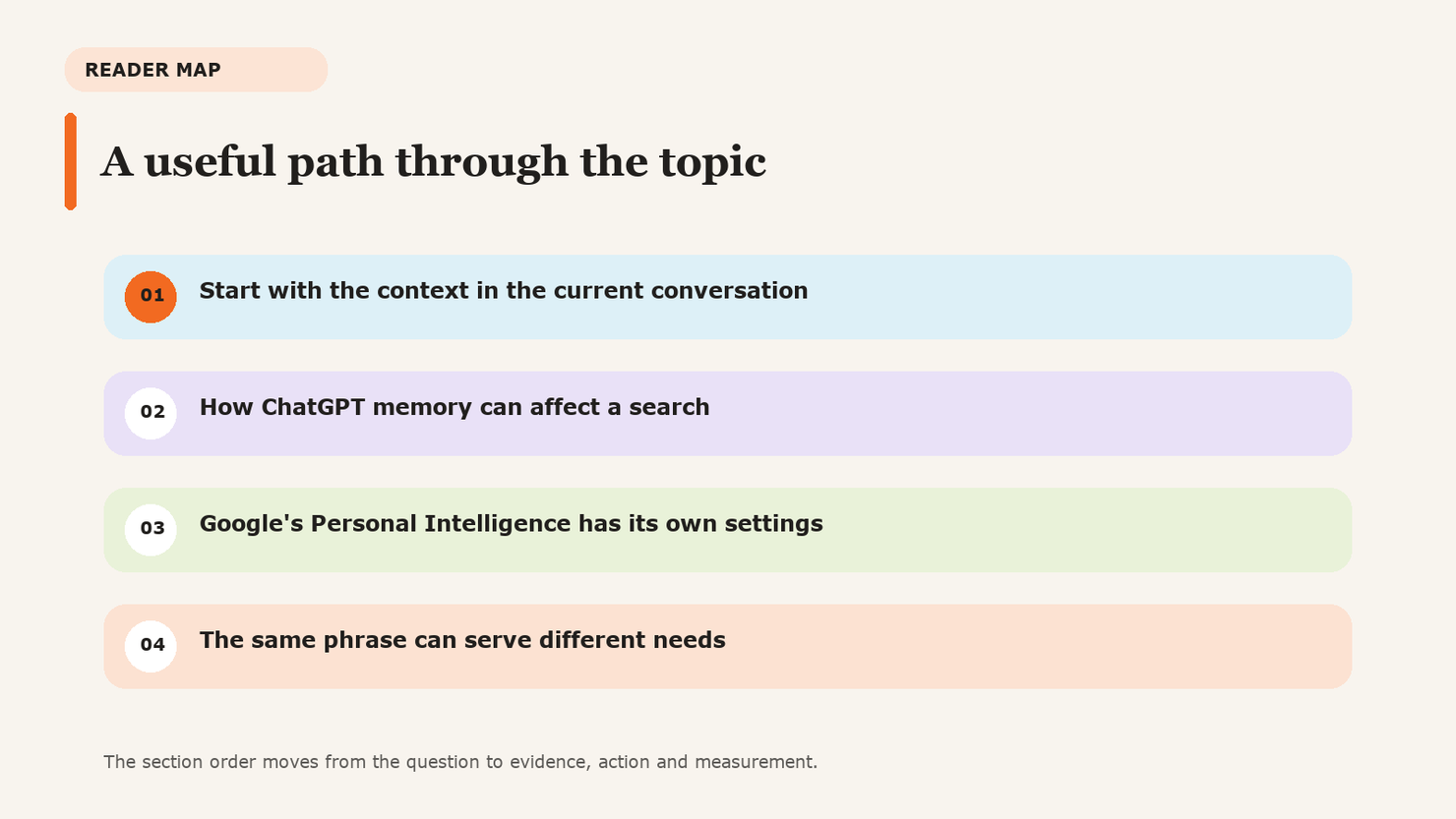
Start with the context in the current conversation
A person can make a question more specific without using stored memory. They might say they have a small team, a fixed budget, and an existing tool they need to keep.
Those details change the task. “Recommend a support platform” is not the same request as “suggest one for five people using our current CRM.” The second asks the system to judge fit against stated needs.
A follow-up can add another condition or correct an assumption. That is context within the conversation, not proof that the product remembered the person across chats.
I would separate these sources when discussing use of personal context. Current instructions, saved memory, location, and connected data can each play a role. Treating them as one hidden profile makes it harder to understand what a test actually shows.
How ChatGPT memory can affect a search
OpenAI's current memory guidance says ChatGPT can use relevant personal details when Memory is enabled. Features and controls vary by plan, region, platform, and workspace settings.
Memory does not retain every detail or use all the facts it can access for each answer. OpenAI also says useful remembered details can help write a search query.
Its web search guidance gives a clear mechanism: ChatGPT may rewrite a question into targeted queries for search providers. Saved preferences can inform that rewrite, and approximate location can help with local results.
This shows how context can change the search before the system writes an answer. It does not reveal a fixed weight for your brand or prove that every remembered preference changes every result.
For a hypothetical software buyer, a remembered need for a simple setup could be useful to a comparison. Whether it is used, and how it affects the answer, remains something to inspect rather than assume.
Google's Personal Intelligence has its own settings
Google's AI Mode help page describes using previous searches and activity when the required history and personalized-recommendation settings are enabled. It also describes optional connections to Google content apps such as Gmail, Calendar, and Photos.
The page distinguishes those capabilities from an AI Mode memory experience that it lists as available in the US in English. It warns that settings are being updated and may differ from a user's current experience.
That distinction matters. An announcement about Personal Intelligence in Gemini does not prove that every AI Mode user has the same controls or connected sources.
I would check the current product, account, and setting before reporting a test. “Google personalized this result” needs more detail to be useful. Record which product you used and what context you supplied.
The provider also says use of personal context can be wrong. A tailored answer still needs checks against the source and the user's actual needs.
The same phrase can serve different needs
Imagine two hypothetical buyers asking, “What is a good project management tool?”
One is a freelance designer who needs a simple board. The other manages several delivery teams and needs clear access controls and reporting. If those needs are supplied or used as context, different answers may be reasonable.
I would look at how well each answer serves the buyer. Check whether your product is described correctly for the tasks it can serve.
A broad claim such as “ideal for every team” hides the choice. Clear pages about team size, setup effort, plan limits, and supported work help people understand the fit.
This is my main editorial implication: write around real customer conditions. Do not invent a separate page for every tiny variation. Group related needs where one coherent explanation can address them.
Why one answer cannot prove a fixed position
An AI answer can include a list, a comparison, or a direct explanation. Calling the first named product “position one” may describe its place in that response, but it does not make it a stable rank across all users.
The prompt, earlier conversation, settings, location, and source material may differ. Even where those are held steady, a repeated answer can vary. A change alone cannot tell you which factor caused it.
I would describe the result precisely: the brand appeared in a given test, under recorded conditions. Then assess whether the answer was accurate and useful.
That is a stronger basis for comparison than claiming “we rank first in ChatGPT.” It also helps a team respond to a disappointing result. One missing mention is a question to investigate, not proof that customers cannot find you.
Put this into practice
The GTM Funnel Playbook
How B2B teams find, win and keep customers, with a 90-day action plan. Seven funnel stages, one owner each, from the revenue number to the clients you keep.
Compare a baseline with stated customer contexts
A practical review can begin with a baseline set of questions, then add a small set of clear customer needs. Keep the test narrow enough to read the answers carefully.
For our project tool, the baseline might ask about managing design work. A second test could specify a solo designer. A third could specify a larger team with reporting needs.
Those are clearly labelled examples, not attempts to recreate private customer histories. Use test accounts and permitted settings, and record what you control. Do not upload real customer emails just to create a more realistic prompt.
Change one important condition at a time where possible. If you change the budget, team size, and platform together, you cannot tell which difference mattered.
Use repeat checks to see whether a pattern holds. Keep dates and product details so that a later comparison does not confuse a platform change with a content change.
Read the answer for fit, not only presence
For each test, check whether the right brand and product were named. Then inspect the claim that placed the product in or out of the shortlist.
If the answer says a needed feature is missing, verify that against current help pages. It may be wrong, or the feature may exist only on a plan that does not meet the stated budget.
If a competitor is named first, read why. The answer may be addressing a need your product does not serve well. That is a useful finding even when it does not suggest a content fix.
I would keep mentions, citations, and suggestions separate. A source link does not prove endorsement, and a positive suggestion is not useful if it creates a false expectation.
The review should give you a set of clear issues: unclear fit, stale facts, missing evidence, or a claim to validate. A score alone cannot explain those issues.
Keep customer controls separate from brand strategy
The fact that a system can use personal context does not give marketers access to that context. You cannot infer a person's saved memory from one answer or assume a brand can access a connected inbox.
I would focus on public facts you can make accurate and useful. Let the customer decide what to share and which product settings to enable.
When testing, use made-up scenarios that do not contain sensitive personal data. Keep any real research material within the permissions given for that work.
There is also no sound reason to encourage customers to “remember” your brand simply to influence future answers. A useful product experience and honest evidence are a better basis for the shortlist.
Improve what remains useful across contexts
Start with the conditions that affect the buying decision. Explain who the product suits, what it requires, and where its limits begin.
Keep important facts close to the claim they qualify. If a feature requires an added cost, say so. If a result came from a given team or test, explain the scope.
Make the next step useful to the person with that need. A reader checking a feature should be able to find the help pages. A buyer with a difficult setup question should have a clear route to ask for help.
Personalized search makes accurate fit more important to assess. It does not provide a shortcut to visibility for every user. I would use checks with stated needs to improve the quality of the public answer, then compare those findings with what customers tell the team.
For more practical guides on search, AI, and growth, join The Agentic Pivot newsletter.
Frequently Asked Questions
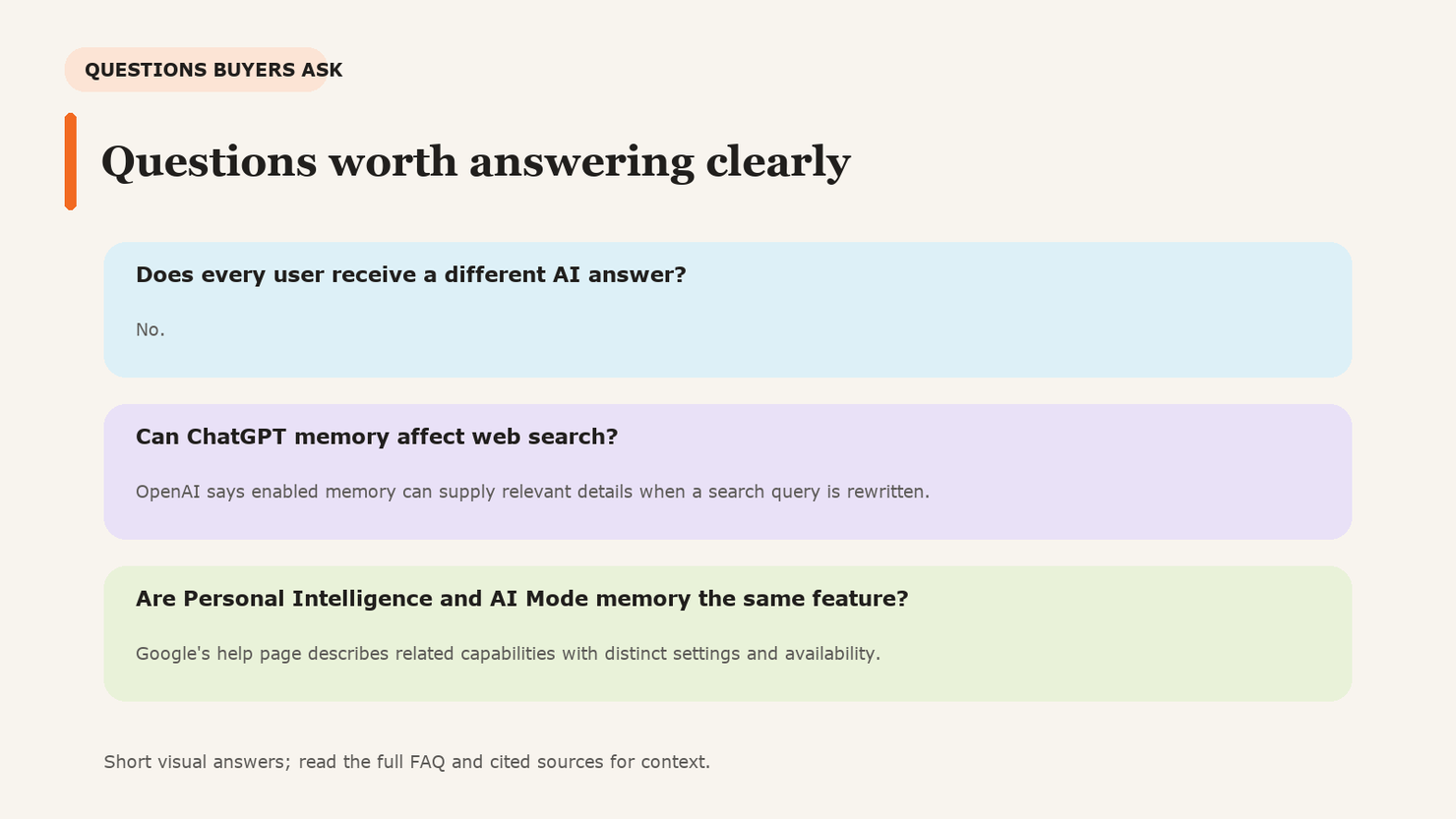
Does every user receive a different AI answer?
Can ChatGPT memory affect web search?
Are Personal Intelligence and AI Mode memory the same feature?
How should marketers compare context-dependent answers?
Put this into practice
The GTM Funnel Playbook
How B2B teams find, win and keep customers, with a 90-day action plan. Seven funnel stages, one owner each, from the revenue number to the clients you keep.
Frequently Asked Questions
Does every user receive a different AI answer?
Can ChatGPT memory affect web search?
Are Personal Intelligence and AI Mode memory the same feature?
How should marketers compare context-dependent answers?

Swapan Kumar Manna
Go-to-market & AI search strategist
Swapan Kumar Manna is a go-to-market and AI search strategist and Founder & CEO of Oneskai. He has spent 14+ years helping companies get found, get chosen and grow.