Part of the Modern SEO Strategy: A Practical Guide for the AI Era series
Content refresh makes substantive changes so a page remains accurate and useful. Diagnose traffic changes separately from content problems, prioritize reader value and accuracy risk, and record real updates. A newer date does not guarantee recovery.
Key Takeaways
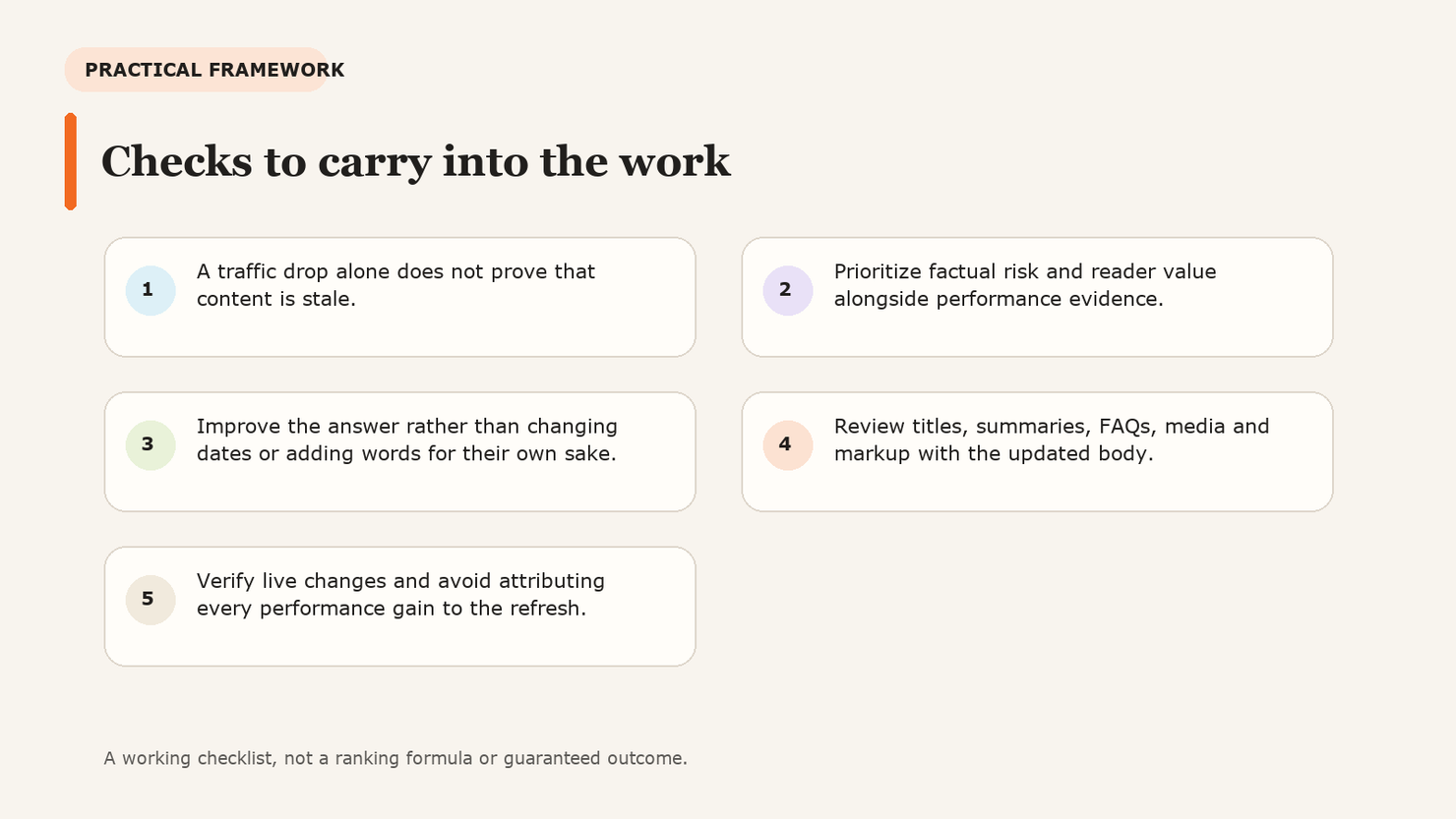
- A traffic drop alone does not prove that content is stale.
- Prioritize factual risk and reader value alongside performance evidence.
- Improve the answer rather than changing dates or adding words for their own sake.
- Review titles, summaries, FAQs, media and markup with the updated body.
- Verify live changes and avoid attributing every performance gain to the refresh.
Playbooks
Frameworks you can put to work
Growth marketing, LinkedIn presence, and more — delivered as PDFs.
Browse the playbooksAn old article is not automatically a weak article. A new date does not automatically make it useful. The real question is whether the page still gives its intended reader a sound answer.
Content refresh means making substantive changes to an existing page so its facts, examples and guidance remain useful. Content decay describes a decline in a page's usefulness or performance over time. The two can be connected, but a traffic drop alone does not prove that the writing has gone stale.
My recommendation is to diagnose the change before choosing the edit. Check the page's accuracy, reader task and search performance separately. Then fix the problem you can show, rather than rewriting every article that has lost clicks.
The workflow below gives a content team a practical way to triage pages, document changes and review the result. It does not promise ranking recovery or more AI citations.
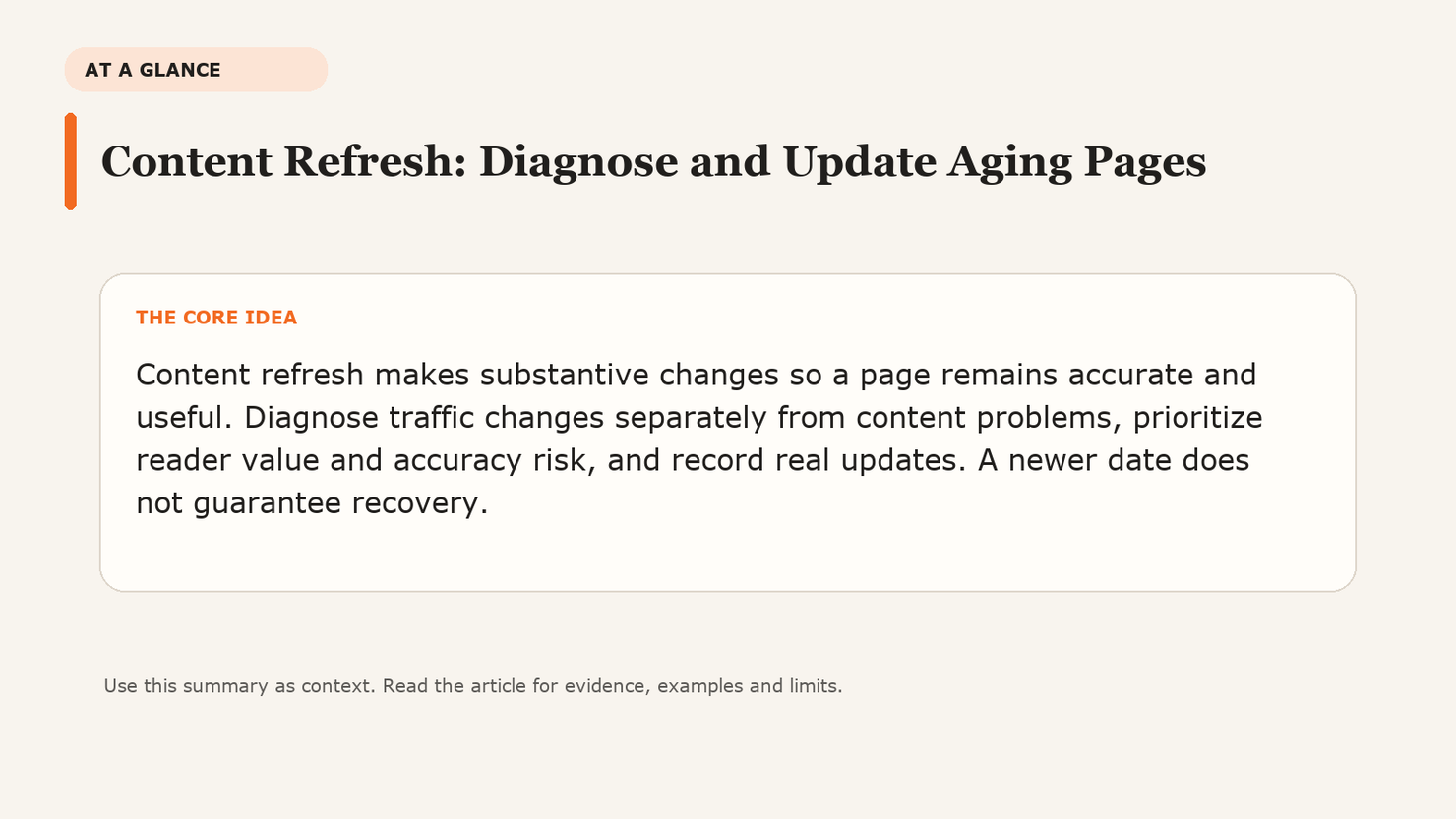
Separate content problems from performance changes
A page can become less useful because the facts changed. A product no longer supports the feature described, a policy has been revised or the example no longer matches the reader's work. Those are clear reasons to review the content, even if traffic is steady.
Performance can change for other reasons. Search demand may fall, a technical issue may limit access or the results may change. A page can lose clicks while remaining accurate, and it can contain errors while still attracting visitors.
Google's guide to search traffic drops describes several possible causes and ways to investigate them. Use the evidence to narrow the issue. Do not label every decline “content decay” before checking the alternatives.
Begin with two notes: what has changed in the page's usefulness, and what has changed in its performance. If you only have evidence for one, keep the other open rather than assuming a cause.
Build a small review queue
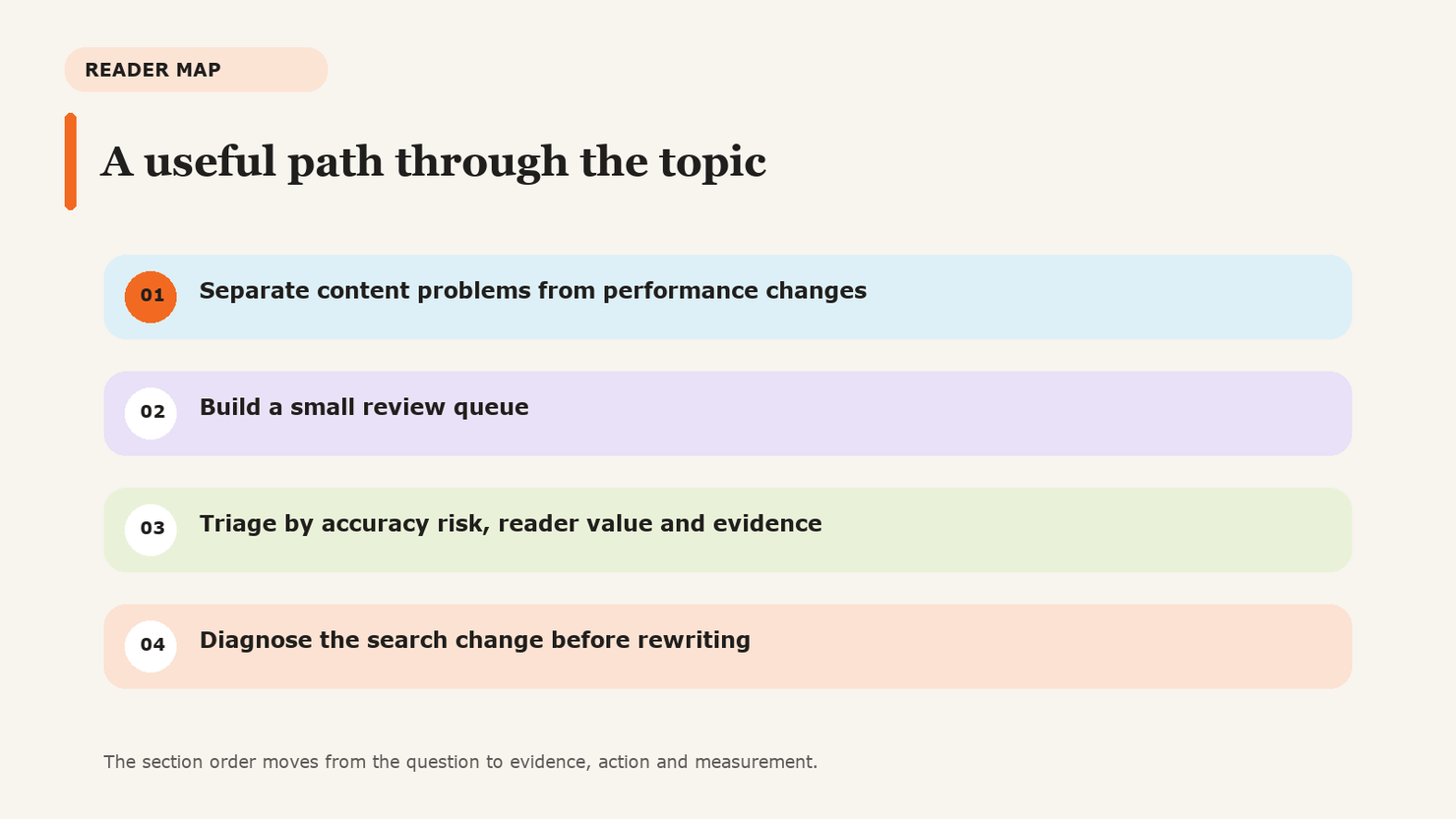
Start with important pages that contain facts likely to change, pages that support a buyer decision and pages with a meaningful performance shift. This is more useful than sorting the whole site by age alone.
For each page, record its URL, main reader task, current owner, last substantive review and known concerns. Add the evidence that brought it into the queue, such as a changed source or a sustained decline across comparable periods.
Keep the queue manageable. A short list with clear decisions can lead to real improvements. A large export without owners can become another file that nobody uses.
The review date is an internal control, not a reason to change the public article date. A page may pass the review with no edits. Record that result without pretending the content has been rewritten.
Triage by accuracy risk, reader value and evidence
I suggest reviewing three dimensions: the risk of leaving the facts unchanged, the value of the page to its audience and the strength of the evidence behind the concern. Consider the work required as well.
A wrong product requirement can mislead a buyer even if the page has little traffic. That may deserve attention before a broad guide with a modest click decline. A page supporting an important workflow can matter beyond its search volume.
Treat AI-citation observations as a separate input when you have them. Record the product, query, date and conditions. One missing mention does not prove that a page is stale or that an update will restore it.
Do not multiply rough traffic and citation estimates into a precise-looking “refresh score” unless you can explain the inputs and their limits. A simple priority label with a reason is often easier for an editor to challenge.
Useful decisions include fix now, investigate first, schedule a review or leave unchanged. Write why you chose each one. That reason should point to evidence, not just the page's age.
Diagnose the search change before rewriting
Compare periods that make sense for the page. Check whether the decline is sudden or gradual and whether it affects one page, a group or the whole site. Seasonal subjects need a comparison that accounts for the time of year.
Review queries as well as pages. A drop in impressions can suggest a different problem from a drop in clicks with similar visibility. Neither pattern is a complete diagnosis on its own, so inspect the broader context before acting.
Check access and indexing where relevant. A page blocked by a changed setting will not be repaired by a stronger introduction. A broken route or missing content needs the right technical owner.
If a core update overlaps with the change, follow Google's core update guidance. It recommends careful assessment rather than quick fixes aimed at supposed ranking rules. Do not assume that every affected page has one obvious defect.
Keep the diagnosis in the brief. State what you know, what remains uncertain and which part of the page the evidence suggests reviewing. That prevents a measured investigation from becoming a vague instruction to “make it fresh.”
Refresh the answer, not just the surface
Read the page as someone trying to complete its main task. Check the claims, sources, examples, steps and next actions. Identify what no longer holds and what is missing from the answer.
A useful refresh may replace outdated instructions, add a needed limit or improve a confusing example. It may shorten a repeated section or remove a claim that cannot be supported. More words are not the default sign of progress.
Google's people-first content guidance asks whether readers leave with enough understanding to reach their goal. Apply that check to the revised page. Do not merely match the headings of a newer competitor article.
Preserve the parts that still work. If a definition is clear and correct, keep it. If a section serves another task better, consider linking to the appropriate page rather than expanding the article into a broad guide.
Check the whole page package
An updated body can still sit beneath a misleading headline. Review the title, description, summary, FAQs and any structured data alongside the prose. Each should reflect the evidence and scope of the revised article.
Google's guidance on generative AI content calls for factual review, including supporting page elements. Apply that care whether AI helped draft the change or a person wrote every sentence.
Check links and media as well. A screenshot may show an old interface. A source may have moved. A download may no longer exist. Decide whether to replace, explain or remove each item based on the reader's needs.
Do not invent a human review or firsthand test to strengthen the page. If you only checked documentation, keep claims within that evidence. An updated example can be useful without being presented as a client result.
Use dates to describe real changes
Keep the original publication date distinct from the date of a substantive update. Make visible dates and markup consistent with what happened. Google's publication-date guidance explains how to provide clear date information.
Changing a date without changing the content is not a refresh strategy. Google's people-first guidance specifically warns against making pages appear fresh when they have not substantially changed.
A review log can be more detailed than the public date. Record what was checked, what was edited, the sources used and who approved the work. That helps the next editor understand the page without relying on memory.
There is no single update schedule for every article. A fast-changing product guide may need attention when the product changes. A stable concept page may need less frequent review. Choose the trigger from the risk and subject.
A worked example: a software setup guide
Imagine a hypothetical guide that explains how to connect two business tools. The vendor changes the setup steps and limits one feature to a different plan. The page's traffic is still steady.
The accuracy issue is enough to act. The editor should verify the current requirements, revise the steps and check the page's summary and screenshots. Waiting for a traffic decline would leave readers with advice that no longer works.
Now imagine another guide loses clicks but its steps remain current. Search demand may have shifted, or the result may be displayed differently. The team should investigate before replacing a useful process with new wording.
These are illustrative scenarios, not findings from a test of this website. They show why factual risk and search trends belong in the same review queue while remaining distinct reasons for action.
Choose consolidation or removal carefully
Sometimes two pages now serve the same task. Sometimes a page no longer has a useful role. Those findings may call for a broader content decision, not a routine refresh.
Review existing value and links before changing URLs or removing pages. Consider whether a clearer scope, a better answer or a deliberate combination would serve readers. Do not treat deletion as a shortcut to a healthier traffic chart.
Google's core update guidance describes deletion as a last resort when content cannot be salvaged. Keep that in mind when a performance review turns into a proposal to remove a large part of the site.
Document the decision and its implementation needs. A suggestion to combine pages does not itself carry out the redirects, link updates or publishing work. Those changes need a clear plan and checks.
Verify the update and keep the outcome honest
After publication, check that the live page contains the approved changes and that links, dates and supporting elements agree. Save a short change record and the date when the revision went live.
Then review performance over a useful period. Keep other changes in view, including demand, technical work and search updates. A before-and-after increase does not establish that the refresh alone caused it.
Start with one page in your next content audit. Record the task, accuracy concern, search evidence, proposed fix and owner. A good maintenance system makes the reason for each edit clear and keeps useful content reliable, rather than giving old pages a new date and hoping for recovery.
Frequently Asked Questions
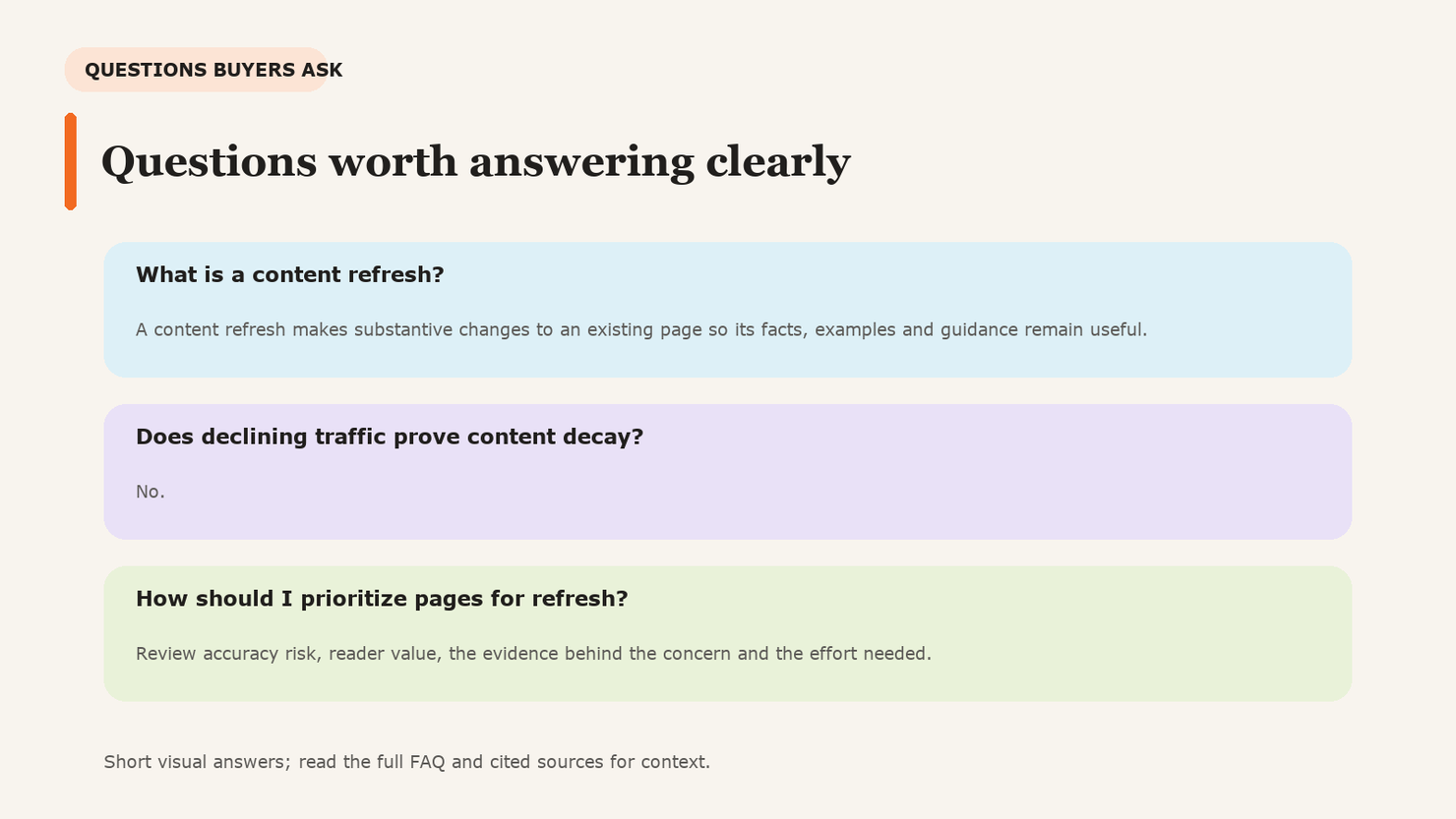
What is a content refresh?
Does declining traffic prove content decay?
How should I prioritize pages for refresh?
Will a newer update date restore rankings or AI citations?
Frequently Asked Questions
What is a content refresh?
Does declining traffic prove content decay?
How should I prioritize pages for refresh?
Will a newer update date restore rankings or AI citations?

Swapan Kumar Manna
Go-to-market & AI search strategist
Swapan Kumar Manna is a go-to-market and AI search strategist and Founder & CEO of Oneskai. He has spent 14+ years helping companies get found, get chosen and grow.