Part of the Modern SEO Strategy: A Practical Guide for the AI Era series
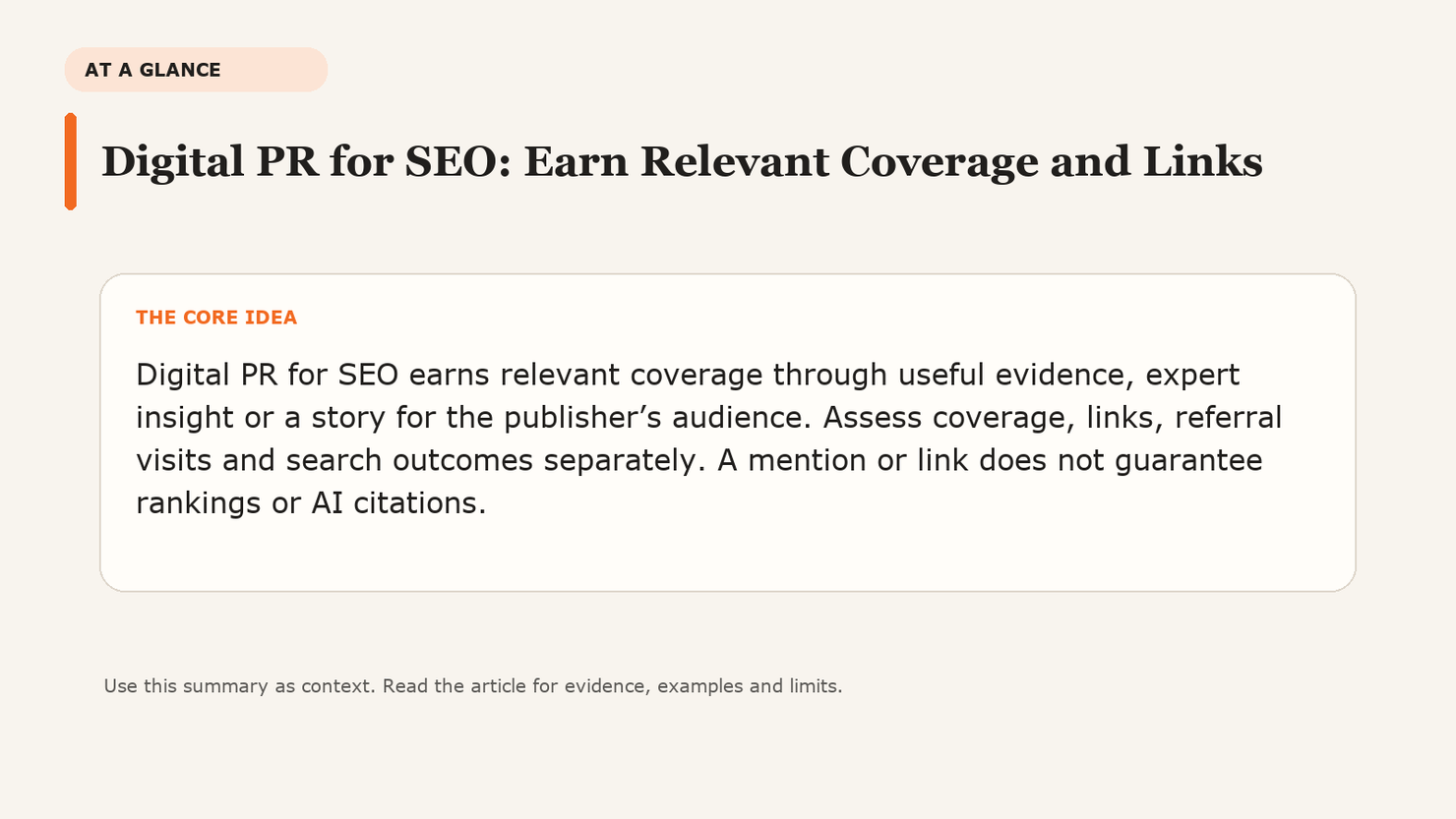
Digital PR for SEO earns relevant coverage through useful evidence, expert insight or a story for the publisher’s audience. Assess coverage, links, referral visits and search outcomes separately. A mention or link does not guarantee rankings or AI citations.
Key Takeaways
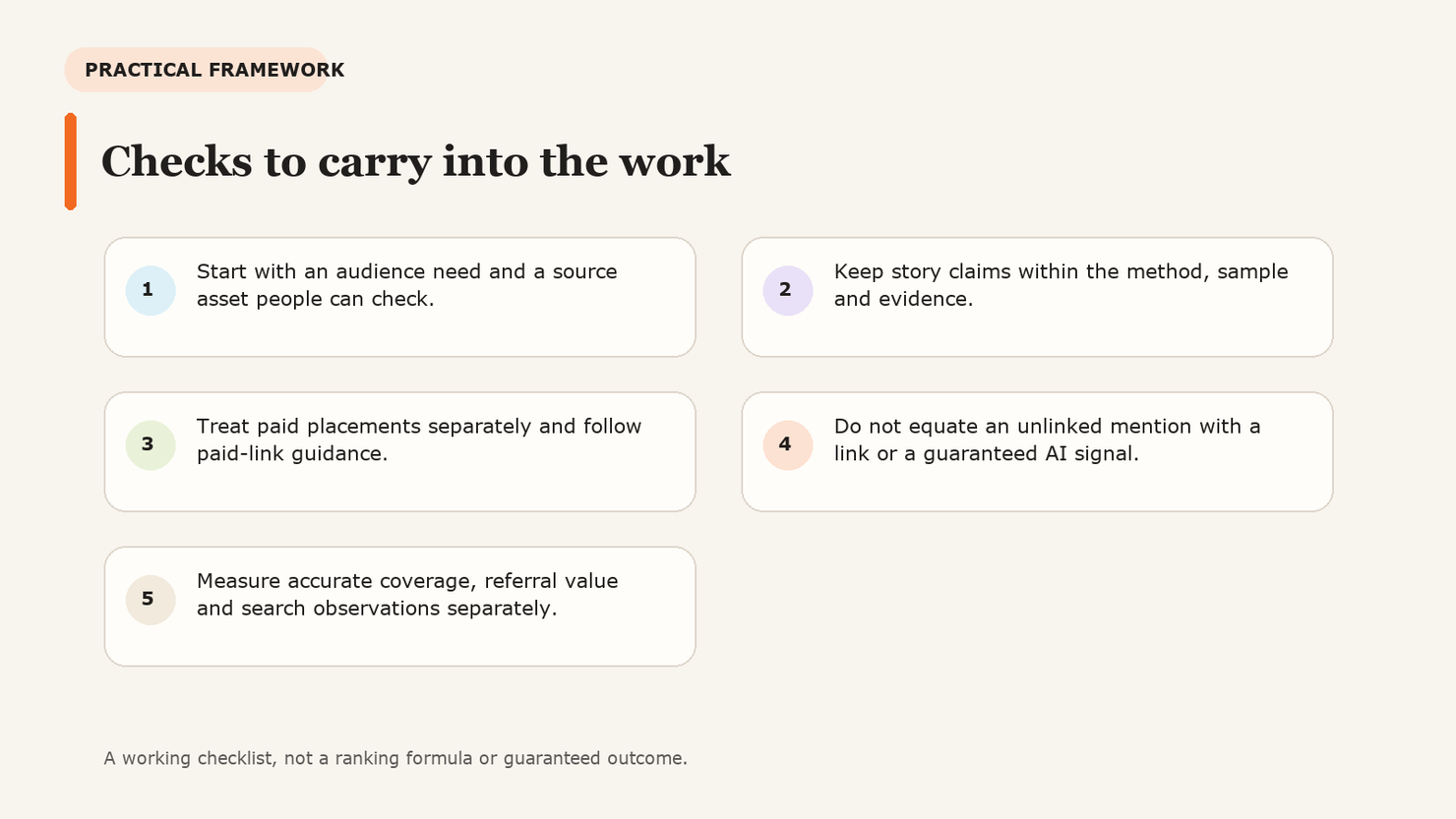
- Start with an audience need and a source asset people can check.
- Keep story claims within the method, sample and evidence.
- Treat paid placements separately and follow paid-link guidance.
- Do not equate an unlinked mention with a link or a guaranteed AI signal.
- Measure accurate coverage, referral value and search observations separately.
Playbooks
Frameworks you can put to work
Growth marketing, LinkedIn presence, and more — delivered as PDFs.
Browse the playbooksA link report can look strong while saying little about whether the coverage reached the right people. A brand mention can be useful without a link, but its value still needs a clear explanation.
Digital PR for SEO means earning well-matched online coverage through useful evidence, expert insight or a story that serves the publisher's audience. A link may help readers find the source and can play a role in search. Coverage may also build awareness or bring referral visits. Those are different results, and none is automatic.
My advice is to start with something worth referring to, then choose the people and sites whose readers would benefit from it. Measure the resulting coverage on its own merits before claiming a ranking or AI-citation effect.
Digital PR is one approach to earning attention and links. It has not replaced every form of link building, and a mention is not a fixed ranking signal across all search and AI products.
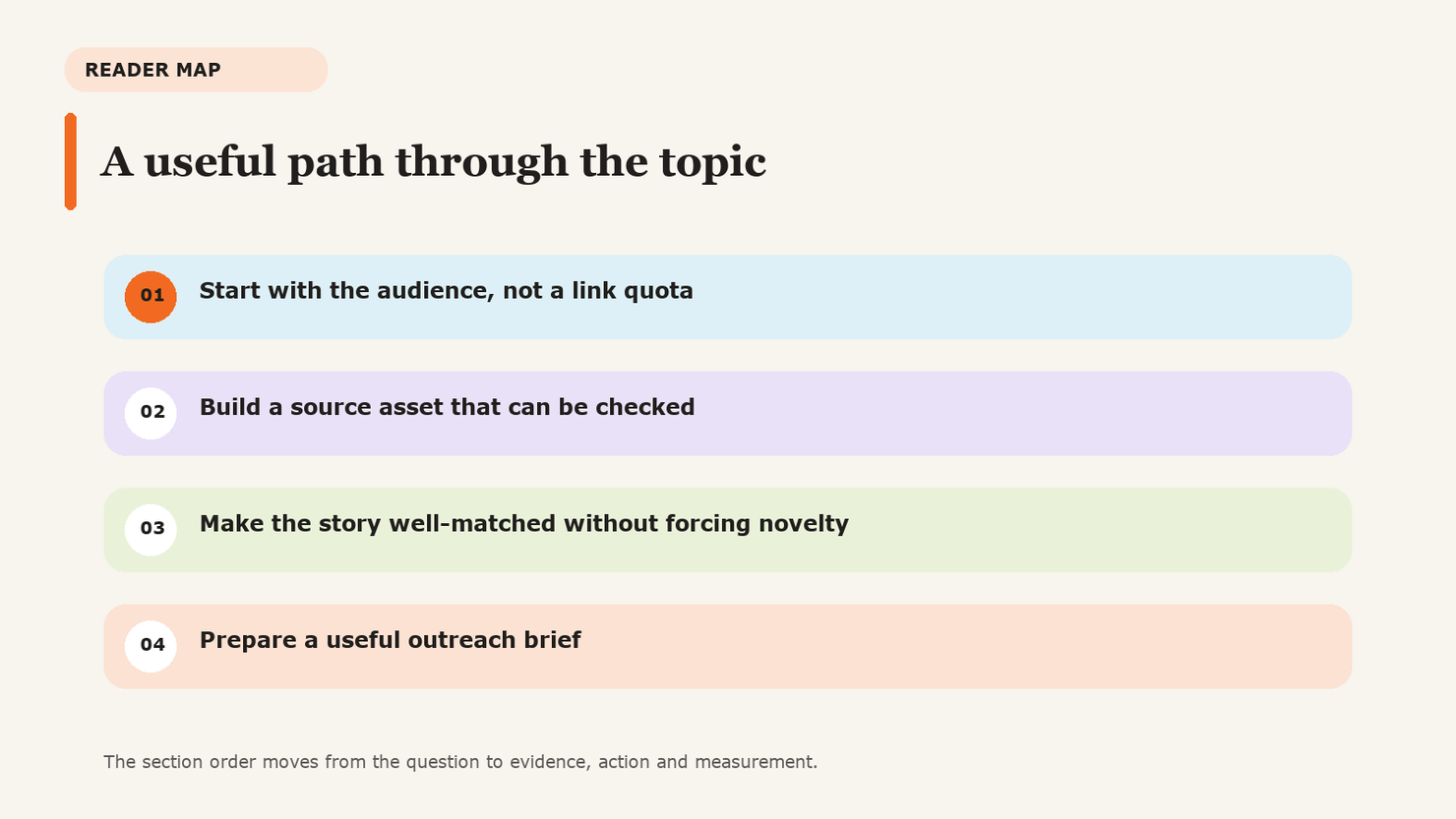
Start with the audience, not a link quota
Choose the people you want to help and the question they need answered. A campaign for a B2B operations team may need a very different source asset from one aimed at a broad consumer audience.
Look for publishers whose subjects and readers overlap with that need. A well-matched specialist article can have a clear purpose for readers even if the site is smaller than a broad site. A large audience is not always the right audience.
Use third-party site metrics as research aids, not as proof of business value or Google's private view. Review the site, its actual coverage and whether a reader would find your work useful there.
A link quota can push the team toward easy placements that have little relevance. I would define the campaign's audience role first, then review the quality of each result rather than treating every link as an equal unit.
Build a source asset that can be checked
Useful assets include new analysis, a practical tool, a clear explanation of a change or a supported expert view. Choose the form that fits the question and the evidence you can provide.
For a data-led story, show where the data came from, when it was collected and what the sample includes. Explain the method and limits. A title that sounds strong but outruns the evidence can undermine the entire piece.
For an expert work, make the reason behind the view clear. Give a concrete tradeoff or example. Do not turn a broad opinion into a claim that you have tested a method or seen client results when you have not.
Put the full explanation on an accessible source page where right. The reader should be able to follow a citation and check the basis for the claim. A press summary is useful, but it should not be the only place the evidence exists.
Make the story well-matched without forcing novelty
A story needs a reason for a specific audience to care. That reason might be a decision it changes, a misunderstanding it clears up or a result that merits closer review.
Novelty alone is not enough. An unusual claim can be wrong, and a familiar subject can become useful through a careful method or a specific example. Ask what the reader will understand better after seeing the work.
Google's AI search guidance encourages distinctive, useful content. It also warns against seeking inauthentic mentions. That supports a focus on real detail, rather than manufacturing discussion to look widely cited.
Keep the claim within the evidence. A small sample of one industry should not be presented as the state of all businesses. A proposed workflow should not be described as a proven benchmark. Those limits should travel with the story when others refer to it.
Prepare a useful outreach brief
A good brief explains the audience question, the work, the evidence and why the writer's readers may care. Include a clear source link, the main limits and who can answer follow-up questions.
Keep it specific to the site. Read well-matched recent coverage before deciding the angle. A broad pitch sent to many unrelated people may save preparation time but leaves the writer to find the relevance for you.
Do not demand a specific anchor phrase or imply that coverage must contain a ranking-passing link. Editorial coverage should serve the reader. The publisher may quote the view, link to the source or decide the story is not a fit.
Plan for corrections as well as questions. If someone misstates the method or a fact, provide the correct detail with its source. Your aim is a faithful account of the work, not merely another appearance of the brand name.
A B2B example: a useful study with clear limits
Imagine a hypothetical company studying how teams document software handovers. It has consent to use a set of anonymous internal process records and can explain how the records were selected.
A useful report might define what counts as a complete handover, describe the sample and show which steps were often missing within that sample. It could give readers a checklist based on the seen gaps.
The weak version claims that most companies fail at handovers without evidence beyond its own narrow records. The stronger version says exactly what was reviewed and leaves room for other teams to differ.
A well-matched trade site could use that bounded finding to explain a practical problem. The source page would carry the method, definitions and limits so readers can assess it. The company could also offer a checked expert explanation of why the missing step matters.
This is an illustrative campaign design, not a study I conducted. It shows how the usefulness of the evidence comes before the number of links a story might earn.
Keep earned coverage separate from paid placement
Google's spam policies address links created primarily to manipulate rankings, including certain paid links, excessive exchanges and automated link creation. A service calling a placement “PR” does not change the nature of the deal.
If you pay for advertising or sponsored content, treat it honestly as paid media. Google's outbound-link guidance recommends marking paid links with sponsored; nofollow remains acceptable. Do not buy a promise that the link will pass ranking credit.
The same care applies when money is replaced by another benefit. Review the terms rather than assuming a placement is earned because the invoice uses a different label.
Earned coverage is not a license to pressure an editor into a link scheme. Focus on the value of the source and let the publisher decide how to present it. Keep paid and earned results separate in your reporting.
Understand what a link and a mention can prove
Google's search systems guide describes systems that use link analysis, including PageRank, among its search systems. That does not mean one acquired link produces a predictable ranking change.
A mention without a link is a different kind of result. It may expose the brand to well-matched readers or provide a useful reference in a discussion. Do not count it as if it were the same technical signal as a link.
For AI visibility, stay equally careful. A mention in a source does not prove that ChatGPT, Copilot, Perplexity or Gemini will retrieve or cite it. Products, prompts and results differ, and a single seen answer cannot prove a fixed rule.
If you test visibility, record the product, query, date and settings. Report what you saw. Do not turn a campaign launch and a later change in an answer into proof that the campaign caused the change.
Measure the campaign at several levels
Start with coverage quality. Was the account correct? Did it reach a well-matched audience? Did the publisher refer to the intended source, and does the link work when one is present?
Next review referral visits and useful actions where you can track them. A visit from a well-matched article may matter differently from an unrelated placement. Keep the destination page and next action in view, rather than judging the campaign by coverage alone.
Review search performance as a separate layer. Record other work, such as new content, technical work and shifts in demand. A before-and-after chart does not isolate the effect of a PR campaign.
Avoid double-counting reprinted copies as distinct choices by editors. Note when several pages repeat the same original report. That helps the team understand whether it earned multiple distinct stories or wider spread of one story.
Keep the source useful after the campaign
A source page needs an owner after launch. Correct errors, keep important links working and explain major changes to the method or findings. If facts become outdated, add context or revise them rather than leaving a confident claim untouched.
Google's generative AI content guidance calls for truth checks across reader-facing content and other page parts. Apply that care to the title, summary and metadata, as well as the source asset itself.
AI assistance can help organize a brief or draft an explanation. It cannot create a real dataset, a genuine expert review or evidence of a test that never happened. A human should review the full package before site.
Start with one useful asset in your next SEO audit. Define its audience, evidence, well-matched publishers and success measures. Earn attention through the work, and judge the link or mention by what it actually provees rather than what a dashboard promises.
Frequently Asked Questions
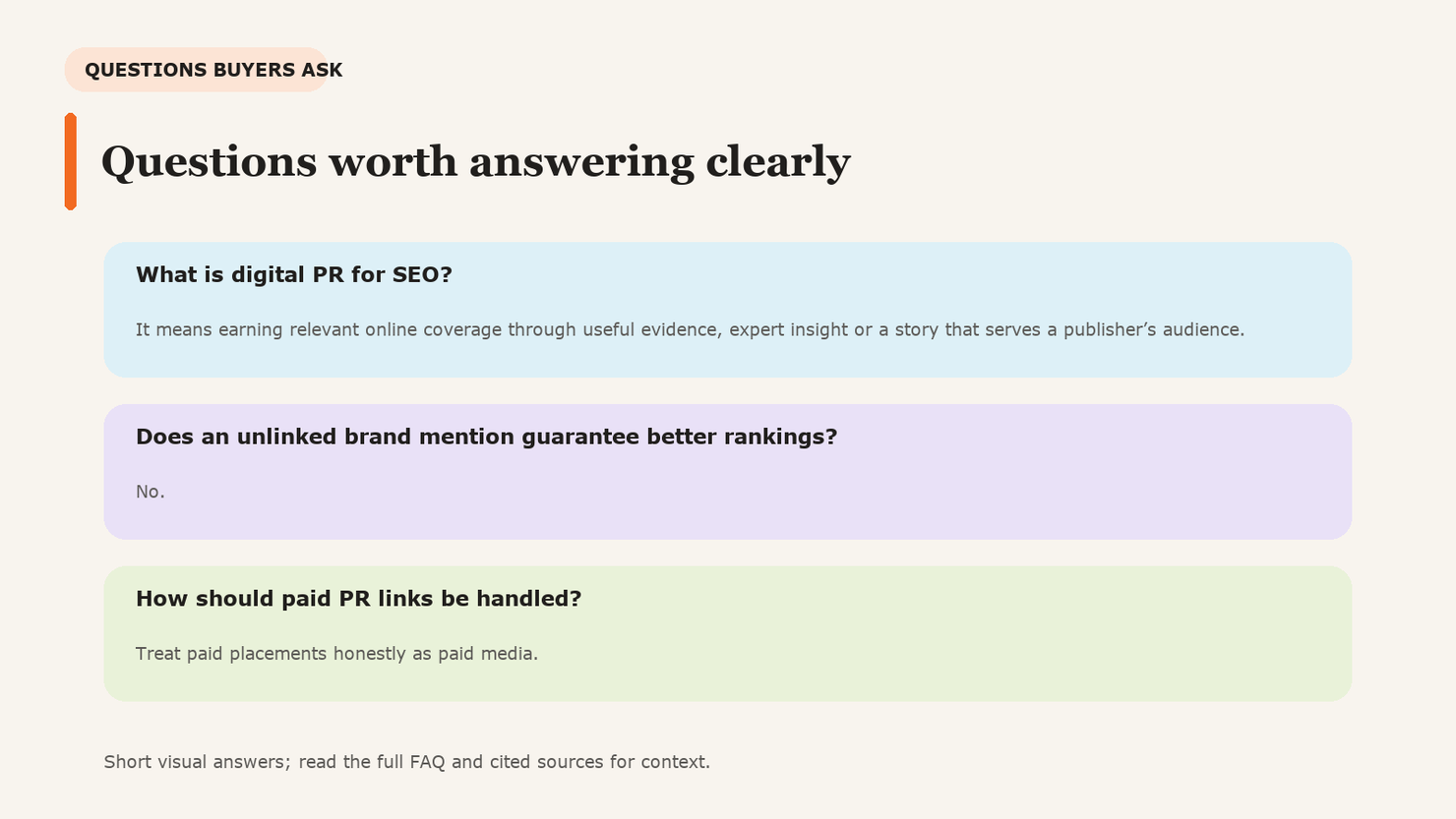
What is digital PR for SEO?
Does an unlinked brand mention guarantee better rankings?
How should paid PR links be handled?
How should I measure a digital PR campaign?
Frequently Asked Questions
What is digital PR for SEO?
Does an unlinked brand mention guarantee better rankings?
How should paid PR links be handled?
How should I measure a digital PR campaign?

Swapan Kumar Manna
Go-to-market & AI search strategist
Swapan Kumar Manna is a go-to-market and AI search strategist and Founder & CEO of Oneskai. He has spent 14+ years helping companies get found, get chosen and grow.