Part of the Modern SEO Strategy: A Practical Guide for the AI Era series
Entity SEO starts with clear, verified facts about a person, business or product. Align key pages and profiles, link the same identity with sameAs, and keep markup accurate. These steps do not guarantee a knowledge panel or AI recognition.
Key Takeaways
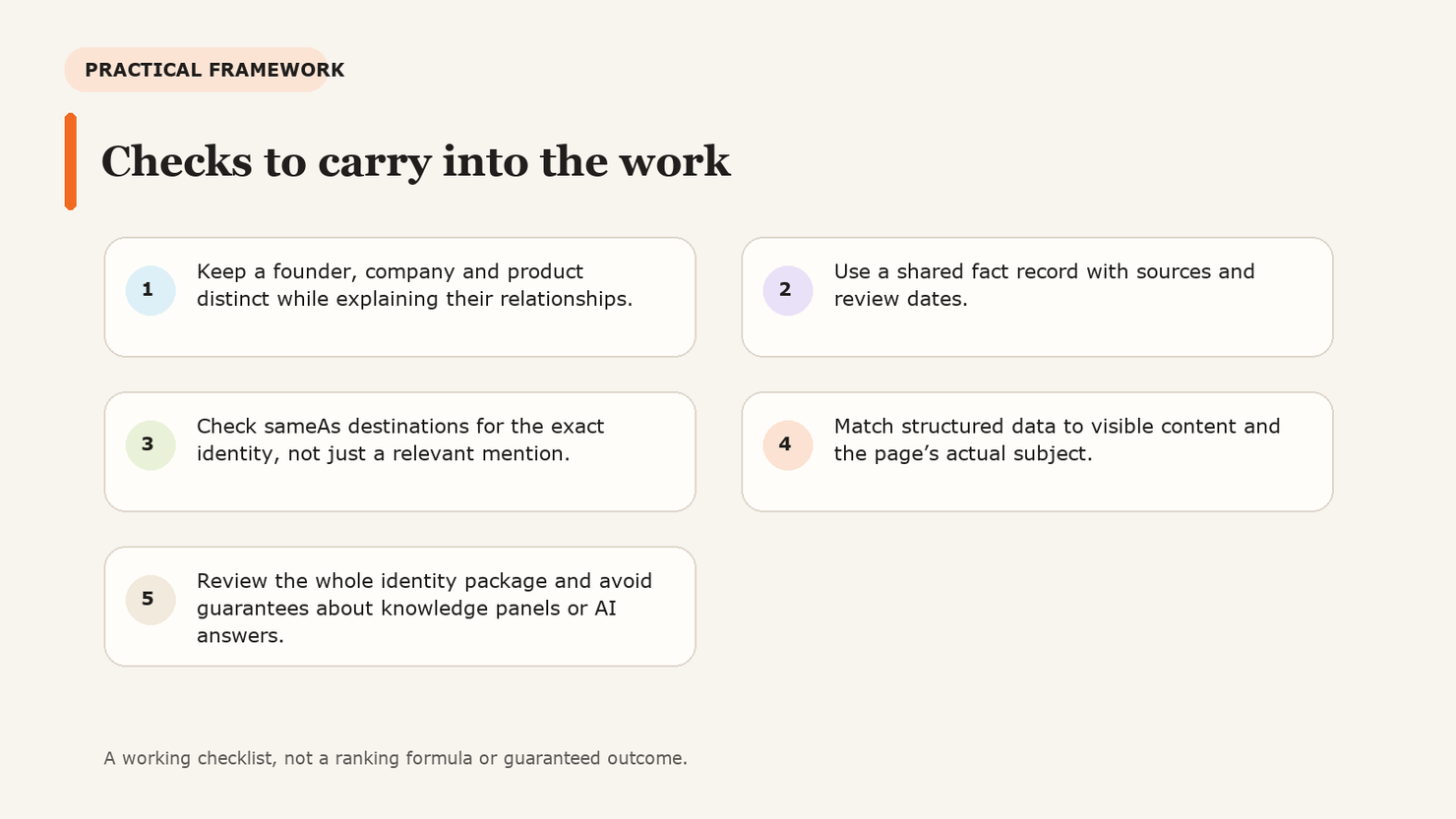
- Keep a founder, company and product distinct while explaining their relationships.
- Use a shared fact record with sources and review dates.
- Check sameAs destinations for the exact identity, not just a relevant mention.
- Match structured data to visible content and the page’s actual subject.
- Review the whole identity package and avoid guarantees about knowledge panels or AI answers.
Playbooks
Frameworks you can put to work
Growth marketing, LinkedIn presence, and more — delivered as PDFs.
Browse the playbooksA buyer searches for your company and finds three descriptions of what it does. One calls it a software business, another calls it an agency, and a third still names a founder's old role. Each page may read well on its own. Together, they leave a basic question unresolved: who is this business, and what does it offer now?
Entity SEO helps make a person, business, or product easier to identify. It helps tell one from another. Start with clear public facts and links to the right profiles. Then use structured data that matches what readers see.
I would start with those facts before buying a promise of a knowledge panel or an AI recommendation. Clear identity gives people and systems a better source to work with. It does not guarantee how a search engine or assistant will use it.
Start with the thing you want people to identify
A keyword is a phrase someone searches for. An entity is the person, organization, product, or other thing the phrase may refer to. A founder, their company, and the company's product are related, but they are not the same entity.
That distinction matters when several names appear on a site. The founder's profile should explain the person and their role. The company page should explain the business. A product page should describe the product and who provides it.
Consider a hypothetical founder, Maya, whose company sells a tool called LedgerFlow. Maya's personal profile, the company profile, and LedgerFlow's product page should not all use one generic description. Each needs its own purpose, with the relationships stated in plain language.
My first check would be whether a reader can tell which name belongs to the person, business, and offer. If the answer is unclear, markup will only package that uncertainty in another format.
Build a short record of verified brand facts
Create a small record that writers and developers can use. Include the public name, official website, current description, relevant people and roles, and verified external profiles. Add a source and review date so the team knows where each fact came from.
Keep the record true to the facts. Do not stretch a claim to make it sound stronger. A career length, award, credential, or customer result needs support. A statement that combines several facts can also create a claim none of the sources establish.
Take my About page as a limited example. It describes Swapan Kumar Manna as a go-to-market and AI search strategist, states 14+ years in GTM and growth, and identifies me as Founder & CEO of Oneskai. Those details describe a person, experience, and a business relationship.
They should not be rewritten as 14+ years specifically in generative AI search. That would change the meaning of the experience claim. This is an example of checking a public description, not a report of an identity cleanup or improved search results.
For Maya's business, I would ask a colleague outside marketing to read the record. If they cannot explain what LedgerFlow is or who provides it, the wording still needs work.
Align your important pages and profiles
Review the home page, About page, author pages, company profile, and key product pages. Then check the external profiles you control. Look for material differences in the names, roles, website links, and description of the offer.
Consistency does not mean copying one paragraph everywhere. A short social bio and a full About page have different jobs. They should agree on the facts while giving readers the detail suited to each place.
Old titles need context. If a role ended, show the relevant dates where appropriate rather than presenting it as current. If a business changed its name, explain the connection where readers are likely to encounter the older name.
Prioritize information you can correct directly. For a third-party page, record the error and ask the publisher for a correction when you have evidence. Do not create fake profiles or inauthentic coverage to make the web appear to agree with you.
This review is also useful beyond search. A buyer checking a founder or company should not have to guess whether two pages describe the same business.
Use sameAs for identity, not a collection of backlinks
Schema.org defines sameAs as a link to a reference page that clearly identifies the same item. The important word is identity. A useful article about a company is not automatically the same kind of reference as the company's own profile.
Google's guide to Organization markup includes sameAs for relevant pages on other sites. These can include a business profile on a social or review site. Check that the link points to the exact business you mean.
A founder's personal profile should not be added as though it were the company's profile. In the LedgerFlow example, a page about Maya and a page about the company describe related but different subjects.
Open each link before using it. Confirm the account belongs to the intended person or business, the page still exists, and the name is not being confused with another brand. Similar handles alone are weak evidence of identity.
I would keep a small, checked list rather than add every mention I can find. sameAs is not a way to claim someone else's authority or a setting that forces AI systems to recommend a brand.
Match structured data to the page's subject
Google says Organization markup on a home page can help it understand a business's details and distinguish it from others. Use fields that apply to the real organization, and make sure the visible site supports the information.
A profile page has a different role. Google's ProfilePage guidance covers pages focused on one affiliated person or organization, including author pages and an About Me page on a blog. A broad product home page is not automatically a profile page.
For an author page, the person should be clear, with relevant biographical details and links to their work. For a company page, keep the business identity and contact details accurate. Your developer can then choose the appropriate markup using the current requirements.
Google's markup rules require the data to match the page. A test can find errors in the code, but it cannot prove the facts are true. Passing the checks does not guarantee a search feature.
Review the rendered page as well as the data. A template can repeat an outdated role or description across many articles even after the main About page has been corrected.
Understand the limits of knowledge panels and AI answers
Google's knowledge panel explanation says Google creates panels using several sources. If a panel already exists, its subject or an official representative can claim it and suggest changes. That process lets them give feedback; it does not give them full control.
Google describes these panels as boxes in Search for entities in its Knowledge Graph. The box is a search feature, not something you can create simply by adding markup.
That is different from paying for guaranteed inclusion. Fixing your site and profiles can improve the source information you control, but it does not require Google to create a panel or accept every suggested edit.
The same care applies to LLMs and AI search. Google, ChatGPT, Copilot, Perplexity, and Gemini are different products. An update to your website does not prove that every system has found it or will repeat the new facts.
If you inspect an AI answer, record the question, product, date, and conditions. Compare the description with verified sources. A corrected answer is an observation from that check, not proof that a particular markup change caused it.
Review the whole identity package before publishing
A page can get the facts right but still have a misleading title or bio. Google's AI content guidance calls for manual fact-checking before content goes live. That includes metadata and image alt text.
For entity work, that review should cover names, roles, experience claims, relationships, and profile destinations. AI-assisted wording can make a small fact sound like a broader credential. A person who knows the business should check that meaning before it goes live.
I would give each correction an owner and keep a simple record of the source, affected pages, and review date. Recheck the record when a role, product, or business name changes. Clear facts need maintenance as much as they need good writing.
Start your next audit with three pages. Read the main identity page and the author or company profile. Then check the profile on another site that buyers are most likely to read. Fix the facts that disagree, and have your developer review the matching structured data. You now have a clear task the team can inspect.
Frequently Asked Questions
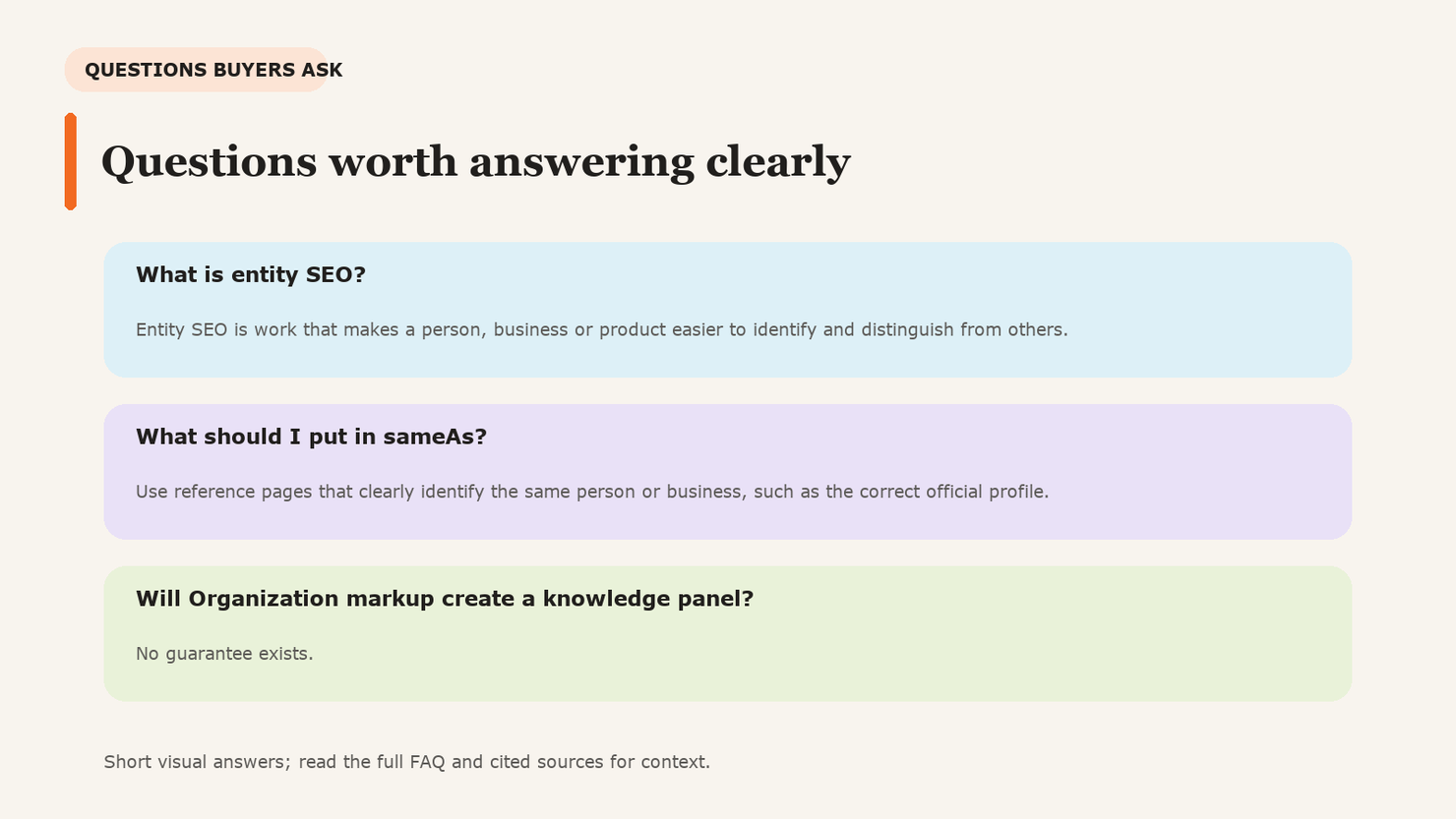
What is entity SEO?
What should I put in sameAs?
Will Organization markup create a knowledge panel?
How should I judge an entity cleanup?
Frequently Asked Questions
What is entity SEO?
What should I put in sameAs?
Will Organization markup create a knowledge panel?
How should I judge an entity cleanup?

Swapan Kumar Manna
Go-to-market & AI search strategist
Swapan Kumar Manna is a go-to-market and AI search strategist and Founder & CEO of Oneskai. He has spent 14+ years helping companies get found, get chosen and grow.