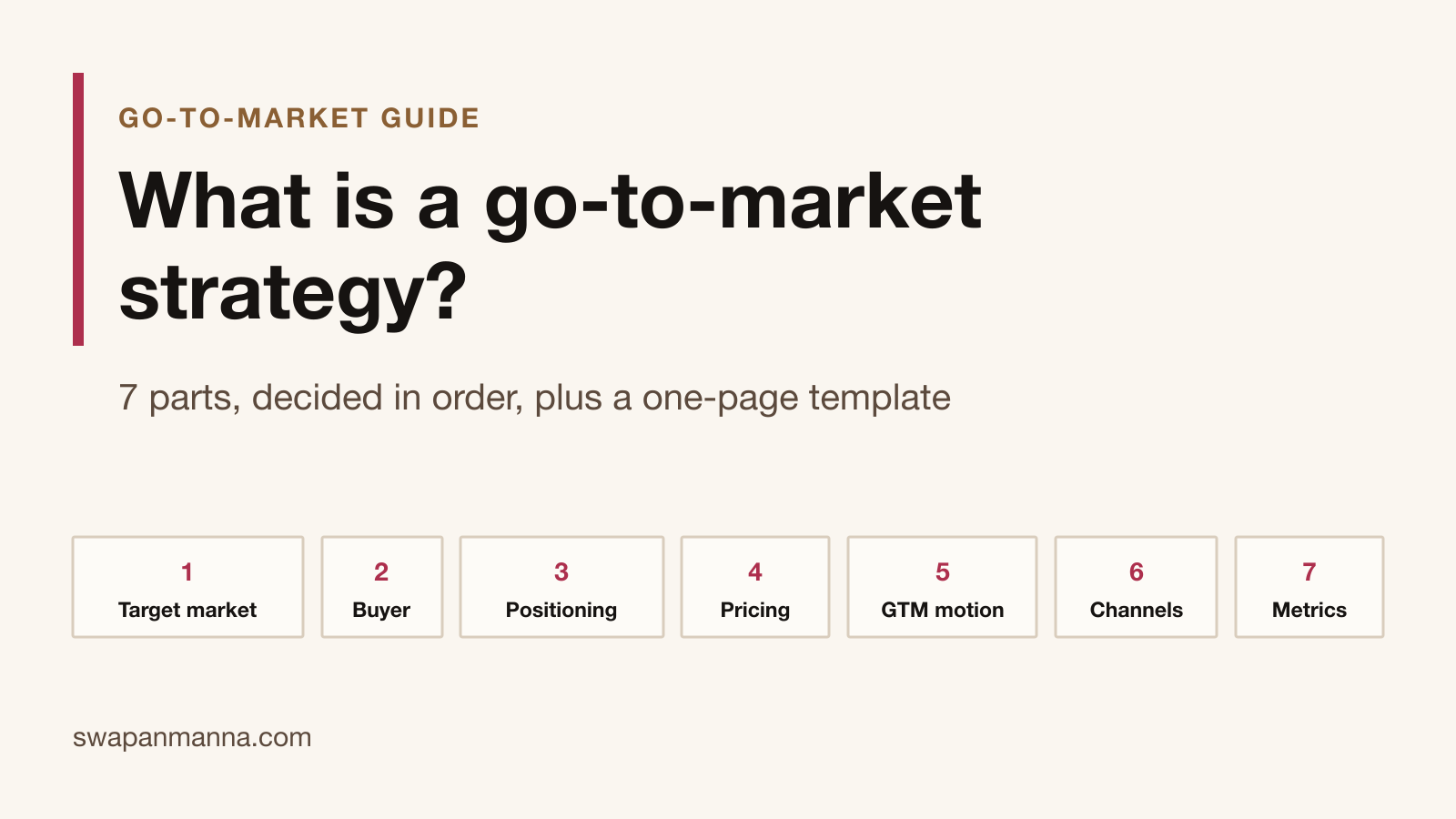
A go-to-market strategy is the plan for how a product reaches and wins buyers. Decide seven parts in order: target market, buyer, positioning, pricing, GTM motion, channels and metrics. Write it on one page, test one segment first and review it monthly.
Key Takeaways
- A go-to-market strategy is a set of choices about who you sell to, why they choose you, how they buy, where you reach them, the price and the metrics, including who you are not for.
- Decide the seven parts in order: target market, buyer, positioning, pricing, motion, channels, metrics. Each answer limits the next, so a change early means re-checking everything after it.
- Choose the GTM motion (sales-led, product-led, marketing-led or partner-led) from how your buyer buys and what your price can pay for, not from what a competitor does.
- Treat AI search as a channel: many buyers ask ChatGPT, Perplexity or Google for a shortlist before they talk to a vendor.
- Write the strategy on one page, test it on one segment, and review it monthly against pipeline, win rate and payback.
In this articleShowHide
Playbooks
Frameworks you can put to work
Growth marketing, LinkedIn presence, and more — delivered as PDFs.
Browse the playbooksA go-to-market strategy is the plan for how a product reaches and wins its buyers. It sets out who you sell to, why they should choose you, how they buy, where you reach them, what you charge and how you will know it's working. You make those choices before you spend money on a launch, a sales hire or ads.
This guide gives you the seven parts of a go-to-market strategy in the order to decide them, the four common GTM motions and when each fits, worked examples, the mistakes to avoid and a one-page template you can copy. If you are planning the timeline for a specific launch, the product launch strategy post covers the five launch phases.
What is a go-to-market strategy?
A go-to-market strategy answers one question: how will this product turn into revenue? HubSpot defines it as "a step-by-step plan for bringing a new product to market and driving demand" (HubSpot, 2025). Stripe's guide calls it a comprehensive plan for launching a product or service, narrower than a business plan because it covers one product or one new market (Stripe, 2026).
Both definitions tie GTM to a launch. In practice you need a go-to-market strategy whenever you change who you sell to, what you sell or how you sell it: a new segment, a new country, a new price, or the move from founder-led sales to a sales team. For a company with $1M–$25M in annual revenue, that last point is often where it matters most, when sales can no longer live in the founder's head.
A go-to-market strategy is a set of choices, and every choice includes what you will not do. If your strategy doesn't rule out a segment, a channel or a deal type, it isn't a strategy yet. It's a wish list.
Why does a go-to-market strategy matter?
It matters because marketing, sales and product make GTM decisions every week whether you write them down or not. Without a shared version, each team works from its own guess about the buyer.
- One target for every team. Marketing writes for the same buyer that sales calls and product builds for. The sales and marketing alignment problem is usually a missing GTM decision, not a personality clash.
- Spend follows evidence. You decide the segment and the message before you buy ads or hire reps, so money amplifies something that already works.
- Misses become diagnosable. When pipeline falls short, you can ask which part failed: the wrong segment, a weak message, a channel the buyer doesn't use, or a price they won't pay. Without the parts written down, every miss looks like "marketing isn't working".
- New hires ramp faster. A one-page strategy tells a new rep or marketer who to talk to and what to say on day one.
How is a GTM strategy different from a marketing plan or a business plan?
A business plan covers the whole company, a go-to-market strategy covers how one product or market reaches buyers, and a marketing plan covers the marketing work that carries the GTM strategy out. Stripe puts it plainly: the marketing strategy is a subset of the GTM strategy.
| Business plan | Go-to-market strategy | Marketing plan | |
|---|---|---|---|
| The question it answers | Why does this company exist and how will it make money? | How will this product win these buyers? | Which campaigns, content and spend will create demand? |
| Scope | The whole company | One product, segment or market | Marketing activity only |
| Covers | Vision, model, finances, team | Market, buyer, positioning, price, motion, channels, metrics | Channels, calendar, budget, campaign targets |
| Changes when | The company's direction changes | You change who, what or how you sell | Every quarter or campaign |
| Owned by | The founder or CEO | The CEO with sales, marketing and product leaders | The marketing lead |
A growth strategy sits one level up from GTM: it decides which growth levers to pull (new customers, expansion, new markets). The go-to-market strategy is how you execute the lever that involves winning buyers.
What are the 7 parts of a go-to-market strategy?
The seven parts are the target market, the buyer, positioning, pricing, the GTM motion, channels and metrics. Most guides list similar parts. What they rarely say is that the order matters: each answer limits the next. You can't choose channels before you know who the buyer is, and you can't set a price before you know what they compare you with.
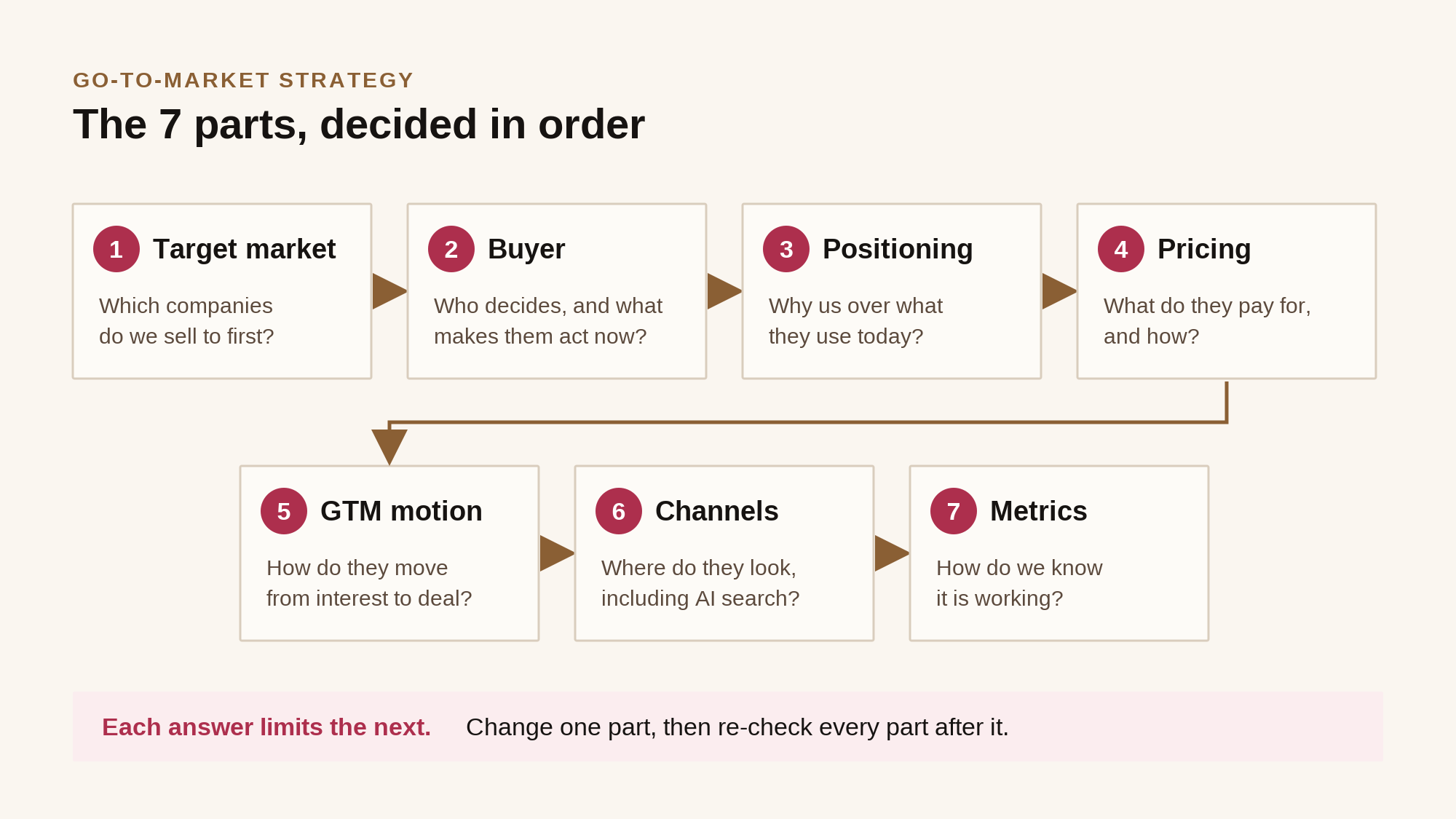
Each part below follows the same pattern: the question it answers, what you decide, what you write down and how you know it's right. One running example carries through all seven. It is hypothetical: a company with about $4M in annual revenue selling shipment-tracking software to manufacturers.
1. Target market and ideal customer profile
The question: Which companies should you sell to first?
What you decide: The segment where you win most often and keep customers longest. Pick one to start, not every company that could use the product.
What you write down: An ideal customer profile: industry, size, the situation that makes them need you, and a short "not for" list.
How you know it's right: Your best existing customers fit it, and sales agrees they would rather have ten more of them than anything else.
Geoffrey Moore's Crossing the Chasm (first published 1991) makes the case for this: win one segment completely, then use it as the springboard to the next. The step-by-step method is in how to define your ideal customer profile.
Pro tip: Use the free Ideal Customer Profile Generator to get a first draft. Enter what you sell (the only required field), and optionally the problem it solves, your website, who buys today and your market. It returns three profiles ranked by fit; the best fit is free and all three come with your email. Treat the output as a hypothesis to check against your won deals.
Example (hypothetical): Mid-size manufacturers that ship to many customers by road and track shipments in spreadsheets. Not for: freight forwarders, who already have tracking built in.
2. Buyer and buying group
The question: Who decides, who uses the product, and what makes them act now?
What you decide: The economic buyer, the main user, the people who can block the deal, and the trigger events that start a search.
What you write down: A buyer map: each role, what they care about, and the trigger that opens a buying window.
How you know it's right: Your last five won deals involved the roles you listed, and the triggers match what buyers said on discovery calls.
Most purchases above a small price involve more than one person, so plan for the group, not one persona. B2B buying committees covers how to build consensus across them.
Example (hypothetical): The head of logistics feels the pain, the operations director signs, and IT can block on security. The trigger is a large customer complaining about late deliveries.
3. Positioning and value proposition
The question: Why should this buyer choose you over what they use today?
What you decide: What buyers would use if you didn't exist, what only you can do, the value that creates, and the market category you compete in.
What you write down: A positioning statement and a one-line value proposition your whole team can repeat.
How you know it's right: A buyer can repeat your one-liner back after one call, and sales stops leading with a feature list.
April Dunford's book Obviously Awesome (2019) breaks positioning into five components, including the competitive alternatives buyers already use. Start from those alternatives, not from your features.
Pro tip: Use the free Positioning Statement Generator, which is built on Dunford's method. Enter what you sell, plus optionally what buyers use instead, what only you can do, who gets the most value and the proof you have. You get a positioning statement, a one-liner and the positioning canvas; homepage headlines and a list of weak spots come with your email.
For nine real brands decoded into customer, alternative and difference, see these product positioning examples. To turn your positioning into what you say to each buyer and on each channel, build a messaging framework.
Example (hypothetical): Instead of spreadsheets and phone calls to carriers, the head of logistics sees every shipment's status in one place and can warn customers before a delivery is late.
4. Pricing and packaging
The question: What does the buyer pay for, and how does the price compare with their alternative?
What you decide: The pricing model (per user, per unit of usage, flat fee), the packages, and where discounts are and aren't allowed.
What you write down: A price sheet with the value metric you charge on and the rule for discounts.
How you know it's right: Buyers argue about the amount, not the model, and the price leaves room to pay for the way you sell (a field sales team costs more per deal than a self-serve sign-up).
Price and motion depend on each other. A low price can't pay for long sales cycles; a high price usually needs a human in the sale. Check the maths with LTV:CAC ratio before you commit.
Example (hypothetical): Priced per site rather than per user, because the value grows with shipments tracked, not with how many people log in.
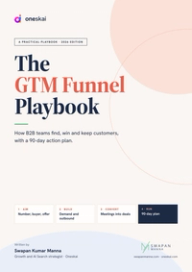
Put this into practice
The GTM Funnel Playbook
How B2B teams find, win and keep customers, with a 90-day action plan. Seven funnel stages, one owner each, from the revenue number to the clients you keep.
5. GTM motion and sales process
The question: How do buyers move from first interest to a signed deal?
What you decide: The primary motion (sales-led, product-led, marketing-led or partner-led, compared below) and the stages a deal moves through.
What you write down: The motion, the sales stages with exit criteria, and who owns each handoff.
How you know it's right: Deals move through the stages without skipping, and each stage has an owner and a definition everyone uses.
Write the stages down with exit criteria. The sales process framework post gives you six stages to start from.
Example (hypothetical): Sales-led: an inbound demo request or an outbound call, a discovery call, a pilot at one site, then a contract signed by operations.
6. Channels, including AI search
The question: Where does this buyer look when the trigger happens?
What you decide: Two or three channels to start, chosen from where buyers already go: search, AI assistants, communities, events, partners, outbound.
What you write down: The channel list, the message for each, and the budget and owner per channel.
How you know it's right: Leads from each channel match the ideal customer profile, not just the volume target.
Many buyers now ask ChatGPT, Perplexity or Google's AI answers for a shortlist before they talk to a vendor. If your category and use cases aren't described clearly on your site, you can be left off the list before a human ever sees you. Treat AI search as a channel in its own right; how to choose growth channels covers how to pick the rest.
Example (hypothetical): Search and AI answers for "shipment tracking for manufacturers", outbound to heads of logistics at target accounts, and one industry event.
7. Metrics and targets
The question: How will you know within one quarter whether the strategy is working?
What you decide: A few leading indicators (meetings booked, pipeline created) and lagging ones (win rate, sales cycle length, customer acquisition cost payback, retention).
What you write down: A scorecard with each metric's owner, target and review date.
How you know it's right: Marketing and sales read the same numbers from the same report, and each miss points to one of the seven parts.
Measure pipeline, not lead volume: MQL vs SQL explains why. Use the free LTV:CAC & CAC Payback Calculator to check that the motion pays back, and revenue operations to keep one set of numbers across teams.
Example (hypothetical): Qualified pipeline from manufacturers per month, pilot-to-contract rate, and how many months a new customer takes to pay back what it cost to win.
Which go-to-market motion fits your business?
Pick the motion that matches how your buyer prefers to buy and what your price can pay for. Most companies run one primary motion and add a second later. HubSpot groups the sales models behind these motions as self-service, inside sales, field sales and channel sales.
| Motion | How the buyer buys | Fits when | Watch out for |
|---|---|---|---|
| Sales-led | Talks to a rep, often through a demo, pilot or proposal | The price is high, several people decide, or the product needs fitting to the buyer's process | Long cycles and a high cost per deal; needs a clear sales process |
| Product-led | Signs up, uses the product, then pays or upgrades | Users can get value alone in minutes and the price is low enough to buy without approval | Plenty of sign-ups that never pay; larger accounts may still want a salesperson |
| Marketing-led (inbound) | Finds you through search, AI answers or content, then asks to talk or buys | Buyers research before they talk to anyone and the problem is searched for | Takes months to build; weak if nobody searches for the problem yet |
| Partner-led | Buys through or alongside a partner they already trust | Someone else already owns the relationship with your buyer (an agency, a platform, an adviser) | Less control over the message and a share of revenue goes to the partner |
Note: a hybrid is normal. A product-led company often adds sales help for larger accounts, and a sales-led company often adds inbound to feed its reps. Decide which motion is primary, because that sets how you hire and what you measure.
What does a go-to-market strategy look like? 3 examples
The three examples below are hypothetical, each a different motion, so you can see how the seven parts change together. Use them to sense-check your own draft, not to copy.
| Part | Shipment-tracking software (sales-led) | Scheduling app for clinics (product-led) | Payroll add-on (partner-led) |
|---|---|---|---|
| Target market | Mid-size manufacturers shipping by road | Independent clinics with 2–10 practitioners | Small firms that already use a partner's accounting software |
| Buyer | Head of logistics; operations director signs | Clinic owner, who also uses it | Firm owner, advised by their accountant |
| Positioning | See every shipment in one place instead of spreadsheets | Patients book themselves; no phone tag | Payroll inside the accounting tool you already use |
| Pricing | Per site, annual contract | Monthly per practitioner, free trial | Monthly per employee, billed through the partner |
| Motion | Demo, pilot at one site, contract | Self-serve sign-up, upgrade in the app | Partner recommends; partner's marketplace sells |
| Channels | Search and AI answers, outbound, one trade event | Search, app marketplaces, referral from users | Partner marketplace, accountant training sessions |
| First metric | Qualified pipeline per month | Trial-to-paid rate | Installs per partner-referred account |
Notice that the price and the motion move together in each column. A monthly fee per practitioner can't pay for a field sales team, and a per-site annual contract is hard to sell through a sign-up page.
How do you build a go-to-market strategy step by step?
Build it from evidence you already have, write it on one page, then test one segment before you scale. Here is the order that works for most teams:
- Gather the evidence. Pull your last 10–20 won and lost deals from the CRM, read the notes and talk to five recent customers. Look for the pattern in who bought, why, and what they compared you with.
- Draft the seven parts on one page. Use the template below. Write one sentence per part, plus the evidence behind it. Leave a part marked "unknown" rather than guessing.
- Pressure-test it with the people who use it. Sales checks the buyer and the motion, product checks the positioning, finance checks the price against the cost of selling. Agree changes in one meeting, not in comments.
- Test one segment and one motion. Run the strategy on the first segment for a set period with a clear target, such as a number of qualified meetings or pilots.
- Review it on a schedule. Read the scorecard monthly and rewrite the part that failed. Re-check every part after it, because each answer limits the next.
If you are still looking for product-market fit, keep step 4 small: your strategy is a set of experiments until customers stay and refer others. The product-market fit metrics post shows what to watch.
Pro tip: paste your one-page draft into ChatGPT or Claude with this prompt to find the gaps before your team does: "Act as a sceptical head of sales at a company with $1M–$25M in revenue. Here is our go-to-market strategy. For each of the seven parts, tell me what evidence is missing, where two parts contradict each other (for example, a price that can't pay for the sales motion), and the one question you would ask before approving it." Check every point it makes against your own data.
Go-to-market strategy template (copy this)
Copy this table into a document and fill in one row at a time, in order. If a row takes more than a sentence or two, the decision isn't made yet.
| Part | Write one sentence | Evidence to attach | Owner |
|---|---|---|---|
| 1. Target market | We sell first to [segment] because [why we win there]. We are not for [who]. | Won and lost deals, retention by segment | CEO |
| 2. Buyer | [Role] feels the problem, [role] signs, [role] can block. They start looking when [trigger]. | Discovery call notes, customer interviews | Sales lead |
| 3. Positioning | Instead of [alternative], [buyer] can [outcome] because only we [unique capability]. | Win reasons, customer quotes | Marketing lead |
| 4. Pricing | We charge [model] per [value metric]; discounts only when [rule]. | Win rate by price, cost to sell | CEO and finance |
| 5. Motion | Buyers move from [first touch] to [signed deal] through [stages]. | Stage conversion rates, cycle length | Sales lead |
| 6. Channels | We reach them through [2–3 channels], including how they appear in AI answers. | Source of won deals, search and AI visibility check | Marketing lead |
| 7. Metrics | We will know it works when [leading metric] reaches [target] by [date]. | Current baseline from the CRM | Revenue operations or CEO |
Once the template is filled in, the hard part is getting the team to run it. That's the work of the 90-Day GTM Build: 90 days with your team to diagnose, rebuild and hand over your ideal customer profile, messaging, channels (including AI search) and pipeline reporting.
Want a second opinion on your GTM strategy?
In a free 30-minute call, Swapan Kumar Manna looks at your ICP, your message and how buyers (and AI tools) find you, and names the two or three gaps to fix first.
What are the most common go-to-market strategy mistakes?
Most GTM failures come from skipping a decision, not from bad execution of a good one. These are the ones to check for:
- Targeting everyone who could buy. A segment of "companies that need X" gives sales nothing to prioritise and marketing nothing to say. Name the first segment and the ones you're not for.
- Positioning on features. A feature list makes buyers compare you on price. Position against the alternative they use today.
- Choosing channels first. Starting with "we need LinkedIn ads" before you know the buyer is the most common way to spend a budget without pipeline.
- Copying a competitor's motion. A product-led competitor with a lower price can afford a motion you can't, and the reverse.
- No owner across teams. When marketing owns the message, sales owns the playbook and product owns the price page, nobody owns how they fit. Give one leader the whole strategy.
- Writing it once. A GTM strategy that isn't reviewed against the scorecard becomes a document nobody reads. Put the review in the calendar.
What should you do next?
Fill in the template's first three rows this week, because target market, buyer and positioning decide everything after them. Use the free Ideal Customer Profile Generator and Positioning Statement Generator for first drafts, then check them against your won deals. If a launch is coming, plan its phases with the product launch strategy playbook. If you want help building and running it with your team, see how the 90-Day GTM Build works.
Put this into practice
The GTM Funnel Playbook
How B2B teams find, win and keep customers, with a 90-day action plan. Seven funnel stages, one owner each, from the revenue number to the clients you keep.
Frequently Asked Questions
How long does it take to build a go-to-market strategy?
Who should own the go-to-market strategy?
What is the difference between a GTM strategy and a GTM plan?
Do you need a new go-to-market strategy for every product?
What does GTM stand for?
Is a go-to-market strategy only for B2B companies?
What is a GTM framework?
In this series
Every article in the What Is a Go-to-Market Strategy? 7 Parts and a Free Template series.

Swapan Kumar Manna is a go-to-market and AI search strategist and Founder & CEO of Oneskai. He has spent 14+ years helping companies get found, get chosen and grow.