Part of the What Is a Go-to-Market Strategy? 7 Parts and a Free Template series
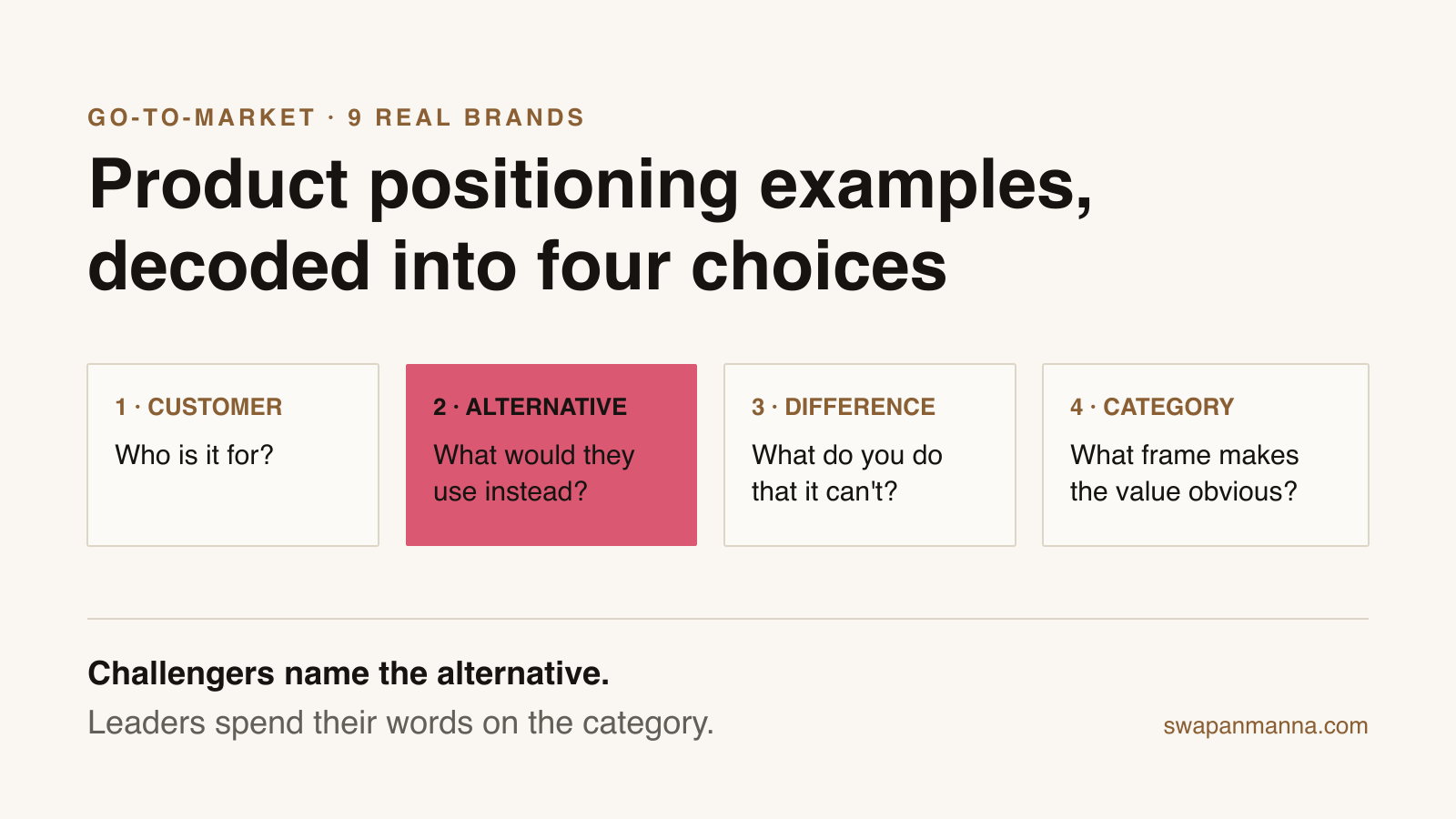
Good product positioning names a customer, the alternative they'd use instead and a concrete difference. Avis, 7-Up and Basecamp name the alternative; HubSpot, Gong and Notion lean on category. Under $25M in revenue, you're the challenger: name what you replace.
Key Takeaways
- Positioning has five parts: the alternative, your unique attributes, the value they create, the customers who care most and the market category. Work through them in that order.
- Challengers such as Avis, 7-Up and Basecamp name the alternative; leaders such as HubSpot, Gong and Notion spend their words on the category.
- A company with $1M–$25M in revenue is usually the challenger, so copy the challengers: name what you replace and how you differ.
- A positioning statement is an internal guide, not a headline. Test it on your homepage, in sales calls and by asking your team to describe the company in one sentence.
In this articleShowHide
Playbooks
Frameworks you can put to work
Growth marketing, LinkedIn presence, and more — delivered as PDFs.
Browse the playbooksProduct positioning is the choice of who your product is for, what buyers compare it with and why it wins that comparison. The fastest way to get yours right is to study product positioning examples where a company made those choices clearly, then copy the method, not the words.
Below are nine real examples, from Avis in the 1960s to Linear today. Each one quotes what the company says in public, breaks it into the parts of positioning, and rewrites it as a one-sentence positioning statement. You also get the template, three weak-to-strong rewrites, the mistakes to avoid and a free tool to draft your own.
Note: companies rarely publish their internal positioning statements, so many example lists simply invent them. Here every quote comes from a public source: the company homepage (checked on 27 November 2026) or, for the older campaigns, the press and archives of the time. The rewritten statements are our reading of that public copy, not the companies' own documents.
What makes a product positioning example worth copying?
A good example makes five choices you can see: a customer, an alternative, a difference, the value of that difference and a market category. April Dunford lists these five components in her quickstart guide to positioning for Lenny's Newsletter, and her book Obviously Awesome builds the whole method on them.
| Part | The question it answers | Weak version | Stronger version (illustrative) |
|---|---|---|---|
| Competitive alternative | What would the buyer do if you didn't exist? | “Other tools” | “Email threads and spreadsheets” |
| Unique attributes | What do you have that the alternative lacks? | “Innovative and easy to use” | “Every approval has an owner and a deadline” |
| Value | What does that difference do for the buyer? | “Saves time” | “Invoices approved in a day, not a week” |
| Best-fit customers | Who cares most about that value? | “Businesses of all sizes” | “Finance teams who chase approvals by email” |
| Market category | What frame makes the value obvious? | “All-in-one platform” | “Accounts-payable tool” |
Start with the alternative. Dunford frames it as a question: “What would a customer do if your offering didn't exist?” The honest answer is often a spreadsheet, an agency, a new hire or doing nothing, not the competitor on your slide.
9 product positioning examples, decoded
Each example uses the same four-line breakdown (customer, alternative, difference, category, with the value folded into the difference), so you can compare them side by side. The first two are classic advertising cases; the other seven are what companies say on their homepages now.
1. Avis: positioning against the leader
What they say: In the early 1960s Avis and its agency, Doyle Dane Bernbach, built ads around being second in car rental: “Avis is only No. 2 in rent-a-cars, so why go with us? We try harder.” That is the wording Al Ries and Jack Trout quoted in their 1972 positioning articles for Advertising Age. TIME reported in 1964 that the line grew from president Robert Townsend's answer when asked how Avis differed from Hertz.
- Customer: people renting a car, who would otherwise default to the market leader.
- Alternative: Hertz, the No. 1, named by implication.
- Difference: effort and service from a company with something to prove.
- Category: car rental, unchanged.
As a positioning statement (our rewrite): “For travellers renting a car, Avis is the rental company that works harder for your business. Unlike the No. 1, it can't afford to take you for granted.”
What to take from it: Ries and Trout's verdict was that “Avis was successful because it related itself to the position of Hertz.” If buyers already know the leader, use the leader as your reference point instead of pretending it doesn't exist.
2. 7-Up: positioning against a whole category
What they say: J. Walter Thompson's “Uncola” ads first appeared in 1968 and cast Coke and Pepsi as the establishment, according to Duke University's Rubenstein Library. Ries and Trout summed it up: “the Un-Cola position establishes Seven-Up as an alternative to a cola drink.”
- Customer: soft-drink buyers, especially younger ones who wanted an alternative.
- Alternative: colas as a whole, not one brand.
- Difference: it isn't a cola. The ads stressed how 7-Up differed from the colas rather than how it resembled them.
- Category: soft drink, framed as the alternative to cola.
As a positioning statement (our rewrite): “For soft-drink buyers who want something other than cola, 7-Up is the soft drink that isn't a cola. Unlike Coke and Pepsi, it stands for the alternative.”
What to take from it: When one type of product dominates a market, you can position against the whole type. The difference doesn't need to be a feature; it can be the category you refuse to join.
3. Basecamp: simplicity for smaller businesses
What they say: Basecamp's homepage calls it “the famously straightforward, easiest-to-use project management platform” and says “most project management systems are bloated, complicated, and confusing.” It names its fit as “especially for small and medium-sized businesses.”
- Customer: small and medium-sized businesses.
- Alternative: “bloated, complicated, and confusing” project management systems.
- Difference: straightforward and easy to use.
- Category: project management, unchanged.
As a positioning statement (our rewrite): “For small and medium-sized businesses that need to run projects without a tool expert, Basecamp is the straightforward project management platform. Unlike bloated, complicated systems, anyone on the team can use it.”
What to take from it: Naming what is wrong with the alternative lets buyers who feel that pain recognise themselves. Simplicity only works as a difference when the alternative really is complex for this customer.
4. Linear: a category built for one kind of team
What they say: Linear's homepage leads with “The product development system for teams and agents” and “Purpose-built for planning and building products. Designed for the AI era.”
- Customer: product teams, from startups to large companies.
- Alternative: general-purpose tools that weren't built for product work (implied by “purpose-built”).
- Difference: made for planning and building products, with AI workflows at its core.
- Category: “product development system”, a narrower frame than project management.
As a positioning statement (our rewrite): “For product teams planning and building software, Linear is a product development system designed for the AI era. Unlike general-purpose tools, it is purpose-built for how product teams plan and ship.”
What to take from it: The category is part of the positioning. “Product development system” tells product teams it was made for them before they read a feature. For the trade-offs of naming your own category, see category creation vs category entry.
5. Calendly: widening the job, keeping the customer
What they say: Calendly's homepage leads with “All the work around meetings, handled” and says it is “built for people whose work runs on meetings.” The subheading runs from AI-powered scheduling to meeting recaps and follow-ups, “with fewer tools and less effort.”
- Customer: people whose work runs on meetings.
- Alternative: several separate tools and manual busywork before and after each meeting.
- Difference: scheduling, recaps and follow-ups in one place.
- Category: scheduling, widened to “the work around meetings”.
As a positioning statement (our rewrite): “For people whose work runs on meetings, Calendly handles the work around them, from scheduling to recaps and follow-ups. Unlike stitching several tools together, it covers the whole meeting in one place.”
What to take from it: The headline reaches beyond booking a slot, but the customer stays the same. If you widen what you do, keep the customer fixed so buyers can still see why the new scope belongs to you.
6. Superhuman: a superlative as the difference
What they say: Superhuman's homepage leads with “Superpowers, everywhere you work” and “Mail, Docs, and AI that works in every app and tab”, and calls its mail product “the most productive email app ever made.”
- Customer: people who spend their day in email and many other tools, with a separate enterprise offer.
- Alternative: the default email app and switching between tabs and tools (a customer quote on the page describes “bouncing between tabs and tools”).
- Difference: a productivity claim.
- Category: email app, widened to mail, docs and AI.
As a positioning statement (our rewrite): “For people whose day runs through email, Superhuman is an email app built to make you faster, with AI that works in every app and tab. Unlike default email, it is designed for speed.”
What to take from it: A superlative is a claim, not proof. It can work when the product proves it on first use. For most companies, a concrete attribute that explains the benefit is more convincing than “the most”.
7. HubSpot: one platform instead of disconnected tools
What they say: HubSpot's homepage leads with “Build demand, win deals, and delight customers — all on one platform” and says HubSpot “aligns marketing, sales, and service around your customer data.” It names the problem as “Disconnected tools and data slow you down.”
- Customer: marketing, sales and service teams, with separate paths for small businesses and startups and for enterprises.
- Alternative: “disconnected tools and data”.
- Difference: one platform on shared customer data.
- Category: a platform across marketing, sales and service.
As a positioning statement (our rewrite): “For marketing, sales and service teams working from separate tools, HubSpot is one platform built on shared customer data. Unlike disconnected tools, every team and your AI see the same customer record.”
What to take from it: The alternative here isn't a competitor; it's the mess the buyer already has. That framing suits a known brand. For a smaller company, “all-in-one platform” is a weak claim unless buyers already trust you, so name a narrower customer and difference first.
Put this into practice
The GTM Funnel Playbook
How B2B teams find, win and keep customers, with a 90-day action plan. Seven funnel stages, one owner each, from the revenue number to the clients you keep.
8. Gong: claiming a category name
What they say: Gong's homepage leads with “More wins, less work” and “Revenue AI knows your business”, explaining that it “learns from every call, email and meeting.” It says it is “built for the whole go-to-market team”, “from execs to RevOps to frontline reps.”
- Customer: the whole go-to-market team.
- Alternative: not named on the page.
- Difference: learns from every call, email and meeting, with AI agents that work alongside reps.
- Category: “Revenue AI”, a category name it uses as its own.
As a positioning statement (our rewrite): “For go-to-market teams, from executives to frontline reps, Gong is a revenue AI platform that learns from every call, email and meeting so each deal makes the next one smarter.”
What to take from it: A named category works when you can afford to teach it. The page names no alternative, which a market leader can get away with. A smaller company that leaves the alternative blank lets the buyer fill it in, often with the cheapest option.
9. Notion: tying an existing strength to a new trend
What they say: Notion's homepage leads with “A shared brain for your team and agents” and “Notion turns your team's knowledge into the context your AI is missing.”
- Customer: teams that use AI agents.
- Alternative: AI tools without your team's context (implied by “the context your AI is missing”).
- Difference: the team's knowledge already lives in Notion, so it can feed AI.
- Category: workspace, reframed as “a shared brain”.
As a positioning statement (our rewrite): “For teams putting AI agents to work, Notion is a shared workspace that turns your team's knowledge into context for AI. Unlike AI tools that start from nothing, it already knows how your team works.”
What to take from it: Notion links what it already does well, holding team knowledge, to a trend buyers care about now. Dunford's book covers using market trends in positioning; this is what it looks like on a homepage.
What do these 9 examples have in common?
The challengers name the alternative; the leaders spend their words on the category. Here is the same breakdown for all nine, based on the quotes above.
| Brand | Customer named? | Alternative named? | Concrete difference | Category move |
|---|---|---|---|---|
| Avis | Implied | Yes (the No. 1) | Tries harder | Kept |
| 7-Up | Implied | Yes (colas) | Not a cola | Defined against a category |
| Basecamp | Yes (small and medium-sized businesses) | Yes (bloated systems) | Straightforward | Kept |
| Linear | Yes (product teams) | Implied | Purpose-built for product work | Narrowed |
| Calendly | Yes (people whose work runs on meetings) | Partly (more tools, more effort) | Scheduling to follow-up in one place | Widened |
| Superhuman | Partly | Partly (in a customer quote) | “Most productive” (a claim) | Widened |
| HubSpot | Partly (by company size) | Yes (disconnected tools) | One platform, shared data | Platform |
| Gong | Yes (whole GTM team) | No | Learns from every interaction | Named its own (“Revenue AI”) |
| Notion | Partly | Implied | Team knowledge as AI context | Reframed (“shared brain”) |
Three patterns stand out:
- Challengers name the alternative. Avis, 7-Up and Basecamp tell you exactly what they are not. That gives the buyer a comparison to make.
- Leaders invest in the category. HubSpot, Gong and Notion talk about platforms, categories and trends, and rarely name a rival. They can, because buyers already know them.
- Nobody says “everyone”. Even the biggest brands name a customer or a job: product teams, people whose work runs on meetings, the whole go-to-market team.
The lesson for a $1M–$25M company: if your company has $1M–$25M in revenue, you are almost always the challenger in your buyer's mind. Copy Avis and Basecamp, not HubSpot. A category-only headline works for brands buyers already know. For everyone else, it leaves the buyer guessing what you replace.
How do you write your own product positioning statement?
Work through the five parts in Dunford's order, alternatives first and category last, then put your answers into the template. Here is the template most teams use, a common form of the one Geoffrey Moore popularised in Crossing the Chasm (1991):
For [target customer] who [need], [product] is a [market category] that [key benefit]. Unlike [main alternative], it [key difference].
Do this with the founder, whoever leads sales and whoever leads product in the same room. Pull the alternatives from recent won and lost deals, not from your competitor slide. To show the method, here is a running example for a hypothetical company that sells shipment-tracking software to manufacturers.
- List the alternatives. What would buyers do if you didn't exist? For example: spreadsheets, the ERP, and a coordinator phoning carriers.
- Find your unique attributes. What do you have that those lack? For example: it reads carrier data directly, so nobody re-keys updates.
- Turn them into value. What does that do for the buyer? For example: the team sees a delay before the customer calls to ask.
- Pick the best-fit customers. Who cares most about that value? For example: logistics teams at mid-size manufacturers that ship with many carriers. If you haven't defined this yet, start with how to define your ideal customer profile or the free Ideal Customer Profile Generator.
- Choose the category last. Which frame makes the value obvious to that customer? For example: shipment-tracking software, not a “supply chain platform”.
Put together: “For logistics teams at mid-size manufacturers who track shipments across many carriers, [Product] is shipment-tracking software that shows delays before your customer calls. Unlike spreadsheets and phone calls to carriers, it reads carrier data directly, so nobody re-keys an update.”
Pro tip: use the free Positioning Statement Generator to do this in about two minutes. Enter what you sell, what buyers use instead, what only you can do, who gets the most value and any proof you have. It returns a positioning statement, a one-liner and the five-part positioning canvas. Add your name and email to also see three homepage headline options and a list of weak spots. Where a claim needs proof, it tells you what evidence to gather instead of inventing a number.
What does a weak positioning statement look like, and how do you fix it?
A weak statement could describe any company; a strong one could only describe yours. The three rewrites below are illustrative: the companies are invented, so you can see the fix without judging a real brand.
| Weak | What's wrong | Stronger |
|---|---|---|
| “For businesses of all sizes, Acme is an innovative all-in-one platform that drives growth.” | No customer, no alternative, and adjectives in place of a difference. | “For agencies that price projects in spreadsheets, Acme is quoting software that turns a scope into a priced proposal in one sitting. Unlike spreadsheets, every price draws on your past project costs.” |
| “We help companies succeed with best-in-class consulting.” | The category and the claim fit any firm. “Best-in-class” can't be checked. | “For companies whose sales stalled when the founder stopped selling, Fieldwork is a sales consultancy that builds a process a first sales hire can run. Unlike a one-day training, it leaves the playbook behind.” |
| “The leading CRM for modern teams.” | “Leading” is unproven and “modern teams” isn't a customer. | “For letting agents who track tenants in shared inboxes, Keyhold is a CRM built for lettings. Unlike general CRMs, it comes set up for viewings, tenancies and renewals.” |
Which positioning mistakes should you avoid?
Most weak positioning comes from avoiding a choice. These are the ones to watch for:
- Everyone as the customer. “Businesses of all sizes” means no one feels it was written for them.
- The wrong alternative. Comparing yourself with a competitor buyers never shortlist, while ignoring the spreadsheet or the decision to do nothing. Dunford notes that many deals are lost to “no decision” (Lenny's Newsletter summary, 2024).
- Adjectives instead of attributes. Innovative, seamless, best-in-class. Name the thing you do that the alternative doesn't.
- Choosing the category first. The category should make your value obvious, so it comes after you know the value.
- Publishing the statement as your headline. A positioning statement is an internal guide. Your homepage, pitch and ads are written from it, in the buyer's words.
- Copying a leader's play. A platform or new-category message works for HubSpot or Gong because buyers already know them. A challenger needs the comparison.
How do you know your positioning works?
Test it where buyers meet it: your homepage, your sales calls and your own team.
- Homepage: can a new visitor say what you do, who it's for and why you in about ten seconds? The free Homepage Clarity Check reads your live homepage against a 12-point checklist and suggests a fix for each gap.
- Sales calls: do prospects repeat your difference back to you, or keep asking how you differ from the alternative? The second means the positioning hasn't landed.
- Your team: ask people in sales, marketing and customer success to describe the company in one sentence. If the answers differ, sales and marketing aren't aligned on the positioning yet.
- When the alternative changes: a new competitor, a cheaper option or an AI tool that does part of the job changes what buyers compare you with. Revisit the five parts then.
Positioning is the first decision in a go-to-market plan. Your ideal customer, messaging, channels and sales process all depend on it, which is why it sits next to finding product-market fit and comes before a go-to-market launch plan.
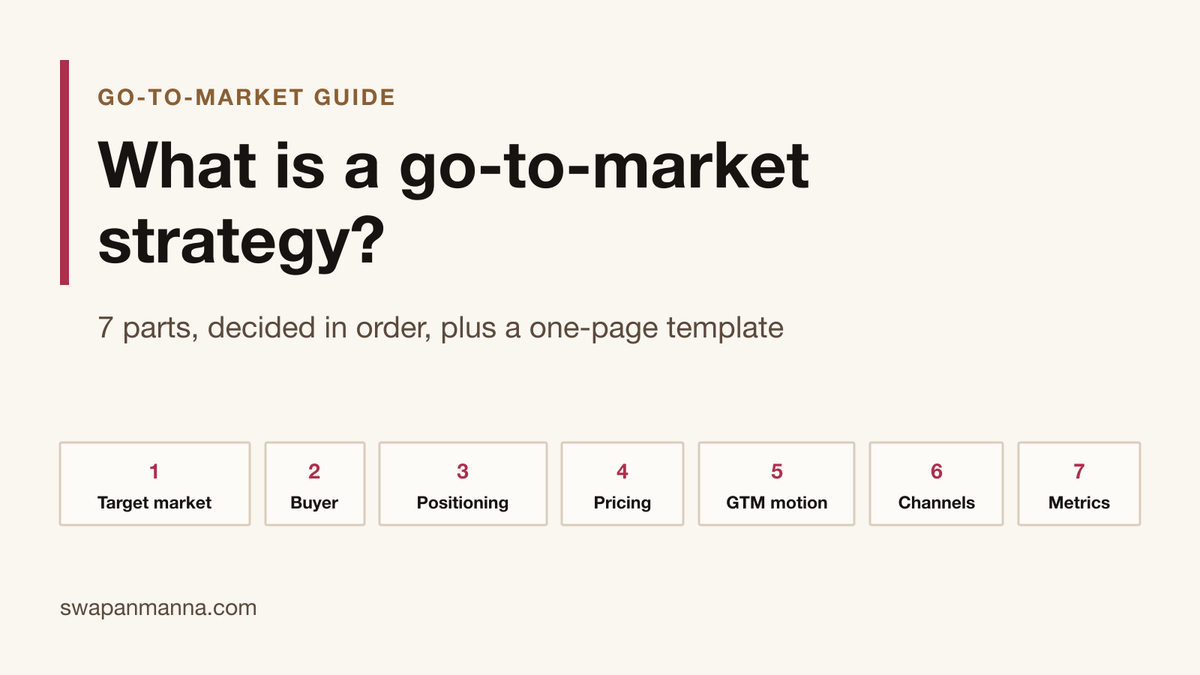
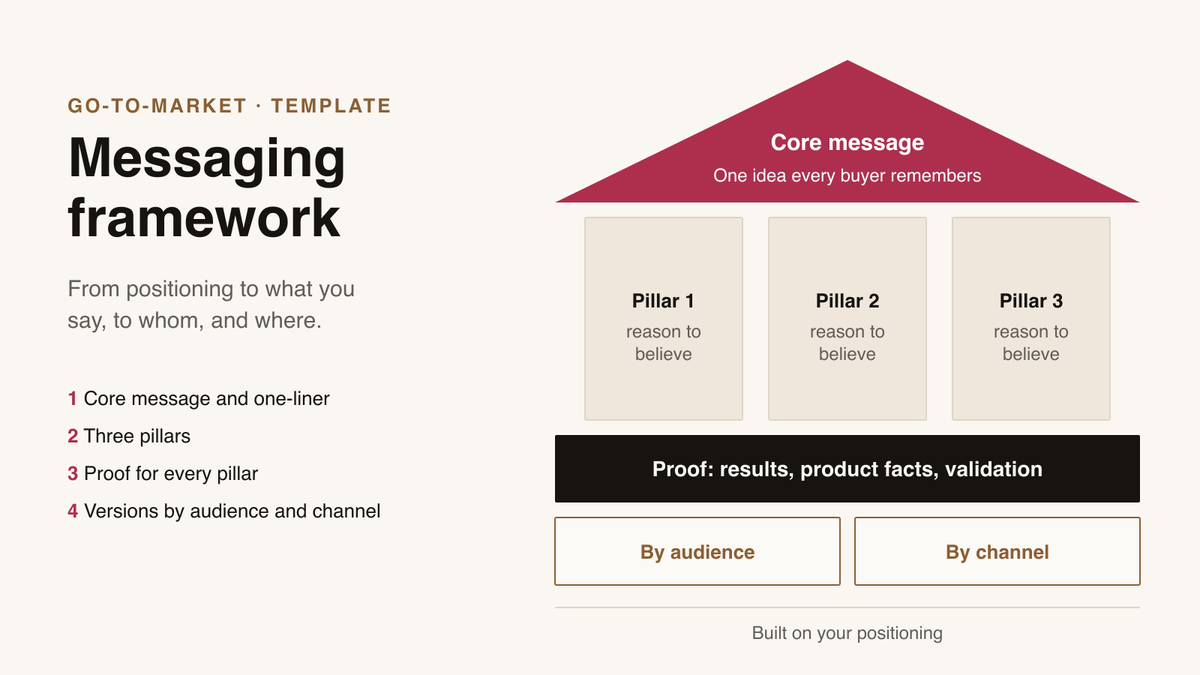
Once your positioning is set, turn it into what you say to each buyer with a messaging framework. Positioning is part 3 of a full go-to-market strategy, after your target market and buyer.
Want positioning your whole go-to-market runs on?
The 90-Day GTM Build fixes who you target, what you say and where buyers find you, starting with customer interviews, your ideal customer profile and positioning, then hands it all to your team. It starts with a free GTM call.
Put this into practice
The GTM Funnel Playbook
How B2B teams find, win and keep customers, with a 90-day action plan. Seven funnel stages, one owner each, from the revenue number to the clients you keep.
Frequently Asked Questions
What is the difference between product positioning and brand positioning?
What is the difference between positioning and messaging?
Is a positioning statement the same as a tagline?
How long should a positioning statement be?
How often should you revisit your positioning?
What are the main types of product positioning?
Do these examples work for service businesses?

Swapan Kumar Manna is a go-to-market and AI search strategist and Founder & CEO of Oneskai. He has spent 14+ years helping companies get found, get chosen and grow.