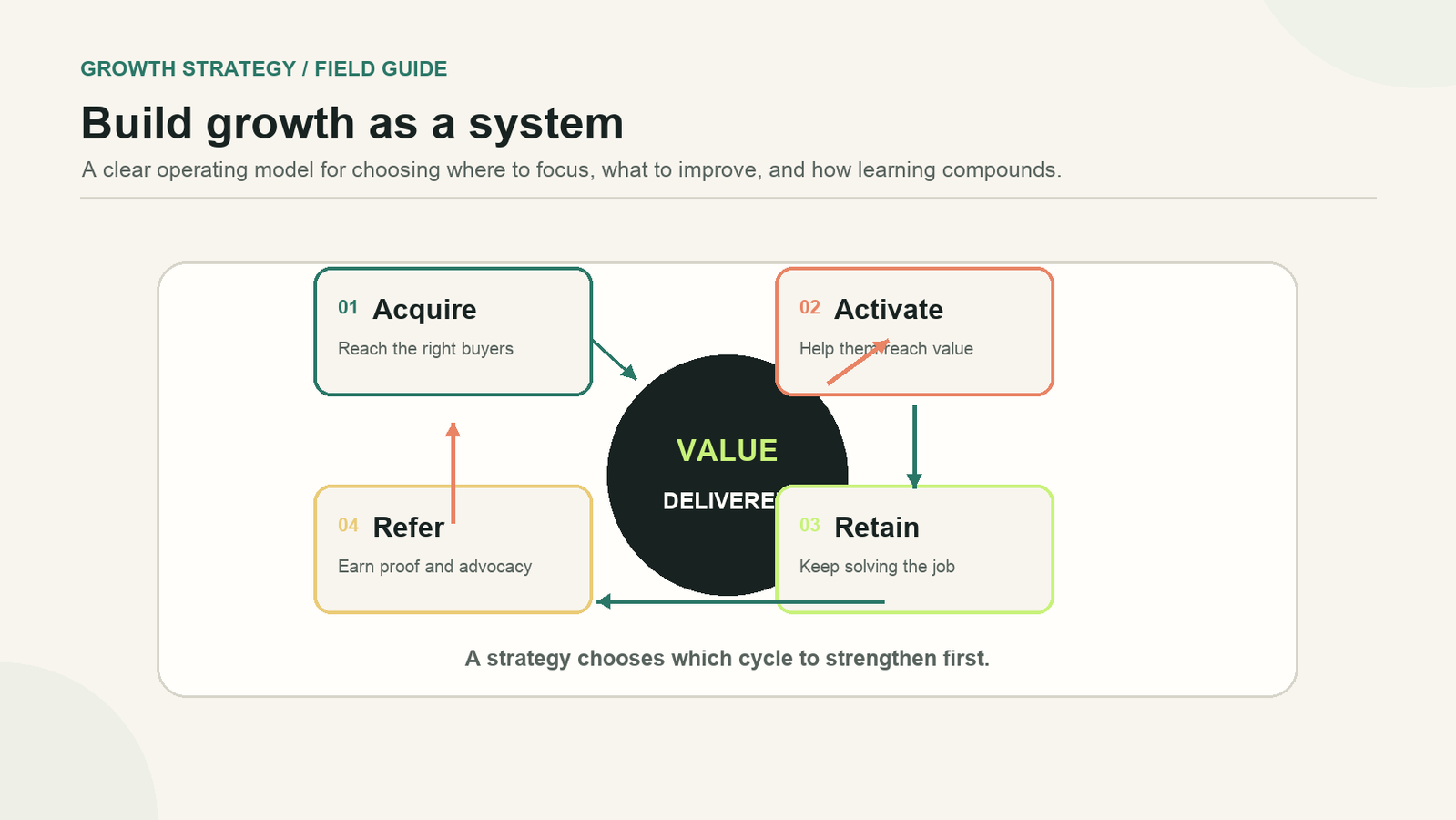
A growth strategy connects a chosen customer and valuable outcome to a way to reach, retain, and learn from that customer. Map the system, identify its current constraint, and test a focused improvement before adding more tactics.
Key Takeaways
- A goal states a desired result; a strategy makes choices about customer, value, distribution, and learning.
- Growth compounds only when a repeatable outcome improves a future input or customer result; loops are not automatic.
- Review acquisition, activation, retention, expansion, economics, and learning together.
- Choose channels by buyer fit, cost, trust, time to learn, control, and dependency rather than copying another company's mix.
- AI can support work inside a growth system, but adoption alone is not a strategy and more content is not automatically more value.
Playbooks
Frameworks you can put to work
Growth marketing, LinkedIn presence, and more — delivered as PDFs.
Browse the playbooksA growth plan can look busy and still leave the business stuck. New campaigns launch, tools get added, and channel reports fill up, but the same customer bottleneck remains. A useful growth strategy gives the team a better answer to a different question: which connected part of the customer and business system should improve next?
A growth strategy is a set of choices about the customer, the value you deliver, the way buyers reach that value, and the evidence you will use to learn. The tactics are the actions that carry out those choices. A growth system connects acquisition, activation, retention, economics, and learning so that today’s work can improve tomorrow’s performance. This guide shows how to build one without assuming that every company needs a viral loop, a new channel, or more content.
The practical goal is not to make every activity compound. It is to identify a repeatable source of customer value, remove the constraint that limits it, and reinvest in the parts that can continue to produce useful outcomes. The model below is a way to organize that work, not a validated formula or a promise of a particular growth rate.
What a growth strategy is, and what it is not
A growth strategy is not a revenue target by itself. “Grow 30%” states an ambition. It does not explain which customer problem, market, offer, distribution path, or retention behavior is expected to make that outcome possible. Nor is a strategy a calendar of campaigns. A calendar helps coordinate activity, while strategy decides which activity matters and why.
The distinction is practical. If a company believes its main constraint is that qualified buyers do not understand the offer, publishing more top-of-funnel content may increase attention without improving conversion. If buyers understand the offer but fail to reach value after purchase, an acquisition campaign can make the retention problem more expensive. A strategy connects the diagnosis to a choice, then connects that choice to a measure.
HubSpot’s broad growth-strategy coverage and Semrush’s current marketing-strategy guide both organize the subject around customer, market, channels, and execution. That is useful for orienting a reader. The additional step I recommend is to make the constraint explicit: which point in the path from buyer need to repeatable value is currently limiting the business, and what evidence would change your mind?
Before choosing a response, write down what is known about the customer and what is still an assumption. Existing sales conversations, implementation requests, support issues, renewals, and lost opportunities can reveal patterns. They can also reflect the experience of only a narrow group. State who the evidence represents and compare it with other sources before treating one loud request as the market’s primary need.
This is why different companies can have different growth strategies even when they sell similar products. Their customer access, delivery model, competitive position, cash constraints, risk tolerance, and team capability can differ. A strategy should make those trade-offs visible so people can understand what the business is choosing to prioritize and what it is willing to defer.
A practical model: customer, promise, motion, value, economics, learning
I use six questions to turn a growth ambition into an operating model. They are a practical planning lens, not a proprietary or industry-standard framework. The questions should connect. If one answer contradicts another, the strategy needs work before the team adds more activity.
- Customer: Which specific buyer or user has a costly, urgent problem you can solve well?
- Promise: What outcome do you help that customer reach, and what proof supports the promise?
- Motion: How does the right customer discover, evaluate, buy, and begin using the offer?
- Value: What needs to happen for the customer to experience a useful result and want to continue?
- Economics: Which costs, margins, payback periods, retention patterns, or capacity limits shape viable growth?
- Learning: What signal will tell you whether the chosen approach is working, and what decision follows?
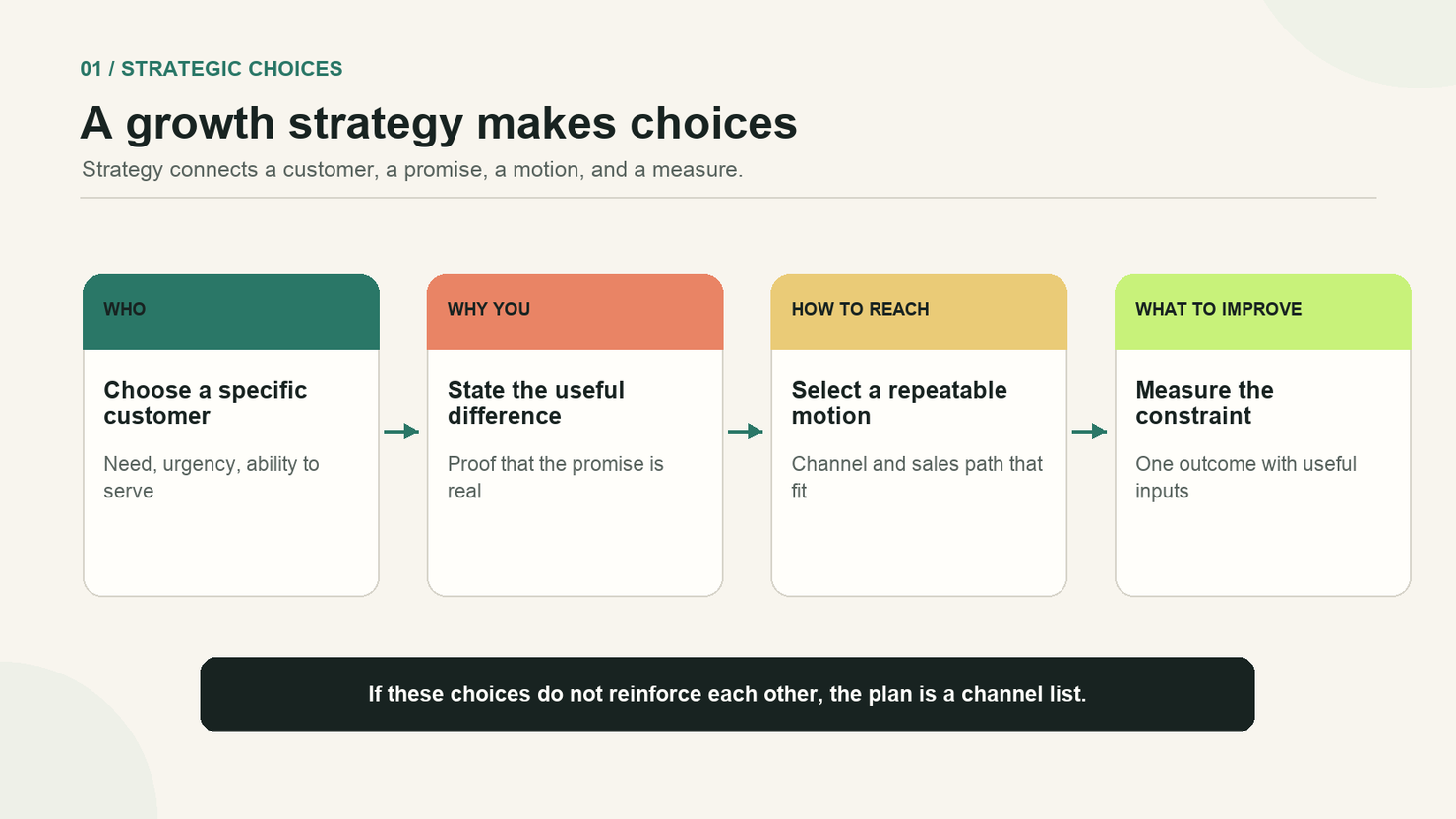
The six questions help stop strategy conversations from collapsing into channel selection. A company may choose to invest in search, partnerships, outbound, product-led onboarding, or a sales team. Those are not interchangeable options. Their value depends on buyer behavior, the time to reach meaningful results, the cost to serve, the proof available, and the team's ability to execute.
A loop should name the mechanism in plain language. “Content drives growth” is too vague. A more useful hypothesis might be: an original, reliable guide helps a buyer solve a problem; the buyer shares it with a colleague; that colleague visits a relevant service page; and the team learns which questions still block evaluation. Each step can fail, so the loop needs evidence at each point and a way to improve the result.
Avoid reporting a theoretical loop as if it were already operating. Mark the expected links as hypotheses, then check actual behavior: did customers invite others, did referrals arrive, did a content asset assist real conversations, did repeat usage correlate with renewal? Correlation may help identify where to investigate, but it does not establish what caused the outcome.
Growth compounds when customer value creates a next step
Compounding growth is often used to describe any improvement that lasts. A more useful test is whether the outcome of one cycle can improve the inputs or success of the next cycle. A returning customer may expand usage. A customer who reaches a visible result may refer a peer. A useful product insight may improve onboarding for later customers. A strong piece of original research may be reused in sales conversations and cited by other sources.
These are possible mechanisms, not automatic loops. A referral program does not create a referral loop if customers have little reason or opportunity to recommend the product. A content calendar does not create compounding distribution if each article reaches the same small audience once and never informs another useful asset. A product sign-up loop can fail if new users do not reach value or if the product is bought by one person and used by no one else.
The core test is: what action or result from this customer creates a plausible next unit of qualified reach, value, retention, or learning? Then ask whether the team can observe that mechanism and improve it without degrading the experience. This is consistent with the systems view in Andrew Chen’s account of growth as a system, while the specific loop depends on the product and market.
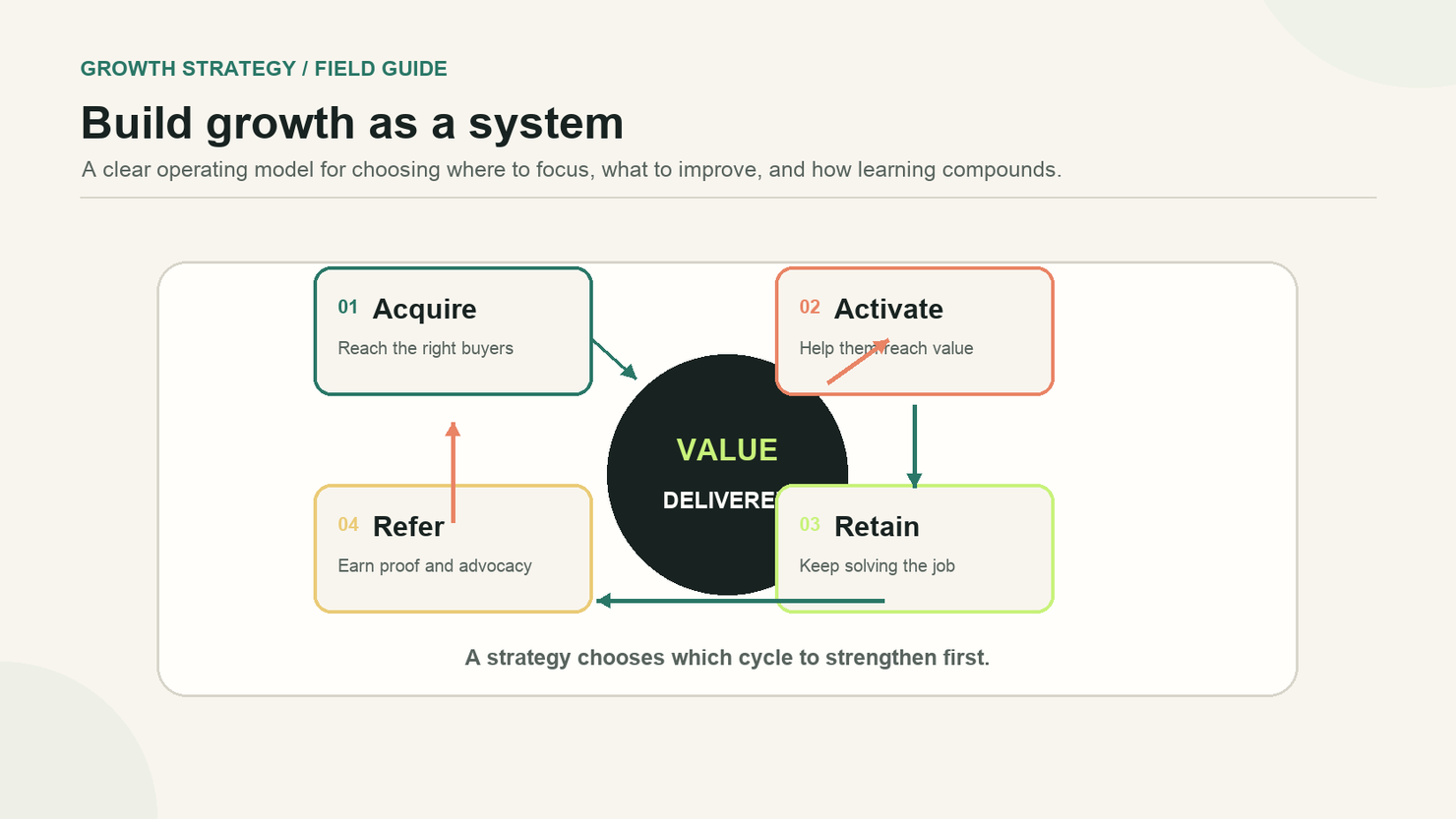
A funnel and a loop describe different things. A funnel helps a team inspect where people progress or drop out during a buying journey. A loop asks whether an outcome creates a new input that can repeat. Most businesses need both views: the funnel to find friction and the loop to understand whether a successful customer or activity can help produce the next one.
Start with the customer path before choosing a growth channel
Map the path from a buyer’s first useful problem signal to repeated value. Do not begin by copying another company’s channel mix. The same channel can behave differently across markets, price points, sales cycles, and degrees of buyer urgency. The path also differs after purchase: onboarding, adoption, support, expansion, and renewal may be where the strongest growth opportunity sits.
Use the stages as a diagnostic, not as a rigid linear journey. B2B buying groups revisit questions, involve new stakeholders, and move between colleagues, vendors, search, communities, and sales conversations. The site’s Future of Search guide explores the changing discovery path; the important point for a growth plan is to connect discovery to what happens after a buyer arrives.
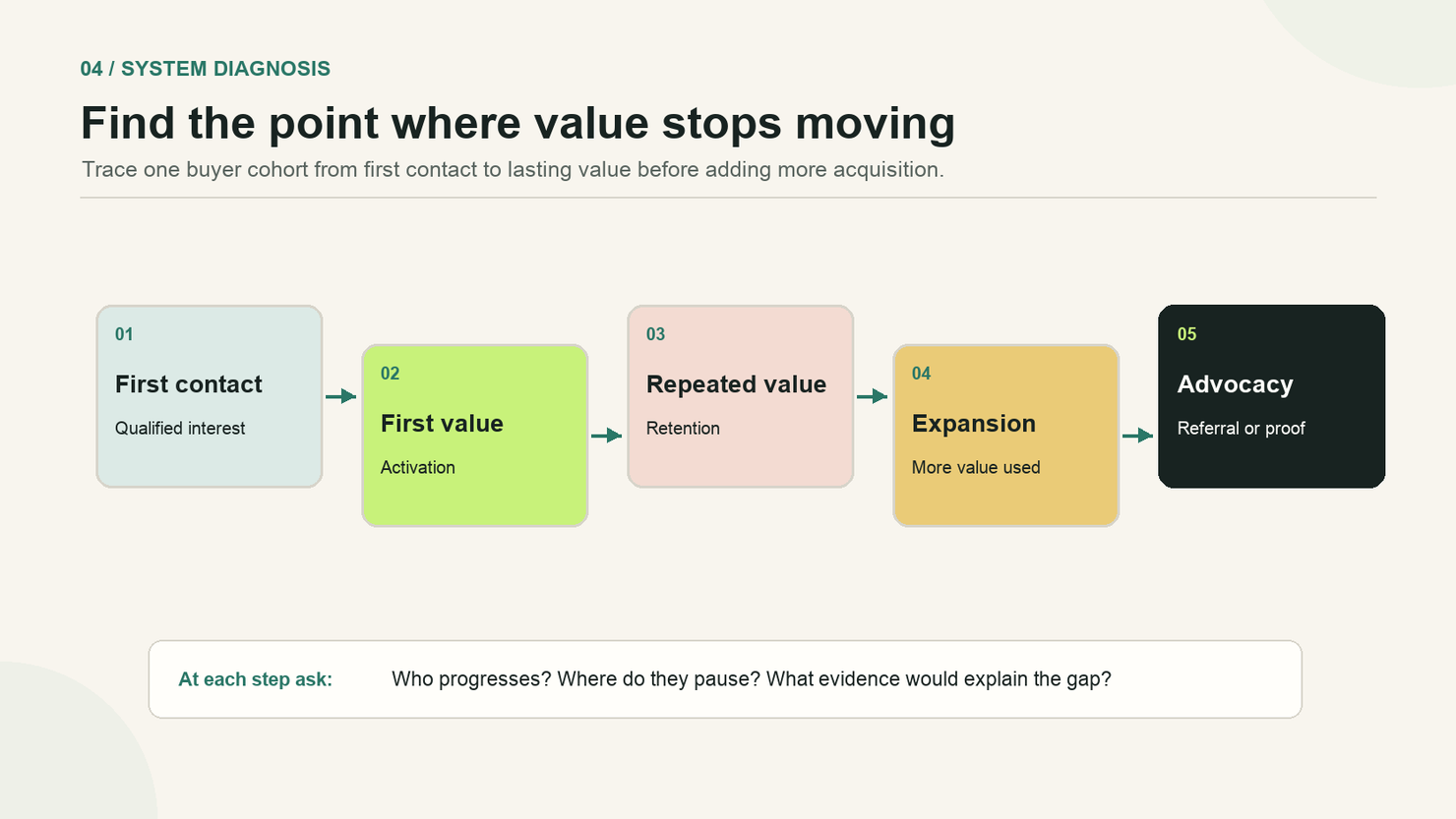
For each stage, write down the evidence you have, the evidence you lack, and one likely obstacle. A low conversion rate can reflect weak fit, unclear positioning, poor timing, a trust gap, a difficult buying process, or a broken page. It does not automatically mean the answer is to buy more traffic. Pair quantitative signals with sales and customer conversations so the team knows what to investigate.
Organic growth is not synonymous with free growth. Search, content, community, partnerships, referrals, and product education require time, people, quality control, and maintenance. Their economics may improve as useful assets and relationships accumulate, but that outcome depends on continued relevance and distribution. A neglected page or inactive community does not compound simply because the company created it once.
Paid investment can complement organic work. It can help reach a defined audience, test a message, or support a launch while slower channels develop. Review the roles together: paid can amplify a strong proof point; customer research can improve positioning; useful content can help a buyer who arrived through a partner or sales conversation. Semrush’s 2026 marketing strategy guide also covers the changing mix of owned, earned, and paid influence, but every company's choice should follow its own evidence.
Treat trust as part of the distribution economics. In B2B, a buyer may need to explain the choice to colleagues, verify claims, evaluate implementation risk, and gain approval. Clear proof, accurate product information, relevant customer examples, independent references, and a reliable buying experience reduce uncertainty. These signals do not guarantee a purchase, but they can help a buyer assess whether the promise is credible.
Trust is earned through what the company does as well as what it publishes. A polished case study cannot compensate for a confusing onboarding process or an unsupported claim. Collect permission-based proof, define where an example applies, and keep product, sales, support, and website descriptions aligned. If a company has limited evidence, explain its capabilities precisely instead of implying a track record it cannot substantiate.
Choose a distribution mix with the trade-offs visible
Every distribution path involves trade-offs in speed, cost, control, trust, reach, and accumulated learning. Paid media can be useful when you need a fast, measurable test or need to reach a defined audience. Search can answer existing demand and build durable discovery, but it depends on relevant content, technical access, competition, and time. Partnerships can transfer trust and access, but require mutual value and coordination. Email and community can deepen direct relationships, but only when people have a reason to stay engaged.
Owned, earned, and rented are useful shorthand categories, not a financial accounting standard. A company's email list may be directly reachable yet still depend on a platform and permission rules. Organic social distribution can be earned but constrained by platform algorithms. Search is not fully owned even when the content lives on your domain. Treat control as a spectrum and record the dependencies that matter.
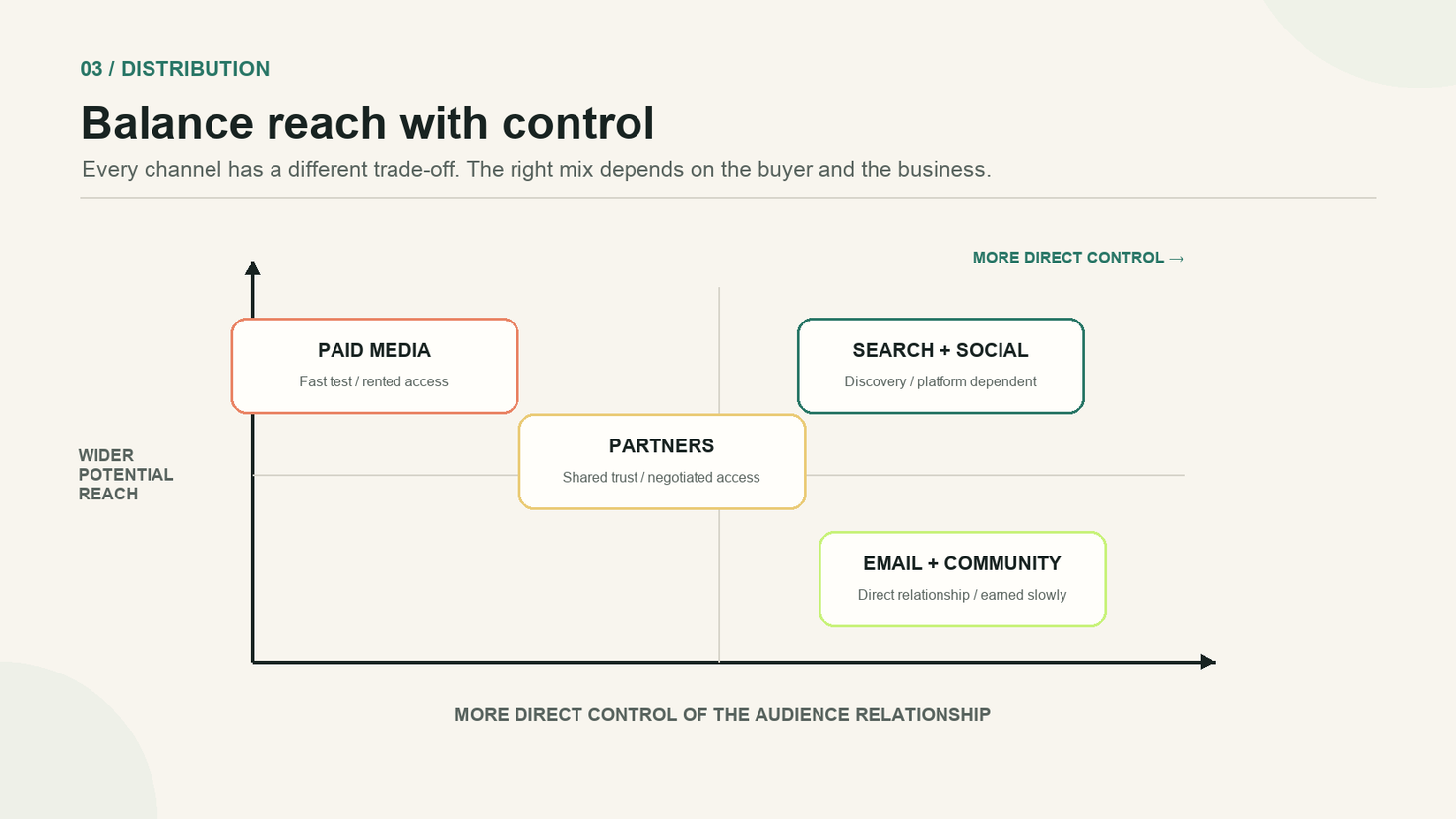
A balanced plan does not mean giving every channel equal budget. It means understanding where each activity contributes and what risk grows when the business relies on it. If one source supplies most qualified demand, the plan should describe a credible backup or a way to reduce dependency. If the team cannot yet demonstrate that a channel reaches the right buyer, keep the investment proportional to the evidence.
For a company investing in discovery, the modern SEO strategy and GEO guide explain the search foundations and AI visibility work in more depth. Google’s current guidance says its generative Search features still depend on Search foundations and encourages original, useful content; it does not offer a separate optimization trick or a guarantee of selection. Use that guidance to support a distribution decision, not to turn search into the whole growth strategy.
Retention and economics belong in the growth plan
Acquisition is visible because campaigns produce immediate activity. Retention can be less visible, but it changes how much value the company keeps from the customers it has already won. If customers leave quickly, expansion is rare, or support demands rise faster than revenue, a larger acquisition budget can conceal rather than repair the underlying problem.
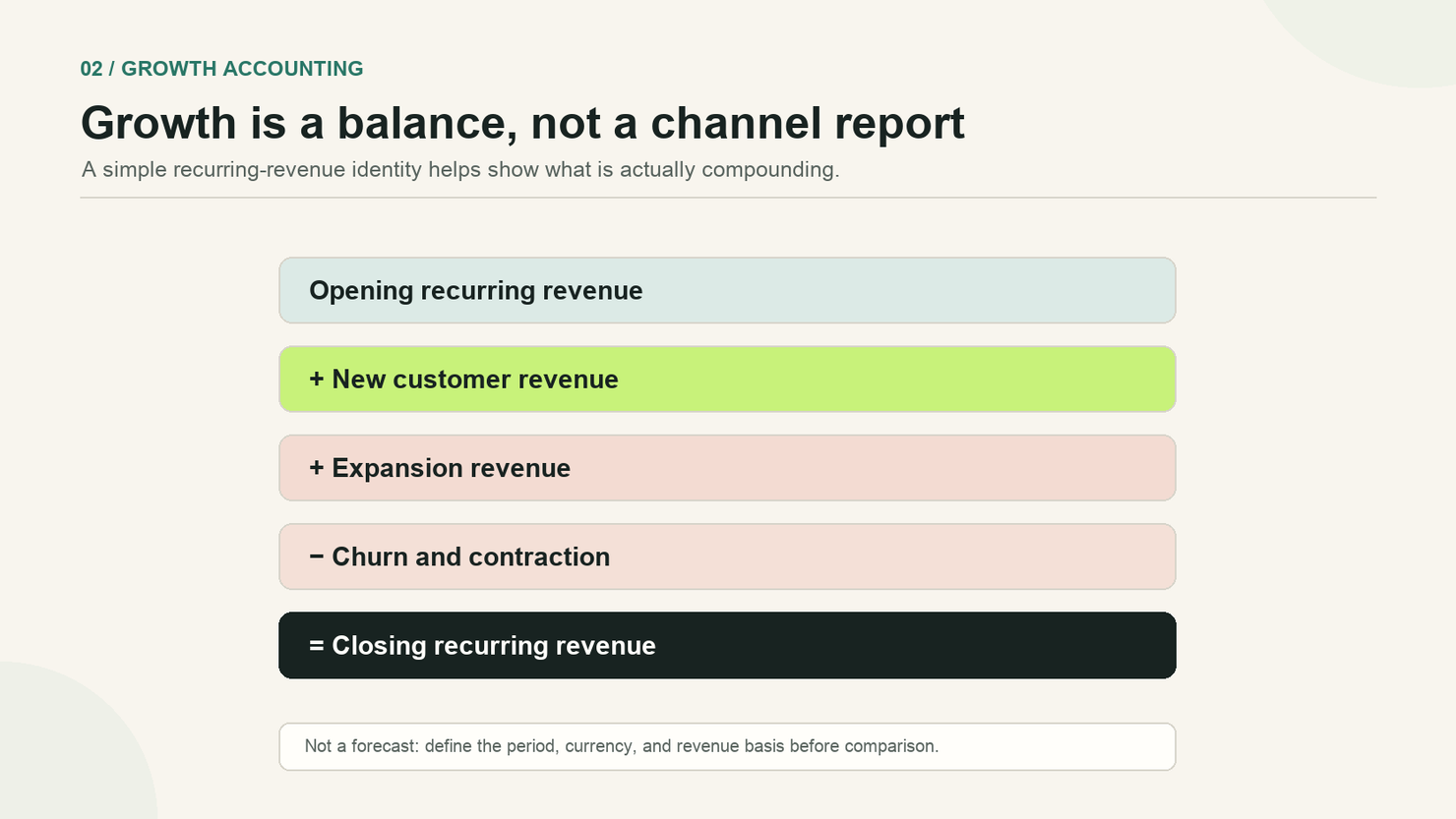
For recurring-revenue businesses, net revenue retention is one useful view of revenue kept and expanded from a starting customer group over a period. A common calculation begins with recurring revenue from that cohort, adds expansion, and subtracts contraction and churn, then divides by the cohort’s starting recurring revenue. Define the cohort, period, exclusions, and treatment of new customers before comparing it with another report. The measure is not a substitute for customer outcomes or profitability.
Retention work should begin with the reasons customers stay, reduce usage, or leave. Look at time to first value, activation by role, adoption of the intended use case, renewal risks, support themes, and expansion patterns. Ask customers what changed in their work, not simply whether they are satisfied. Any conclusion from a small set of interviews should be reported as qualitative evidence rather than a market-wide rate.
Growth accounting helps a team see where gains and losses came from. The graphic uses a simple recurring-revenue identity; it is not a forecast or a claim that the components are equally controllable. Companies with usage-based, transactional, services, or project revenue need definitions appropriate to their business model.
Use experiments to reduce a named uncertainty
An experiment is not just a small campaign. It is a way to learn whether a meaningful change affects a defined outcome for a defined audience. State the constraint, the proposed change, the signal you expect to observe, the time or sample limits, and the decision that follows. If the team cannot say what it would do after either result, the experiment may not be worth running.
Prioritize tests by expected value, cost, confidence, and risk, but do not let a score pretend that uncertain inputs are precise. A simple priority discussion can distinguish tests that could unlock a major constraint from easy optimizations with limited upside. Record why the test was selected, what changed during execution, what the result can and cannot establish, and whether the team will repeat, adapt, or stop.
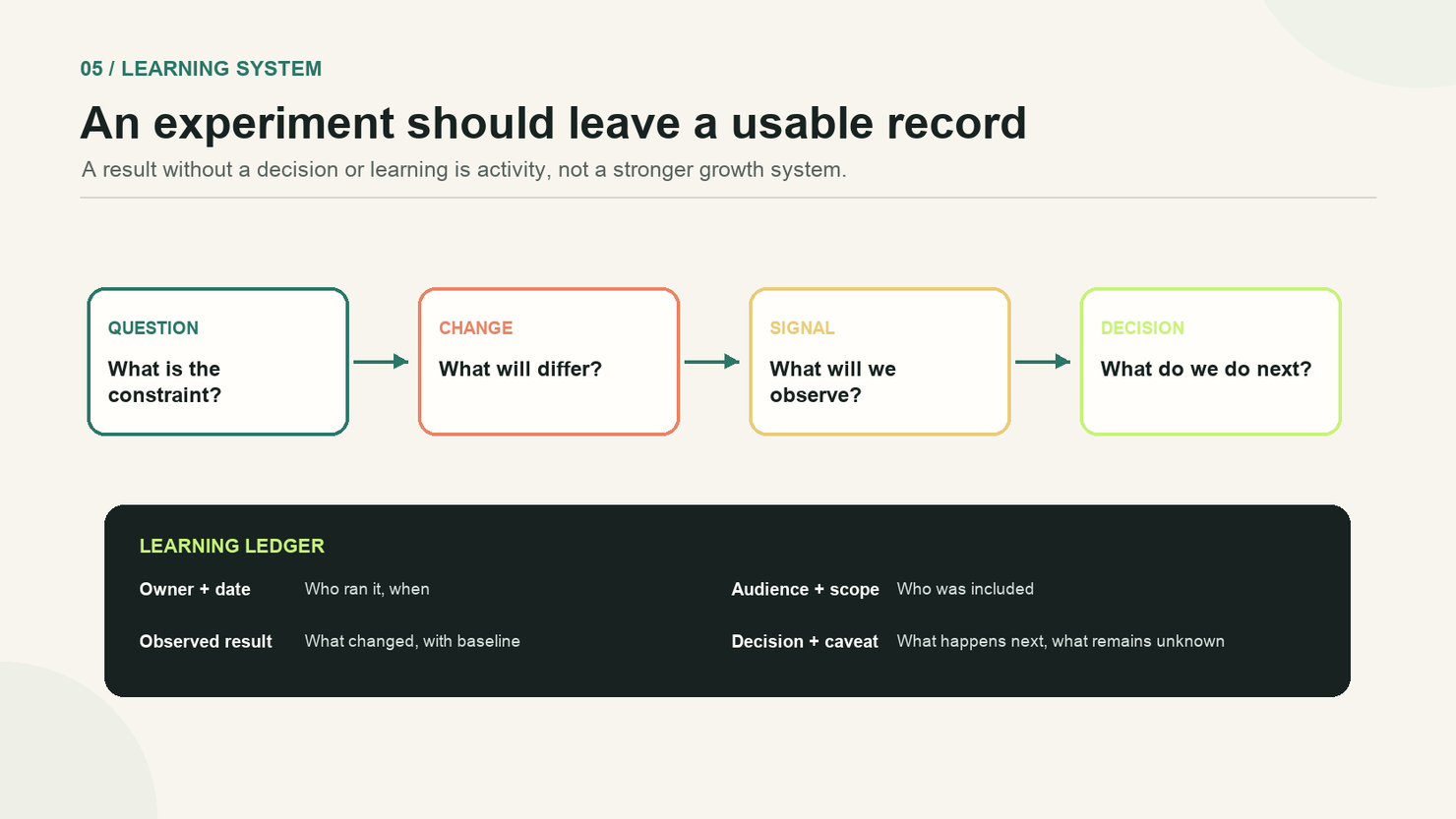
For low-volume B2B programs, a short test may not have enough observations to separate a real effect from noise. Combine quantitative signals with qualitative evidence and label conclusions accordingly. Do not call a directional result statistically significant without an appropriate design and analysis. The purpose is better decisions, not a steady stream of green check marks.
Choose a growth motion that matches how buyers buy
Product-led growth, sales-led growth, and content-led growth are ways to describe where a business places an important part of its acquisition and value delivery. They are not exclusive identities. A product-led motion can still need sales for complex accounts. A sales-led business can build a useful self-serve experience. Content may create awareness and help buyers evaluate, while a direct sales process handles risk and coordination.
Choose the motion by looking at the buyer’s need, product complexity, implementation burden, contract value, buying group, and time to value. If the buyer can understand and experience the product with limited help, self-serve routes may lower friction. If deployment, compliance, integration, or stakeholder coordination is substantial, human guidance may be central to the value. If buyers research independently before a conversation, helpful content and credible third-party proof can support both routes.
A hybrid approach has a cost: the product, marketing, sales, and customer success teams must agree on who owns each transition. A free trial can disappoint if no one helps a high-intent account configure it. A sales team can overwhelm a small buyer who wants to explore alone. Treat handoffs as part of the product and growth experience, then measure whether people actually progress.
Google’s guide to generative AI features in Search recommends creating original, useful content and maintaining search fundamentals, while warning against making pages for every possible query variation primarily to influence results. For a growth team, this means content should answer a real customer need and add evidence or a point of view. Volume is an input cost, not proof of audience value.
What changes in the AI era
AI changes parts of how people research, compare, and complete work. It can also lower the cost of producing drafts, assets, and prototypes. That makes it easier to publish more and easier to create material that looks complete while adding little. More output alone does not create a stronger position. The strategic response is to protect the parts of the experience that are hard to copy: a real understanding of a buyer problem, trusted evidence, a useful product experience, reliable service, and distribution that reaches the right people.
Search is one example. Google says its AI Search experiences are built on existing search systems and highlights unique, valuable, non-commodity content as a priority. That supports investing in technical accessibility, original evidence, and good visitor experience. It does not support making dozens of near-duplicate pages for question variations, and it does not guarantee that any page will be indexed or cited. The measurement guide describes ways to track what platforms report while keeping those signals separate from demand and revenue.
AI tools may help a team research, analyze, draft, summarize, and automate repeatable work. Decide where assistance improves quality or speed, where a human must review judgment and customer context, and what data should not be entered into a tool. Treat AI as a capability within the operating system, not as a growth strategy by itself. The choice depends on the work, risk, and ability to verify the output.
Diagnose a stall before adding another channel
When growth slows, compare the current state with the assumptions behind the strategy. Is the target market still reachable? Has the value proposition become unclear or less differentiated? Are qualified opportunities arriving but not converting? Do new customers fail to activate or renew? Has one channel become more expensive, saturated, or dependent on a change outside the company’s control? These are diagnostic questions, not a standard list of causes or a diagnosis on their own.
Separate a symptom from its cause. Lower pipeline may follow fewer qualified conversations, a weaker conversion rate, a longer sales cycle, a product limitation, or the loss of a distribution partner. Averages can hide meaningful differences among segments, regions, products, or customer cohorts. Break the result down far enough to make the next inquiry useful, but do not split the data until each segment becomes too small to interpret.
If the evidence is thin, run customer interviews, review lost deals, inspect the customer journey, and audit the reliability of the metric before committing to a major repositioning or spend shift. The First Round’s interview on growth by stage is a useful practitioner perspective on how growth work can change as a company matures; its examples are not a universal stage-gating rule.
Growth measures need to connect value to viability
A North Star metric is sometimes used to name the customer outcome the company wants to improve. The term does not make a metric useful by itself. Select a measure close enough to customer value that it reflects a real outcome, then check whether improving it supports retention, revenue quality, and the capacity to serve customers. For example, sign-ups can grow while successful usage stays flat. A revenue number can rise while support burden or churn creates a weak underlying business.
Build a small metric tree beneath the chosen outcome. Separate lagging results such as retained revenue, qualified opportunities, or repeat use from the nearer signals that may help explain them, such as activation, adoption of a core workflow, or time to first value. Use leading signals as diagnostics, not as substitutes for the outcome. If a signal moves in the desired direction while customers receive less value, reconsider the measure.
Keep definitions stable. Document the numerator, denominator, cohort, time window, source system, and exclusions. For a B2B business, specify whether “customer” means an account, a seat, a location, or a paying organization. When a definition changes, annotate the series rather than presenting the new measure as a directly comparable history. The separate measurement guide provides a wider approach to connecting search and AI visibility with business evidence.
Adapt the system to the company's stage
A young company testing whether a specific problem and offer resonate has different needs from a business with a repeatable sales motion and a large customer base. Stage labels can be convenient, but they are not a substitute for evidence. One company may have strong demand and weak onboarding; another may be searching for a clear customer and use case. Assign work to the observed constraint rather than to a milestone borrowed from another company.
In an early stage, keep the customer segment narrow enough to learn from conversations and product use. Avoid automating a process before the team understands the important exceptions. In a repeatability stage, test whether the same positioning, acquisition path, and activation experience work across more customers without depending on founder intervention for every deal. At a larger scale, check whether processes, staffing, systems, and economics can handle more volume without degrading value or trust.
The stage perspective in First Round’s interview on growth by stage offers operator lessons rather than a formula. Use it as a prompt to ask what must become repeatable next: finding a customer, delivering value, acquiring efficiently, retaining accounts, or coordinating a larger organization. A team can be at different levels of maturity across different products and segments.
Build a growth operating rhythm
A workable rhythm gives strategy, execution, and learning different jobs. Quarterly or otherwise regular strategic reviews reconsider the customer, offer, economics, and major constraints. Monthly reviews look at the evidence across the customer path and the channel mix. Weekly working sessions address the active bottleneck and unblock decisions. These cadences are a recommendation, not a universal management rule; adjust them to the sales cycle and the rate at which reliable evidence arrives.
Keep one owner for each growth question. Marketing, sales, product, customer success, and finance may all contribute to the same outcome, but shared responsibility without an explicit owner often leaves important handoffs unattended. Agree on the definition of the metric, the source, the date range, and who can change the plan when the evidence moves.
A concise monthly review can answer four questions: What changed for customers? Which part of the system improved or deteriorated? What do we know, and what remains a hypothesis? What is the next best decision? The point is to connect evidence to action instead of adding more dashboards or presenting a list of activities as progress.
Organize the team around the growth constraint
A growth system is cross-functional because customer progress usually crosses multiple handoffs. Marketing can bring a qualified buyer into a process that sales cannot move forward. Sales can close an account that onboarding is not prepared to activate. Product can improve a workflow whose benefits are not explained to the customer. Finance may spot that a channel’s apparent return ignores delivery costs. Give the shared outcome one accountable owner and make contributors and decision rights clear.
The operating model should include a small set of shared definitions and a place to record decisions. That does not require a new platform. A well-kept document or existing CRM report can be enough if the team can see the owner, evidence, action, and review date. Avoid adding dashboards when the data is unreliable or no one has agreed how the number will change a decision.
AI tools can help with research synthesis, data preparation, draft analysis, and routine coordination. Keep a person accountable for customer interpretation, strategic choices, sensitive information, and claims made to the market. Review the output against its source and set clear access rules. The right boundary depends on the type of data and the consequence of an error; automation speed is not the only measure of value.
A 30-day starting plan
A month is enough to establish a useful baseline and agree on the next constraint. It is not a promise that the business will achieve a growth target in four weeks. Adjust the work to your buying cycle, available data, and the time required to see customer outcomes.
- Week 1: Write the target customer, valuable outcome, and current business goal. Review the top customer segments, sales notes, lost opportunities, retention, and known channel dependencies.
- Week 2: Map the path from first contact to repeated value. Choose one stage where evidence points to friction or where an important uncertainty remains.
- Week 3: Select one change that addresses that constraint. Define the audience, expected signal, measurement limits, owner, cost, and decision that will follow.
- Week 4: Review the result and customer feedback. Record what changed, what remains uncertain, and whether to continue, adapt, or stop. Update the wider strategy only when the evidence justifies it.
If the diagnosis points to search discovery, use the modern SEO strategy or GEO guide as implementation companions. If the problem is that leaders cannot tell whether activity contributes to pipeline, use the measurement guide to define a more honest evidence chain. A strategy should direct readers and teams to the right next action, not treat every growth problem as a reason to launch another channel.
The measure of a useful growth strategy
A good strategy makes it easier to say no to attractive distractions. It links a chosen customer and valuable outcome to a repeatable way to reach and serve that customer. It recognizes retention and economics as part of growth, names the constraint the team is addressing, and creates a way to learn from the work.
In the AI era, distribution and credibility matter, but neither is a shortcut around customer value. Choose the part of the system where better evidence and execution can produce a meaningful improvement. Keep the model simple enough that the team can use it, and revise it when customer behavior or business economics change.
The next useful step is to map one customer path, mark where progress pauses, and identify the evidence behind that diagnosis. That creates a strategy your team can test and improve, rather than another list of tactics.
Frequently Asked Questions
What is a growth strategy?
What is the difference between growth strategy and growth tactics?
How do you build a growth strategy for a B2B company?
What is a growth system?
Are growth loops better than funnels?
Which growth channels should a company prioritize?
How should AI change a growth strategy?

Swapan Kumar Manna
Go-to-market & AI search strategist
Swapan Kumar Manna is a go-to-market and AI search strategist and Founder & CEO of Oneskai. He has spent 14+ years helping companies get found, get chosen and grow.