Part of the What Is a Go-to-Market Strategy? 7 Parts and a Free Template series
A messaging framework turns your positioning into what you say: one core message, three pillars with proof, and a version for each buyer role and channel. Build it in six steps, keep it to one page, and update it when the evidence changes, not when the team is bored.
Key Takeaways
- Positioning decides where you stand; a messaging framework decides what you say, to whom and where.
- Build it top-down: positioning, core message, three pillars with proof, then versions by audience and channel.
- A messaging matrix stops every buyer role getting the same pitch while keeping one story.
- Use proof you can show, or list what you will gather; never a number you hope is true.
- Update messaging when your product, competitors, buyers or proof change, not when the team wants something fresh.
In this articleShowHide
Playbooks
Frameworks you can put to work
Growth marketing, LinkedIn presence, and more — delivered as PDFs.
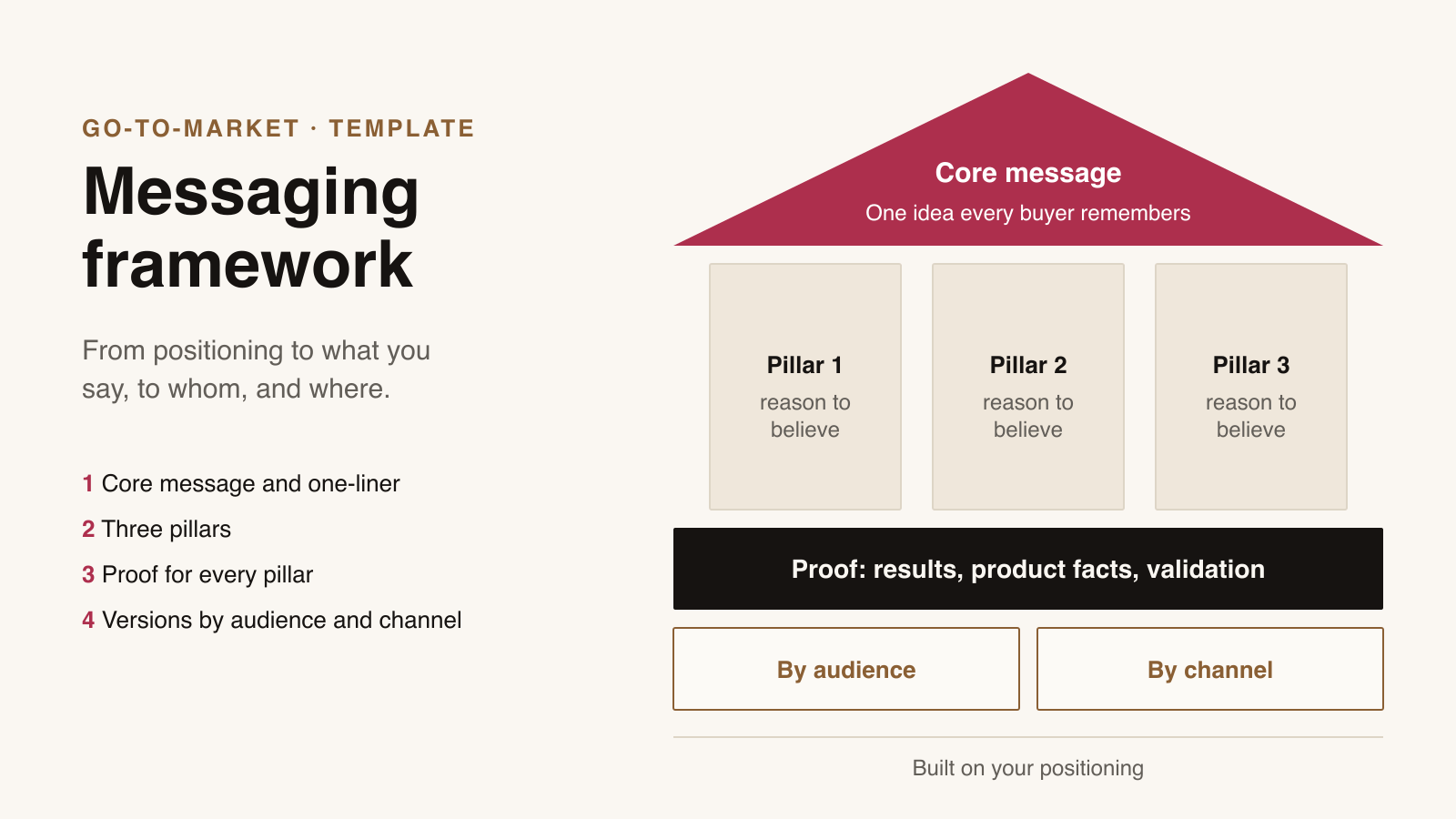
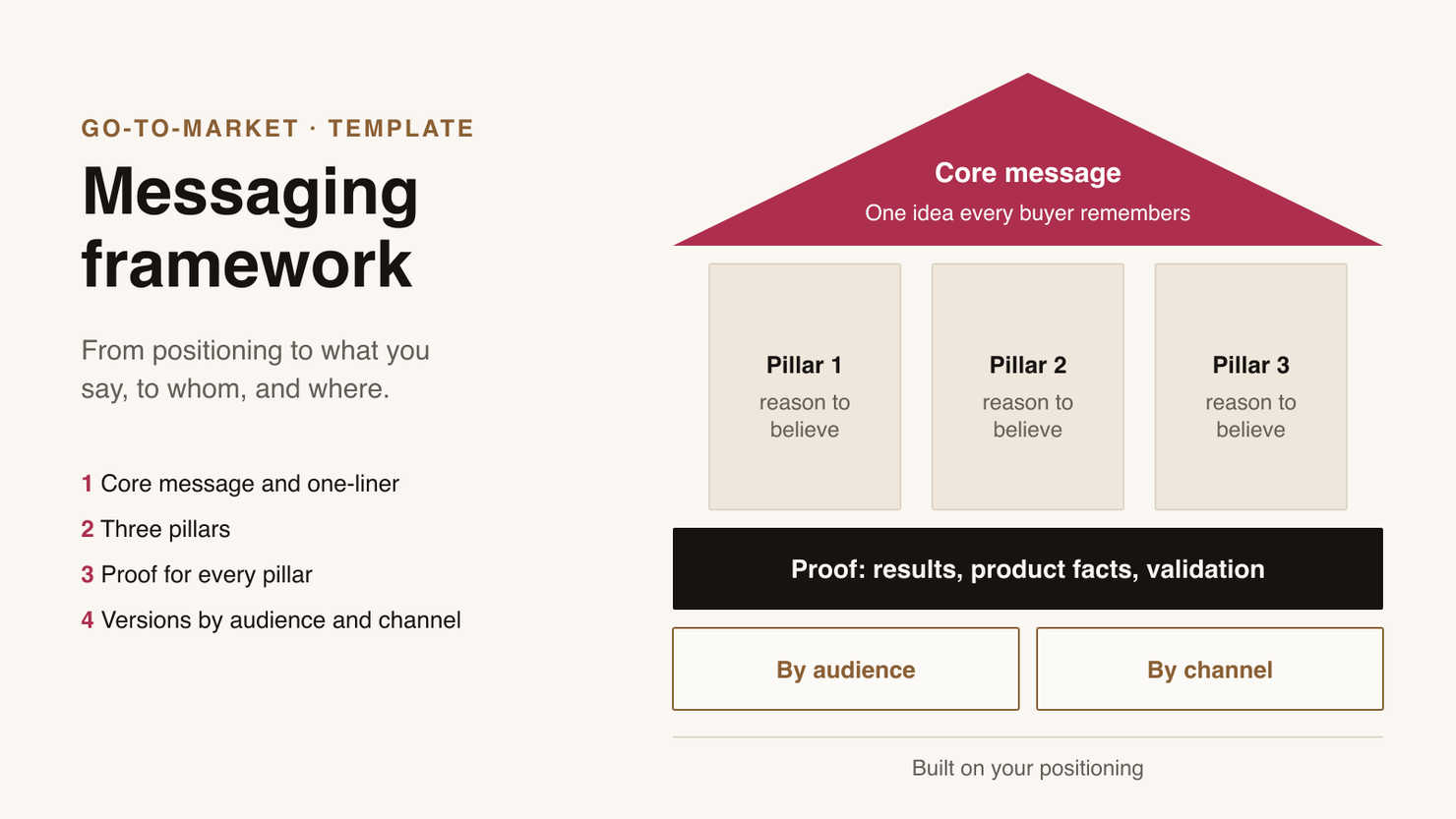
Browse the playbooksA messaging framework is a one-page document that turns your positioning into what you say: one core message, three pillars that support it, the proof behind each pillar, and a version for each buyer and each channel. It keeps your website, sales calls and campaigns telling the same story in the words each reader cares about.
Most teams don't struggle with messaging because they lack words. They struggle because everyone writes their own version. The founder pitches one story, the homepage says another and sales improvises a third. This guide shows you how to build a messaging framework in six steps, gives you a copy-and-fill template with a worked example, and explains how to update brand messaging without starting again.
You need positioning before you start. If yours isn't written down, the free Positioning Statement Generator drafts a positioning statement and canvas from a short description of what you sell.
What is a messaging framework?
A messaging framework is the source document for everything your company says about what it sells. It sits between your positioning, which decides where you stand in the market, and your copy, which is what a buyer actually reads.
Marketing courses often call it a message house. The Lumen Learning marketing course describes the shape most templates follow: a short primary message, one to three pillars that support it, at least three proof points for each pillar, and one call to action, with separate message sets where audiences care about different things.
| Part | What it is | Length |
|---|---|---|
| Core message | The one idea every buyer should remember | 1 to 3 sentences |
| One-liner | The core message short enough to say out loud | Under 12 words |
| Message pillars | The reasons to believe the core message | 3, one line each |
| Proof points | Evidence for each pillar: customer results, product facts, third-party validation | About 3 per pillar |
| Audience versions | What each buyer role hears first, and the objection to answer | One row per role |
| Channel versions | How the message is cut for the homepage, sales deck, email, social and AI answers | One row per channel |
| Voice | How you sound, and the words you use and avoid | 4 tone choices, 2 short word lists |
Running example (fictional): this guide uses Acme, an invented company that sells shipment visibility software to mid-size manufacturers. It is the same example shown on the Positioning Statement Generator page, so you can follow one company from positioning to messaging.
What is the difference between positioning and messaging?
Positioning decides where you stand: who you are for, what you compete with and why you win. Messaging decides what you say, to whom and where. Positioning comes first, and messaging is built on top of it.
April Dunford, author of Obviously Awesome, defines positioning as how your product is a leader at delivering something that a well-defined set of customers cares a lot about, and says plainly that positioning is not messaging and isn't a tagline (Lenny's Newsletter, 2021). Brian de Haaff, co-founder and CEO of Aha!, puts the time difference well: "Positioning should stay consistent over time while messaging is what you are saying right now" (Aha!, 2019).
| Positioning | Messaging framework | Copy | |
|---|---|---|---|
| Question it answers | Where do we stand, for whom, against what? | What do we say, to whom, and where? | What does this page, email or slide say? |
| Who uses it | Leadership, product, marketing, sales | Anyone who writes or sells | Buyers read it |
| Main output | Positioning statement and canvas | Core message, pillars, proof, audience and channel versions | Headlines, emails, decks, posts |
| How often it changes | Rarely: when product, market or competitors change | When proof, audiences or channels change | Every campaign or test |
Need a starting point for positioning? See these 9 product positioning examples from real brands. Positioning and messaging together make up part 3 of a go-to-market strategy.
Note: a value proposition is one line of your messaging, usually the core message for your main buyer. Brand voice is how the messages sound. Both live inside the messaging framework rather than beside it.
How do you build a messaging framework in 6 steps?
Build it from the top down: positioning first, then the core message, then pillars and proof, then versions for each audience and channel. Each step below follows the same pattern: what you need, what you write, an Acme example and a check before you move on.
Give the framework one owner, usually whoever leads marketing or product marketing, and have sales, product and a founder review each draft. Sales matters most, because they hear how buyers react every week.
Step 1: Start from your positioning
Your messaging can only be as sharp as your positioning. Write down the five parts Dunford lists: competitive alternatives, differentiated capabilities, the value they create, your best-fit customers and your market category.
- You need: a positioning statement or canvas.
- You write: one or two lines for each of the five parts.
- Acme example: alternatives are spreadsheets and email, the ERP's shipping module, or hiring another coordinator. The key capability is reading carrier updates directly from 40 carriers. The value is that late shipments show up hours earlier, before the customer notices. Best-fit customers are logistics leads at manufacturers with 200 to 1,000 staff. The category is shipment visibility for mid-size manufacturers.
- Check: could a competitor copy your positioning word for word? If so, fix the positioning before writing any messaging. If you are still unsure who gets real value, go back to product-market fit first.
Use the free Positioning Statement Generator to get a first draft in about two minutes. Enter what you sell and, if you can, what buyers use instead, what only you can do, who gets the most value and the proof you have. It returns a positioning statement, a one-liner and the full canvas, and with your email it adds three homepage headlines and a list of weak spots.
Step 2: Name the audiences who need a different message
List the people who must say yes, not everyone who might read your site. For most companies that is three to five roles: the person who signs, the people who use the product every day, and anyone who can block the deal, such as finance or IT.
- You need: your ideal customer profile and buyer personas.
- You write: one row per role with what they care about most and the objection they are likely to raise.
- Acme example (illustrative): the logistics lead who owns the problem, the coordinators who would use the product daily, the finance lead who approves the budget, and the IT lead who checks the ERP connection.
- Check: every role on your list has a real say in the decision, not just an interest in it.
Start from your ideal customer profile so you know which companies you are writing for, then build personas for the roles inside them. The free Buyer Persona Generator builds up to three personas from what you sell, with your website and main buyer as optional inputs, covering goals, pain points, buying triggers, objections and the channels they trust. When several people must agree, our guide to buying committees covers how to build consensus between them.
Step 3: Write the core message and one-liner
The core message is the one thing every buyer should remember. Write it in one to three sentences, in your customer's words, leading with the value rather than the feature.
- You need: the value and the best-fit customer from Step 1.
- You write: a core message built from three parts: the outcome the buyer wants, how you deliver it differently, and who it is for. Then a one-liner under 12 words.
- Acme example: core message: "Acme shows logistics teams at mid-size manufacturers every late shipment hours before the customer notices, because it reads carrier updates directly instead of waiting on spreadsheets or the ERP." One-liner: "See every late shipment before your customer does."
- Pro tip: borrow words from sales calls, reviews and support tickets. Buyers trust their own phrasing more than yours.
- Check: read it to someone outside the company. If they can't repeat it back in their own words, it is too abstract.
Note: write the one-liner last. It is easier to shorten a sharp core message than to explain a slogan.
Step 4: Choose three pillars and the proof behind each
Pillars are the reasons a buyer should believe your core message. Pick three, each tied to a capability from your positioning, and list the proof for each. The Lumen Learning course suggests at least three proof points per pillar, drawn from data, product features and customer stories.
- You need: your differentiated capabilities and any evidence you already hold.
- You write: a pillar headline and its proof points. Where proof doesn't exist yet, write what you will gather, never a number you hope is true.
- Check: each pillar answers "why should I believe you?" rather than repeating the core message in other words.
| Acme pillar (illustrative) | Proof to gather |
|---|---|
| Earlier warning on late shipments | Average hours of warning per delay at two customers; a customer quote; a demo of a delay being flagged |
| No re-keying from the ERP | Hours of manual entry removed per week; the list of ERP connections; the setup steps |
| Built for the people chasing carriers | The 40 carriers read directly; a coordinator's quote; a screenshot of the exceptions view |
Put this into practice
The GTM Funnel Playbook
How B2B teams find, win and keep customers, with a 90-day action plan. Seven funnel stages, one owner each, from the revenue number to the clients you keep.
Step 5: Map each pillar to each audience (the messaging matrix)
A messaging matrix is a grid with your audiences down the side and what each one hears across the top. It stops you sending the finance lead the message written for the daily user, while every line still comes from the same three pillars.
- You need: the roles from Step 2 and the pillars from Step 4.
- You write: for each role, the pillar to lead with, the line they hear and the objection to answer before they raise it.
- Check: no line in the matrix contradicts the core message.
| Acme audience (illustrative) | Leads with | Their line | Objection to answer |
|---|---|---|---|
| Logistics lead | Earlier warning | Hear about delays before your customer calls. | "We already have the ERP." |
| Coordinators | No re-keying | Stop copying orders between systems. | "Another tool to learn." |
| Finance lead | No re-keying | Cut manual work without adding headcount. | "What does it cost against our current process?" |
| IT lead | No re-keying | Connects to the ERP you already run. | "How much integration work is this?" |
Step 6: Adapt the message for each channel, then test it
Each channel has room for a different amount of the framework. Cut the same message down for each one rather than writing a new message per channel.
| Channel | What to use | Acme example |
|---|---|---|
| Homepage hero | One-liner, plus one pillar as the subhead | "See every late shipment before your customer does." Subhead: reads 40 carriers directly, so delays show up hours earlier |
| Sales deck | Core message, all three pillars, proof, one slide per role | Opens with what it costs to hear about delays from customers |
| Cold email | One role, one pillar, one ask | To a logistics lead: the earlier-warning pillar and a short call |
| LinkedIn and articles | One pillar per post, with proof | What spreadsheets miss about carrier delays |
| Pages that AI assistants read | Core message, category name and pillars stated plainly, in the same words on every page | "Acme is shipment visibility software for mid-size manufacturers" on the homepage, about page and product pages |
Set your voice once while you are here. Kate Moran of Nielsen Norman Group describes tone on four dimensions: formal or casual, serious or funny, respectful or irreverent, and matter-of-fact or enthusiastic (Nielsen Norman Group, 2016). Pick a point on each, then add a short list of words you use and words you avoid.
Then test it before you roll it out:
- Read the core message to a few best-fit customers and ask them to say it back. Note the words they use instead of yours.
- Run your homepage through the free Homepage Clarity Check to see whether a visitor can tell what you offer, who it's for, why you, and what to do next.
- Write a first email to one role with the free Cold Email Generator and check it leads with that role's pillar.
- Ask sales which pillar gets questions on calls and which one buyers ignore.
Messaging framework template: copy it and fill it in
Copy this one-page messaging framework template into a shared doc. The right-hand column shows the fictional Acme example, so you can see how much detail each row needs.
| Section | What to write | Acme example (fictional) |
|---|---|---|
| Positioning summary | Alternatives, capability, value, best-fit customer, category | Replaces spreadsheets and the ERP's shipping module for logistics leads at mid-size manufacturers |
| Core message | 1 to 3 sentences: outcome, how you are different, for whom | Shows every late shipment hours before the customer notices, by reading carriers directly |
| One-liner | Under 12 words | See every late shipment before your customer does. |
| Pillar 1 and proof | Headline plus about 3 proof points | Earlier warning: hours of warning per delay, customer quote, demo |
| Pillar 2 and proof | Headline plus about 3 proof points | No re-keying: hours saved per week, ERP connections, setup steps |
| Pillar 3 and proof | Headline plus about 3 proof points | Built for carrier chasers: 40 carriers, coordinator quote, screenshot |
| Audiences | Role, the pillar they hear first, their objection | Logistics lead, coordinators, finance lead, IT lead |
| Channels | What each channel uses from the framework | Homepage, sales deck, cold email, LinkedIn, pages AI assistants read |
| Voice | A point on each of the 4 tone dimensions | Casual, serious, respectful, matter-of-fact |
| Words we use / avoid | Customer words in; vague claims out | Use: late shipment, carrier, exceptions. Avoid: end-to-end, seamless, AI-powered |
| Owner and review date | Who keeps it current, and when it is next checked | Head of marketing; reviewed every quarter |
Want your positioning and messaging built with you?
The 90-Day GTM Build starts with customer interviews, your ideal customer profile and a message audit, then rebuilds your positioning and messaging with your team and hands over a playbook you own.
How do you update brand messaging?
Update your messaging when the evidence changes, not when the team is tired of it. First decide whether your positioning has changed or only your messaging, because the two need very different amounts of work.
A summary of April Dunford's 2026 Business of Software session names the reasons worth revisiting positioning for: a product change, a market shift or new competitive dynamics. It also warns that boredom is the enemy: marketing teams often want a new message after about six weeks, long before most buyers have even noticed the current one (Business of Software, 2026).
| What changed | Revisit positioning? | What to update in the framework |
|---|---|---|
| New product or major feature | Only if it changes what you are best at | Add a pillar or proof; check the core message still holds |
| Buyers now compare you with a new competitor | Yes: review your alternatives | Core message, objections in the matrix |
| New customer segment or buyer role | Yes, if your best-fit customer changes | Audience rows and the matrix |
| New proof: results, reviews, case studies | No | Proof points, homepage subhead, sales slides |
| Sales hears the same objection on most calls | Usually no | Objection answers; possibly a pillar |
| Conversion falls with no other change | Investigate first | Test the core message and one-liner |
| The team wants something fresh | No | Nothing. Refresh the creative, not the message |
Once you know what to change, roll it out in this order:
- Collect the evidence: win and loss notes, sales call notes, customer interviews, and what search results and AI assistants say about you today.
- Rewrite the framework first, before any page or slide, and keep the old version so you can compare results later.
- Update sales next: the deck, the talk track and the objection answers, because sales hears the reaction fastest.
- Then the website: homepage, product pages and about page, so the core message and category read the same everywhere.
- Then campaigns: ads, email sequences and social profiles. Retire old phrases rather than leaving both versions live.
- Brief the team and set a review date: one short session, the updated doc and the words to stop using.
Pro tip: after the rollout, ask ChatGPT, Perplexity or Google's AI Mode what your company does and who it is for. If the answer still uses your old wording, the old phrases are still live on pages those tools read.
What mistakes make a messaging framework fail?
Most frameworks fail because they are written without positioning, without proof or without an owner. Watch for these:
- Messaging before positioning. Clever lines can't fix an unclear choice of customer, alternative or category.
- Features instead of value. "Reads 40 carriers" is proof. "See every late shipment before your customer does" is the message.
- One message for every role. The finance lead and the daily user weigh different risks, so they need different first lines.
- Claims without proof. A pillar with no evidence is an opinion. Write what you will gather, never a made-up number.
- Words any competitor could use. "All-in-one", "easy to use" and "AI-powered" say nothing about why you are different.
- No owner. A framework nobody maintains goes stale, and sales quietly goes back to its own version.
If sales and marketing already describe the product differently, the framework is your shared reference. Our 30-day sales and marketing alignment plan shows how to agree on definitions and handoffs around it, and the go-to-market launch playbook shows where messaging fits in a launch.
What should you do next?
Draft your positioning with the free Positioning Statement Generator, build personas for each role with the Buyer Persona Generator, then fill in the template above and test it with customers before you change a single page. If you would rather build it with an outside view, the 90-Day GTM Build covers your ICP, positioning and messaging in one fixed-scope project.
Put this into practice
The GTM Funnel Playbook
How B2B teams find, win and keep customers, with a 90-day action plan. Seven funnel stages, one owner each, from the revenue number to the clients you keep.
Frequently Asked Questions
How long should a messaging framework be?
Who should own the messaging framework?
How many message pillars should you have?
What is the difference between a messaging framework and a value proposition?
Can AI write your messaging framework?
What is a message house?

Swapan Kumar Manna is a go-to-market and AI search strategist and Founder & CEO of Oneskai. He has spent 14+ years helping companies get found, get chosen and grow.