Part of the The Future of Search: How Discovery Works When Answers Replace Rankings (2026 Guide) series
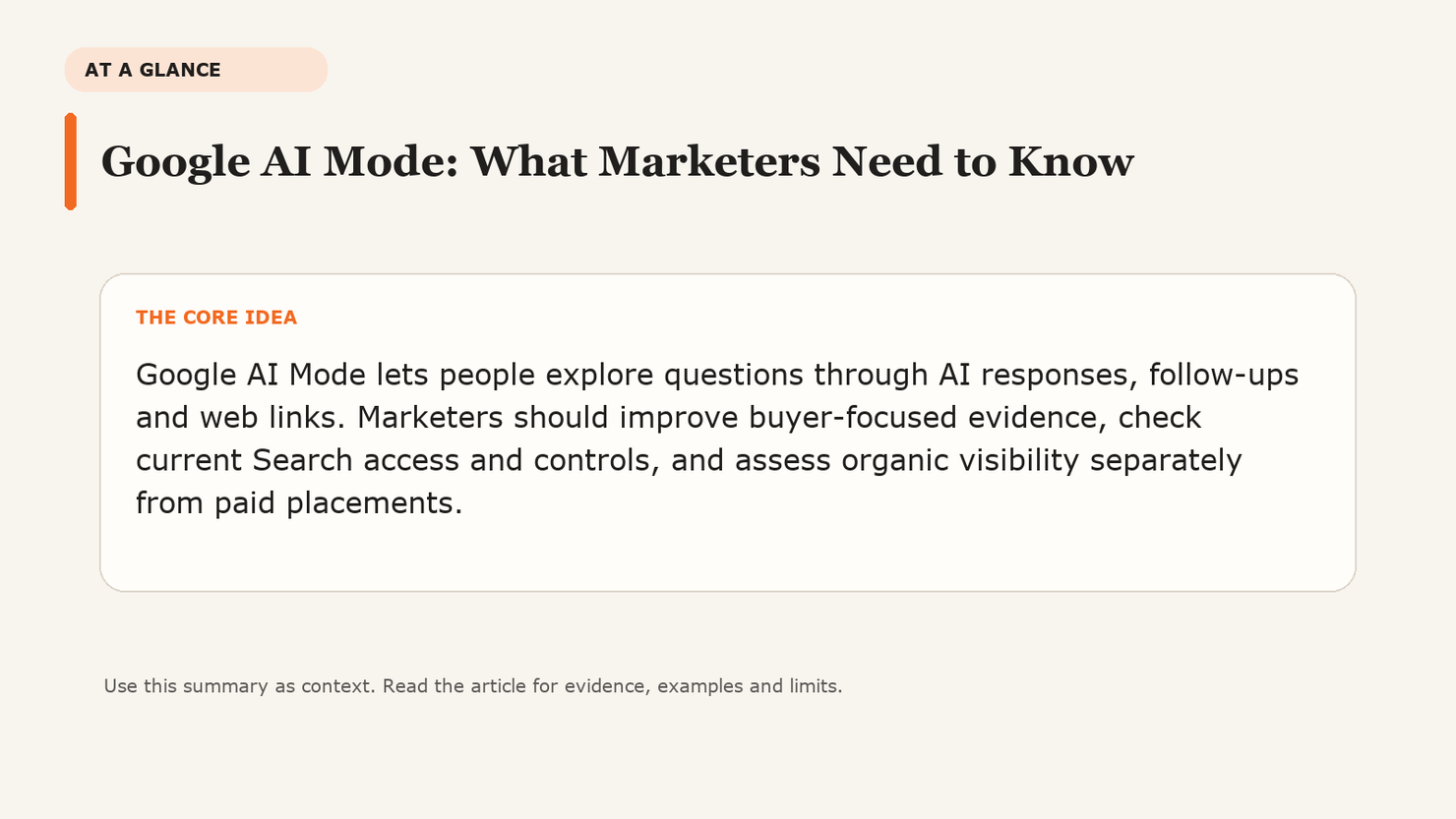
Google AI Mode lets people explore questions through AI responses, follow-ups and web links. Marketers should improve buyer-focused evidence, check current Search access and controls, and assess organic visibility separately from paid placements.
Key Takeaways
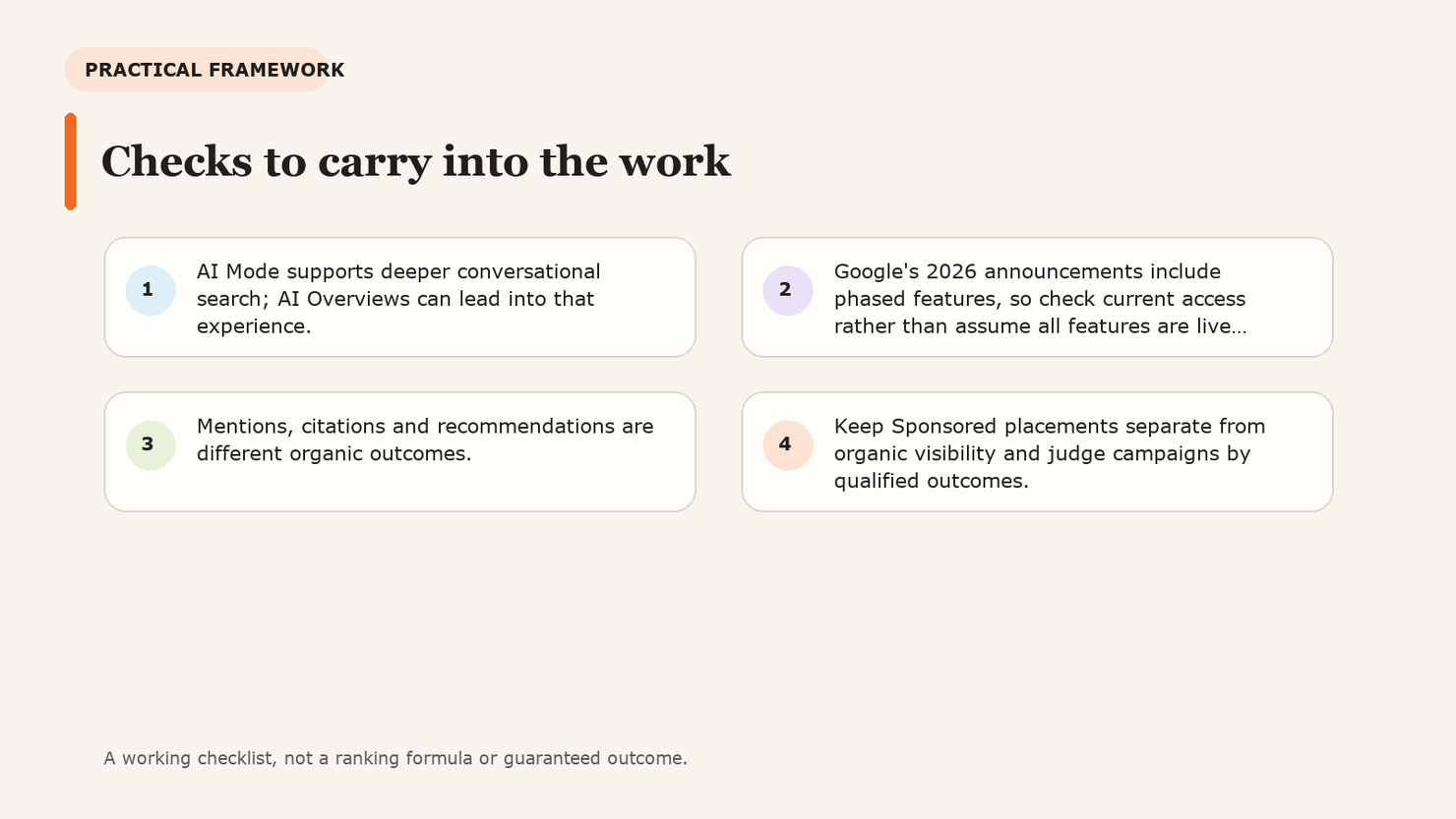
- AI Mode supports deeper conversational search; AI Overviews can lead into that experience.
- Google's 2026 announcements include phased features, so check current access rather than assume all features are live everywhere.
- Mentions, citations and recommendations are different organic outcomes.
- Keep Sponsored placements separate from organic visibility and judge campaigns by qualified outcomes.
Playbooks
Frameworks you can put to work
Growth marketing, LinkedIn presence, and more — delivered as PDFs.
Browse the playbooksGoogle AI Mode is a search experience that lets people explore a question through AI responses, follow-up questions, and links to the web. For marketers, the change is practical: a buyer can compare options and refine a need within Search before visiting a company's website.
That makes it worth understanding, without treating it as a reason to abandon SEO. Your pages still need to be useful, accessible, and clear about the facts. What changes is how the buyer may encounter that information and how much of the decision happens before a visit.
I've spent 14+ years in go-to-market and growth. My starting point here is the buyer's task: what are they trying to decide, and which evidence would help? This guide focuses on Google AI Mode. For the wider view across search and AI assistants, read my guide to the future of search.
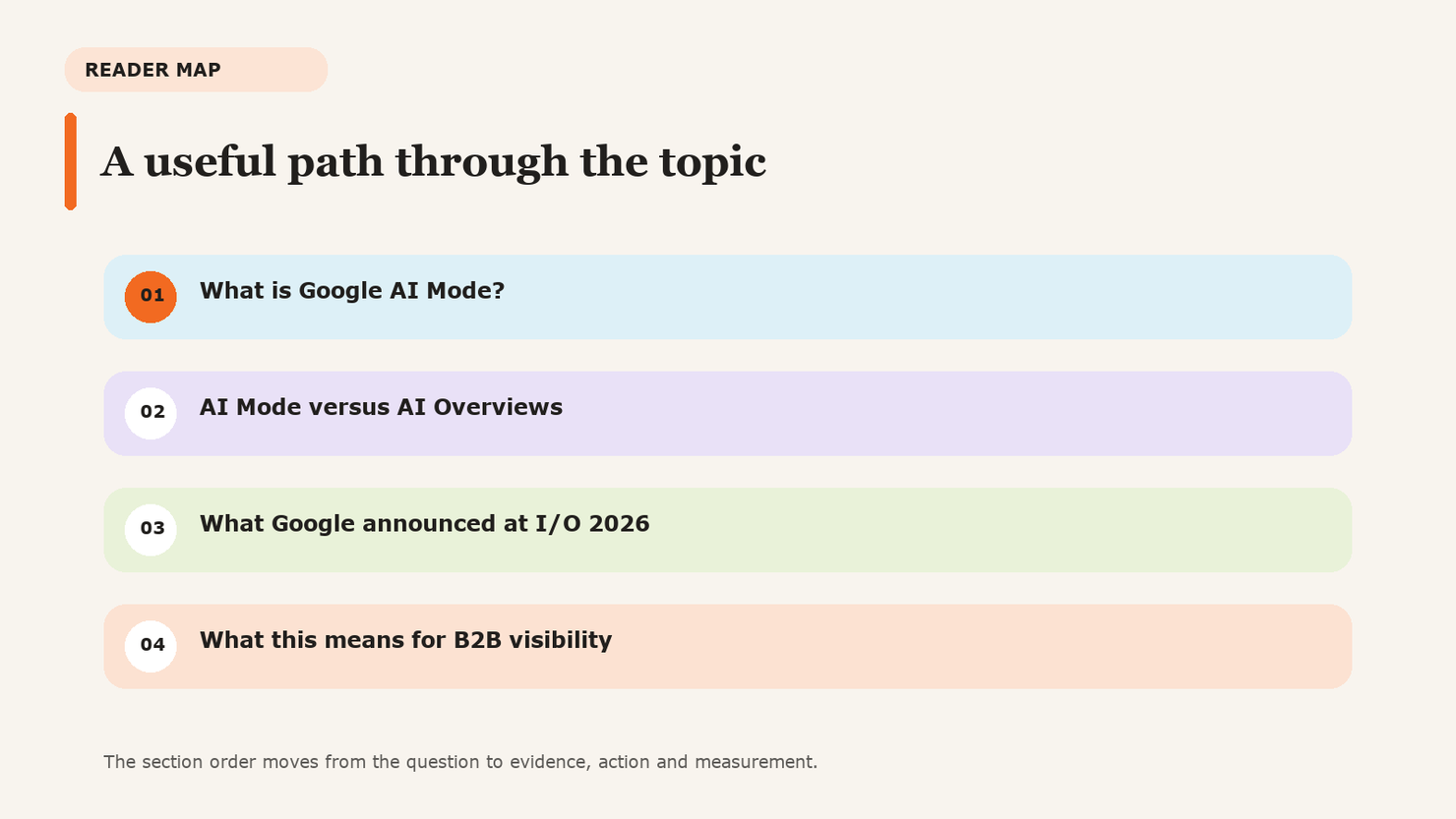
What is Google AI Mode?
Google's help documentation describes AI Mode as a way to ask questions, explore information, and continue with follow-ups. It can divide a question into subtopics and search them at the same time, then bring the findings into a response with helpful links.
Google calls this query fan-out. In plain English, one question can lead to several related searches. A person comparing software might need information about price, setup, features, and fit for their team. The response can draw on those parts rather than treat the request as one short keyword.
Google also warns that AI Mode can misread web content or miss context. A source link gives the user somewhere to check a claim; it does not make every statement correct. Important buying details still deserve a closer look at the source.
For your content team, the useful lesson is to explain decisions well. A page that clearly answers a setup question can help within a broader comparison. A page that says little beyond “easy to use” gives the reader less evidence to assess.
AI Mode versus AI Overviews
AI Overviews provide summaries within Google Search. AI Mode supports a deeper conversational search, where someone can refine a question and explore further. They are related experiences, but the response and links shown in one should not be assumed to match the other.
The distinction is becoming less visible to users. In its May 2026 I/O announcement, Google described follow-ups from an AI Overview flowing into AI Mode while retaining the context. A buyer can move from a quick explanation to more detailed research without starting over.
For reporting, keep the experience clear. Record whether you reviewed an AI Overview or an AI Mode conversation, along with the question and date. “We appeared in Google AI” is too broad to show what happened or which page helped.
What Google announced at I/O 2026
Google's I/O update described a more flexible Search box with AI suggestions and inputs beyond text. It also announced Gemini 3.5 Flash as the new default model for AI Mode, alongside information agents, task-specific generated interfaces, and wider use of personal context.
These announcements were not all promises of the same launch date or access. Some features had phased rollout plans or limits by country and subscription. Treat the May announcement as a dated account of Google's direction, then check current product help for the feature and market you need.
For a marketing leader, the main implication is not the model name. It is that users can describe more of their situation and continue working through it. The same broad product query can become a question about cost, migration, team size, or a specific limitation.
That gives content a more demanding job. It needs to help with the details behind the decision, not simply repeat the category name. It also needs accurate current facts, since an old feature claim can lead to a poor recommendation or an unsuitable enquiry.
What this means for B2B visibility
Consider a hypothetical buyer looking for a CRM for a small team. They ask for a tool that works with Gmail, needs little admin time, and offers clear reporting. The question includes three criteria that a generic “best CRM” list may not resolve.
A useful vendor page would explain the Gmail workflow, what setup requires, and which reports are included. A useful comparison would discuss the tradeoffs. Those pages serve the buyer whether they read them directly or encounter parts of the information through a search response.
This does not prove that one format earns an AI Mode citation. It is a reason to make the evidence stronger. Review the questions sales and support receive, then check whether your public pages answer them with enough detail to assess fit.
Keep three forms of visibility separate. A brand mention names your business. A citation links to a source. A recommendation presents an option as suitable for the stated need. Each can matter, but none alone proves qualified demand.
What changes for traffic?
AI Mode can help a user learn or compare before opening a website. It can also direct them to a source for more detail. The balance depends on the question, the response, and what the person still needs to do.
Do not apply an AI Overview click-through study directly to AI Mode as though the interfaces were the same. Research can raise a useful concern, but it cannot establish your site's result in a different experience. Inspect your own pages and queries before making a traffic forecast.
I would start with the pages closest to a business decision. Are visits changing? Are the people who arrive asking better-informed questions? Are qualified enquiries holding up? Keep total outcomes alongside conversion rates so a smaller audience is not mistaken for better performance.
Your site still needs a reason to visit. Current terms, a detailed comparison, a working tool, or a clear demonstration can help a reader complete a task. Adding more words to a short definition may not create the same value.
What is happening with ads in AI Mode?
Google's May 2026 ads announcement described tests of Conversational Discovery ads and Highlighted Answers. The first tailors ad content to a person's question. The second can place an eligible ad within a recommendation list. Google said these formats would remain labelled as Sponsored.
Those are paid placements. They should not be reported as organic citations or editorial recommendations. The announcement also described other Search ad developments and pilots; it did not establish universal availability for every advertiser or B2B category.
For a paid-search team, check current account eligibility and reporting before changing spend. Assess whether the offer and landing page answer the need behind the question. A new placement does not remove the need for clear terms, good targeting, and a useful next step.
Set a business test before expanding a campaign. Define what counts as a qualified lead, check the cost of reaching that result, and review the lead quality. A product announcement is not evidence that the format will outperform your current activity.
What should your team do now?
Start with access and accuracy. Google's current AI search guidance connects generative search with SEO foundations and useful original content. It also covers current eligibility and controls. Have the technical team check the live pages rather than assume a published page is available for every Search feature.
Google introduced a Search Console control in June 2026 for whether a site appears in and helps ground generative Search responses. Review the current setting and documentation with the site owner. Changing that control is a separate business decision, not a routine article-writing step.
Next, review one important buyer decision. Find the questions your pages leave unanswered and improve the evidence. Keep stable useful URLs, explain conditions beside claims, and link to the next live answer where it helps the reader.
Finally, run a small repeatable review of relevant AI Mode questions. Save the question, context, date, answer, and source links. Check mentions, citations, recommendations, and wrong facts separately. Use the findings with site and sales data; one response is not a measure of the whole market.
There is no need to publish a page for every possible follow-up. Google's guidance warns against creating query variations mainly to manipulate search or AI responses. Cover distinct buyer needs, and keep the content clear enough for a person to use.
Keep the strategy tied to the decision
Google AI Mode changes how someone can ask and explore. It does not change the need for a clear offer, credible evidence, and a website that helps a suitable buyer move forward. Those are the parts your team can inspect and improve today.
Choose one decision, strengthen the facts and guidance around it, and check the result before scaling. Keep organic and paid outcomes separate, and revisit product-specific advice as Google changes the experience.
For more practical thinking on AI, search, and growth, join The Agentic Pivot.
Frequently Asked Questions
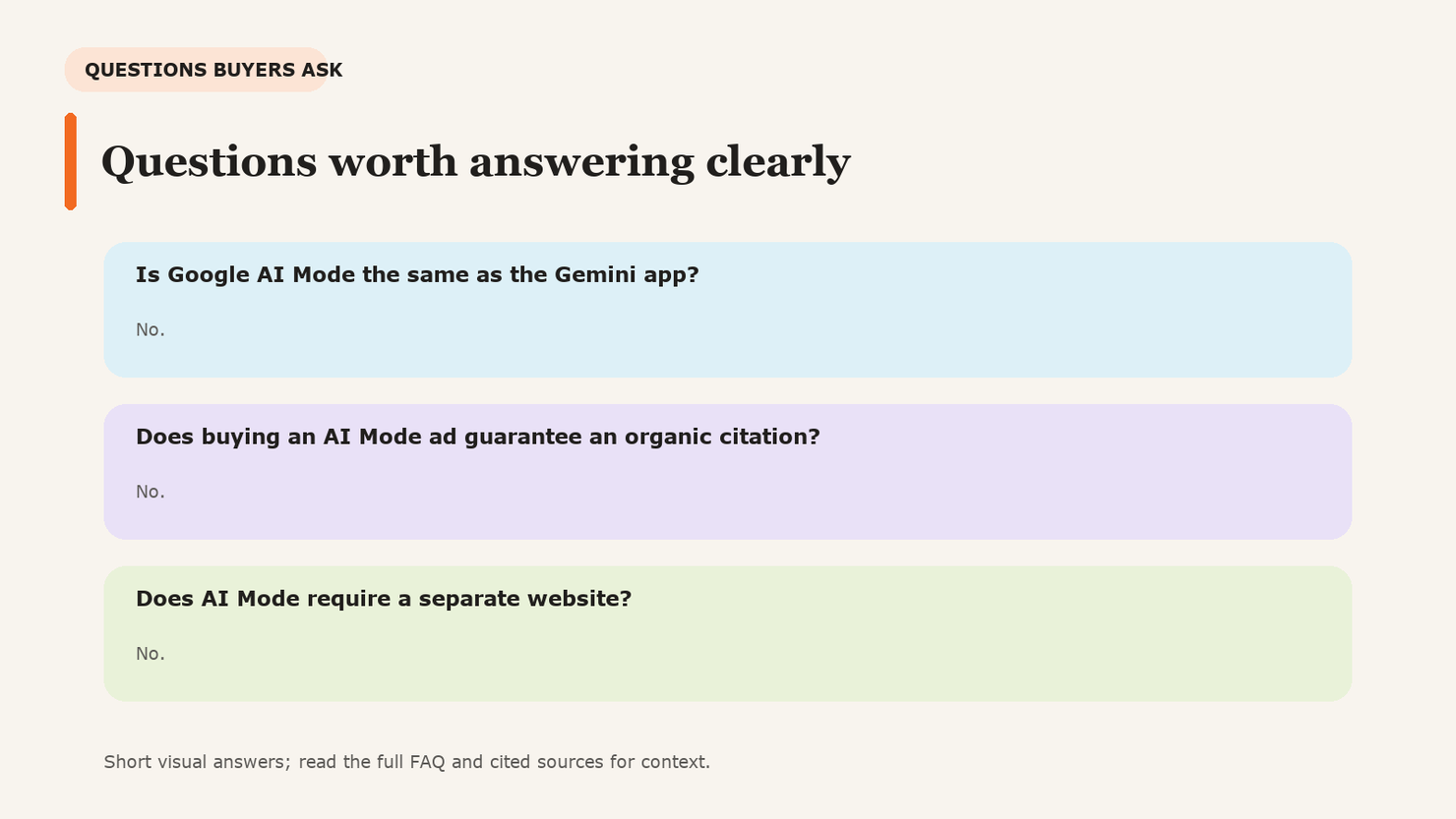
Is Google AI Mode the same as the Gemini app?
Does buying an AI Mode ad guarantee an organic citation?
Does AI Mode require a separate website?
Frequently Asked Questions
Is Google AI Mode the same as the Gemini app?
Does buying an AI Mode ad guarantee an organic citation?
Does AI Mode require a separate website?

Swapan Kumar Manna
Go-to-market & AI search strategist
Swapan Kumar Manna is a go-to-market and AI search strategist and Founder & CEO of Oneskai. He has spent 14+ years helping companies get found, get chosen and grow.