Part of the The Future of Search: How Discovery Works When Answers Replace Rankings (2026 Guide) series
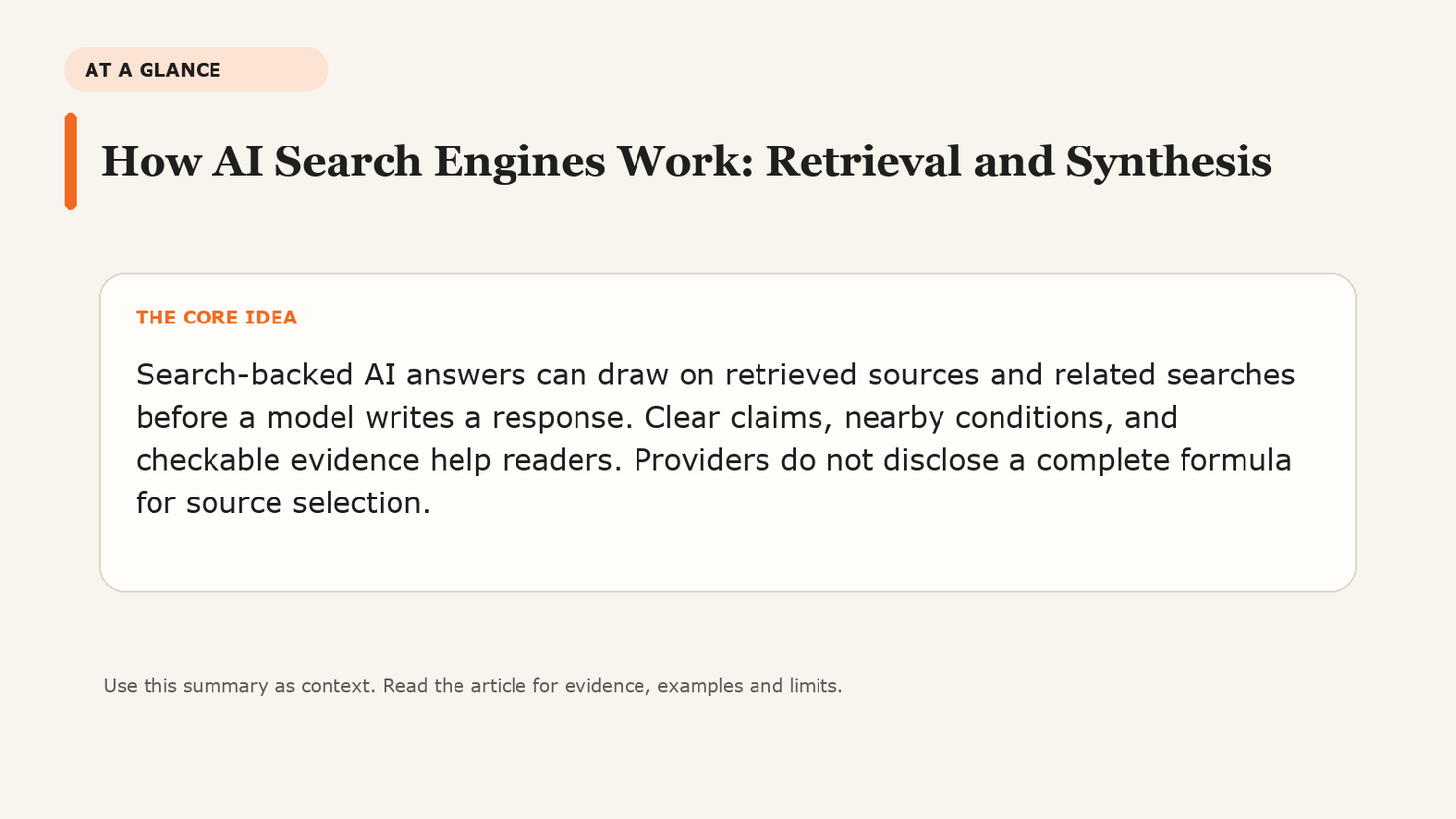
Search-backed AI answers can draw on retrieved sources and related searches before a model writes a response. Clear claims, nearby conditions, and checkable evidence help readers. Providers do not disclose a complete formula for source selection.
Key Takeaways
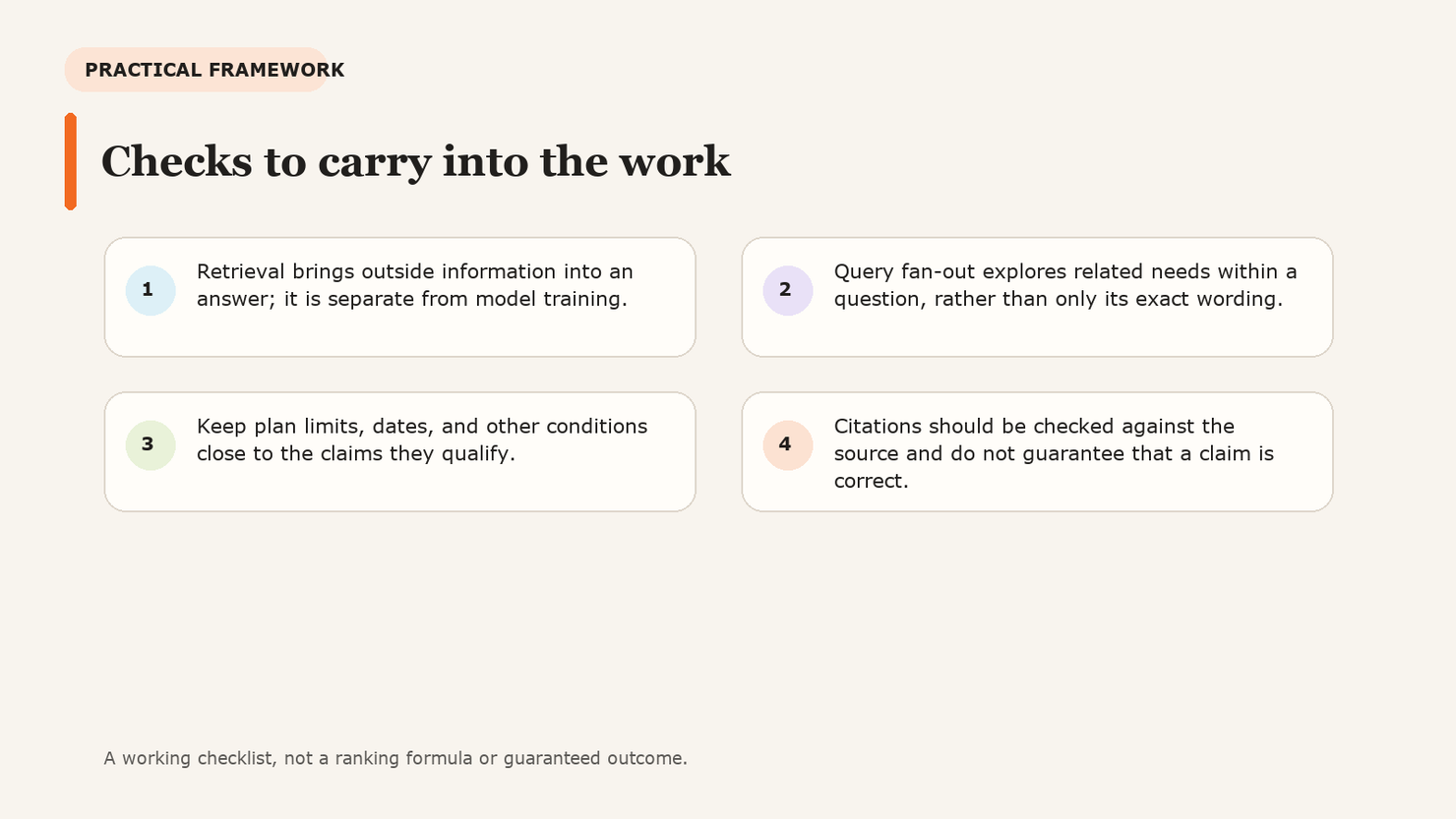
- Retrieval brings outside information into an answer; it is separate from model training.
- Query fan-out explores related needs within a question, rather than only its exact wording.
- Keep plan limits, dates, and other conditions close to the claims they qualify.
- Citations should be checked against the source and do not guarantee that a claim is correct.
Playbooks
Frameworks you can put to work
Growth marketing, LinkedIn presence, and more — delivered as PDFs.
Browse the playbooksAI search engines can look up sources, find information that fits a question, and use a language model to write an answer. Some also run several related searches before they respond. This helps explain how an answer can combine advice from one page, a price from another, and a warning from a third.
That is a useful starting point, but it is not a blueprint for every product. A chatbot can answer without searching the web. And providers do not reveal every rule they use to choose sources.
For marketing teams, the useful question is where your content can help a reader make a decision. This guide explains the mechanics behind that question. It sits within my wider guide to the future of search and discovery.
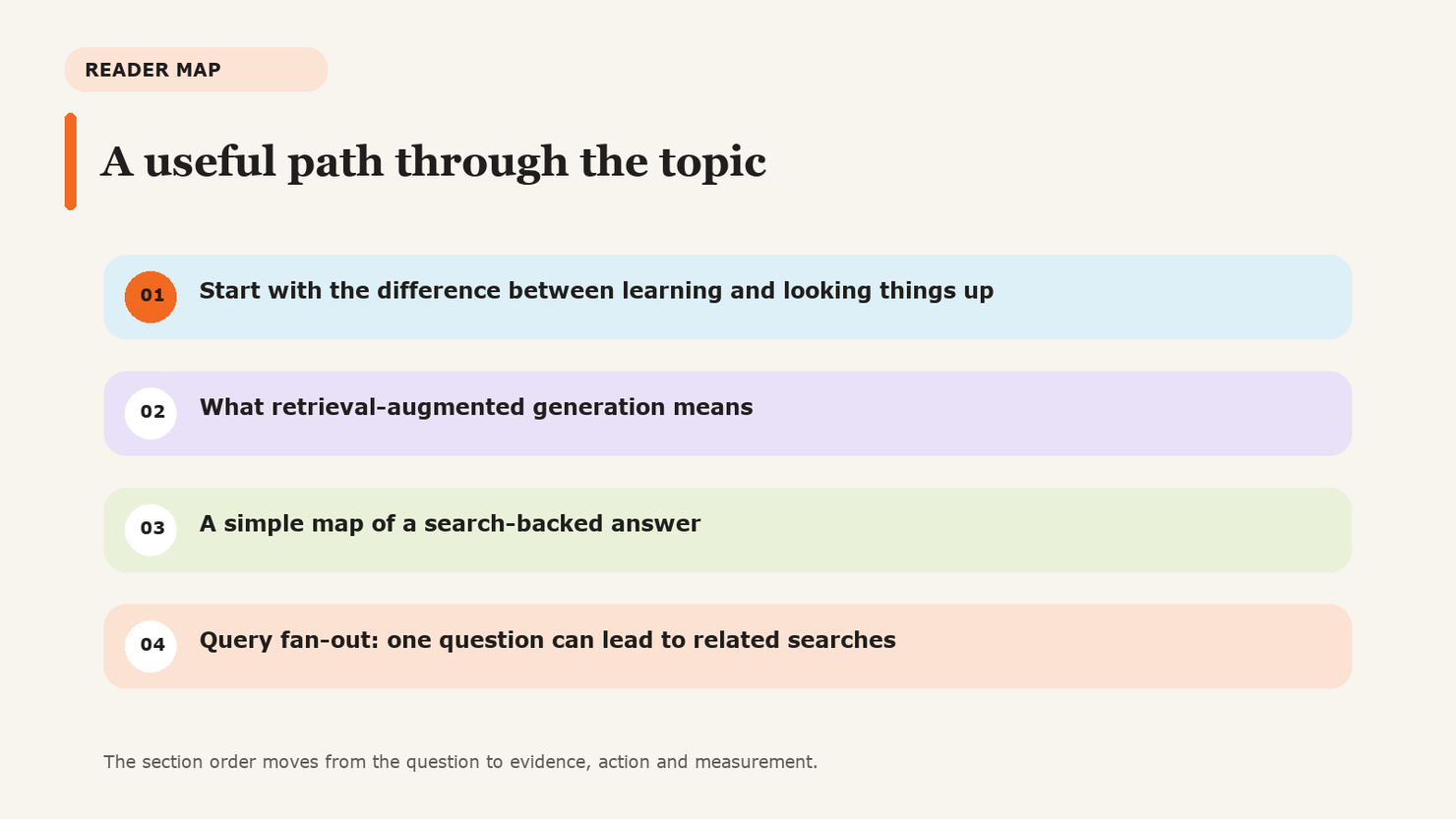
Start with the difference between learning and looking things up
A language model learns patterns during training. It can then use those patterns to produce text, explain ideas, and respond to questions. That does not mean it has a current copy of every website.
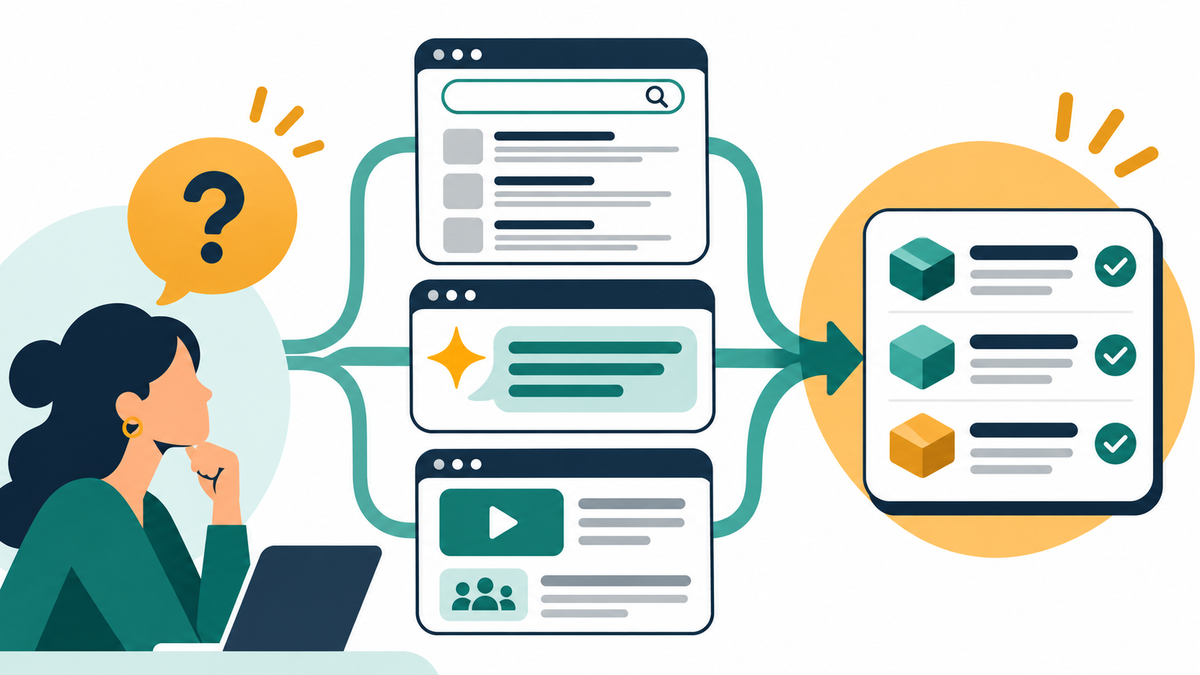
Looking something up is a separate task. A search tool can fetch information when the answer needs facts beyond the model's stored knowledge. Think of the difference between answering from memory and opening a reference book.
The book might contain a new fact, a correction, or a detail you never learned. But having the book open does not ensure that you read it well. The same distinction matters in AI search: access to a source and a sound answer are different things.
This is why publishing a new page does not mean a chatbot has learned it. A page may become available through search without becoming part of the model's training.
What retrieval-augmented generation means
Retrieval-augmented generation, or RAG, combines a model with information retrieved from an outside source. In plain English, the system looks up useful material and uses it while writing.
In a 2020 paper, Patrick Lewis and his co-authors tested RAG with Wikipedia passages. Their work helps explain the idea. It does not show how today's ChatGPT, Gemini, Copilot, or Perplexity are built.original RAG paper by Patrick Lewis and colleagues, published in 2020, studied a model paired with a searchable store of Wikipedia passages. It provides a research foundation for this idea. It does not describe the full architecture of today's ChatGPT, Gemini, Copilot, or Perplexity.
For a simple example, imagine a buyer asking whether an email platform supports two languages. An answer based on old knowledge might miss a recent feature launch. A system that retrieves the current help page has better source material to work with.
It can still make a mistake. It might read a feature available only on an expensive plan and describe it as available to everyone. Retrieval improves the information available; it does not remove the need to check the answer.
A simple map of a search-backed answer
The flow below is a teaching model. Real systems can repeat searches, revisit sources, or use different tools rather than follow one fixed sequence.
Question → related searches → candidate sources → relevant information → written answer with source links
Imagine this question: “Which email platform suits a small team that sends newsletters in English and Hindi?”
The buyer has given the system more than a product category. There is a team size, a use case, and a language need. A useful answer must deal with those limits.
As we move through the flow, keep that question in mind. It shows why a broad article about email marketing may be less useful than a precise page about language support, costs, or the work needed to get started.
Query fan-out: one question can lead to related searches
Query fan-out means generating related searches to explore parts of the original question. Google documents this technique for its generative Search features, alongside retrieval from its Search index.
In our example, related searches might explore language support, email templates, list size limits, and prices for small teams. Those are hypothetical searches, not a record of what an engine actually ran.
The point is that the buyer's question contains several needs. One search phrase may not cover all of them. Related searches can help gather information across those needs.
I would use that insight to improve topic planning. Ask what a reader needs to know before they can act. Then decide which questions belong together on one page and which deserve a fuller guide.
For the email platform, “Does it support Hindi text?” could fit within a product guide. “How should we plan a bilingual newsletter?” may need a separate article because it covers a different job. That distinction gives a cluster a purpose beyond collecting keyword variations.
Retrieval: finding material worth checking
Retrieval is the search for source material. In a web search context, that can involve finding pages through a search service. In other settings, the material might be company documents or a private knowledge base.
Providers describe their products differently. OpenAI says ChatGPT search can turn a prompt into one or more targeted queries for search providers and may run further searches. ChatGPT may search automatically when helpful, but not every answer uses web search.
Perplexity describes a process of interpreting a question, searching the web, and summarising information with numbered citations. These descriptions support a broad comparison. They do not establish identical source scoring across products.
For a content team, this stage raises a practical question: can the intended service reach the useful information? Check the page, its access controls, and relevant crawler settings before blaming the writing.
OpenAI identifies access for OAI-SearchBot as important for inclusion in ChatGPT search. It also says placement depends on multiple factors and cannot be guaranteed. An access check is a basic check, not a promise of a citation.
Put this into practice
The GTM Funnel Playbook
How B2B teams find, win and keep customers, with a 90-day action plan. Seven funnel stages, one owner each, from the revenue number to the clients you keep.
Passage retrieval: why a useful section matters
A passage is a portion of text, such as a paragraph or section. Passage retrieval focuses on finding text relevant to a particular need, rather than treating every word on a long page as equally useful.
Return to the buyer's language question. A detailed section stating which parts of the product support Hindi could be useful. A headline saying “Built for global teams” leaves too much to guess.
A good section would explain whether the support covers email content, the editor, system messages, or all three. It would also note any limits. That detail helps a buyer avoid an expensive misunderstanding.
My editorial test is simple: if someone arrived at this section first, would they understand the claim and its limits? A clear subject, direct explanation, and concrete example usually help.
That does not require writing every paragraph as a tiny answer card. Google explicitly says artificial chunking is unnecessary. Keep the flow a human reader needs, with enough context to understand each point.
Synthesis: turning source material into an answer
Synthesis means bringing information together into a coherent response. The system may combine product details, support guidance, and other material to address the question.
This is where context can be lost. Our hypothetical buyer might see a low entry price next to a feature that requires a higher plan. Both facts could be correct on their own, while the combined recommendation misleads.
For writers, the lesson is to keep important conditions close to the claim. If a feature needs a paid plan, say so in the sentence that explains it. If a result came from a small test, describe the test's limits beside the result.
This is also good editing for people. It saves readers from hunting through footnotes to learn whether a statement applies to them.
A page full of bold claims and scattered caveats makes that work harder. A page that explains the evidence, conditions, and trade-offs gives readers a firmer basis for a decision.
Citations: follow the link before trusting the claim
A citation gives the reader somewhere to check. It does not prove that the answer has represented the source correctly.
Open the linked page and compare it with the claim. Does it support the exact feature, plan, date, or market mentioned? Does it describe a live capability or a planned release?
When marketers ask how ChatGPT picks sources, the honest answer has limits. Providers share broad guidance, but they do not publish a complete formula for every citation decision. We cannot infer that formula from one answer.
For measurement, record the question, product, date, cited page, and surrounding claim. Repeat checks before calling a change a trend. Treat a citation as one observation, then look at whether it brings relevant visits or helps people understand the brand.
Turn the mechanics into better content decisions
I would review a content cluster through three questions: can readers find the information, can they understand it, and can they check it?
For the email example, that means a useful product guide with clear language support, plan limits, and links to evidence. A deeper bilingual newsletter guide can cover planning and workflow. Each page should have its own reason to exist.
Google's guidance keeps SEO relevant to its AI features and rejects special markup or llms.txt as a requirement. The practical work remains grounded in useful content and sound site basics.
My priority would be to fix unclear claims before expanding the cluster. Adding ten pages will not help a buyer if none explains the condition that matters most.
If you want more practical guides on search, AI, and growth, join The Agentic Pivot newsletter.
Frequently Asked Questions
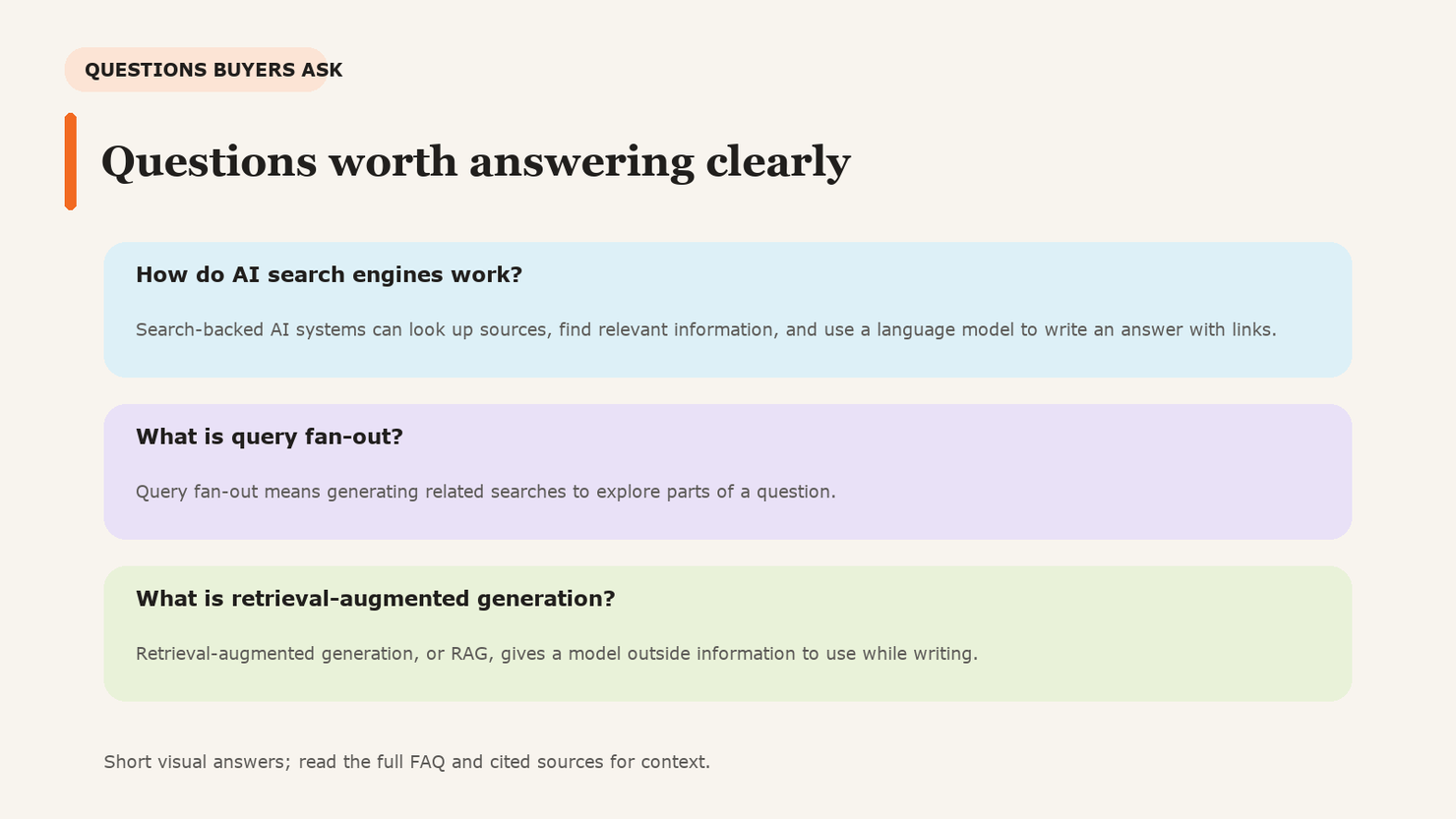
How do AI search engines work?
What is query fan-out?
What is retrieval-augmented generation?
How does ChatGPT pick sources?
Put this into practice
The GTM Funnel Playbook
How B2B teams find, win and keep customers, with a 90-day action plan. Seven funnel stages, one owner each, from the revenue number to the clients you keep.
Frequently Asked Questions
How do AI search engines work?
What is query fan-out?
What is retrieval-augmented generation?
How does ChatGPT pick sources?

Swapan Kumar Manna
Go-to-market & AI search strategist
Swapan Kumar Manna is a go-to-market and AI search strategist and Founder & CEO of Oneskai. He has spent 14+ years helping companies get found, get chosen and grow.