Part of the Modern SEO Strategy: A Practical Guide for the AI Era series
Information gain SEO asks what useful understanding a page adds beyond the basic answer. Check its contribution, evidence, decision value, usability and honest claims. This editorial test does not guarantee rankings or AI citations.
Key Takeaways
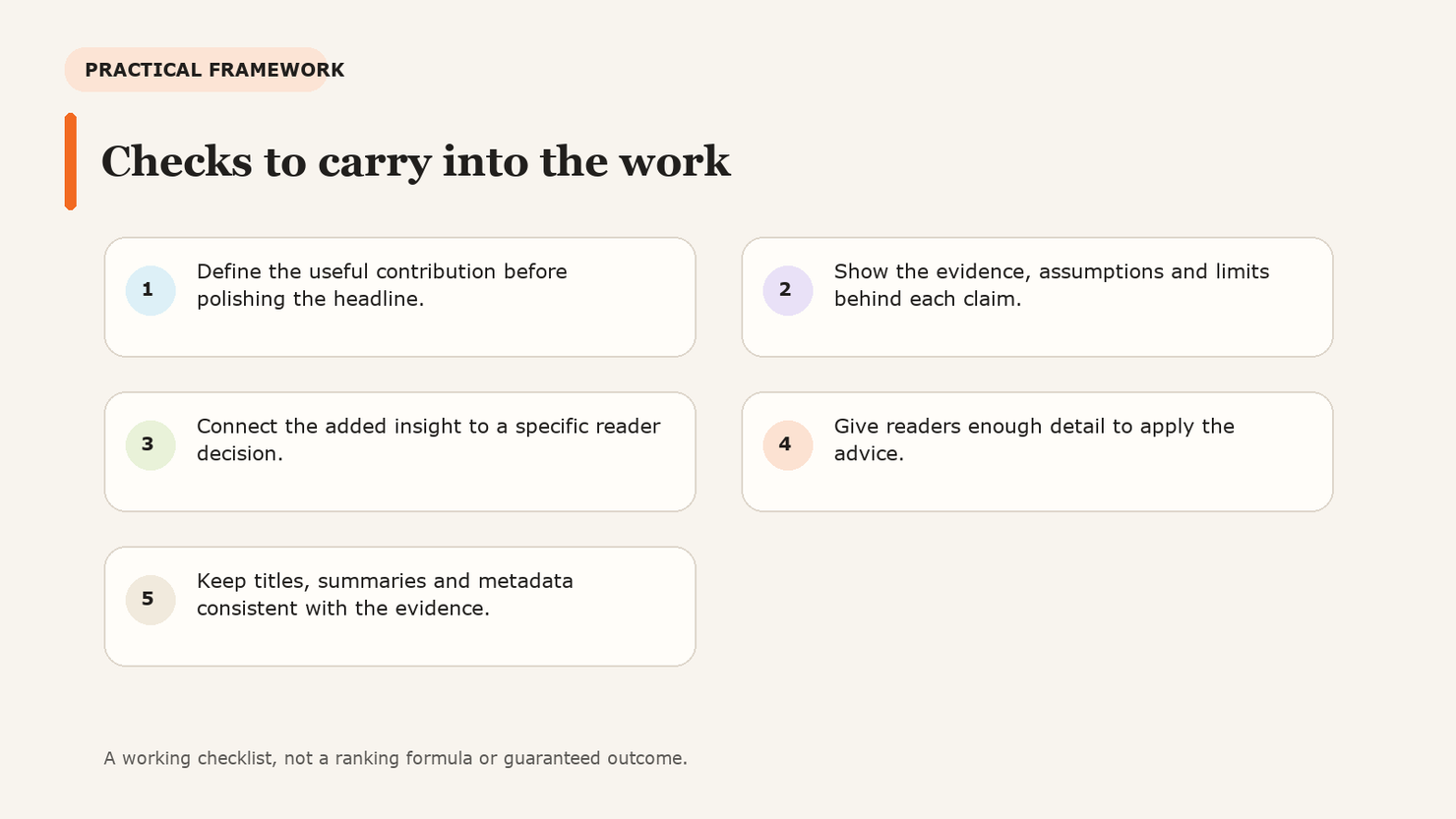
- Define the useful contribution before polishing the headline.
- Show the evidence, assumptions and limits behind each claim.
- Connect the added insight to a specific reader decision.
- Give readers enough detail to apply the advice.
- Keep titles, summaries and metadata consistent with the evidence.
Playbooks
Frameworks you can put to work
Growth marketing, LinkedIn presence, and more — delivered as PDFs.
Browse the playbooksA draft can be accurate, clear and full of the right keywords, yet still give readers little reason to choose it. The problem often sits beneath the writing: it repeats advice they can find almost anywhere.
Information gain SEO, as I use the term here, means asking what useful understanding a page adds beyond the basic answer. That might be a checked example, a clear decision rule, fresh evidence or a well-supported view. It does not have to be a new discovery.
My recommendation is to review that added value before polishing the headline. A stronger title can bring someone to the page. The page still needs to help them do something they could not do as well before.
The five-question test below is an editorial tool. It is not Google's scorecard, a confirmed ranking formula or a promise of AI citations.
What Google means by non-commodity content
Google's guide to generative AI search encourages useful content with distinctive views and expert or experienced insight. It contrasts that with pages that largely recycle common knowledge. It also stresses clear structure for human readers.
That gives content teams a useful direction, rather than a recipe for a ranking boost. A page needs a reason to exist beyond another keyword slot in the calendar.
Non-commodity content does not mean making every sentence surprising. Readers still need definitions and context. The useful difference comes from what you do with those basics: explain a tradeoff, show a method, reveal a limit or help someone make a choice.
A guide can cover a familiar topic and still be valuable. A strange claim can be novel and still be wrong. Originality needs to serve the reader, not compete with accuracy.
Set a baseline before judging the draft
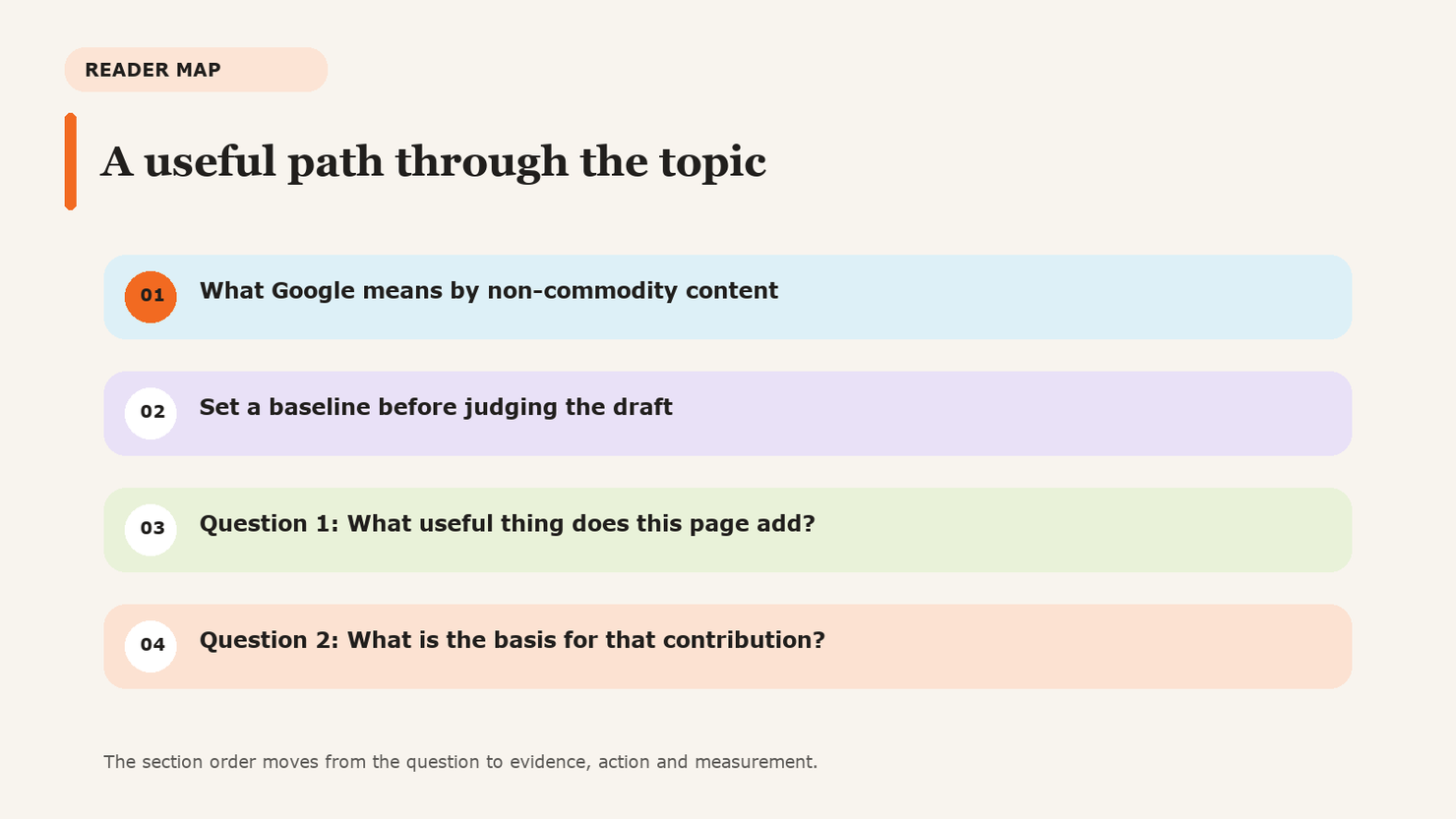
Start with the task the reader wants to complete. Then review a small, relevant set of sources: current search results, official guidance and material the audience already uses. Note the shared advice and the questions left open.
Keep that review bounded. Record what you checked and when. A sample of search results cannot prove that an idea is new across the whole web, and a few prompts cannot tell you everything an AI model knows.
Use the baseline to find a practical gap. Perhaps most guides say to choose a tool that is easy to use. Your reader needs to know how to test that claim before signing a contract. That is a better brief than simply asking for a longer guide.
Write the intended contribution in one sentence: “This page helps this reader make this choice by adding this specific evidence or method.” If that sentence stays vague, the draft probably needs more thinking.
Question 1: What useful thing does this page add?
Point to the actual contribution. Do not accept “more detail” or “better quality” without saying what the detail changes.
Useful additions can take several forms. A worked example can show how a rule applies under a real constraint. A comparison can make hidden costs easier to see. A tested process can explain where a common approach breaks down. A sound view can help readers weigh two reasonable options.
You do not need all of these in every article. Choose the contribution that fits the task and that you can support. For a simple definition page, a clear explanation of a common confusion may be enough to help the intended reader.
Ask an editor to highlight the passage that carries this value. If they can only point to a broad claim in the introduction, the promise has not reached the body.
Question 2: What is the basis for that contribution?
Separate what you know from what you suggest. A fact needs a source. A result needs a method. An opinion needs a reason. A made-up example needs a clear label.
Google's people-first content guidance asks whether pages offer original information or analysis and add substantial value when drawing on other sources. A list of citations alone does not do that work for you.
For research, explain the sample, date and limits. For a product test, say what was tested and under which conditions. For a recommendation, show the assumptions behind the choice. Readers should be able to see how you reached the answer.
First-hand experience is valuable when it exists. Do not invent it to make the page sound credible. If the article relies on desk research, say enough about the sources and reasoning to make that clear.
Question 3: Which decision becomes easier after reading?
Information is most useful when it connects to a choice. Identify the point where the reader can now act with less doubt.
A page about content briefs might help an editor decide whether to commission a new article or improve an existing one. A software guide might help a team choose what to test in a trial. A migration guide might help someone decide when to delay a move.
Show the conditions behind the advice. “Use this approach when…” is often more helpful than a universal best practice. Explain the cost or tradeoff as well as the benefit.
This also keeps content differentiation grounded. You are not trying to create a clever phrase for its own sake. You are making a decision clearer for a particular reader.
Question 4: Can the reader use the value without guessing?
A strong idea can still fail in delivery. Check whether the reader has the steps, inputs or example needed to use it.
If you recommend an audit, explain what to inspect and what counts as a problem. If you give a formula, define its inputs. If you show a checklist, explain how its answers change the next action.
Keep examples close to the advice they support. Short paragraphs help readers follow the argument, but breaking every sentence into a separate paragraph can make the page feel choppy. Group related thoughts and use headings when the task changes.
Clear structure also makes a claim easier to understand out of context. That is useful for readers who skim or arrive at one section. It does not guarantee that a search or AI system will quote the page.
Question 5: Is the promise honest across the whole page?
Read the title, summary and description beside the body. They should describe the same level of evidence.
A draft built on a hypothetical example should not be titled as a proven case study. A small test should not support a market-wide claim. A proposed framework should not sound like a method that hundreds of teams have already adopted.
Google's guidance on generative AI content calls for accuracy checks, including supporting page elements. Treat the metadata as part of the article, rather than a place to make stronger claims for clicks.
Check sources, dates, numbers and links before publication. AI assistance can help with drafting, but it does not remove the need for human review or create evidence for an experience that never happened.
A worked example: improve the answer, not its length
Consider a hypothetical article for an operations lead choosing an employee onboarding tool. The first draft says to compare features, check prices, read reviews and pick something easy to use.
That advice is reasonable but leaves the hard work with the reader. What should they compare? What does easy to use mean in their workflow?
A more useful version could provide a trial exercise. Ask each vendor to demonstrate the same scenario: a new hire needs access to three systems, one approval is delayed and the hiring manager changes midway through the process.
Have the team record who owns each step, where the delay appears and whether the change requires duplicate work. Then explain how those observations affect the choice. A team with frequent manager changes may care more about clear handoffs than a long feature list.
This is a proposed evaluation method, not a report of a test I conducted. It adds value through a specific scenario and decision rule. If the publisher later runs the trial, genuine observations can replace the assumptions, with the test conditions disclosed.
The article has become more useful without adding a grand claim or a large study. Its contribution is now easy to point to, check and apply.
Use the test as an editorial gate
For each draft, write a short answer to all five questions in the brief. Name the contribution, its basis, the decision it supports, how the reader uses it and whether the page's promise matches the evidence.
If the answers are weak, return to the brief. More words are rarely the first fix. You may need a better example, a narrower question or access to someone who knows the work.
Do not turn the test into a numerical “Google information gain score.” It is a way to expose gaps in your own editorial judgment. Nor should every missing detail become a separate cluster page. Google's spam policies warn against producing many low-value pages primarily to manipulate rankings.
Start with one article already in your queue. Add the five answers to its review notes and revise the weakest part. The useful question is simple: what can this reader now understand, decide or do better because this page exists?
Frequently Asked Questions
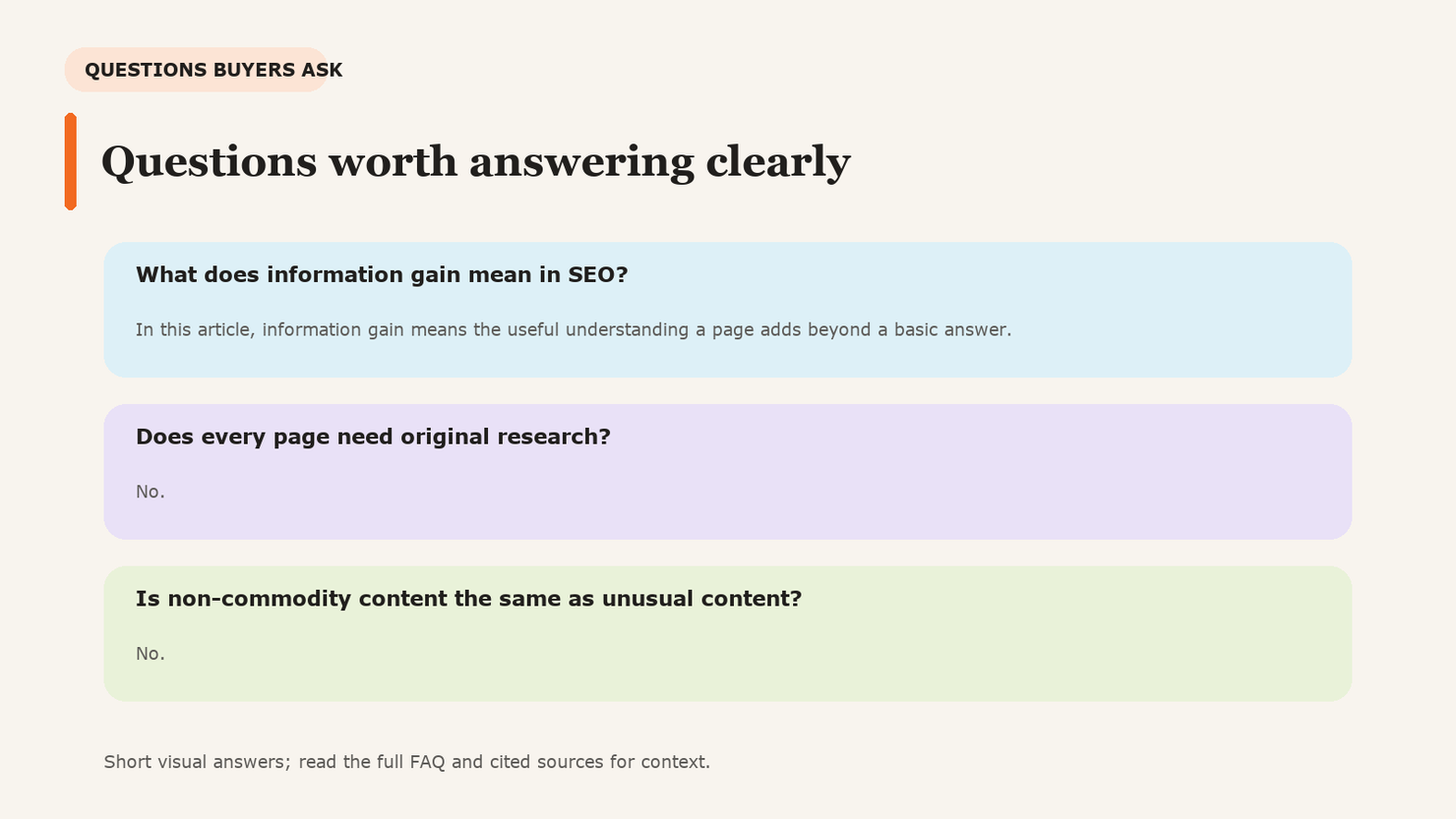
What does information gain mean in SEO?
Does every page need original research?
Is non-commodity content the same as unusual content?
Can this test guarantee AI citations or higher rankings?
Frequently Asked Questions
What does information gain mean in SEO?
Does every page need original research?
Is non-commodity content the same as unusual content?
Can this test guarantee AI citations or higher rankings?

Swapan Kumar Manna
Go-to-market & AI search strategist
Swapan Kumar Manna is a go-to-market and AI search strategist and Founder & CEO of Oneskai. He has spent 14+ years helping companies get found, get chosen and grow.