Part of the Demand Generation and Brand Authority: How Companies Become the Brand Buyers (and AI) Already Know series
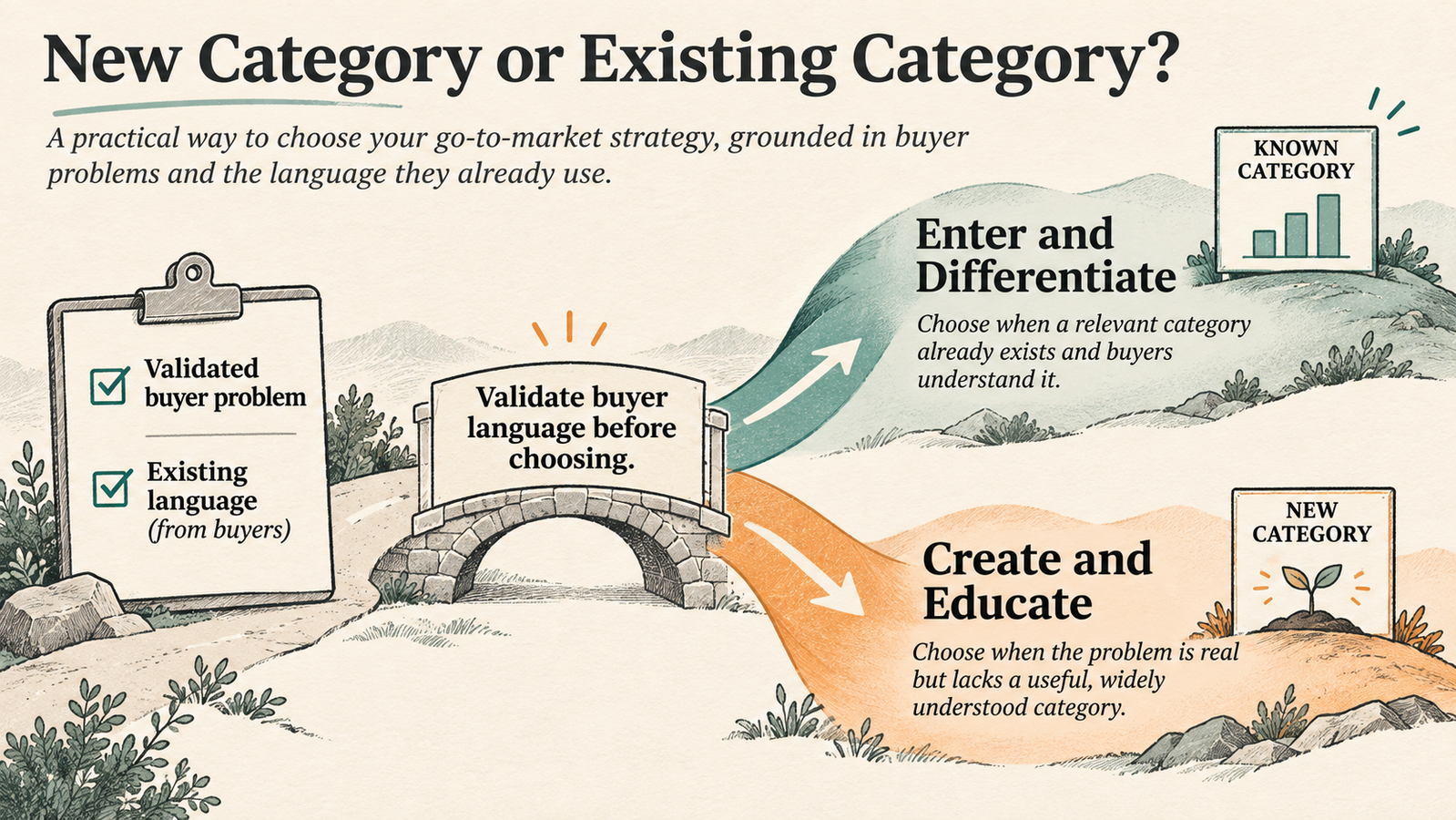
Create a new B2B category only when a repeated, important buyer problem is poorly described or served by existing categories and buyers can adopt a new frame. If buyers already understand the need, entering the known category with a clear, evidence-backed difference may be more practical.
Key Takeaways
- Category creation requires buyers to learn and adopt a new frame.
- Validate the problem in customer language before naming a category.
- Assess budget ownership, urgency, alternatives, and adoption costs.
- Category entry points describe buying situations, not a company entering a market.
- Treat category creation as a hypothesis to test, not a guaranteed strategy.
Playbooks
Frameworks you can put to work
Growth marketing, LinkedIn presence, and more — delivered as PDFs.
Browse the playbooksA company should create a new market category only when buyers have a meaningful problem that existing categories fail to describe or solve well, and when evidence suggests enough buyers will learn and adopt a new frame. If buyers already recognize the need and compare established solutions, entering that category with a clear difference is usually the lower-friction choice.
The decision is not simply about naming. Category creation asks a market to learn a new way to describe and evaluate a problem. Category entry means competing within a category buyers already understand. This guide offers a practical decision process and clarifies how category entry points fit into the discussion. It supports the demand generation and brand authority pillar and the guide to building an executive point of view.
Category creation and category entry are different strategies
A category is a shared way buyers and sellers group related problems, solutions, and expectations. When a company creates a category, it tries to establish or change that shared frame. This can involve educating buyers, helping them recognize a problem, defining a new solution type, and influencing how the market evaluates alternatives. It may also require changes in product, sales, customer education, and partner language, not just a new label.
Category entry means making an offer visible within an existing market frame. The company still needs a reason for buyers to consider it, but buyers can use familiar language, comparison criteria, budgets, and procurement processes. The distinction is about the market’s existing understanding, not whether the product feels innovative to its maker.
In branding literature, category creation is sometimes used broadly to describe reframing existing boundaries. Academic reviews note that research on how new market categories emerge is still developing, and researchers distinguish different formation processes. This is a reason to treat category creation as a strategic hypothesis to test, rather than a guaranteed playbook. See the review of market category formation processes and the overview of research on market categories.
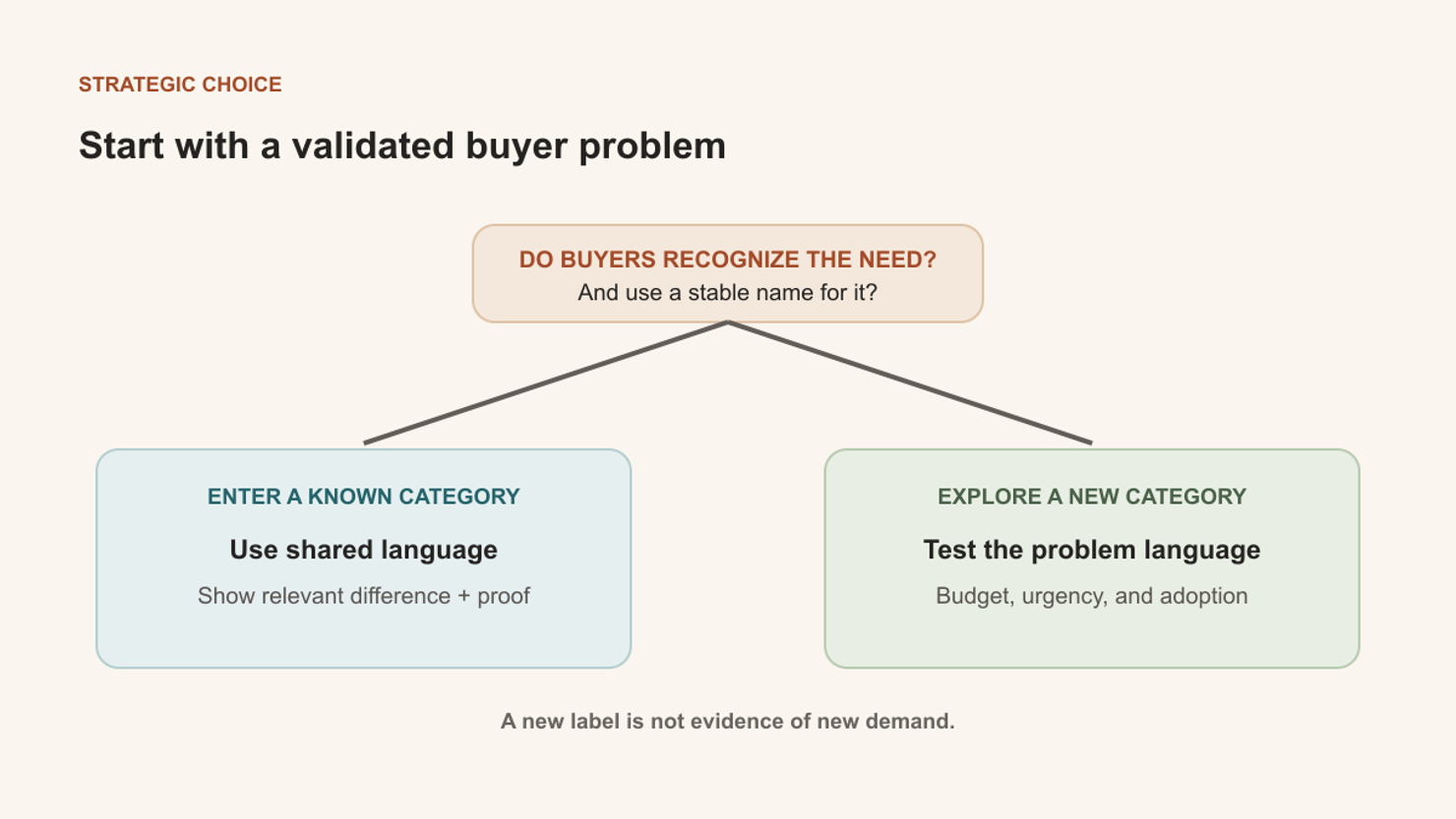
First validate the buyer problem
Start with customer interviews, sales conversations, support questions, search language, procurement criteria, and product usage. Ask what happened before buyers looked for help, how they describe the problem, what they use now, who is involved, and what makes the issue urgent. Look for repeated patterns across accounts rather than relying only on the founding team’s view.
A real problem does not automatically justify a new category. Buyers may already have a workable name for it, even if the company uses a different phrase internally. If buyers consistently search, budget, compare, and buy within an established category, changing its name can make the offer harder to find and explain. A new term may be useful as a descriptor, but it should not replace familiar buyer language until evidence supports that change.
Signals that a new category may be warranted
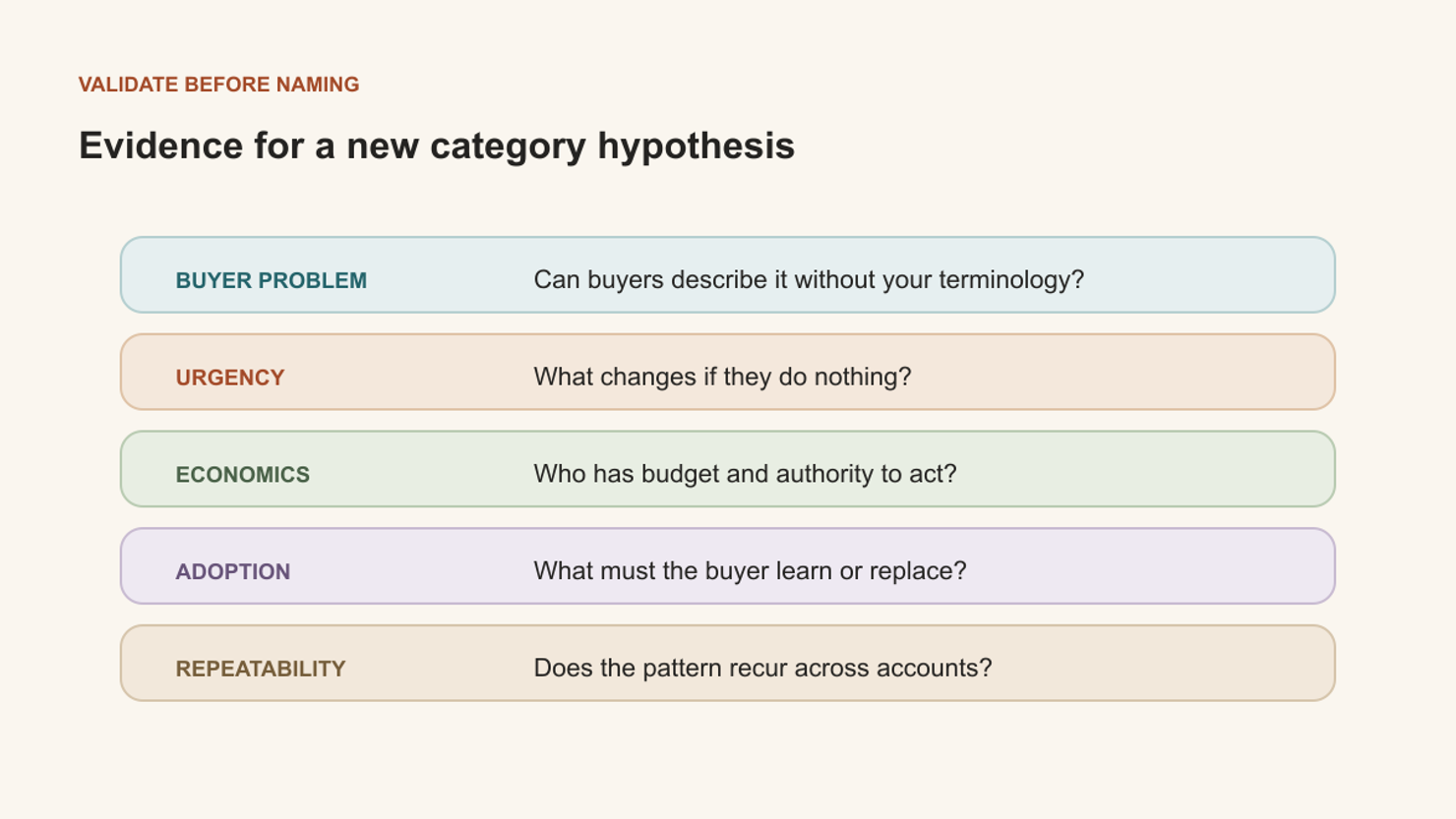
A new category may be worth exploring when a recurring problem is important but poorly served, buyers cannot find a relevant comparison set, and current terminology hides a meaningful difference in the job to be done. The case is stronger when buyers independently describe the unmet need, have a reason to act, can identify a budget owner, and understand why current alternatives do not fit.
A new category also needs a credible adoption path. Consider who must learn the language, what proof they need, which internal teams must agree, and whether the buying process can accommodate an unfamiliar solution. If education costs fall entirely on the first company and competitors can easily use the new language after demand appears, assess that risk before investing heavily.
A product that combines features from two known categories does not necessarily create a third one. Nor does a marketing team’s preference for a distinct term prove that buyers will adopt it. Test the problem and decision context first, then decide whether a new category label helps buyers understand the choice.
When category entry is the better choice
Choose category entry when buyers already recognize the need and have a stable way to search for, compare, and buy solutions. Use the language they understand. Make the difference concrete: the audience served, use case, implementation model, proof, integration, risk profile, or total cost may matter more than a new category name.
A new entrant still needs to earn attention and trust. Build a clear position, demonstrate performance with supportable evidence, explain trade-offs, and make comparison easy. Avoid claiming to be “the only” or “first” option unless the statement can be verified and materially helps a buyer.
Put this into practice
The GTM Funnel Playbook
How B2B teams find, win and keep customers, with a 90-day action plan. Seven funnel stages, one owner each, from the revenue number to the clients you keep.
Category entry points are not the same as category creation
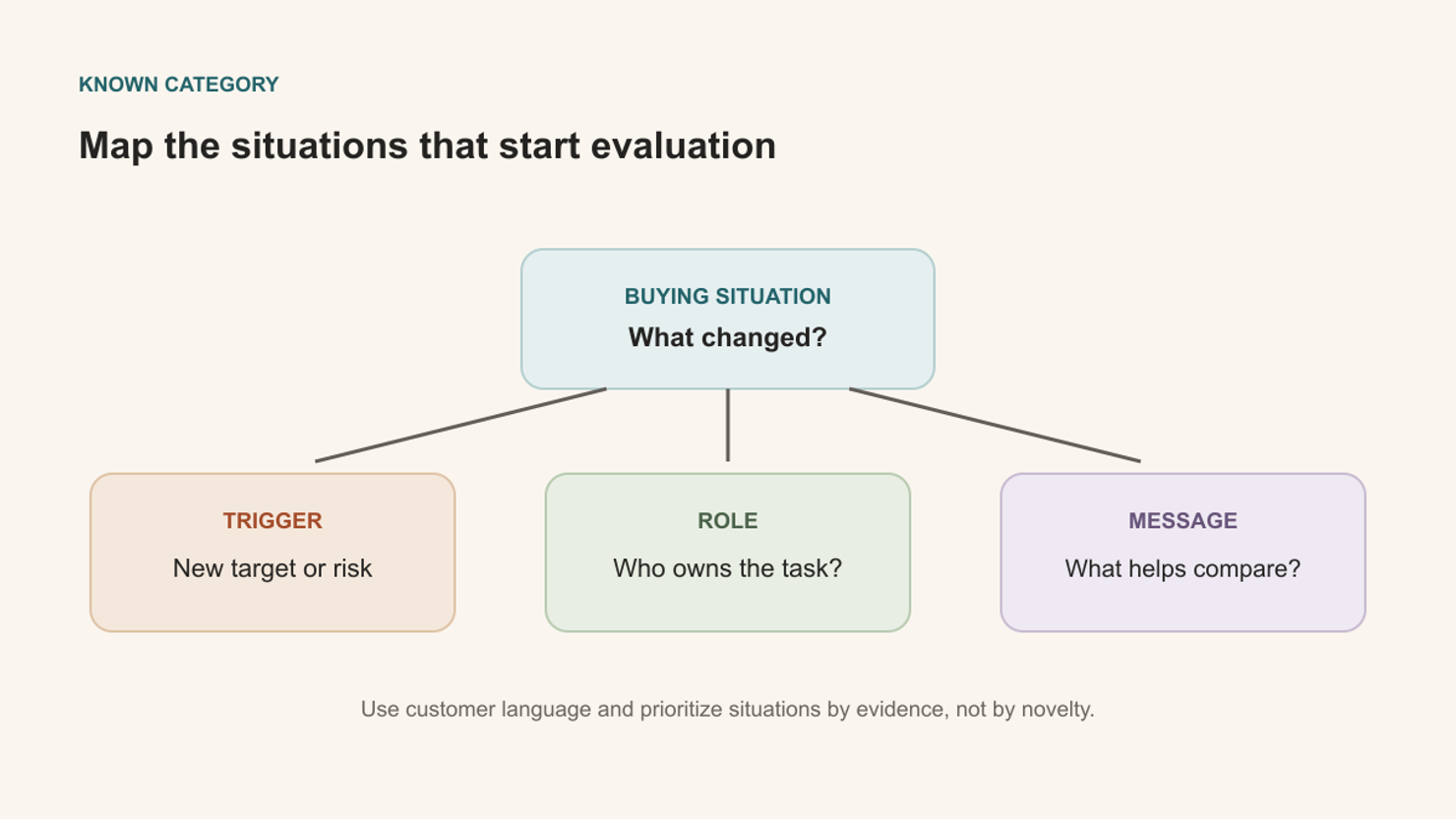
The term category entry points has a specific use in marketing science: it refers to situations, needs, or cues that bring a buyer into consideration of a category and associated brands. It does not mean a company’s entry into a market. The Ehrenberg-Bass Institute has published B2B guidance on identifying buying situations and connecting brand messages to relevant category entry points. For an established category, mapping triggers, roles, and common buying contexts can help a company become easier to recall when the need arises.
Use those buying situations to sharpen content, sales explanations, and brand messaging without inventing a category. See the Institute’s overview of category entry points in a B2B context. This idea complements the broader demand generation strategy: understand when the need appears, then provide useful information in the places buyers consider options.
A practical test before committing
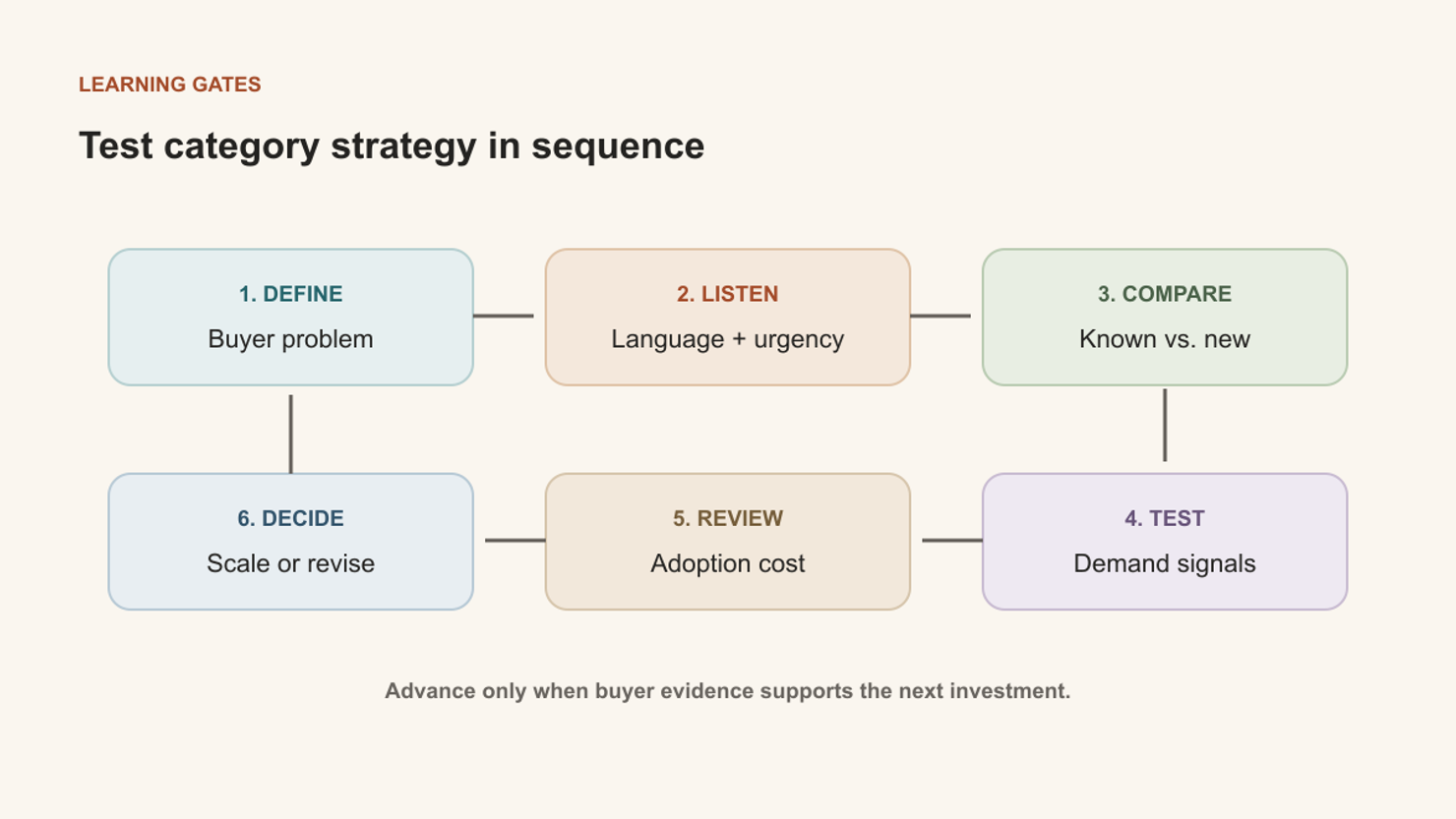
Write down the buyer problem in the words customers use, without introducing the proposed category label. Test whether it recurs across the intended segment. Identify what buyers do now and whether the current category language helps them find and compare solutions. Ask what changes if they do nothing, who owns the budget, and which colleagues need to agree.
Then test the category frame. Show buyers a neutral description of the proposed concept and ask them to explain it back, identify when they would use it, compare it with existing options, and say what proof they would need. Avoid leading questions such as “Would you buy this revolutionary category?” Test willingness to change behavior through observed steps, pilot participation, budget discussions, or other appropriate evidence, not compliments alone.
Compare the cost of entering an existing category with the cost of educating a market. Estimate the evidence, content, sales enablement, product changes, and time required. Set a learning milestone before a larger investment. If buyers do not understand the new framing, revise the explanation or return to the established category.
Common category strategy mistakes
Do not confuse a differentiated product with a new market category. Do not assume that a coined phrase creates demand or that a large addressable market exists because the language sounds broad. Do not present analyst labels, press mentions, or competitor adoption as proof that customers understand or buy within the category.
Avoid splitting content between a new label and established buyer terms without explaining the relationship. If the company introduces a new concept, define it in plain language and connect it to the problem people already recognize. Track whether the audience understands the idea and whether it affects evaluation, not only whether they repeat the name.
Frequently asked questions
Frequently Asked Questions
What is the difference between category creation and category entry?
When should a B2B company create a new category?
Is category creation always better than entering an existing category?
What are category entry points in B2B marketing?
How can you test whether a new category is viable?
Can a new product create a new category?
Research and further reading
Ehrenberg-Bass Institute: Category entry points in a B2B world discusses buying situations and category entry points in B2B.
Durand and Khaire: Market category formation processes reviews research on how market categories are formed.
The short history and long future of research on market categories reviews work on category emergence and creation.
Put this into practice
The GTM Funnel Playbook
How B2B teams find, win and keep customers, with a 90-day action plan. Seven funnel stages, one owner each, from the revenue number to the clients you keep.
Frequently Asked Questions
What is the difference between category creation and category entry?
When should a B2B company create a new category?
Is category creation always better than entering an existing category?
What are category entry points in B2B marketing?
How can you test whether a new category is viable?
Can a new product create a new category?

Swapan Kumar Manna
Go-to-market & AI search strategist
Swapan Kumar Manna is a go-to-market and AI search strategist and Founder & CEO of Oneskai. He has spent 14+ years helping companies get found, get chosen and grow.