Part of the Modern SEO Strategy: A Practical Guide for the AI Era series
Programmatic SEO uses templates and data to create pages at scale. Before expanding, check each page’s task, source facts, useful answer and maintenance owner. Automation alone is not the abuse test, and this review cannot guarantee search outcomes.
Key Takeaways
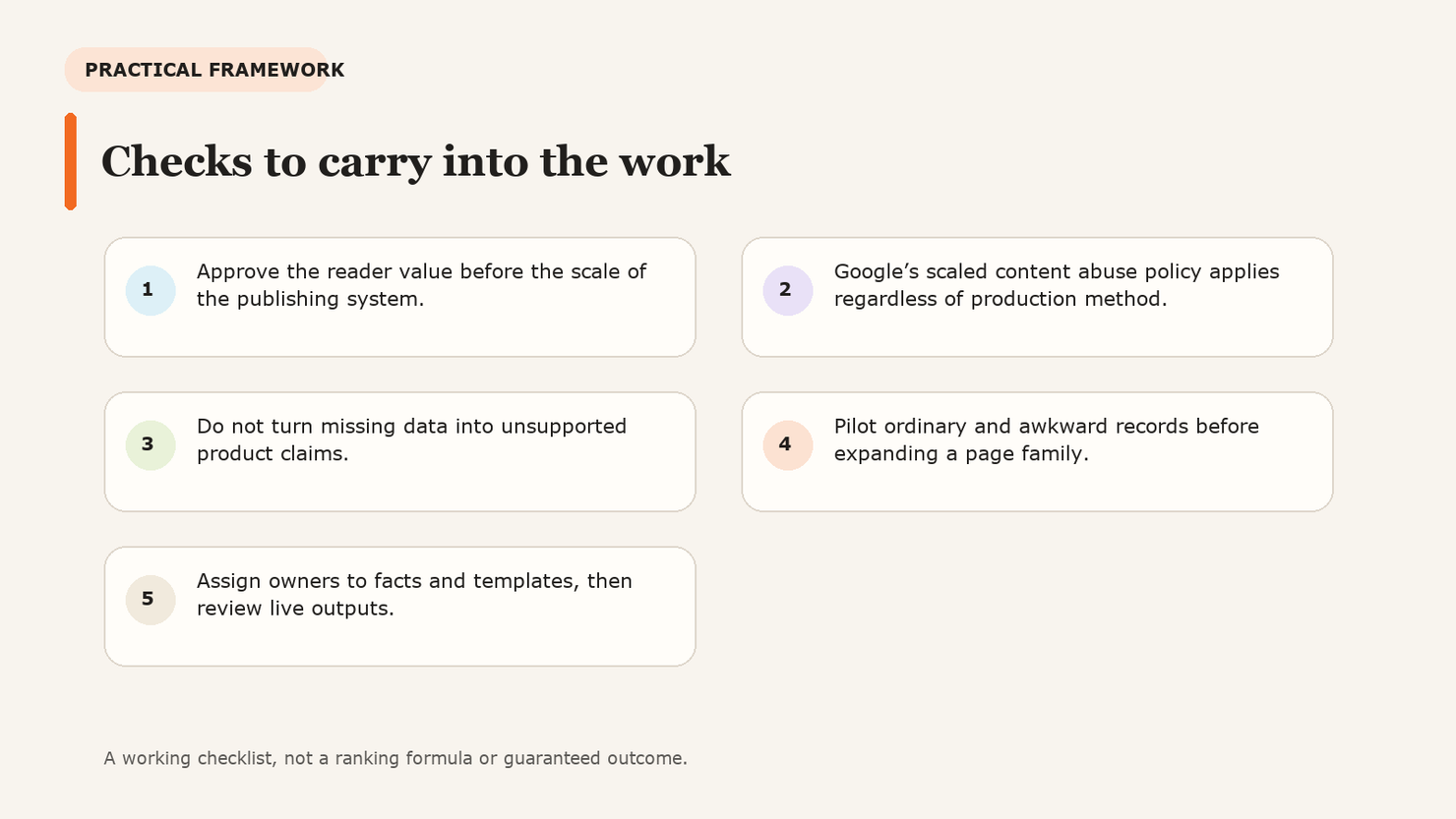
- Approve the reader value before the scale of the publishing system.
- Google’s scaled content abuse policy applies regardless of production method.
- Do not turn missing data into unsupported product claims.
- Pilot ordinary and awkward records before expanding a page family.
- Assign owners to facts and templates, then review live outputs.
Playbooks
Frameworks you can put to work
Growth marketing, LinkedIn presence, and more — delivered as PDFs.
Browse the playbooksA template can save a team hours of work. It can also turn one weak idea into hundreds of weak pages before anyone stops to read them.
Programmatic SEO uses templates and data inputs to create pages at scale for search demand. The useful question is what each page helps a visitor do. A different keyword, city name or product label does not, on its own, create a different answer.
My advice is to approve the value of the page before approving the scale of the system. Check whether the data supports a useful answer, whether the template expresses it clearly and whether someone can keep it accurate.
The value-per-page test below is an editorial decision tool. It is not Google's scoring system or a guarantee against a search penalty. It helps teams find weak assumptions before those assumptions spread across the site.
What Google's scaled content policy actually addresses
Google's spam policies describe scaled content abuse as making many pages primarily to push up rankings rather than help users. The policy applies regardless of how the content is created.
That distinction matters. Automation is not inherently the problem, and human writing is not a shield for low-value pages. Look at the purpose and result of the work, rather than treating the production method as the whole test.
Useful scaled pages may answer distinct needs through checked data or tools. Weak ones may swap terms into the same text, combine material without adding value or send visitors through near-identical pages to the same destination.
Do not read a lack of immediate enforcement as proof that the approach is sound. Equally, a traffic drop alone does not prove that a particular policy was enforced. Review the evidence before naming the cause.
Choose a use case with a real difference between pages
Start with the task. An integration directory can help people check whether two systems work together. A product specification library can help buyers compare concrete limits. A location directory can help users find a service that is actually available nearby.
Those examples only work if the differences are real. An integration page needs accurate details about what is supported, what is required and where the limits sit. A location page needs useful local facts, not a place name inserted into a broad service pitch.
For a B2B team, the inputs often matter more than the prose generator. A well-kept set of supported features can power clear answers. A spreadsheet of keyword variants cannot prove product fit or local service coverage.
Choose one page family you can support well. Describe the source of its facts and how each page differs. If that explanation relies mainly on changing the title, pause the project and rethink the need.
Test 1: Does this page resolve a distinct task?
Write the reader's task in one sentence. Then explain why it deserves its own page rather than a section in a main guide or a filtered view in a useful directory.
A distinct URL can make sense when someone needs a stable, specific answer they can return to or share. It makes less sense when the page repeats the same answer for a slightly different phrase.
Google's AI search guidance warns against making distinct pages for every possible search variation primarily to push up rankings. Apply that principle before multiplying your keyword list into URLs.
Related wording can often share an answer. Build the page around the task and supporting facts, then use natural language that describes it. Do not force each variation into a distinct template slot.
Test 2: Are the inputs correct and useful enough?
Inspect the data that will drive the page. Where did it come from? Who can check it? What does an empty field mean? When does it need review?
A missing fit field must not silently become “supported.” A stale price should not be presented as current. If a source cannot prove a claim, the template should not fill that gap with claims that sound sure.
Keep facts, assumptions and suggestions distinct. Product documentation can support a feature statement. A suggested workflow needs to be labeled as guidance. A reported result needs evidence of how it was measured.
Google's generative AI content guidance calls for accuracy checks across the content and supporting page elements. Apply the same care to titles, descriptions and any data the template puts into markup.
Test 3: Is the complete page useful without the template pitch?
Read a page from the system as a visitor, not as the person who built the system. Can you complete the task? Are the constraints clear? Does the page explain what to do next?
Shared navigation and common explanations are normal parts of a site. The main answer still needs enough page-specific detail to justify the visit. A long introduction cannot compensate for an empty or vague result.
Google's people-first content guidance asks whether readers leave with enough knowledge to achieve their goal. Use that as a quality check on the output, rather than setting a minimum word count for every template.
Sometimes a concise table of verified facts is more useful than a few paragraphs of generated text. Sometimes the data needs context and a worked example. Choose the treatment from the task, not from a requirement to make every page look long.
Test 4: Can the page be maintained after launch?
Assign an owner to the data and another to the template if those roles differ. Decide what triggers a review: a product change, a source update, a broken link or a report from a user.
Think through what happens when the facts disappear. The team may need to revise the page, stop generating that pair or review whether the URL still serves a purpose. Do not leave unsupported answers online simply because the system already produced them.
Give important fields a traceable source and review date. That does not make the facts correct forever, but it makes checking and updating them possible.
The maintenance cost belongs in the business case. A large page count with no clear owner can create a growing burden. Scale should reflect what the team can keep useful, rather than how fast the publishing system can run.
A B2B example: integration pages with meaningful differences
Imagine a hypothetical workflow software company building pages for supported integrations. The reader wants to know whether a connection can handle their process before trying it.
A useful page could show the supported actions, required plan, setup steps and known limits. One integration might send new records in one direction; another might support updates in both directions. Those differences affect the buyer's choice.
The weak version uses the same broad promise on every page: connect your tools, save time and improve productivity. It replaces the partner name but offers no evidence about what the connection does.
The better system only creates a page when the company has enough verified information to answer the task. If a connection is planned but not available, it should not be described as live. If details are incomplete, the team should resolve the gap before presenting a firm answer.
This is an made-up design example, not a report of a system I tested. Its lesson is that the source data and publishing rules decide whether the template has useful detail to express.
Pilot the system across ordinary and awkward cases
Review a small set of pages before growing. Include straightforward examples, records with missing fields and cases with unusual limits. A template that looks good on its richest record may fail on the rest.
Check the whole page package. Does the headline overstate what is available? Does the description promise a comparison that the page does not provide? Does the visible text agree with any structured data?
Test the public response and navigation as well. A well-written output is not useful if it is hidden behind a broken route or a page that cannot be reached as intended. Keep technical access checks distinct from editorial value checks.
Choose the pilot size from the variety of the inputs. There is no fixed page count that makes a launch safe. The purpose is to expose failure patterns and fix the rules before making more instances of them.
Watch for doorway patterns and empty expansion
A warning sign is a family of pages that differs mainly by search phrase but funnels everyone toward the same generic destination. Google's doorway policy addresses pages created to rank for similar queries that lead users through less useful in-between pages.
Ask whether someone arriving directly gets a meaningful answer there. A location page with actual availability and relevant details may serve a need. A page that merely repeats the central sales pitch under a new city heading needs closer review.
Do not try to hide a weak pattern by spreading it across domains or changing the wording. Revisit the task and the source material. If you cannot explain the value of the single page, the larger system is not ready to grow.
Make the scale decision from evidence
After the pilot, record what passed, what failed and what must change. Separate page usefulness, truth of the facts, page delivery and business results. A gain in one area does not prove success in all the others.
Review whether visitors can do the job they came to do and whether the pages attract useful demand. If search performance changes, consider other factors before crediting the template alone. Neither indexing nor a short-term traffic gain provees lasting value.
Start with one proposed page family in your SEO audit. Write the task, source, page-specific answer and person who keeps it up to date for a sample record. If those four parts are clear, build a pilot. If they are not, improve the inputs or choose a more useful page before scaling the output.
Frequently Asked Questions
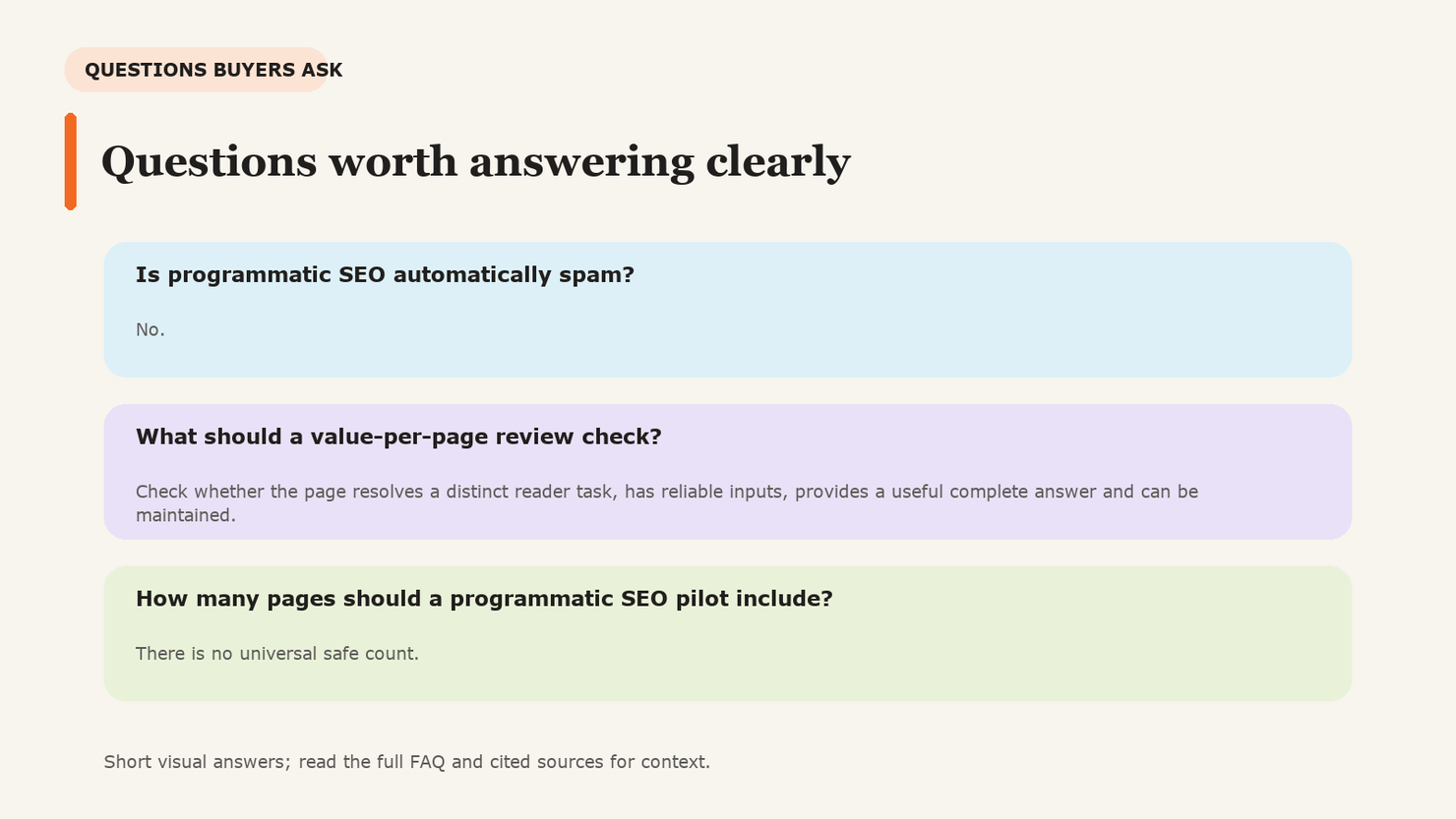
Is programmatic SEO automatically spam?
What should a value-per-page review check?
How many pages should a programmatic SEO pilot include?
Are city pages always doorway abuse?
Frequently Asked Questions
Is programmatic SEO automatically spam?
What should a value-per-page review check?
How many pages should a programmatic SEO pilot include?
Are city pages always doorway abuse?

Swapan Kumar Manna
Go-to-market & AI search strategist
Swapan Kumar Manna is a go-to-market and AI search strategist and Founder & CEO of Oneskai. He has spent 14+ years helping companies get found, get chosen and grow.