Part of the Modern SEO Strategy: A Practical Guide for the AI Era series
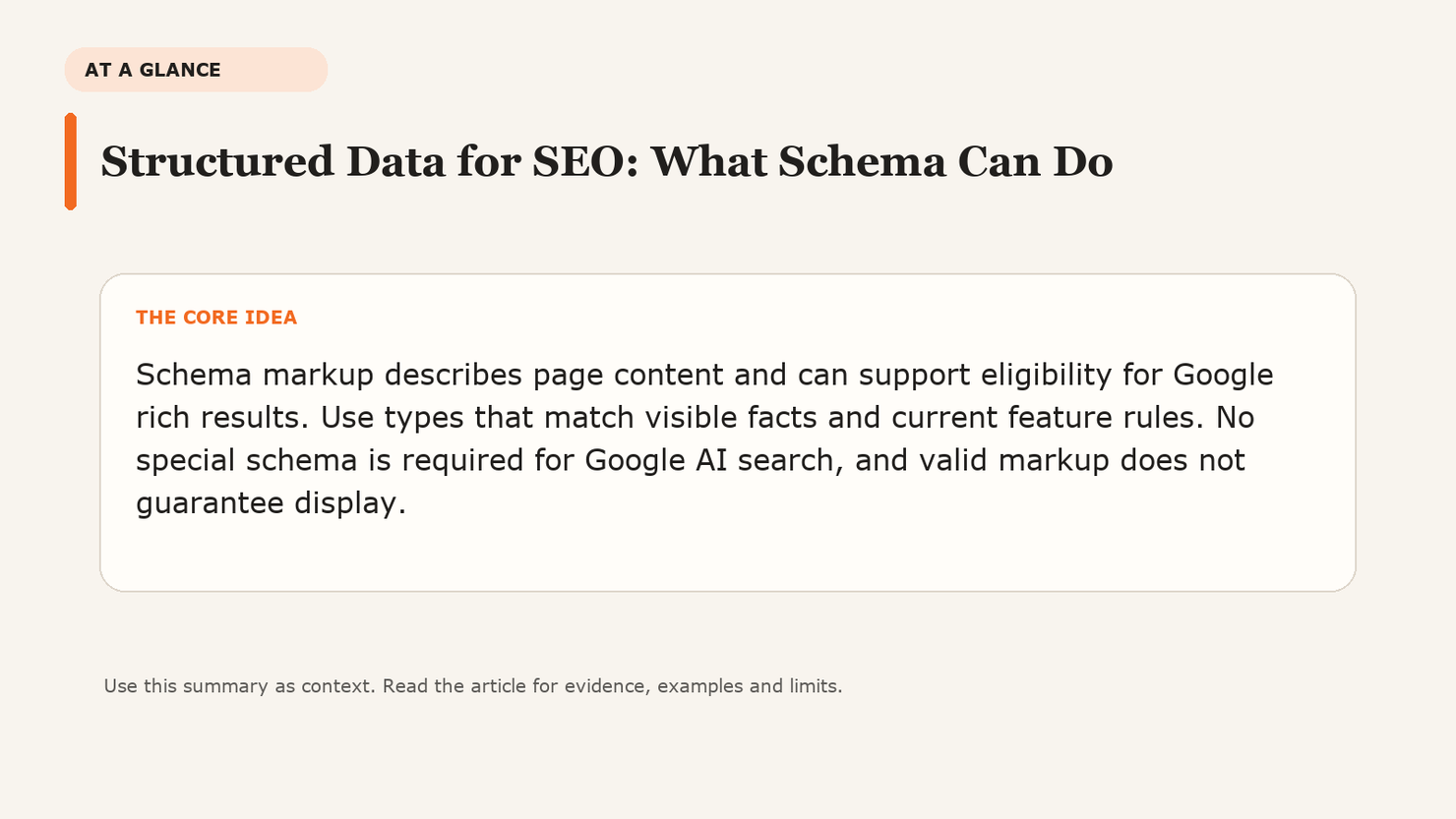
Schema markup describes page content and can support eligibility for Google rich results. Use types that match visible facts and current feature rules. No special schema is required for Google AI search, and valid markup does not guarantee display.
Key Takeaways
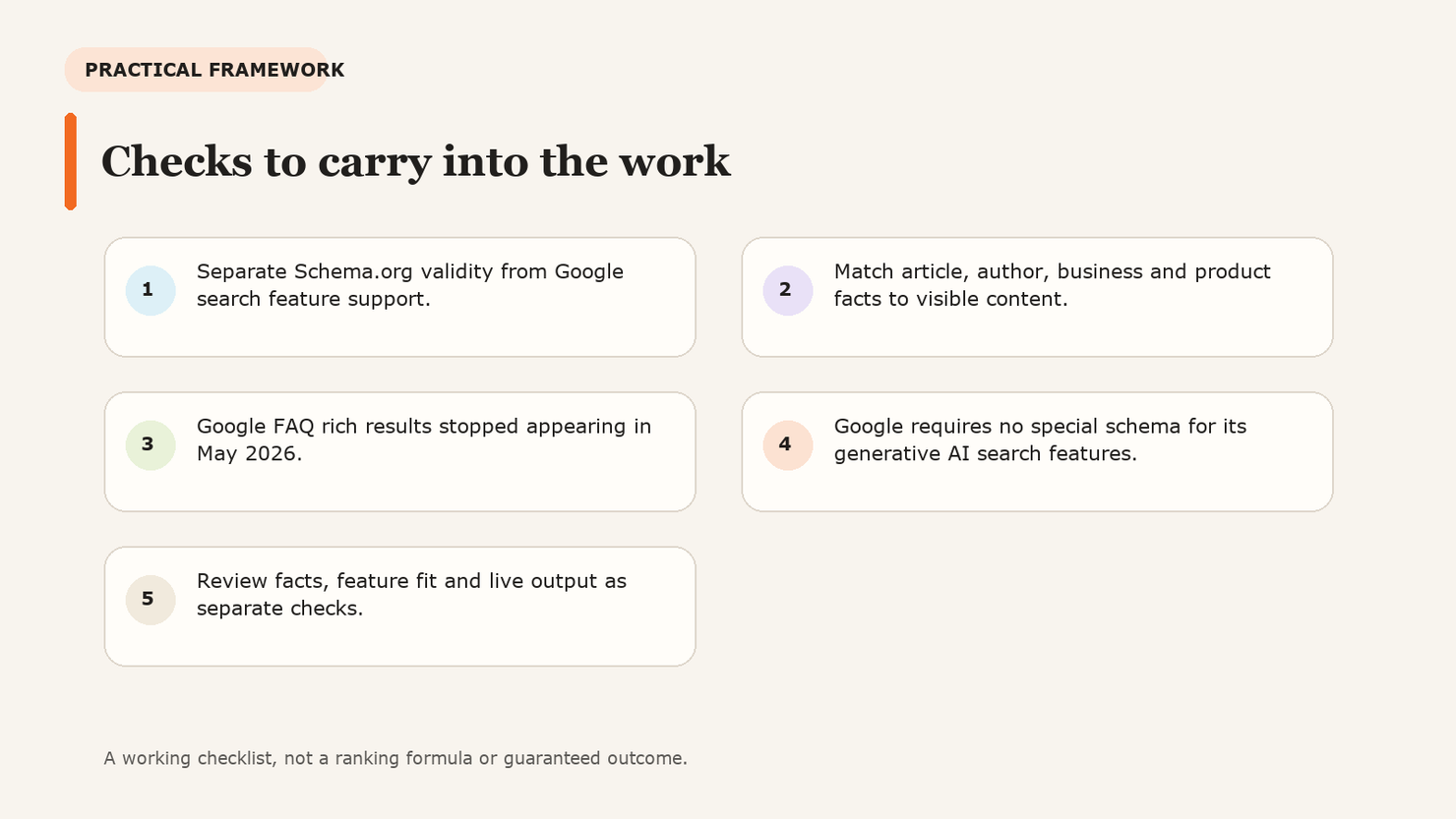
- Separate Schema.org validity from Google search feature support.
- Match article, author, business and product facts to visible content.
- Google FAQ rich results stopped appearing in May 2026.
- Google requires no special schema for its generative AI search features.
- Review facts, feature fit and live output as separate checks.
Playbooks
Frameworks you can put to work
Growth marketing, LinkedIn presence, and more — delivered as PDFs.
Browse the playbooksSchema markup can be useful work. It can also become a long list of labels that adds little to a page and gives the team another thing to maintain.
The useful starting point is simple: describe what the page actually contains, choose a type that fits its purpose and check the current rules for the search feature you want to support. Do not start with the claim that more schema will make an AI system trust or cite you.
Schema markup is structured data that uses a shared vocabulary to describe things such as an article, person, business or product. Google uses it to understand page content, and supported types can make a page eligible for richer search displays. Eligibility does not mean that display is guaranteed.
My working rule is that schema describes; it does not persuade. It can express a fact clearly. It cannot turn a weak claim into evidence or make an unrelated page qualify for a feature.
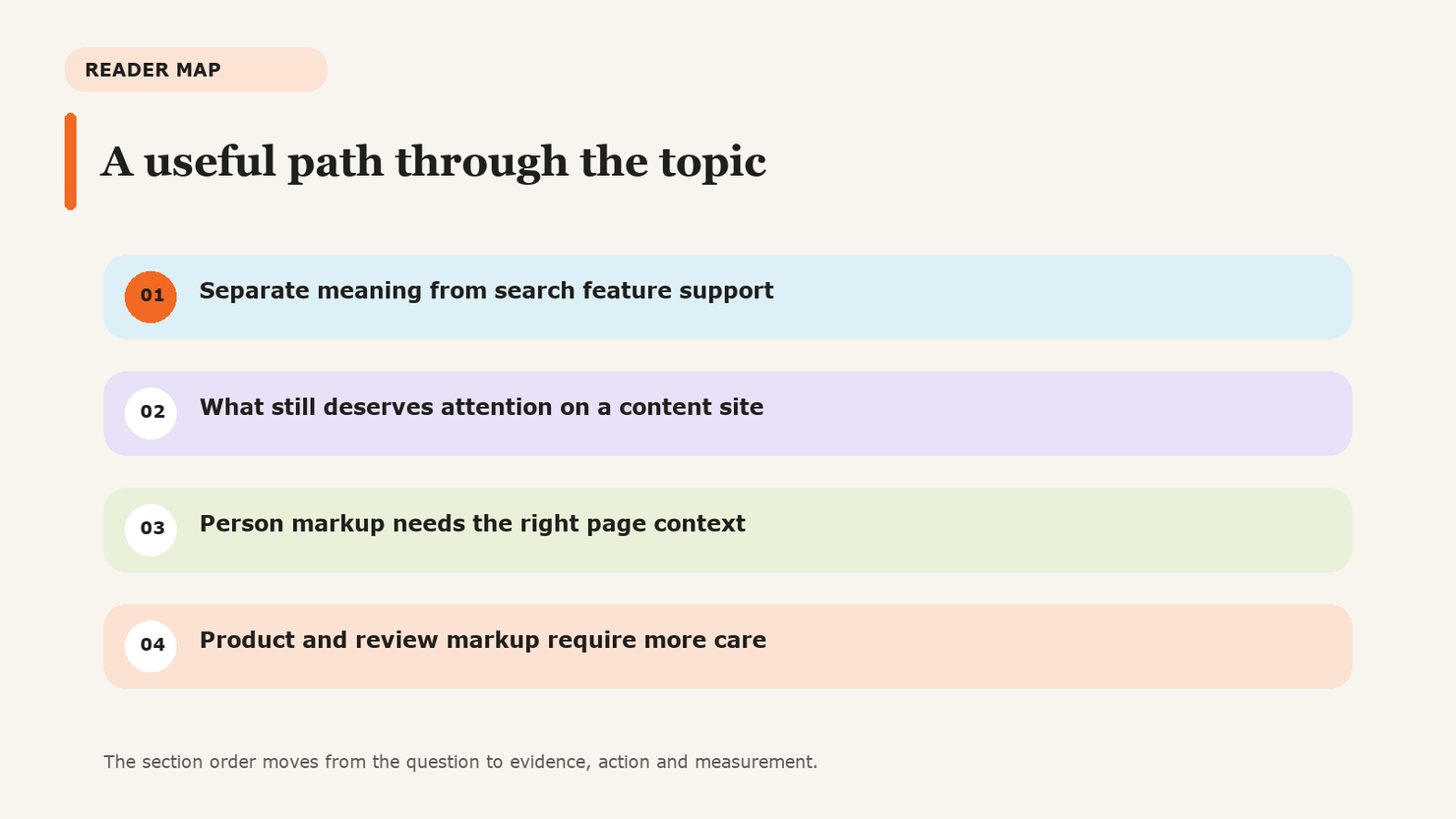
Separate meaning from search feature support
There are two questions to ask when choosing markup. Does the type accurately describe the page? Does Google support a relevant search feature for it?
Those are different questions. A type can be valid within Schema.org without having a matching Google rich result. A field can help describe an entity without producing a visible change in search.
Google's structured data introduction explains both its use of the data and supported formats. It recommends JSON-LD in most cases because it is easier to implement and maintain. Microdata and RDFa are also supported when used correctly.
JSON-LD is a way to write the data, not a quality signal in itself. A neat block of code can still contain a false price, the wrong author or a stale date. Treat its facts with the same care as the text on the page.
What still deserves attention on a content site
For a site built around articles, start with the facts that identify the content and its source. Keep the first pass small enough that you can check every field.
Article markup can describe a headline, author, dates and relevant images. Google's Article guide explains how these details can help it understand article pages. That is a useful purpose; it is not a promise of a new search badge or a ranking increase.
Keep the author linked to the right person and profile. Do not change an old article's date merely to make it look fresh. If it has been revised, the visible page and its data should tell the same story about that change.
Organization markup belongs where it accurately describes the business. Google's Organization guide says it can help distinguish one organization from another. Use correct public facts and official links. Do not blur the founder, company and product into one identity.
Breadcrumb markup can describe a page's place in the site. Google's Breadcrumb guide covers its use in search. Choose a trail that reflects a sensible route for readers. Do not build a chain of keyword labels with no real place in the site.
These types do different jobs. An article describes the piece, its author identifies who created it and a breadcrumb describes its place. Copying the same block everywhere without checking those roles can create conflicts rather than clarity.
Person markup needs the right page context
Person schema is often sold as a shortcut to authority. I would treat it as a way to describe identity, with claims that need support.
A person's name, profile links and job title should agree with the visible page. If a profile says someone founded a company, check that relationship before adding it to the data. Do not fill in awards or credentials simply because a field is available.
Google's ProfilePage guidance has its own rules and valid use cases. It is designed for pages whose main focus is a person or organization connected to the site. Check those rules before using it on a page that merely mentions someone.
A byline inside an article and a dedicated author profile have different purposes. Link them clearly, but do not assume that every page containing a person's name is a profile page. Nor does Person markup guarantee a knowledge panel or an AI recommendation.
Product and review markup require more care
If a page is about a product, check the relevant Google feature guide rather than borrowing a generic template. Product snippets and merchant listings have different purposes and requirements. Google's Product overview is a useful starting point.
A price or offer must reflect what the visitor can actually find on the page. If the price changes, the data needs to change with it. The same applies to stock, ratings and review counts where those fields are used.
Do not add Product markup to every service page simply to chase stars. Do not invent a rating or turn praise from a sales call into a review count. A field's existence is not permission to use it on an unsuitable page.
For a B2B site, the first question is still what the page represents. A software review, a pricing page and a consulting service page are not the same thing. Decide the page's role before choosing its markup.
FAQ content remains useful, but its rich result has changed
Readers can still benefit from a short FAQ section that resolves real questions. That editorial value should guide whether you include one.
Google's Search documentation updates say FAQ rich results stopped appearing in Search from 7 May 2026. Google later removed the feature's documentation. Advice that promises an expanded Google FAQ result for adding FAQPage markup is therefore out of date.
This does not mean that a question-and-answer section has become bad content. It means the feature claim has changed. Keep useful answers when they help readers, and review any template or plugin still sold on the retired display benefit.
Avoid attaching the same generic questions to every article. Each page should resolve the questions left by its own subject. A repeated block should not substitute for a clear main answer.
No special schema unlocks Google AI search
Google's guide to generative AI search states that structured data is not required for its generative AI features and that no special Schema.org markup is needed. It still recommends using relevant structured data within a wider SEO approach.
That is a good reason to question a package sold as “AI schema” if its main promise is guaranteed placement in AI Overviews or AI Mode. Ask which official feature it supports, what visible content it describes and how the claim will be checked.
Keep that conclusion within its scope. Google guidance does not prove how every other AI product handles markup. If a vendor makes a claim about ChatGPT, Copilot or Perplexity, ask for current evidence from that product rather than accepting a universal citation formula.
Clear facts, useful content and sound technical access still deserve work. Schema cannot replace them. A page that says little of value does not become a strong source because its labels are detailed.
Validate truth, fit and delivery separately
I suggest three checks before approving a markup change. First, check the facts against the visible page. Second, check the type and feature rules. Third, check the data delivered on the public URL.
Google's general structured data guidelines require markup to reflect visible content and meet quality rules. Do not mark up claims that a visitor cannot find on the page. Keep the data current and relevant to the page's main purpose.
Use the Rich Results Test for Google-supported features. Use a Schema.org validator when you need to check broader vocabulary and structure. These tools answer different questions; a valid type need not have a Google rich result.
Then inspect the page Google can access. A correct snippet in a CMS does not prove that the live page outputs it. Check for duplicate blocks, conflicting values and template changes that remove key fields.
A passing test does not establish factual accuracy or guarantee display. Someone still needs to review what the data says. Give that review a named owner, especially for fields that change often.
A worked example: an article template with conflicting dates
Imagine a hypothetical content site. Its article shows one publication date, while a plugin outputs another. A second block uses today's date whenever the page is loaded. All three values may look tidy on their own, but together they give a confused account of the content.
The useful fix is to identify the source of truth, remove the conflict and connect each field to the right event. Publication reflects when the article was first published. A modification date should reflect a real change, not a routine page request.
The team should then check a sample of article pages and confirm that the visible dates and output agree. This is a proposed review method, not a finding from a test of this website. Its value is in showing what to verify before adding more fields.
Start your schema audit with one page type. Record what it describes, which current feature it supports, who maintains the facts and how you will test the live output. If a field has no clear purpose or cannot be kept truthful, leave it out until you can support it.
Frequently Asked Questions
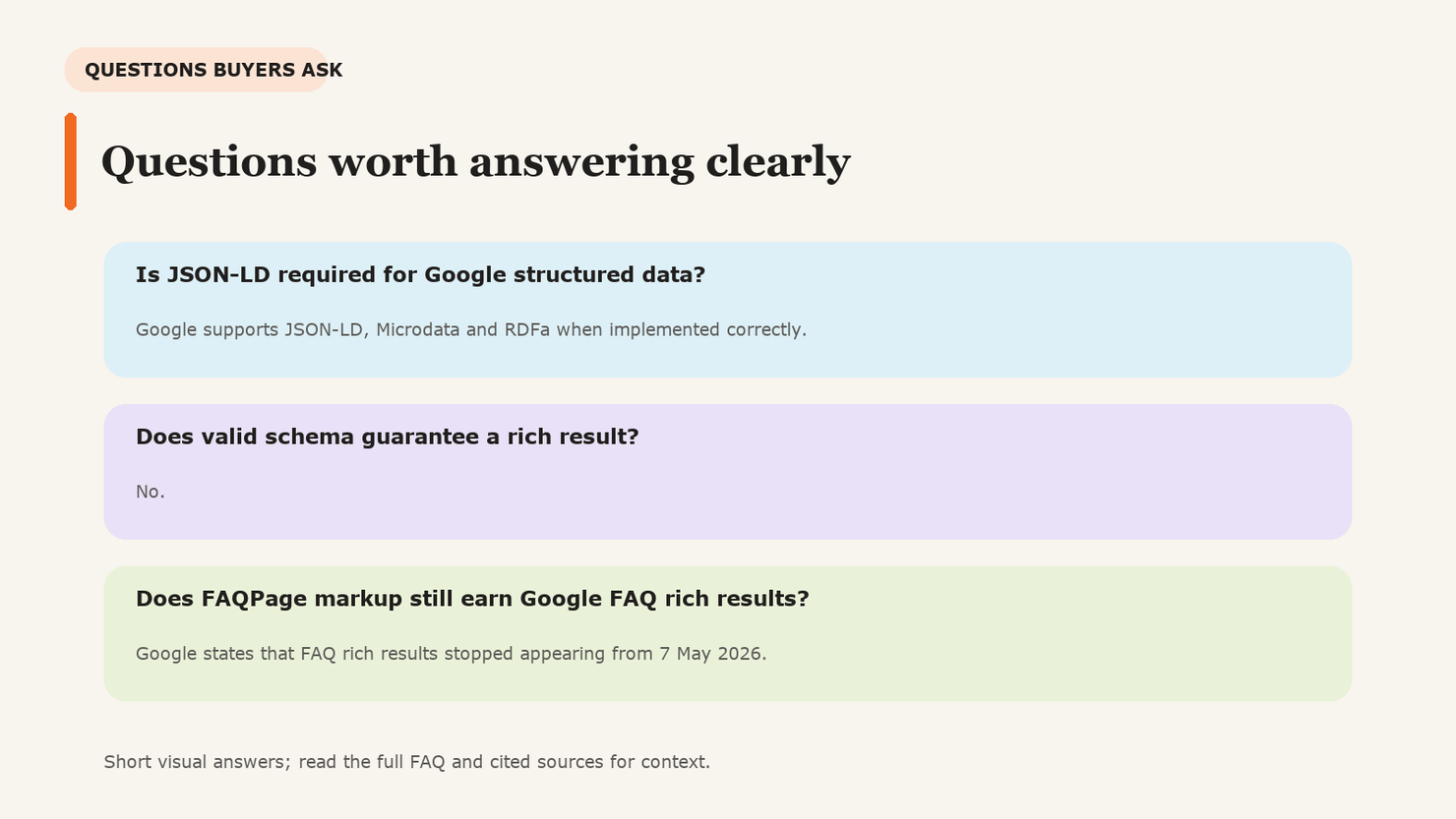
Is JSON-LD required for Google structured data?
Does valid schema guarantee a rich result?
Does FAQPage markup still earn Google FAQ rich results?
Which schema is required for Google AI Overviews?
Frequently Asked Questions
Is JSON-LD required for Google structured data?
Does valid schema guarantee a rich result?
Does FAQPage markup still earn Google FAQ rich results?
Which schema is required for Google AI Overviews?

Swapan Kumar Manna
Go-to-market & AI search strategist
Swapan Kumar Manna is a go-to-market and AI search strategist and Founder & CEO of Oneskai. He has spent 14+ years helping companies get found, get chosen and grow.