Part of the Modern SEO Strategy: A Practical Guide for the AI Era series
Search intent is the purpose behind a query. Map the reader’s task, the questions blocking it and the wording they use. Choose a page and format that serve that task, rather than creating separate pages for every keyword variation.
Key Takeaways
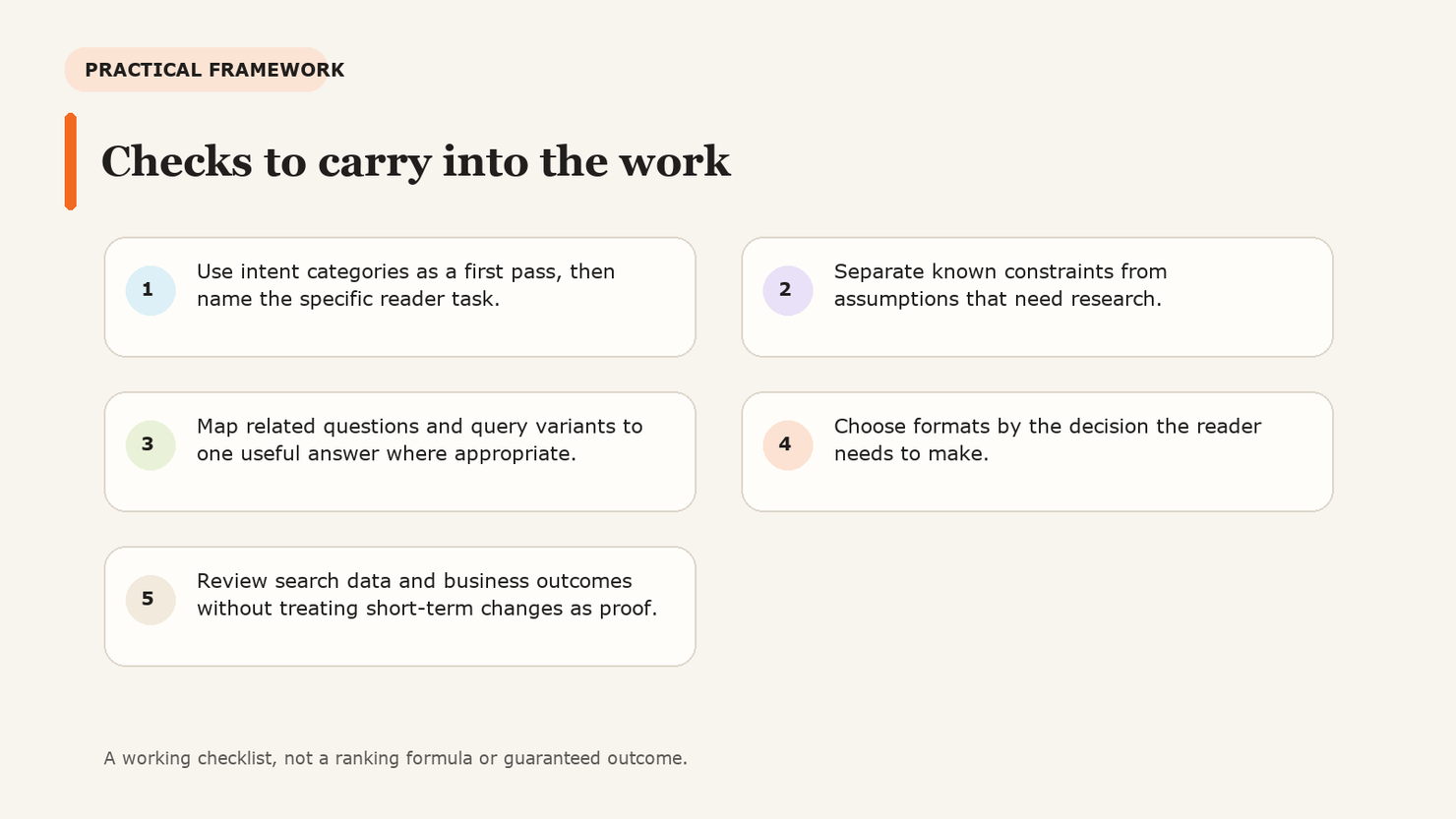
- Use intent categories as a first pass, then name the specific reader task.
- Separate known constraints from assumptions that need research.
- Map related questions and query variants to one useful answer where appropriate.
- Choose formats by the decision the reader needs to make.
- Review search data and business outcomes without treating short-term changes as proof.
Playbooks
Frameworks you can put to work
Growth marketing, LinkedIn presence, and more — delivered as PDFs.
Browse the playbooksA keyword tells you what someone typed. It rarely tells you the whole job they want to finish. If your brief stops at the phrase, you can write an accurate article that still leaves the reader without a useful answer.
Search intent is the purpose behind a search: what the person wants to learn, find, compare or do. Intent mapping connects that purpose to a page that helps them complete the task. The keyword remains useful, but it becomes one part of the brief rather than the whole brief.
My recommendation is to work through three layers: the task, the questions that stand in its way and the language people use to ask those questions. I call this the Task–Question–Keyword ladder. It is a planning method, not a published Google ranking formula.
This approach works for short searches and longer questions. You do not need a new page for every wording, or a separate writing style for every AI product.
Start with the task behind the phrase
Consider the phrase “project management software.” It could come from someone learning what the category means, someone comparing tools or someone trying to reach a product they already know. The same broad phrase can sit near several different tasks.
Before choosing an article format, write what success looks like for the reader. “Understand the category” and “choose a tool for a remote design team” require different answers. The second also needs constraints: team size, budget, existing tools and the kind of work being managed.
Keep those constraints honest. If the query does not reveal them, treat them as questions to investigate. Do not build a confident persona from a few words and assume every visitor fits it.
Google's explanation of how Search works describes its effort to return relevant, useful results. Your planning goal is to understand the need well enough to provide that kind of answer, rather than repeat the query as often as possible.
Use intent labels as a first pass
Common intent labels can help sort a keyword list. Informational searches seek understanding. Navigational searches aim to find a known destination. Commercial investigation involves weighing options, while transactional searches move toward an action such as buying or signing up.
These are useful working categories, not a complete account of the reader. “Informational” is too broad to decide whether a page needs a definition, a worked example or a troubleshooting guide.
Mixed intent also deserves attention. A reader may want to compare tools and understand a concept before choosing. A page can support both when they form a coherent task, but it should still have a clear main purpose.
Add a plain sentence after the label. For example: “Commercial investigation: compare three tools for a small design team that needs client approvals.” That sentence gives the writer more guidance than the category alone.
Build the Task–Question–Keyword ladder
At the task layer, state the outcome and the important constraints. Keep it close to what the audience needs to do. A phrase such as “grow traffic” is a business goal, not necessarily the visitor's task.
At the question layer, identify what must be resolved to reach that outcome. Someone choosing a tool may need to understand permissions, approval steps, costs and migration effort. These questions guide the substance of the answer.
At the keyword layer, record how people express those needs. A short search, a full question and a phrase from a sales conversation can all be useful leads. They do not need separate URLs just because the wording differs.
Then move back up the ladder to check the brief. Does the proposed page answer the questions? Do those answers help the reader complete the task? If the connection is weak, more keyword variants will not fix it.
Gather evidence before settling on the page
Use several inputs where you have access to them. Search results can show the formats currently being returned. Your own search data can reveal queries that already bring people to the site. Customer conversations can expose constraints that a keyword list misses.
When reviewing results, note the date, market and query. Look for patterns in the pages and the questions they answer. A results page is a sample, not a permanent description of intent. Different places, times and wording may produce a different mix.
Treat competitor pages as evidence to inspect, rather than an outline to copy. They may share a format because it suits the task, but they may also leave important questions open. Your brief needs a useful contribution beyond rephrasing them.
Google's people-first content guidance asks whether someone leaves with enough understanding to achieve their goal. Use that as the editorial check after the research, not just whether your outline resembles the current results.
Match the format to the decision
Choose the format that makes the task easier. A clear definition can resolve a basic concept. A step-by-step guide can support a process. A comparison can help someone weigh choices. A checklist can reveal whether something meets a set of needs.
A comparison page needs meaningful criteria and tradeoffs, rather than a row of similar feature lists. A troubleshooting page should help readers recognize the problem and test a likely fix. A tutorial needs enough detail to carry out the work.
These choices are editorial judgments, not guaranteed winning formats. Test whether the reader has what they need. The best format may be a short page, a deeper guide or an existing page with one missing section improved.
Keep the next action aligned with the task. A reader checking a definition may not be ready for a sales call. Someone weighing options may need a trial plan or a clear explanation of fit before taking that step.
A worked example: choosing a tool for client approvals
Imagine a hypothetical design studio choosing project software. Its task is to keep client feedback and approval clear without making clients learn a complex system. That is more specific than “find the best project management software.”
The key questions might be whether guests can comment without paid seats, how the team records an approval and what happens when feedback conflicts. Cost matters, but it is part of a wider workflow decision.
The keyword layer could include phrases about client approvals, guest access and project tools for design teams. These are illustrative phrases, not verified search-volume findings. They help show the kinds of needs the team would research.
A useful page could compare approval workflows under one shared scenario. For each option, explain who can comment, who approves and where the final decision is recorded. State which facts come from current documentation and which points require a hands-on check.
That page has a clear main job. A separate article defining project management may still serve beginners, but the comparison does not need to repeat the whole definition. Link to the broader context where it helps.
Map several queries to one useful answer
Look for phrases that lead to the same task and can be answered well together. “Guest access for clients” and “can clients approve designs in the tool” may belong in one workflow comparison, if the research supports that scope.
Create a separate page when the task or required treatment is meaningfully different. A detailed migration guide may deserve its own space because the reader is now doing a process, not choosing among options.
Google's AI search guidance explains that its systems can understand synonyms and broader meanings. It also warns against creating pages for every search variation primarily to manipulate rankings. Do not turn intent mapping into a page factory.
A conversational question may reveal more context, but it does not automatically need a long article. Answer the actual task. Avoid claiming that all users of ChatGPT, Copilot, Gemini or Perplexity ask questions in the same way.
Keep a reusable intent worksheet
For each proposed page, record the audience and task, important constraints, questions to resolve, query examples, evidence checked, main format, existing URL and next action. Add a short note on what the page will leave to another article.
Fill in those fields before writing the outline. If the task is unclear or the evidence is thin, mark that uncertainty. It is better to ask one useful research question than build a full article on a guessed need.
The worksheet should also help you choose between creating and improving content. When an existing page already serves the task, record the gap to fix instead of commissioning another near-duplicate guide.
This is a simple working template, not a scoring system. Its value comes from making the team's assumptions visible so an editor can challenge them before the draft grows.
Check the mapping after publication
Review the queries and pages in your own search data once there is enough useful evidence. Google's Search Console Performance report can help you examine query and page performance. It is not a complete record of every visitor's intent.
Look beyond clicks where possible. Are visitors taking the action the page was designed to support? Do feedback or sales conversations suggest that a key question remains unresolved? Keep those observations alongside search performance.
If the results differ from the brief, revisit the assumptions. A title, answer, audience or format may need work. Do not assume a short-term change proves that one intent label was right or wrong.
Start with one article in your queue. Write the task in a sentence, list the questions that block it and group the query wording around those needs. A strong brief should explain what the reader will be able to do after reading, before it tells the writer which keyword to use.
Frequently Asked Questions
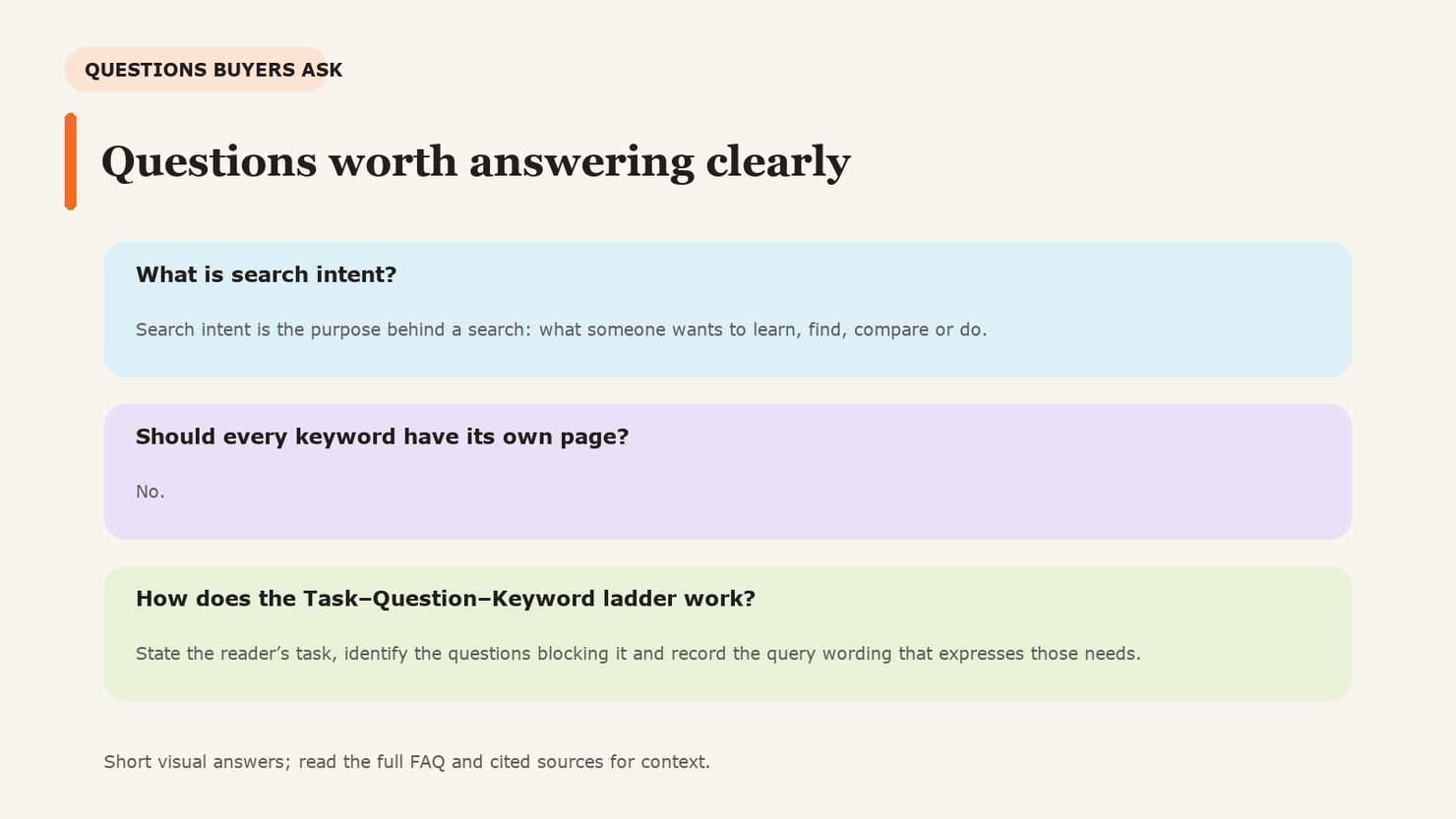
What is search intent?
Should every keyword have its own page?
How does the Task–Question–Keyword ladder work?
Does a longer conversational query need longer content?
Frequently Asked Questions
What is search intent?
Should every keyword have its own page?
How does the Task–Question–Keyword ladder work?
Does a longer conversational query need longer content?

Swapan Kumar Manna
Go-to-market & AI search strategist
Swapan Kumar Manna is a go-to-market and AI search strategist and Founder & CEO of Oneskai. He has spent 14+ years helping companies get found, get chosen and grow.