Part of the The Future of Search: How Discovery Works When Answers Replace Rankings (2026 Guide) series
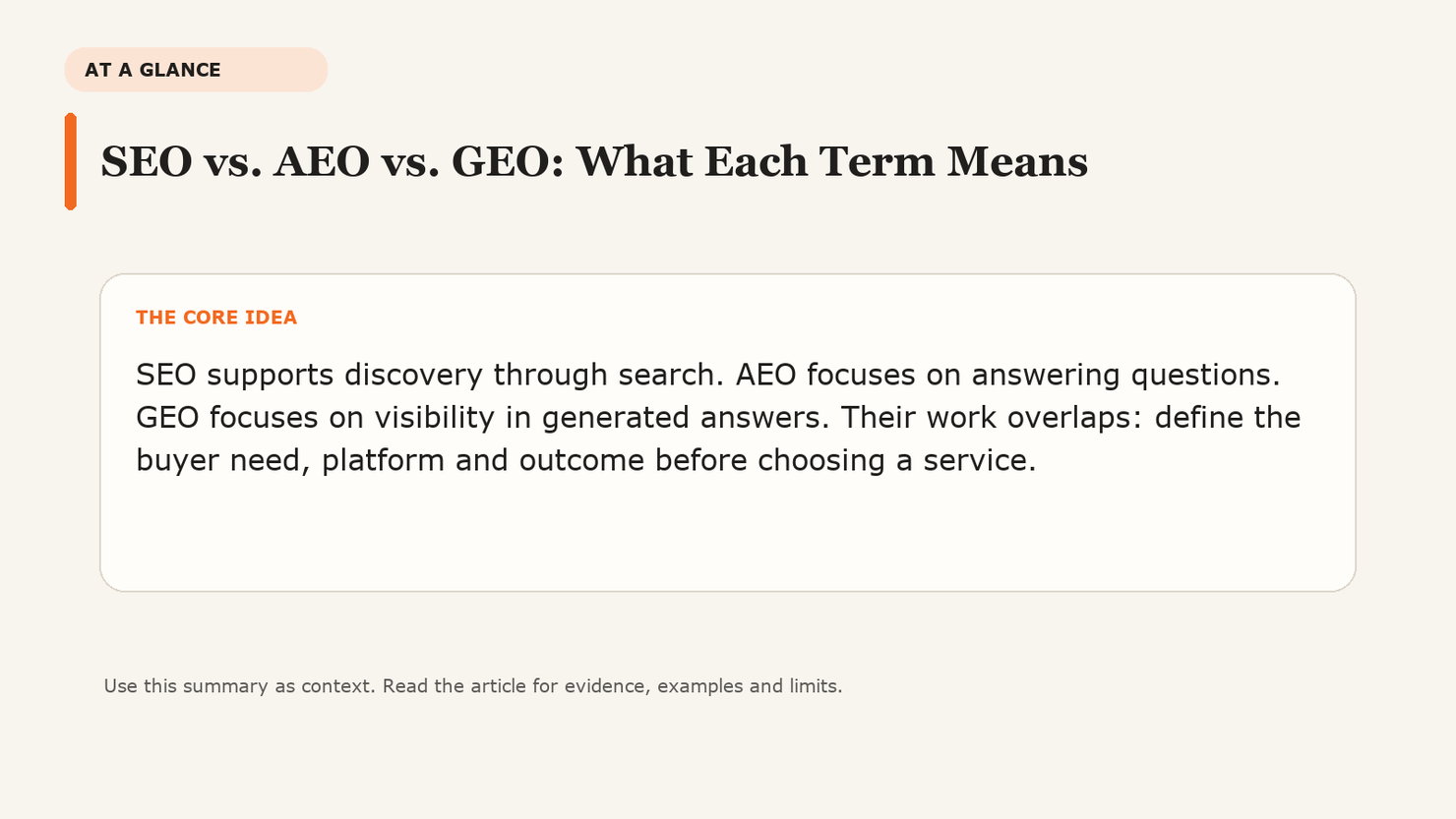
SEO supports discovery through search. AEO focuses on answering questions. GEO focuses on visibility in generated answers. Their work overlaps: define the buyer need, platform and outcome before choosing a service.
Key Takeaways
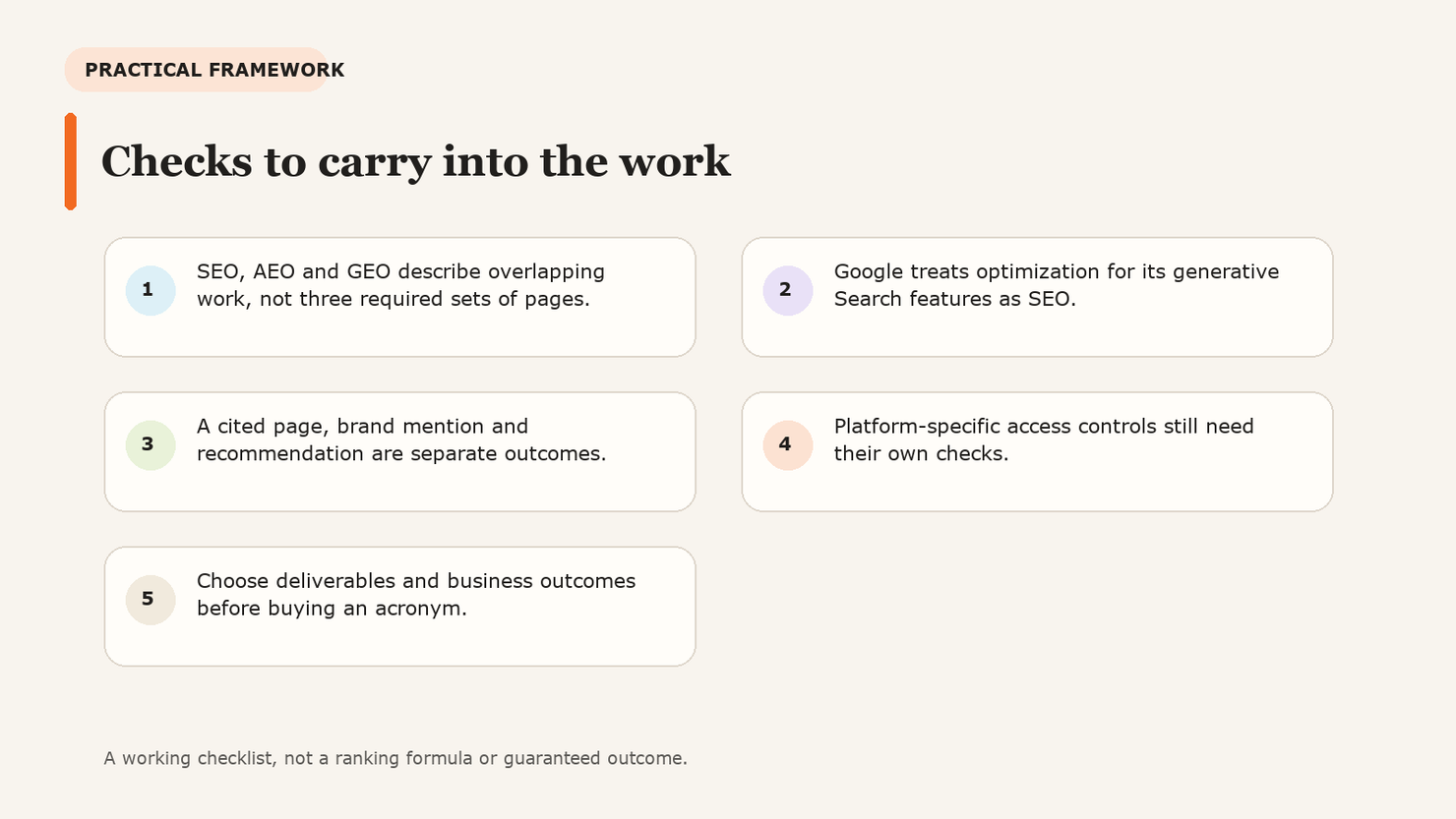
- SEO, AEO and GEO describe overlapping work, not three required sets of pages.
- Google treats optimization for its generative Search features as SEO.
- A cited page, brand mention and recommendation are separate outcomes.
- Platform-specific access controls still need their own checks.
- Choose deliverables and business outcomes before buying an acronym.
Playbooks
Frameworks you can put to work
Growth marketing, LinkedIn presence, and more — delivered as PDFs.
Browse the playbooksA marketing team can now receive three proposals for the same website: one for SEO, one for AEO, and one for GEO. Each sounds urgent. The harder question is whether they describe three different jobs or three ways to frame work the team already needs.
SEO helps people find and understand your content through search. AEO focuses on content that answers a question. GEO focuses on visibility within answers built by generative AI. These goals overlap, but the terms can help teams discuss where they want to appear and what they need to measure.
My approach is to start with the buyer's question, then define the work and the outcome. The acronym comes after that. This fits the broader shift covered in my guide to the future of search: a buyer may read a page, use a short answer, or ask an assistant to compare options.
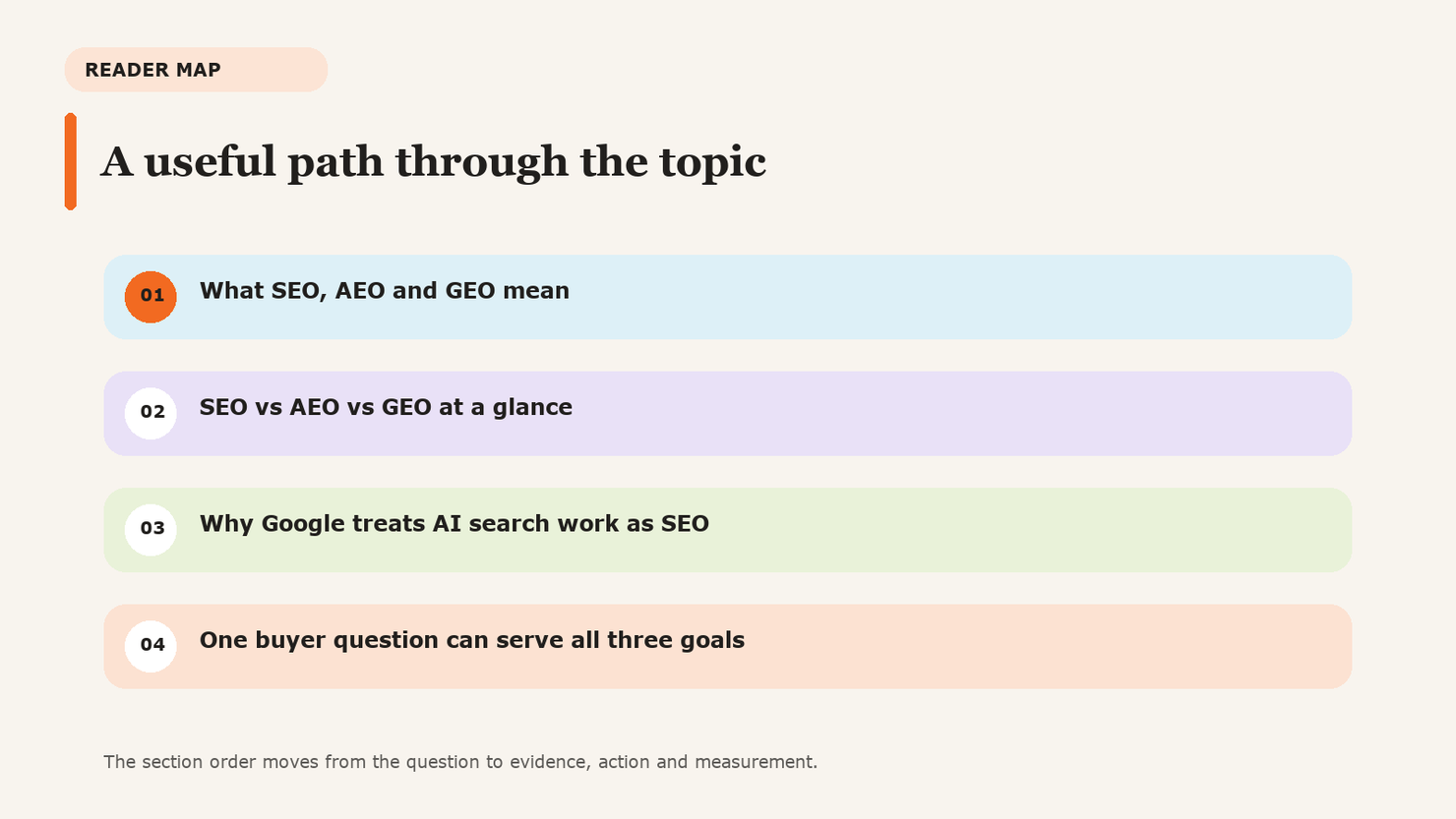
What SEO, AEO and GEO mean
SEO stands for search engine optimization. It covers work that helps search engines discover and understand useful pages, and helps people find those pages. That includes site access, clear content, internal links, and a good experience when someone visits.
AEO stands for answer engine optimization. I use it here to describe work that makes a useful answer easy to find, read, and understand. The focus is a question and its answer, whether that answer appears on your own page or in a search experience.
GEO stands for generative engine optimization. It describes work aimed at making content or a brand visible in answers that an AI system creates. Visibility might mean a cited page, a brand mention, or inclusion in a comparison. Those are different outcomes, so a brief should name which one matters.
These are working definitions, not three fixed standards shared by every platform. AEO and GEO often refer to much of the same work. A vendor may use one term for content, another for technical checks, and a third for its reporting product.
The term GEO also has a research history. The GEO paper accepted at KDD 2024 proposed a framework for studying visibility in generative answers. Its findings concern the systems, queries, and methods tested. They do not establish a reliable uplift for every brand on today's live products.
SEO vs AEO vs GEO at a glance
| Dimension | SEO | AEO | GEO |
|---|---|---|---|
| Main focus | Discovery through search | A clear answer to a question | Visibility in a generated answer |
| Useful content work | Relevant pages with sound structure | Direct answers with enough explanation | Clear facts, evidence, comparisons and limits |
| Example outcome | A buyer finds and visits a product page | A buyer understands a setup requirement | An assistant cites a source or names a suitable option |
| What to measure | Search visibility, visits and business outcomes | Answer accuracy and relevant search appearances | Mentions, citations, accuracy and referral outcomes |
| What it cannot promise | A top ranking | Selection as the answer | A citation or recommendation |
The table separates the focus of the work. It does not imply that each column needs its own set of pages. One well-built guide can serve all three goals, while a weak page can fail all three.
Why Google treats AI search work as SEO
Google's guide to optimizing for generative AI search explicitly discusses AEO and GEO. From Google Search's perspective, this work remains SEO because its AI features draw on core Search ranking and quality systems.
That is a statement about Google Search. It is not proof that ChatGPT, Copilot, Perplexity, and Gemini all select sources in the same way. A shared label cannot replace a platform's own guidance.
The practical point for a marketing leader is that a new name does not remove the old foundations. If a useful page cannot be found or understood, rewriting its opening as an answer will not solve the whole problem.
Google's AI features documentation also says there is no special schema or AI text file required for AI Overviews and AI Mode. Pages need to be indexed and eligible for a search snippet to appear as supporting links. Meeting those conditions does not guarantee selection.
I would use this guidance to challenge vague claims about a secret format. Ask what problem a proposed change solves for the reader or for access to the page. A clear explanation is more useful than a promise that an AI system prefers a certain paragraph length.
One buyer question can serve all three goals
Consider a hypothetical SaaS company that sells project software. A buyer asks, “Can we move our team from spreadsheets without losing task history?” The company's existing page says the product makes work seamless, but gives no detail about the move.
An SEO review might find that the migration guide has few internal links and a title that fails to describe the topic. The fix would make the guide easier to find and clearer about the need it serves.
An AEO review would ask whether the page answers the question. It should state which data can be imported, what cannot, and how a buyer can check the result. A short answer helps, but the steps and limits give that answer value.
A GEO review would ask whether the facts are clear enough to support a fair comparison. Does the guide specify supported file types, plan requirements, and known limits? Can someone verify those claims through current product docs?
The team does not need three guides called spreadsheet migration. It needs one useful guide, supported by product evidence and a clear path to the next step. Different reviews can improve that asset without creating competing versions of it.
This example shows why I prefer one shared content plan. The work can have several purposes, but the buyer should still find a coherent answer.
Put this into practice
The GTM Funnel Playbook
How B2B teams find, win and keep customers, with a 90-day action plan. Seven funnel stages, one owner each, from the revenue number to the clients you keep.
Where platform differences do matter
The overlap in content does not mean access controls are identical. For example, OpenAI's crawler documentation distinguishes OAI-SearchBot, used for search, from GPTBot, used for potential model training. A decision about one should not be treated as a decision about the other.
OpenAI's publisher FAQ advises allowing OAI-SearchBot for content to be included in ChatGPT summaries and snippets. That is a concrete access question. It is quite different from adding more question headings to a blog post.
A sensible brief therefore names the product being reviewed. “Improve AI visibility” is too broad on its own. “Check access for ChatGPT search and verify how our pricing is described” gives the team work it can inspect.
The same discipline applies to measurement. A citation points to a source. A brand mention names a business. A recommendation expresses a fit for the request. Report them separately, with the question, date, and conditions of the check. A mention without a link is not a referral visit.
Choose the next action by the problem
When useful pages are hard to find, start with access and site structure. When buyers reach a page but still need basic facts, improve the answer. When an AI answer describes the product wrongly, check the source material and publish clear, current facts where they belong.
For a small team, I would choose one high-value buyer question and review the pages that answer it. Assign an owner, identify the missing evidence, and agree on a business outcome before commissioning a large content batch.
Keep the baseline simple. Record search performance for the relevant pages, inspect a defined set of AI answers, and track qualified visits or enquiries. These views can inform the same decision without being collapsed into a single score.
If a supplier proposes separate SEO, AEO, and GEO services, ask for the deliverables, the overlap, and the checks used to judge progress. Useful work should be clear enough to explain without relying on the service name.
Build better answers without creating more noise
Google's helpful content guidance asks creators to add original value rather than simply restate other pages. Its spam policies address scaled content made to manipulate rankings. Publishing every slight variation of a question is a poor substitute for covering a real need well.
The most useful distinction in SEO vs AEO vs GEO is the outcome you are trying to improve. Keep the shared foundations, make the answer worth reading, and assess each search product on its own terms.
For more practical notes on search, AI, and growth, join The Agentic Pivot.
Frequently Asked Questions
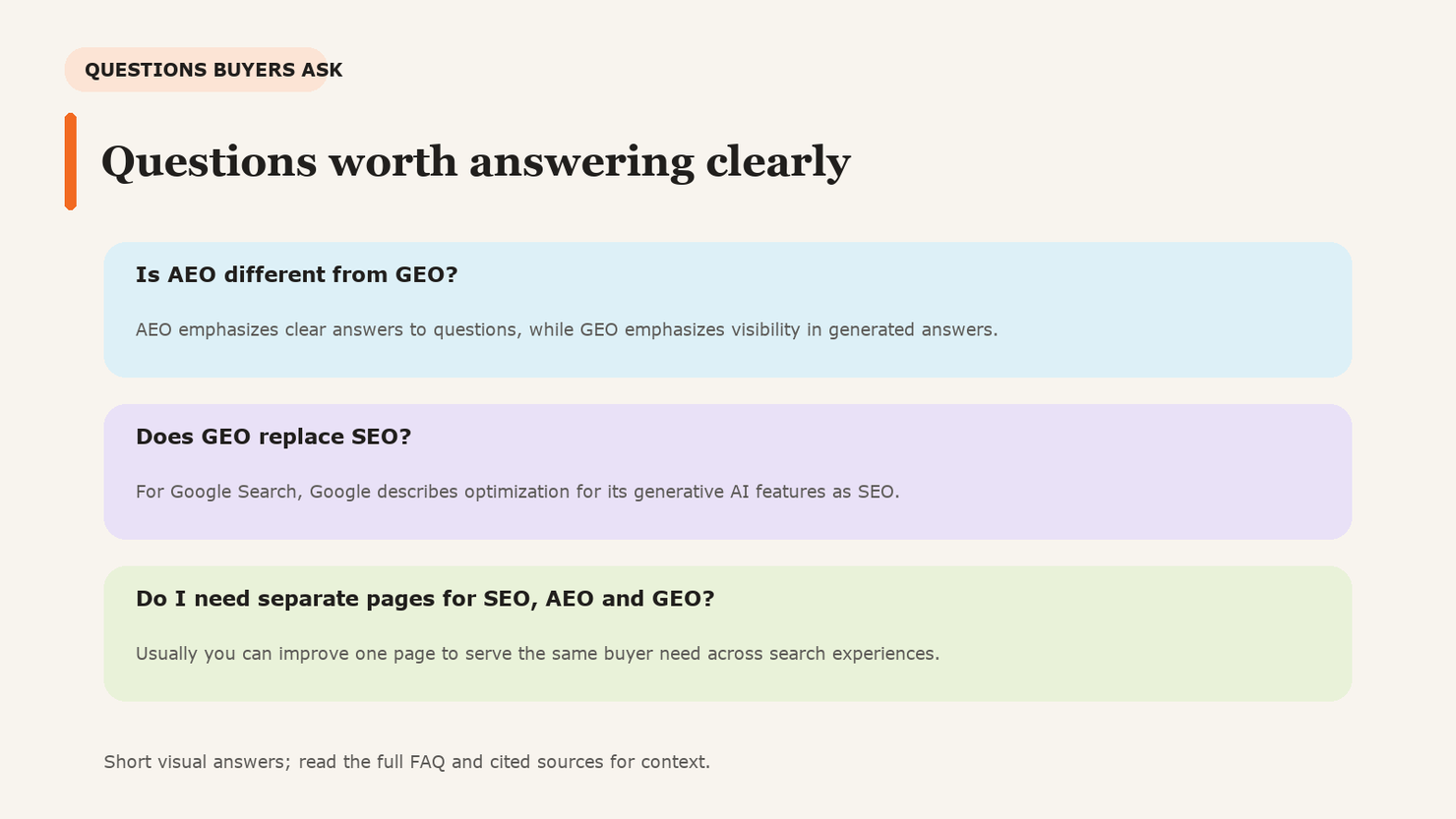
Is AEO different from GEO?
Does GEO replace SEO?
Do I need separate pages for SEO, AEO and GEO?
Does a citation mean an AI assistant recommends my brand?
Put this into practice
The GTM Funnel Playbook
How B2B teams find, win and keep customers, with a 90-day action plan. Seven funnel stages, one owner each, from the revenue number to the clients you keep.
Frequently Asked Questions
Is AEO different from GEO?
Does GEO replace SEO?
Do I need separate pages for SEO, AEO and GEO?
Does a citation mean an AI assistant recommends my brand?

Swapan Kumar Manna
Go-to-market & AI search strategist
Swapan Kumar Manna is a go-to-market and AI search strategist and Founder & CEO of Oneskai. He has spent 14+ years helping companies get found, get chosen and grow.