Part of the The Future of Search: How Discovery Works When Answers Replace Rankings (2026 Guide) series
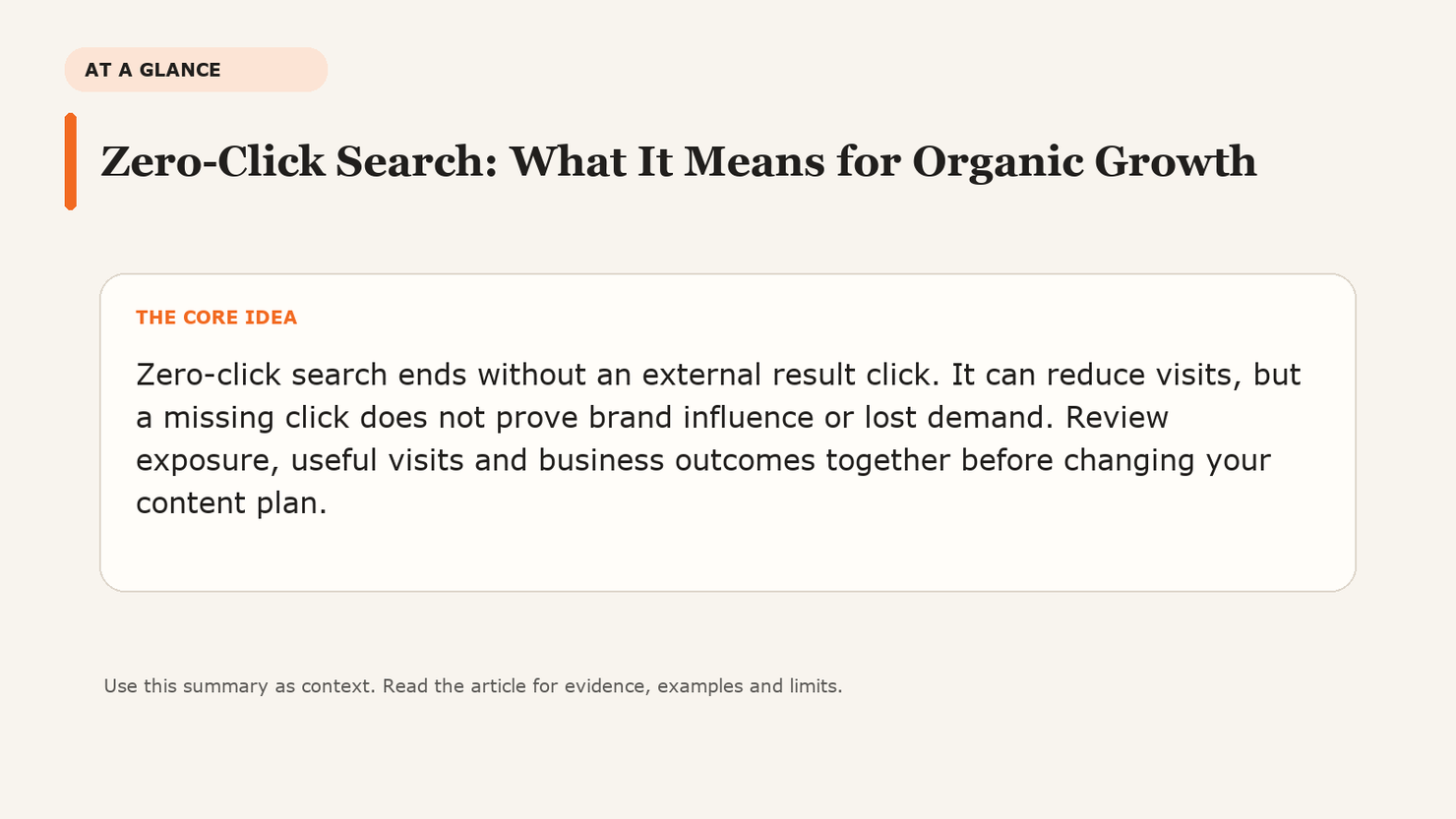
Zero-click search ends without an external result click. It can reduce visits, but a missing click does not prove brand influence or lost demand. Review exposure, useful visits and business outcomes together before changing your content plan.
Key Takeaways
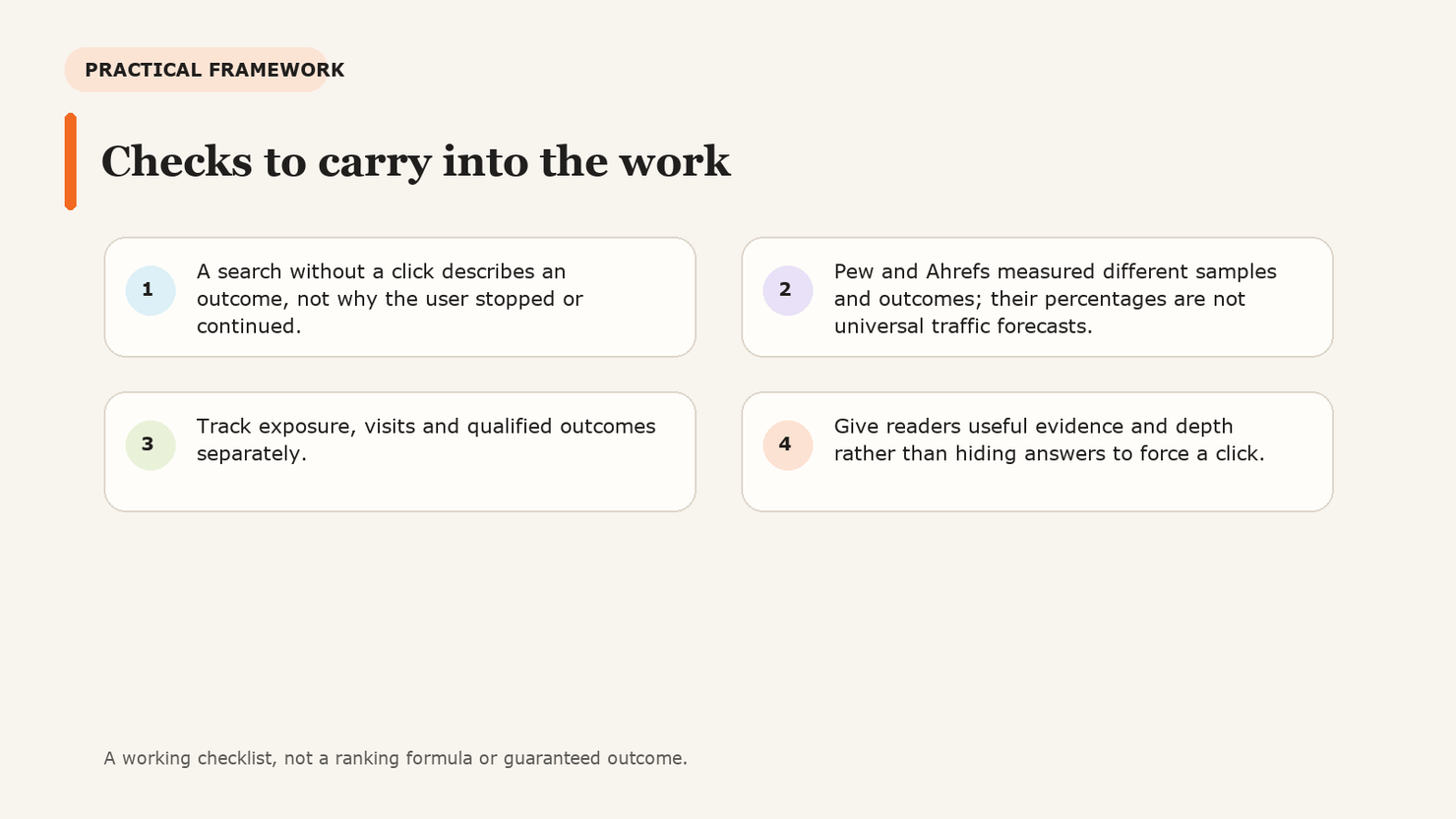
- A search without a click describes an outcome, not why the user stopped or continued.
- Pew and Ahrefs measured different samples and outcomes; their percentages are not universal traffic forecasts.
- Track exposure, visits and qualified outcomes separately.
- Give readers useful evidence and depth rather than hiding answers to force a click.
Playbooks
Frameworks you can put to work
Growth marketing, LinkedIn presence, and more — delivered as PDFs.
Browse the playbooksA page can rank well and receive fewer visits than it used to. The reader may get a useful answer on Google, continue searching, or leave without opening a result. For a business that invested in the page, the lost visit is real. What happens after that is often harder to see.
Zero-click search describes a search that ends without a click to an external result. AI summaries are one reason this can happen, but they are not the only one. A short answer, a local listing, or a new query can also keep someone from visiting your site.
I've spent 14+ years in go-to-market and growth. My view is that a click was always one signal in a buying journey. We should still measure it, while asking what the content helps a suitable buyer understand or do. This is part of the wider shift covered in my guide to the future of search.
What zero-click search does, and does not, tell you
A search without an external click is an outcome, not an explanation. Someone who checks the weather may get everything they need on the results page. Someone choosing software may ask another question because the first search did not help. Both can produce no visit to your website, for different reasons.
That distinction matters when you discuss organic traffic decline. You cannot infer from a missing click that the user saw your brand, trusted your advice, or went on to buy. You also cannot infer that the content had no role in the decision.
The honest starting point is a gap in what you can observe. Your analytics records activity on your site. It does not fully record what someone learned elsewhere before arriving, or why another person never arrived at all.
This is why I would avoid claiming that influence has simply replaced traffic. Some lost visits may reflect useful exposure. Others are lost opportunities. Your job is to gather enough evidence to tell the difference and decide where to invest.
What the research says about AI summaries and clicks
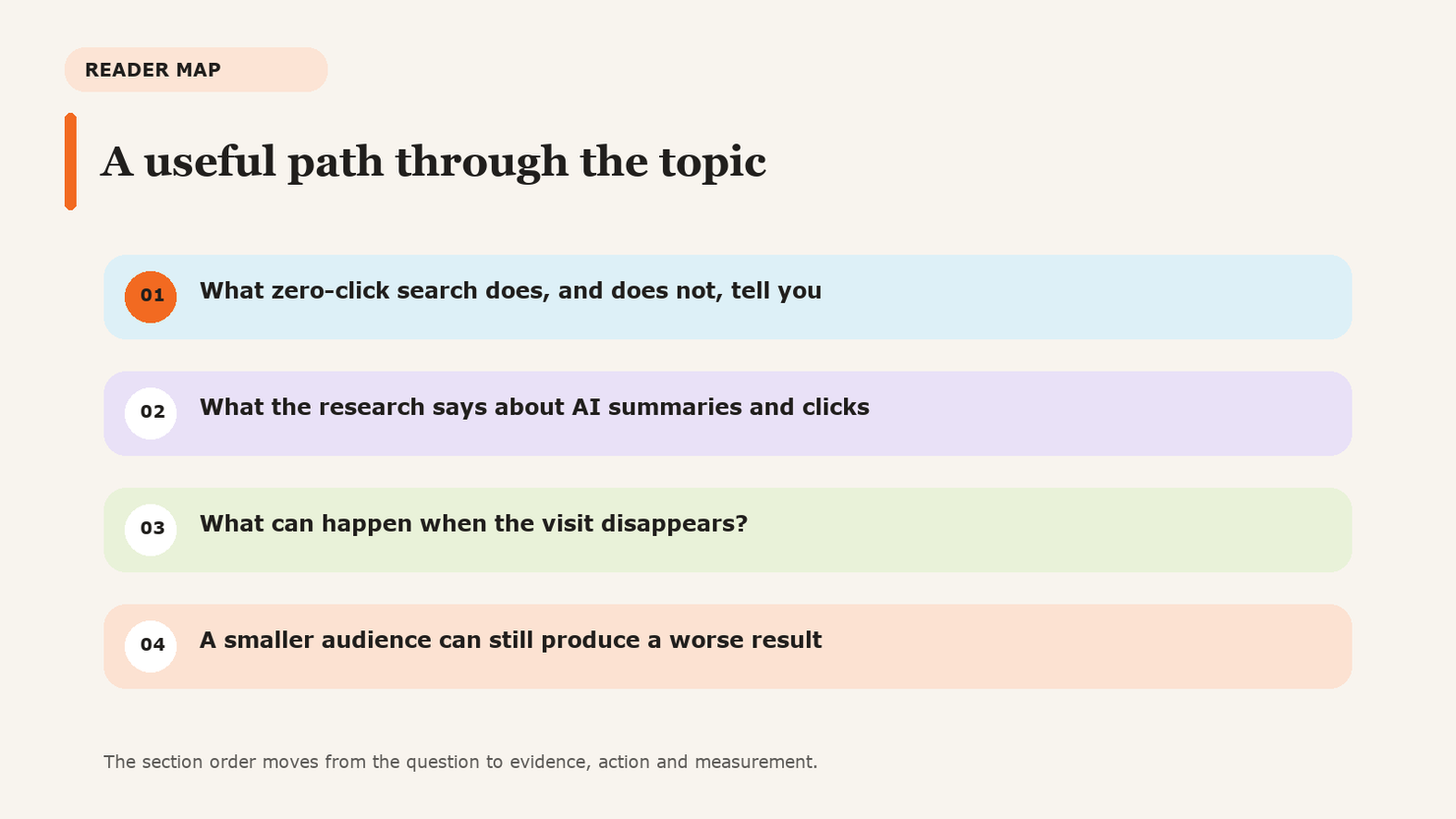
Two studies help explain why teams are concerned. They measure different things, so their percentages should not be combined or presented as one universal rate of loss.
In a Pew Research Center study published in July 2025, users clicked a traditional result in 8% of visits with an AI summary, compared with 15% without one. Links inside a summary received clicks in 1% of visits with a summary.
Pew used browsing data from 900 US adults in March 2025, with search results collected in April. That is a finding about a specific sample and period. It does not measure your current audience, and the observed difference does not prove that summaries caused every missing click.
Ahrefs published an updated analysis in February 2026, using 300,000 keywords and aggregated desktop Google Search Console data. It compared December 2023 with December 2025, including keywords with AI Overviews and an informational comparison group without them.
Ahrefs estimated a 58% lower click-through rate for the top-ranking page on AI Overview keywords, relative to its modelled expectation. That is not a 58% loss of all organic traffic. It depends on the selected keywords, the time periods, and the comparison method; it is not a randomised test.
Taken together, these studies justify looking closely at clicks for affected queries. They do not justify applying the same decline to every page, country, device, or business. Start with your own data before changing the whole content plan.
What can happen when the visit disappears?
The answer depends on the task. A person looking for a definition may finish on the results page. A person checking a vendor may encounter a brand name, then search for it later. Someone else may see a competing answer and never consider your offer.
There is also a difference between being used as a source and being chosen as a supplier. A citation can help explain a concept without recommending your business. A brand mention can appear without a link. A recommendation can rely on a review published by someone else.
Keep those outcomes separate. Otherwise, a team can treat an educational citation as proof of new demand while its commercial pages receive fewer useful visits. The content may still have value, but the claim needs evidence.
A smaller audience can still produce a worse result
Consider a hypothetical site that receives 5,000 organic visits and 50 qualified enquiries per month. If visits fall to 3,000 and the enquiry rate stays at 1%, the site receives 30 qualified enquiries. A stable conversion rate does not make up for the loss.
If the rate rises to 2%, it receives 60. That would be a better outcome, assuming the enquiries remain equally valuable. These are illustrative numbers, not a forecast that AI search makes the remaining visitors more likely to buy.
The lesson is to inspect totals as well as rates. A higher conversion rate can coexist with fewer sales. More citations can coexist with lower revenue. Neither metric should end the discussion.
Decide which pages still have a useful job
I suggest reviewing affected content by the task it serves. This gives the team a better basis for action than labelling all informational traffic expendable or trying to protect every visit at any cost.
For a simple fact, a search answer may be enough. Keep the page accurate if it supports a broader topic, but ask whether another version of the same fact deserves more investment. Length alone will not create a reason to visit.
For a complex decision, the reader may need detail that a short answer cannot settle. A useful comparison can explain costs, limitations, fit, and the conditions behind a recommendation. A worked example can show how to apply the advice to a real task.
For a product or service check, your site should provide current facts. Make pricing terms, supported use cases, availability, and next steps clear. A buyer who comes to verify an answer should not have to search again because your page says little beyond a slogan.
For a tool or workflow, give the visitor something they can use. A calculator, a clear demonstration, or a practical worksheet can earn a visit when it genuinely helps. Do not add a tool-shaped lead form that promises a result it cannot deliver.
Measure exposure, visits, and outcomes separately
Start with a small set of important pages and queries. Review impressions, clicks, click-through rate, and search position over comparable periods. Check device and country where relevant. A changed query mix or a ranking loss can affect the result alongside an AI feature.
Then inspect what appears for those queries. Record the date, search experience, and any sources shown. A result seen once is useful evidence for that check, not proof of what every user saw throughout the month.
Use three layers in the review:
- Exposure: relevant impressions, observed mentions, and citations.
- Visits: clicks and meaningful activity after someone reaches your site.
- Outcomes: qualified enquiries, sales opportunities, purchases, or another goal that fits the page.
These layers help you ask a better question. If exposure rises but useful visits fall, does the page still help the right audience? If visits hold but enquiries decline, is the content attracting the wrong need, or has the offer changed?
Add buyer feedback when you can. Ask new customers where they first heard about you and which sources helped them decide. Treat their answers as useful context rather than exact attribution. Brand search can also change for many reasons; a rise does not prove that AI mentions caused it.
Improve the content without chasing zero-click tricks
The response should be better evidence and a clearer task, not hiding the answer to force a visit. Answer the reader's question, then give them depth worth checking: a method, a useful comparison, current terms, or supported experience that changes the decision.
Google's current AI search guidance emphasises useful, original content and the foundations of SEO. It does not require special AI markup or tiny content chunks. It also warns against creating separate pages for query variations mainly to manipulate rankings or generated responses.
Keep existing useful URLs and improve the pages that serve them. Make related answers easy to find through contextual links. Avoid publishing another broad summary simply because the original page lost traffic; first identify what the reader still needs.
For the commercial side of that work, my guide to SEO content strategy for B2B SaaS connects buyer questions with content planning. The same principle applies here: choose the question and the useful evidence before choosing the format.
Keep the click, widen the review
Zero-click search is a reason to rethink how you assess organic growth. It is not permission to stop measuring traffic or to call every unseen impression valuable. Some losses need a direct response. Some pages may still help buyers even when the next visit arrives by another route.
Review one affected topic, identify the task behind the search, and check the business outcome before scaling the response. The click remains useful. The better decision comes from understanding what happened around it.
For more practical thinking on search, AI, and growth, join The Agentic Pivot.
Frequently Asked Questions
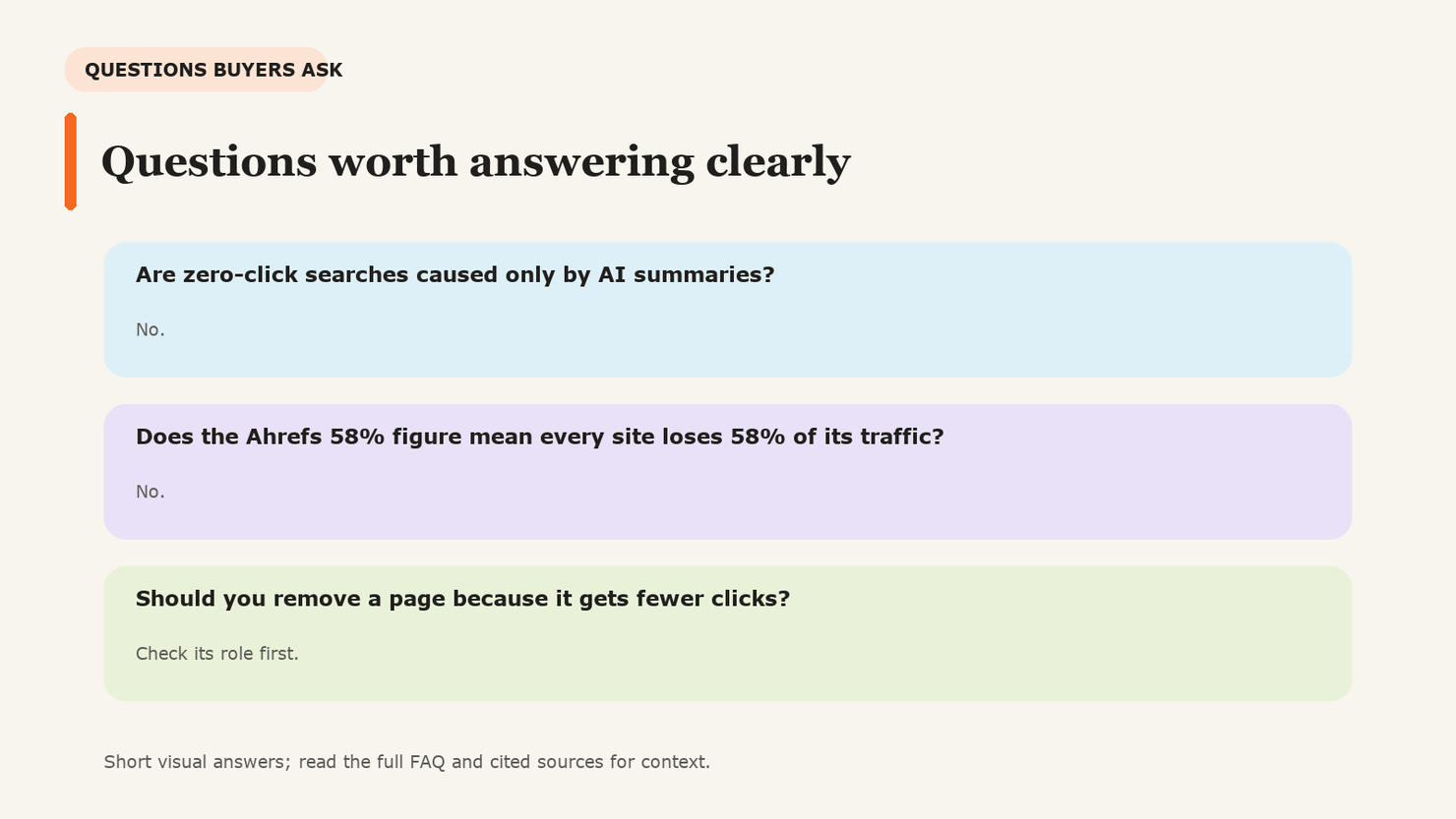
Are zero-click searches caused only by AI summaries?
Does the Ahrefs 58% figure mean every site loses 58% of its traffic?
Should you remove a page because it gets fewer clicks?
Frequently Asked Questions
Are zero-click searches caused only by AI summaries?
Does the Ahrefs 58% figure mean every site loses 58% of its traffic?
Should you remove a page because it gets fewer clicks?

Swapan Kumar Manna
Go-to-market & AI search strategist
Swapan Kumar Manna is a go-to-market and AI search strategist and Founder & CEO of Oneskai. He has spent 14+ years helping companies get found, get chosen and grow.