Part of the The Future of Search: How Discovery Works When Answers Replace Rankings (2026 Guide) series
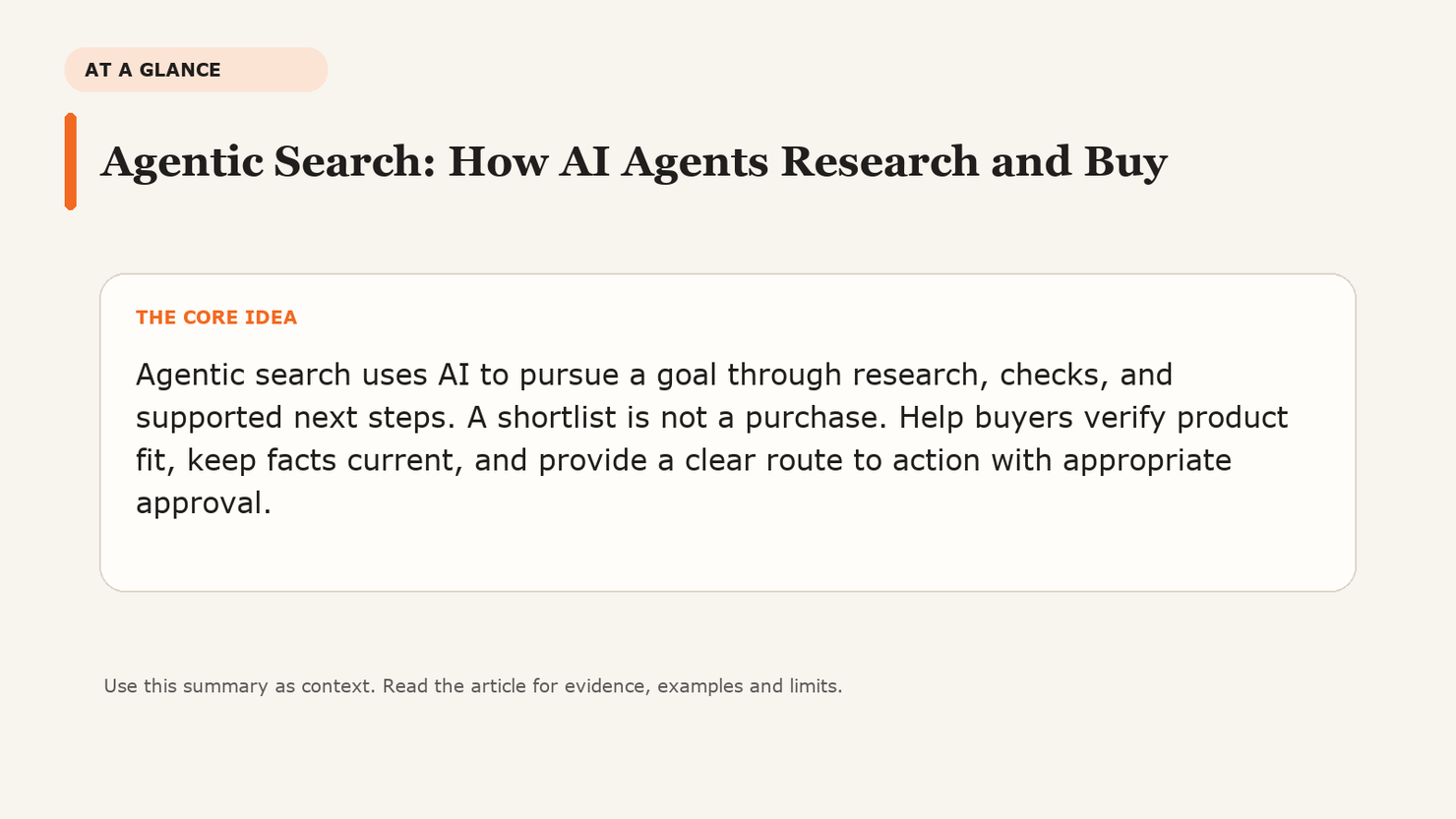
Agentic search uses AI to pursue a goal through research, checks, and supported next steps. A shortlist is not a purchase. Help buyers verify product fit, keep facts current, and provide a clear route to action with appropriate approval.
Key Takeaways
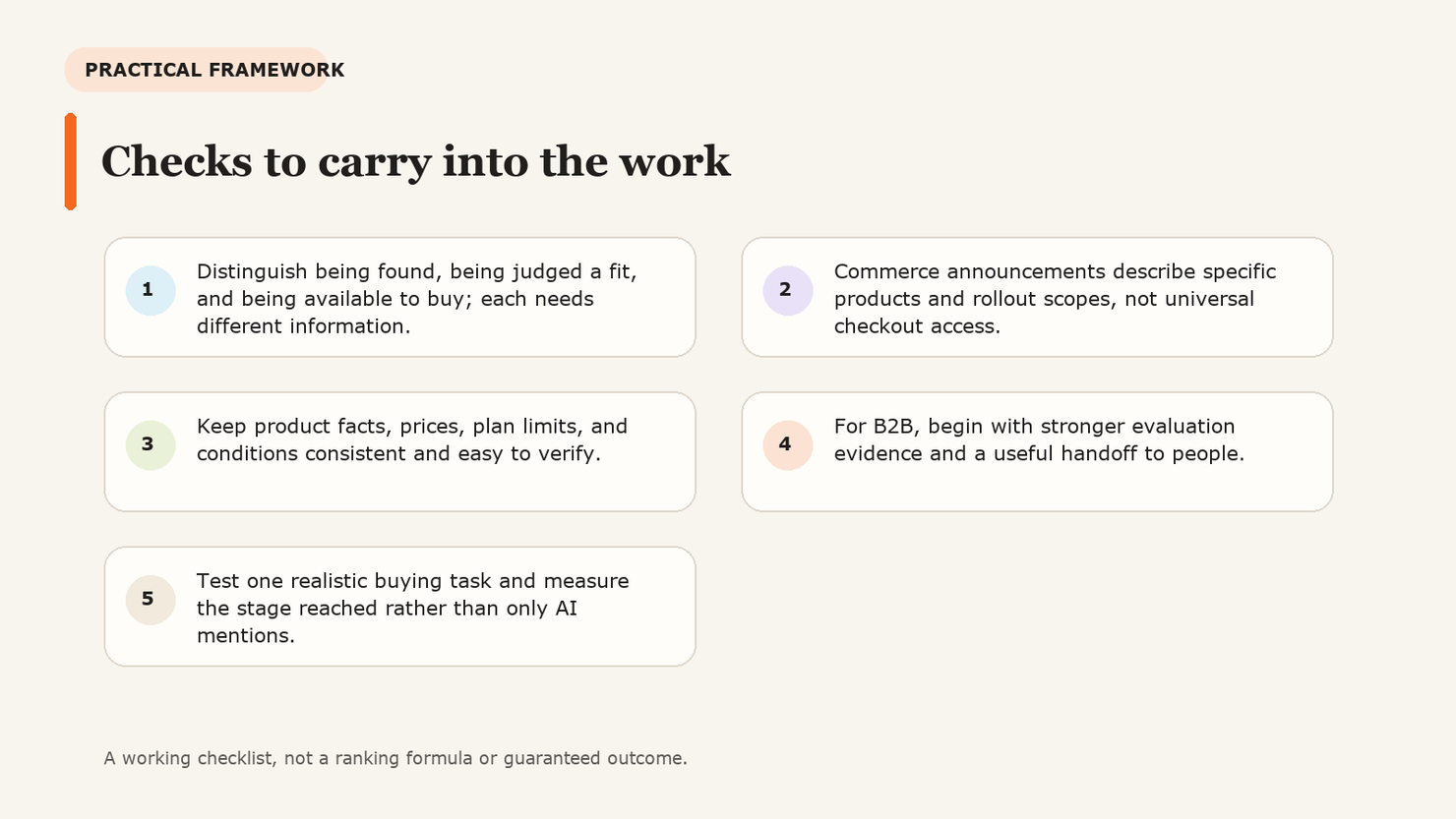
- Distinguish being found, being judged a fit, and being available to buy; each needs different information.
- Commerce announcements describe specific products and rollout scopes, not universal checkout access.
- Keep product facts, prices, plan limits, and conditions consistent and easy to verify.
- For B2B, begin with stronger evaluation evidence and a useful handoff to people.
- Test one realistic buying task and measure the stage reached rather than only AI mentions.
Playbooks
Frameworks you can put to work
Growth marketing, LinkedIn presence, and more — delivered as PDFs.
Browse the playbooksAgentic search means using an AI system to pursue a goal through several steps, rather than only asking it for an answer. The system might search for options, check details, compare them against your needs, and prepare a next step. Some supported workflows can also lead to a purchase.
For marketers, the shift is practical. Your offer needs to be easy to assess against a buyer's actual requirements. A strong headline cannot make up for missing prices, unclear limits, or a booking process that leaves people stuck.
This guide looks at what has been documented and what I would change now. It is part of my broader guide to the future of search and discovery. The aim is to prepare for delegated tasks without assuming every buyer has handed purchasing decisions to a bot.
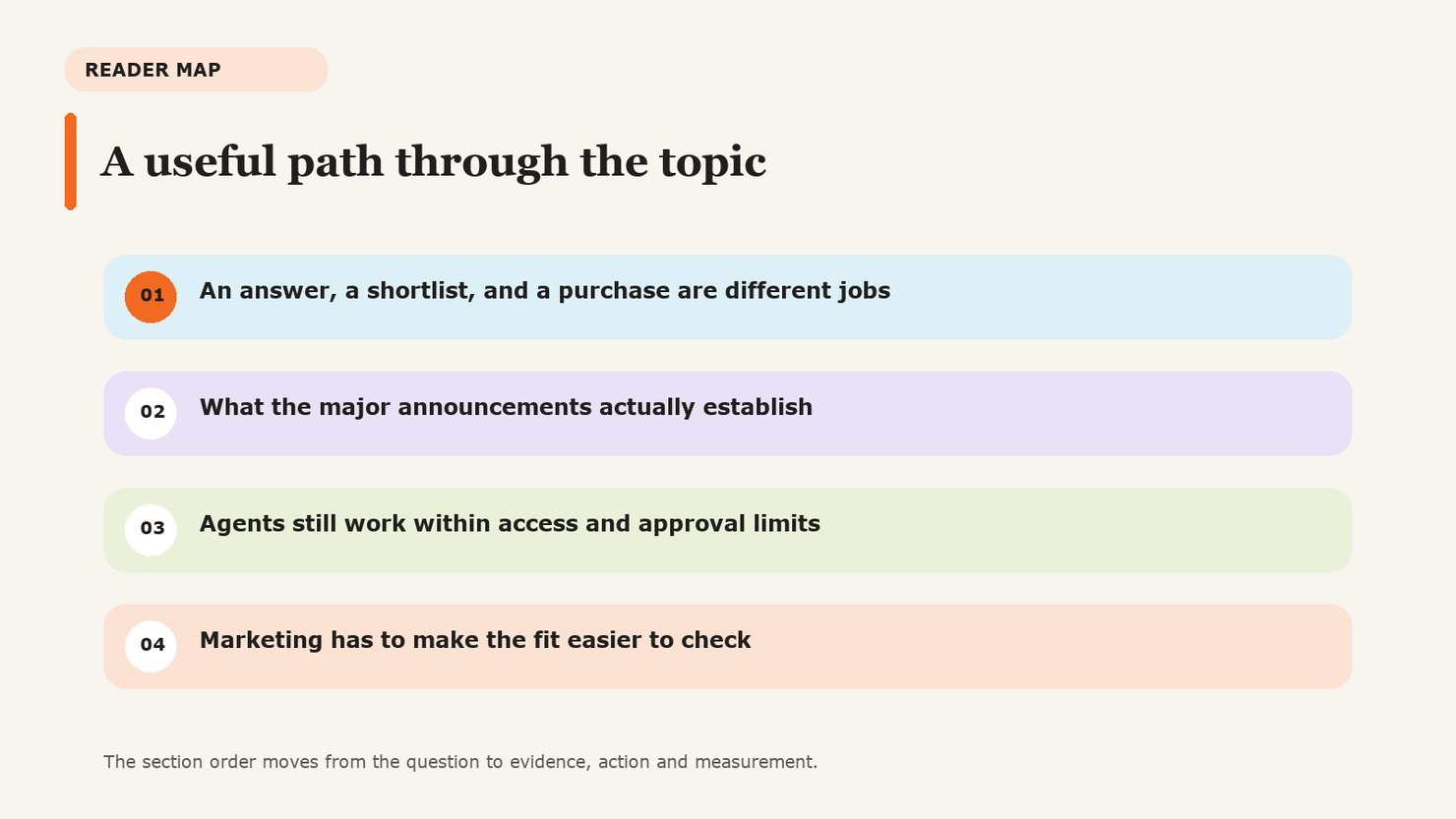
An answer, a shortlist, and a purchase are different jobs
A search-backed answer can explain which products might fit a need. An agent can go further by working through steps toward an outcome. That distinction is about the task, not a promise that the system can finish it.
Imagine asking for a monitor that works with your laptop, fits your desk, and arrives before Friday. A useful answer might list options. A more involved task could check the ports, compare delivery dates, and prepare a cart.
Buying adds further conditions. The item must be in stock, the final cost must fit the budget, and the user must have authorised the action. A promising shortlist is not a completed order.
I would separate these stages when planning marketing work. Being found, being judged a fit, and being available to buy each depend on different information. Improving one stage may leave the next unresolved.
What the major announcements actually establish
Google introduced the Universal Commerce Protocol, or UCP, in January 2026. It is an open standard intended to help consumer services, businesses, and payment providers work together on commerce tasks.
Think of it as a common way to exchange information and support actions. It is not a ranking rule, a content format, or a guarantee that a merchant will appear in an answer. Google's implementation also has merchant and product eligibility requirements.
In May 2026, Google announced Universal Cart. Its described features include monitoring deals and stock, checking product compatibility, and supporting checkout or transfer to a merchant's site. The announcement set out a rollout beginning with Search and Gemini in the US.
That dated announcement is evidence of the direction and planned scope. It is not evidence that every feature is now available to every shopper, merchant, or country. Check current access before building a campaign around it.
ChatGPT commerce has also changed. In its March 2026 product discovery update, OpenAI said its initial Instant Checkout approach lacked the flexibility it wanted. It described allowing merchants to use their own checkout experiences while focusing on product discovery.
That matters because older articles can make checkout sound more uniform than it is. Assess the route your customers can actually use. A commerce protocol, a shopping experience, and a merchant's checkout are related parts of the journey, but they are not the same thing.
Agents still work within access and approval limits
OpenAI's current cloud browser guidance describes supported web tasks in ChatGPT Work, such as checking availability, requesting quotes, and comparing options. The browser can read pages, use forms, and pause for input or sign-in.
The same guidance says consequential actions, such as making a payment or confirming a booking, require confirmation. Some sites or steps may not be supported. This is a more useful picture than the idea of an agent that can buy anything from any website.
For a business, the lesson is to make the route clear. Explain what a quote request involves, what happens next, and which steps require a person. Keep the final price and terms visible before commitment.
I would preserve those controls. A smooth buying experience should help a customer understand the decision and approve it. Removing friction should not remove the information needed to make a sound choice.
Marketing has to make the fit easier to check
My working view is that delegated research puts more pressure on the detail behind the claim. A buyer can give an assistant several conditions at once. Your content then needs to help establish whether the offer meets them.
Take our hypothetical monitor purchase. “Ideal for remote work” says little about laptop support. The buyer needs the ports, cable requirements, screen size, and any limits on charging through the display.
Delivery is another separate fact. A general promise of fast shipping does not establish whether an item reaches a specific postcode before Friday. The agent or buyer may need a live check.
The marketing task is to identify those decision facts and give them a reliable home. Keep stable facts in clear product content. Keep changing facts, such as price and stock, aligned with the systems that hold the current data.
This does not mean filling every page with technical detail. It means putting the right detail where someone can use it, with links to deeper evidence when the choice needs more explanation.
I would also check whether two parts of the site give the same answer. If a product page says a cable is included but the help page says it is sold on its own, a buyer has no clear fact to trust. Fix the source of the conflict, then update the pages that depend on it.
Keep a date where time matters. A guide to last year's model can still help, as long as the reader knows which model it covers. Updating the date without checking the facts does not make the guide current.
B2B buying needs a different readiness test
Consumer checkout examples do not prove that agents can take over complex business purchases. A software contract can involve budget approval, security review, legal terms, and several people with different needs.
For B2B teams, I would begin with research and evaluation. Consider a hypothetical buyer comparing customer support tools for a team of twenty. They need to know which plan includes single sign-on, what data export allows, and how pricing changes with team size.
A broad feature page may suggest that everything is included. A clear plan comparison and current support guide give the buyer a better basis for a shortlist. The agent may still misunderstand a condition, so the human reviewer needs access to the same sources.
The next step might be a demo or a request for a written answer. Make that handoff useful. Let the buyer state their requirements and tell them who will respond, rather than asking them to repeat the entire search journey.
I would not describe this as the end of sales. It is a reason to improve the evidence people can gather before speaking to sales, and the quality of the conversation that follows.
Five moves I would prioritise for agent readiness
1. List the facts that decide whether you fit
Choose one important buying task and write down its constraints. For a retailer, those may include size, compatibility, delivery, and total cost. For a software company, they might include plan limits, setup work, and access controls.
Compare that list with what is public and current. Fix gaps that could cause a wrong choice before creating more broad content. Give each key fact an owner who can keep it accurate.
2. Keep claims and conditions together
A feature claim should say which plan or product version it applies to. A price should explain its basis, such as per user or per month. A result should include the context needed to judge it.
This is ordinary good writing with a practical payoff. Readers spend less time piecing together an offer, and automated research has clearer source material. It still cannot guarantee a correct answer.
3. Choose integrations from a real buying route
Ask where your customers research and how they can complete the next step today. Then assess the relevant platform's feeds, protocols, and eligibility with your product or commerce team.
Avoid treating UCP or any other protocol as a universal requirement for every business. A retailer with eligible stock and a service firm selling a custom engagement have different needs. Start from the route, then choose the technology.
4. Test the task, including the human handoff
Use a small set of realistic requests to review your public information. Record what the system found, what it misunderstood, and where the task stopped. Check the result against the actual product or offer.
Begin with research or draft actions that do not create a commitment. If you test a live transaction, use an authorised test setup and review the final details. The useful outcome is a list of specific faults you can fix.
5. Measure outcomes beyond an AI mention
Track the stage reached: a source link, a shortlist, a quote request, a prepared cart, or a completed order. These are different outcomes and should not share one success label.
Keep the customer context where it is available, and compare it with your normal sales or order records. A mention alone cannot tell you whether the offer was understood or whether the resulting customer was a good fit.
Start with one buying task you can improve
Google's guidance for AI Search features keeps SEO relevant and stresses useful, original content. I would build on that foundation while making product facts and next steps easier to verify.
The most useful starting point is one task: choose a compatible product, compare a plan, check availability, or request a quote. Map the information needed, find the gaps, and improve the route.
Agentic commerce may change where parts of a purchase happen. It does not remove the need for a clear offer, sound evidence, and an accountable business behind it. Those are investments worth making before the channel becomes a major source of revenue.
For more practical guides on search, AI, and growth, join The Agentic Pivot newsletter.
Frequently Asked Questions
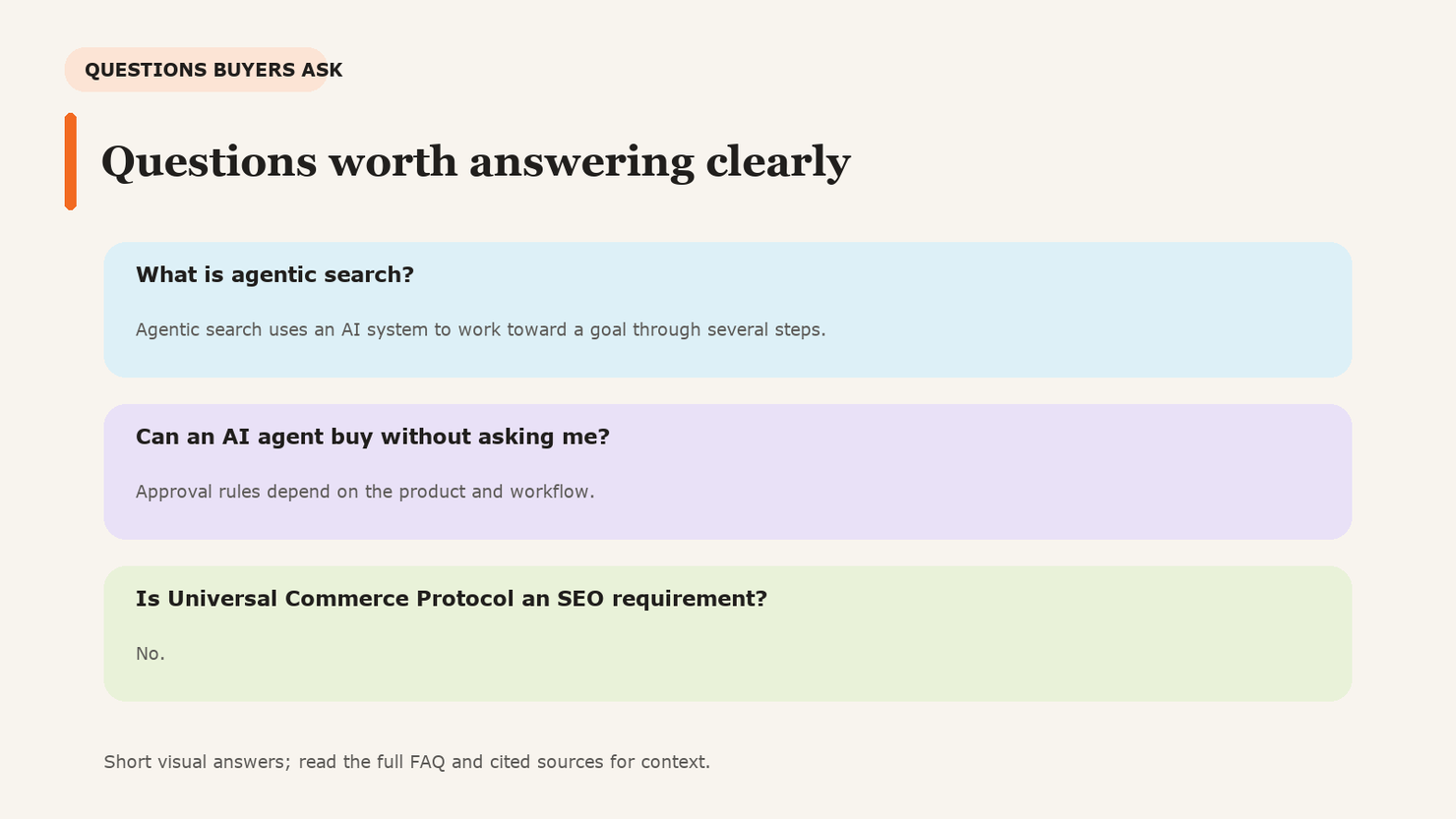
What is agentic search?
Can an AI agent buy without asking me?
Is Universal Commerce Protocol an SEO requirement?
What should a B2B company improve first?
Frequently Asked Questions
What is agentic search?
Can an AI agent buy without asking me?
Is Universal Commerce Protocol an SEO requirement?
What should a B2B company improve first?

Swapan Kumar Manna
Go-to-market & AI search strategist
Swapan Kumar Manna is a go-to-market and AI search strategist and Founder & CEO of Oneskai. He has spent 14+ years helping companies get found, get chosen and grow.