Part of the The Future of Search: How Discovery Works When Answers Replace Rankings (2026 Guide) series
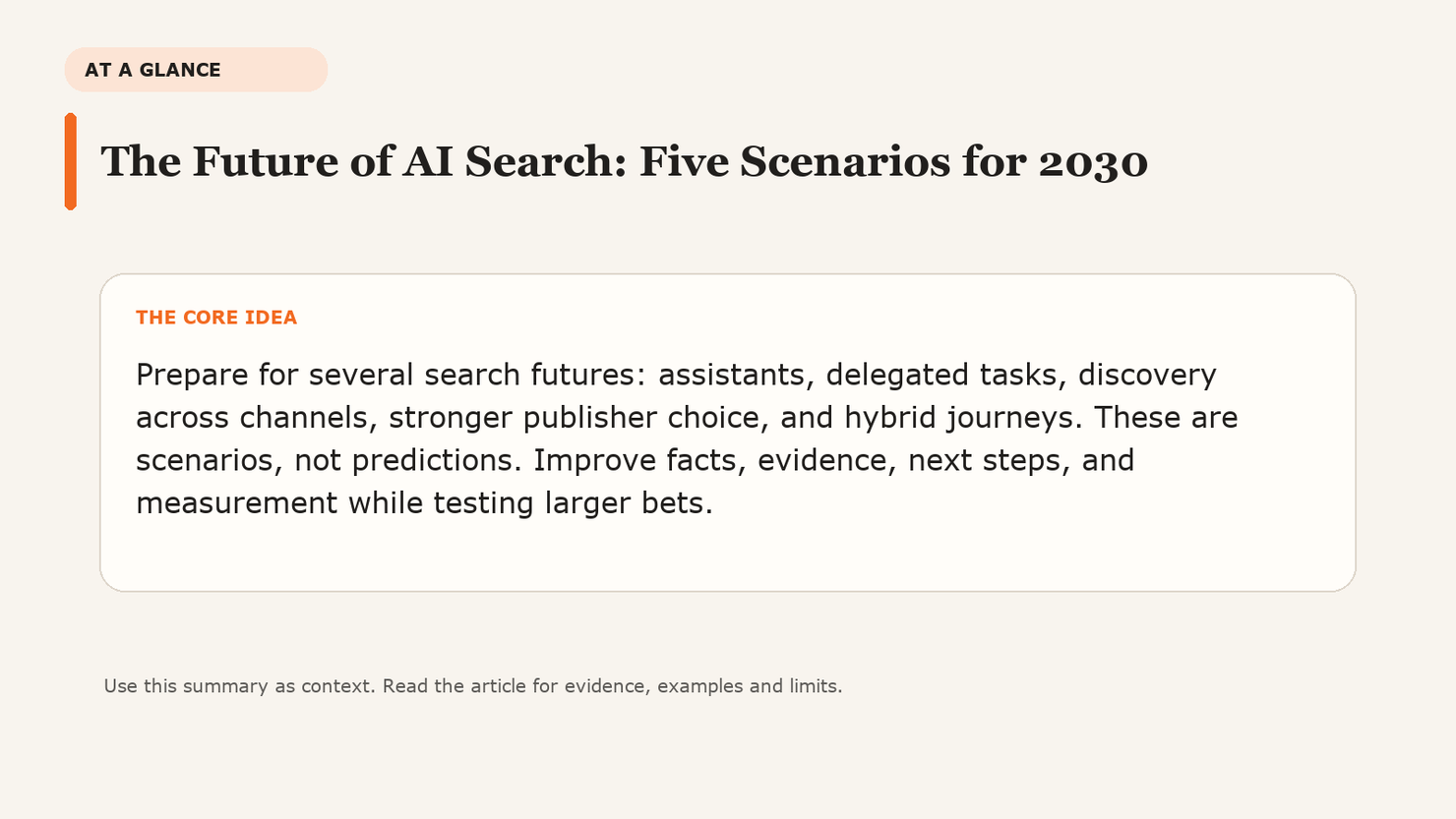
Prepare for several search futures: assistants, delegated tasks, discovery across channels, stronger publisher choice, and hybrid journeys. These are scenarios, not predictions. Improve facts, evidence, next steps, and measurement while testing larger bets.
Key Takeaways
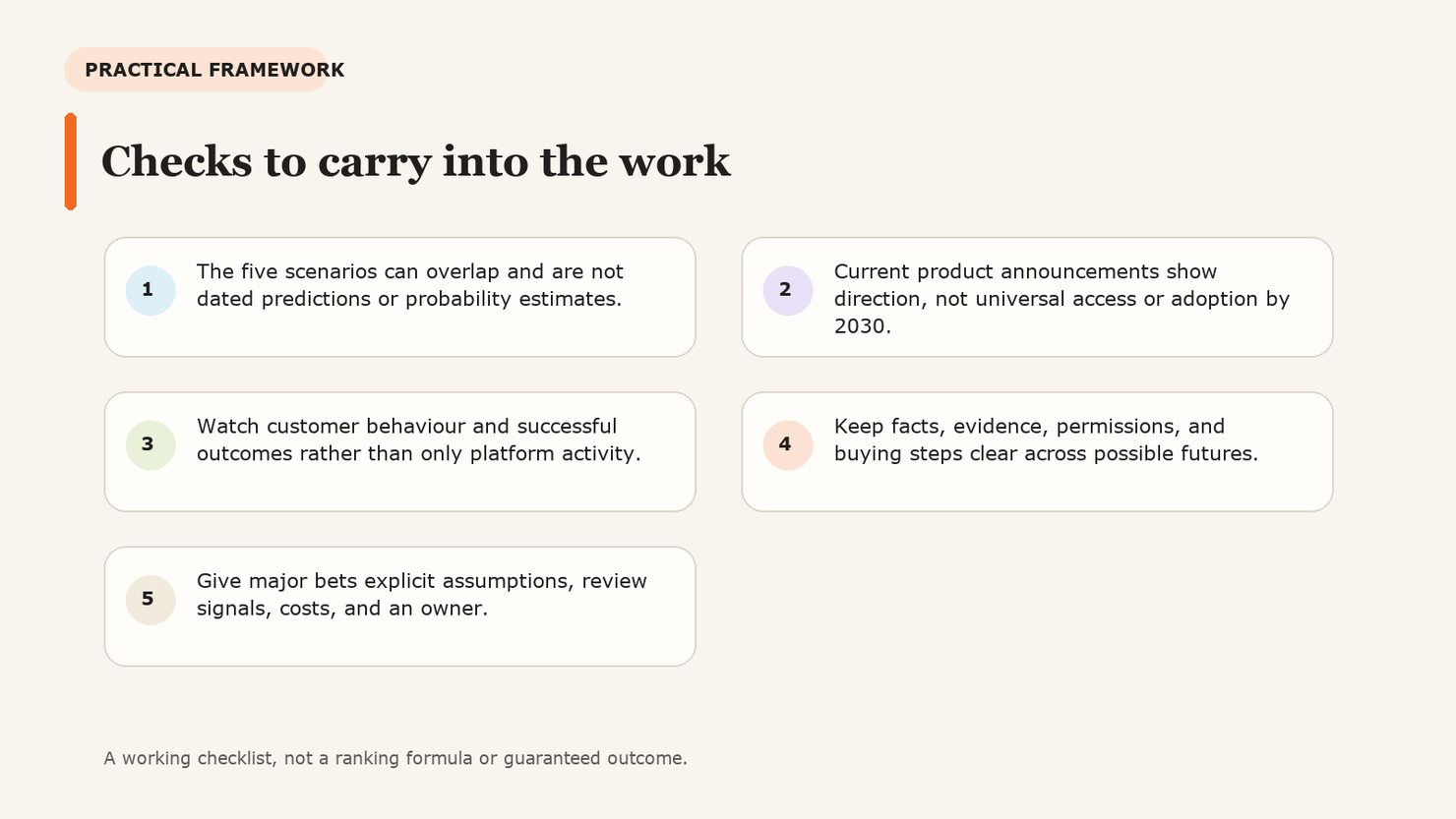
- The five scenarios can overlap and are not dated predictions or probability estimates.
- Current product announcements show direction, not universal access or adoption by 2030.
- Watch customer behaviour and successful outcomes rather than only platform activity.
- Keep facts, evidence, permissions, and buying steps clear across possible futures.
- Give major bets explicit assumptions, review signals, costs, and an owner.
Playbooks
Frameworks you can put to work
Growth marketing, LinkedIn presence, and more — delivered as PDFs.
Browse the playbooksThe future of AI search will depend on more than better models. It will also depend on what people trust, which tasks they delegate, how platforms share value, and what businesses can afford to support.
I would prepare for several possible futures rather than build a marketing plan around one confident forecast. A scenario helps a team ask what it would do if a change became important. It is not a claim that the change will happen by a fixed date.
The five scenarios below are my planning lenses for 2030. They can overlap, and different markets may follow different paths. This article builds on the future of search and discovery, moving from today's documented changes to choices a marketing team can make under uncertainty.
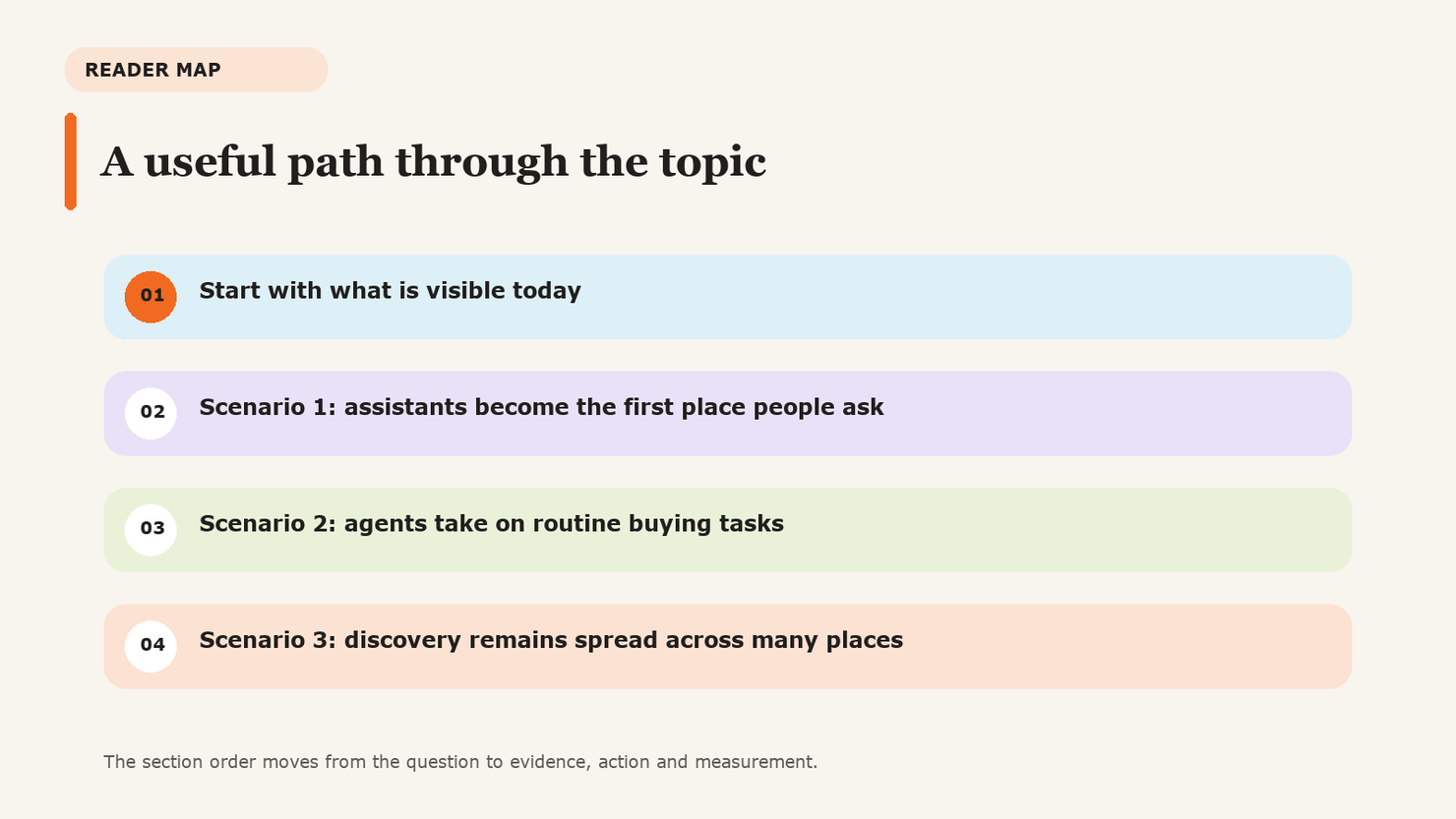
Start with what is visible today
Google's guidance for AI Search features describes retrieval and related searches while keeping SEO foundations relevant. This shows how generated answers can work alongside existing search systems.
OpenAI's cloud browser guidance describes supported multi-step web tasks in ChatGPT Work. It also explains access limits and confirmation before consequential actions. Delegation exists, but it is not unlimited.
Google's May 2026 Universal Cart announcement describes an intended shopping experience with checks, alerts, and checkout options. Its announced rollout scope does not establish universal access or tell us how widely customers will use it.
These are starting signals, not proof of a single destination. The useful planning question is how your business would respond if one of these behaviours became common among your customers.
Scenario 1: assistants become the first place people ask
In this scenario, many people begin with a conversation rather than a list of links. They describe the problem, ask follow-up questions, and use the answer to decide which sources or products deserve closer attention.
For marketers, the challenge would be to remain useful before the click. Clear product facts and sound explanations would matter, as would whether the assistant describes them correctly. The website would still need to support deeper checks and next steps.
Imagine a hypothetical buyer asking which training tool suits a small remote team. A useful public guide would explain the options and the conditions that change the choice. A vague promise about transforming learning would give the buyer little to test.
I would watch customer interviews, referral patterns, and the accuracy of answers to real buyer questions. More mentions in a tool would be a signal to investigate, not proof that the tool now drives revenue.
The early move is to improve a few important evaluation pages. Make them clear enough for readers to check fit, with evidence they can follow.
Scenario 2: agents take on routine buying tasks
Here, people delegate more of the work after defining the need. An agent might check stock, compare terms, prepare a booking, or carry a task through a supported purchase flow.
The marketing problem expands beyond being visible. The offer has to work when someone or something tries to act on it. Current facts, a clear route, and sensible approval points become part of the experience.
A retailer might need reliable product and delivery data. A service firm might need a quote form that collects the right requirements and explains the response time. A software company could need clearer plan limits before a trial begins.
I would watch completed tasks, where they stop, and how often a person has to repair the result. Count successful outcomes separately from carts or forms that were merely prepared.
The early move is to test one realistic task with the relevant teams. Find the missing fact or broken handoff before investing in a large integration. A protocol should serve a buying route, not become a badge on a roadmap.
Scenario 3: discovery remains spread across many places
In this scenario, no single tool becomes the main route for every question. People use video to see a process, communities to hear other views, search to find sources, and assistants to organise information.
The challenge is choosing where to invest without spreading the team too thin. The same message may need a different explanation in each setting.
Our hypothetical training company could keep a full guide on its site and show a lesson setup in a video. A professional post might explain when live training works better than a recorded course. Each format has a job.
I would watch which sources customers say helped them and what questions appear in each place. Distinguish discovery through a feed from a deliberate search. They can reach different people at different moments.
The early move is to choose two channels your team can maintain. Give each a clear purpose and adapt the explanation while keeping the underlying facts consistent. More accounts do not, on their own, create a better route to customers.
Scenario 4: rules and publisher choice shape access
This scenario gives greater weight to how content can be used and what publishers choose to make available. Rules, platform controls, and commercial agreements could change the sources an answer service can use.
There is already a visible signal. Google's website-owner update, updated in August 2026, describes a control for inclusion in its generative AI Search features and new appearance insights. This is a documented platform change, not a forecast of future law.
I would not assume that all countries, platforms, or publishers will settle on one model. A business should be ready to assess the value of access, attribution, and direct relationships in its own setting.
The signals to watch are concrete changes to terms, controls, access, and the traffic or enquiries associated with them. Get qualified advice when a decision involves rights or obligations; a marketing scenario cannot settle those questions.
The early move is to know what content you own and who approves its use. Keep sources and permissions clear. That makes future decisions easier without guessing which rule will arrive.
Scenario 5: a hybrid journey becomes normal
In this scenario, people mix assistants, links, social content, and human help. AI speeds up routine research, while readers return to trusted sources for detail and speak to people when the choice is difficult.
For many teams, this would require fewer dramatic changes than the headlines suggest. The work would be to join the steps well. An answer, a visit, and a sales conversation should not give three conflicting versions of the offer.
Our training buyer might ask an assistant for a shortlist, watch a demo, read a plan page, and speak with a specialist about delivery. Each step adds something the previous step did not resolve.
I would watch whether customers move smoothly between those steps and whether the same questions keep surfacing. If sales repeatedly corrects a public claim, improve the source rather than treating the correction as normal.
The early move is to review one complete journey. Make the facts consistent and the next step useful, including a route to a person when the question needs judgment.
Moves that remain useful across the scenarios
The table below is an editorial planning aid, not a forecast model. It shows why I would prioritise these moves before betting heavily on one platform.
| Move | What it helps the team do | Useful across |
|---|---|---|
| Keep product facts current | Reduce wrong expectations and avoid stale comparisons | All five scenarios |
| Publish evidence with clear limits | Help people inspect important claims | Assistant, fragmented, hybrid |
| Maintain usable next steps | Turn interest into a supported action | Agent, hybrid |
| Record ownership and permissions | Make informed decisions about content use | Publisher-choice scenario and normal operations |
| Build direct customer relationships | Keep a route to people beyond a single platform | All five scenarios |
| Measure business outcomes | Separate reach from useful visits, enquiries, and revenue | All five scenarios |
These moves still have costs. A maintained guide needs an owner. A direct audience needs something worth returning for. The table is not a reason to add six projects at once.
Start where the business has a clear gap. If customers cannot find a plan limit, fix it. If they cannot complete a quote request, improve the handoff. If claims lack proof, gather it before adding more promotion.
Turn the scenarios into a decision you can review
I would use a short planning session rather than ask a team to agree on which future will win. Choose one important customer task and discuss what would change under each scenario.
Separate actions you can take now from bets that need more evidence. Improving a current guide may be worth doing today. Building a platform-specific checkout integration may need confirmed demand, access, and a business case.
For a larger bet, write down the signal that would justify more effort and the signal that would make you pause. Give the test a time limit and a named owner. Review costs as well as activity.
Do not assign precise probabilities just to make the plan look rigorous. If you lack a sound basis, say so. The value is in making assumptions visible and giving the team a way to update them.
Search in 2030 may combine several of these paths. Your plan should be able to learn as customers and platforms change. I would invest first in a clear offer, sound evidence, and a buying experience people can trust, then expand the bets that earn their place.
For more practical guides on search, AI, and growth, join The Agentic Pivot newsletter.
Frequently Asked Questions
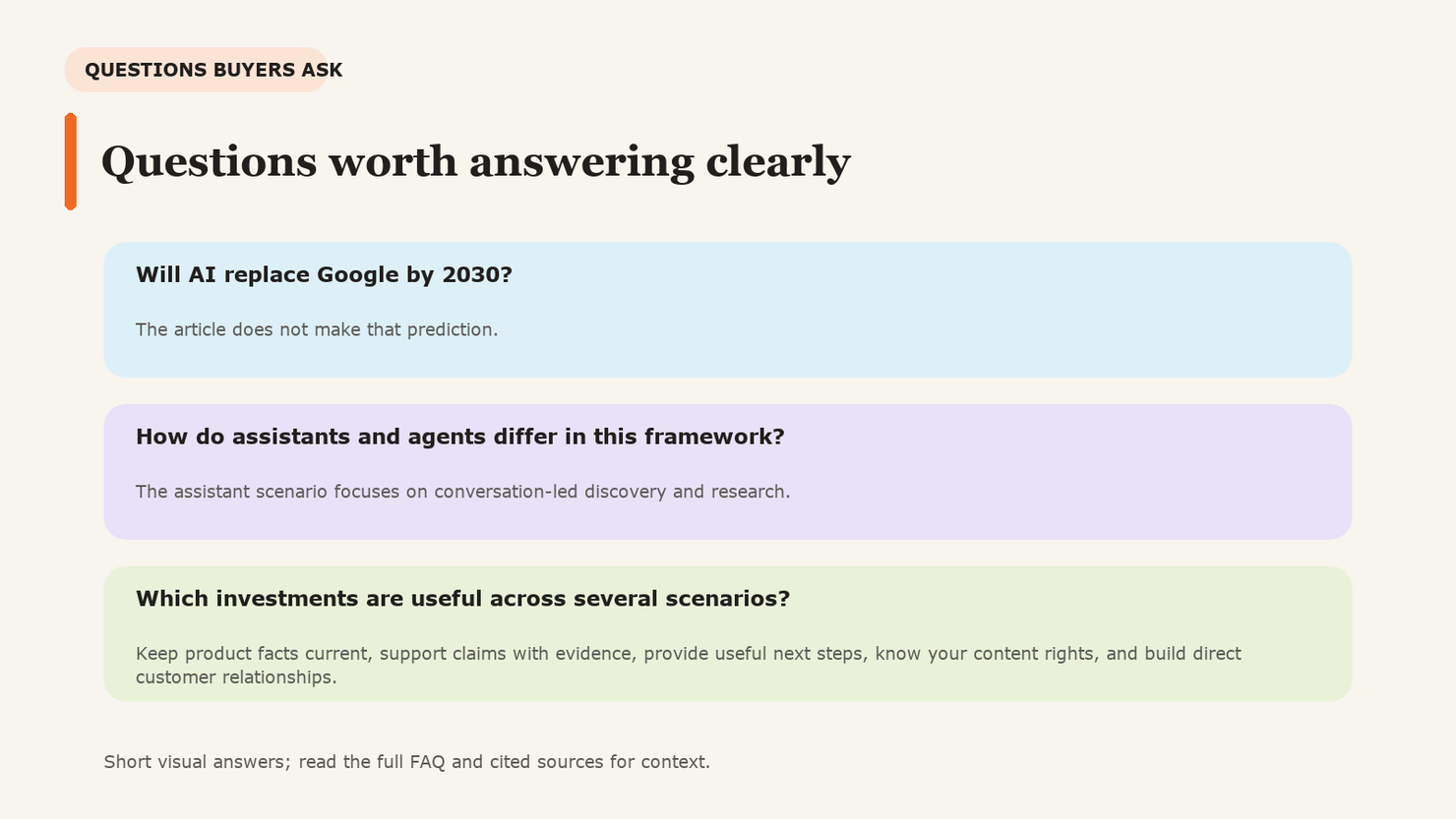
Will AI replace Google by 2030?
How do assistants and agents differ in this framework?
Which investments are useful across several scenarios?
How should a marketing team use the scenarios?
Frequently Asked Questions
Will AI replace Google by 2030?
How do assistants and agents differ in this framework?
Which investments are useful across several scenarios?
How should a marketing team use the scenarios?

Swapan Kumar Manna
Go-to-market & AI search strategist
Swapan Kumar Manna is a go-to-market and AI search strategist and Founder & CEO of Oneskai. He has spent 14+ years helping companies get found, get chosen and grow.