Part of the The Future of Search: How Discovery Works When Answers Replace Rankings (2026 Guide) series
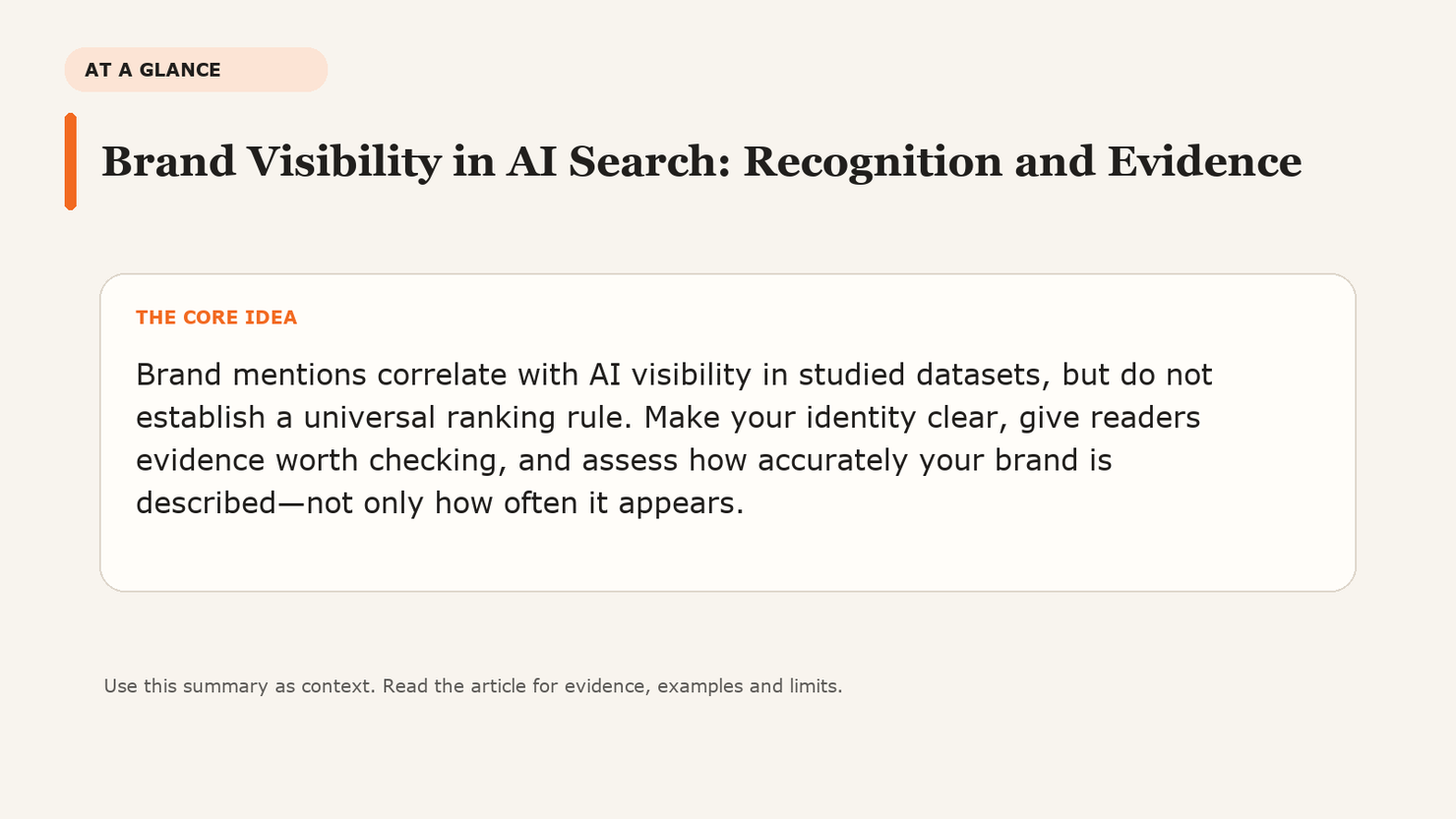
Brand mentions correlate with AI visibility in studied datasets, but do not establish a universal ranking rule. Make your identity clear, give readers evidence worth checking, and assess how accurately your brand is described—not only how often it appears.
Key Takeaways
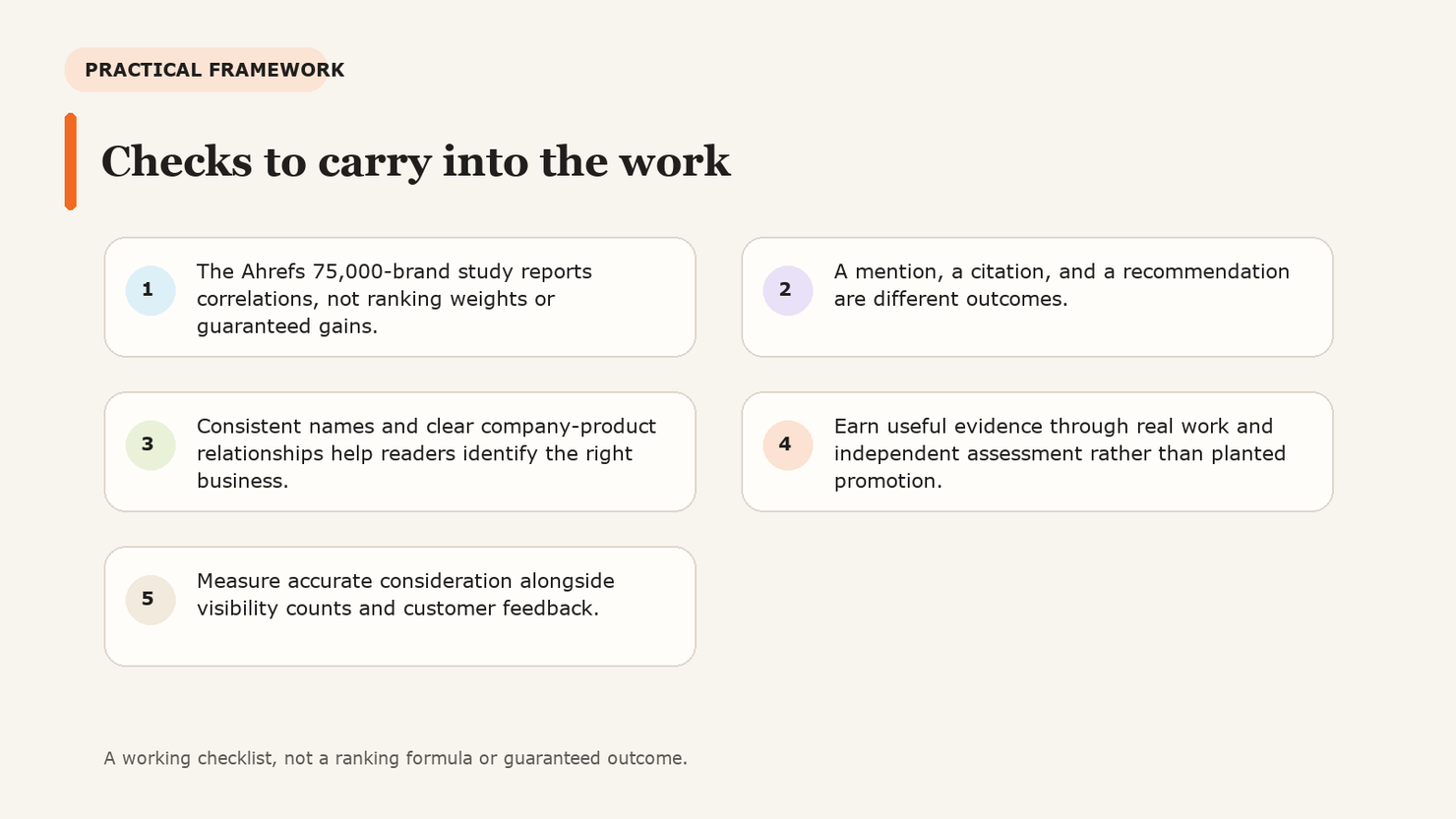
- The Ahrefs 75,000-brand study reports correlations, not ranking weights or guaranteed gains.
- A mention, a citation, and a recommendation are different outcomes.
- Consistent names and clear company-product relationships help readers identify the right business.
- Earn useful evidence through real work and independent assessment rather than planted promotion.
- Measure accurate consideration alongside visibility counts and customer feedback.
Playbooks
Frameworks you can put to work
Growth marketing, LinkedIn presence, and more — delivered as PDFs.
Browse the playbooksBrand in AI search is about how your name appears in an answer. The useful question is whether it identifies the right business, explains what you offer, and helps people decide whether you fit.
A familiar brand may have more public material for search systems and readers to draw on. But familiarity is not a rule used by all engines. Being widely mentioned does not prove that a brand is the best fit for a particular need.
My view is that brand work and useful search content should work together. Make the business easy to identify, give people something worth discussing, and support your claims with evidence. This guide builds on the future of search and discovery, focusing on what brand recognition can—and cannot—tell us about AI visibility.
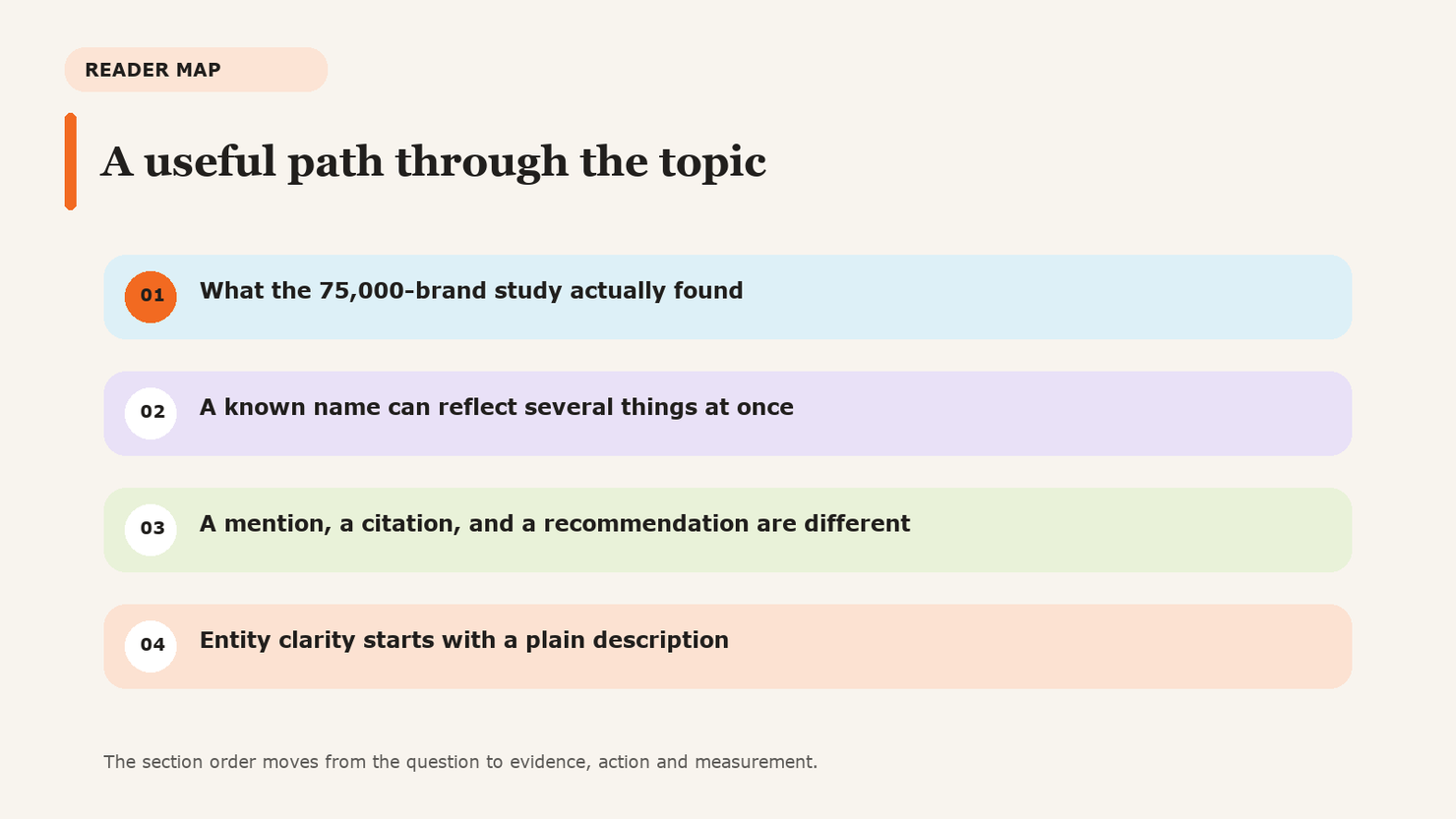
What the 75,000-brand study actually found
In December 2025, Ahrefs analysed 75,000 brands and their mentions in ChatGPT, Google AI Mode, and AI Overviews. YouTube mentions showed a strong correlation with AI visibility, around 0.737. Branded web mentions also correlated strongly, at roughly 0.66–0.71.
Those numbers show how the measures move together. They are not gains in visibility or ranking weights. They do not prove that buying more mentions will help.
The study selected domains with Ahrefs Domain Rating above 40 and a high-volume keyword of at least 800 monthly searches. That selection matters: the sample does not represent every new brand or small business.
Ahrefs used its Brand Radar responses and Spearman correlation. The authors warned that a link between two measures does not prove that one causes the other. I would treat the findings as a reason to examine your public presence, not as a formula for manufacturing authority.
A known name can reflect several things at once
A business with many mentions may also have many customers, a strong product, a long history, and a large marketing budget. Those factors can move together.
Imagine two hypothetical project management tools. One has been used for years and appears in reviews, tutorials, and discussions. The other launched last month with a small website. Their public records differ before either team starts an AI visibility campaign.
If the first appears more often in answers, we cannot tell from that result alone which part of its history caused the difference. Nor can we conclude that publishing the same number of mentions would give the second the same outcome.
For marketers, this is a useful limit. Invest in work that has value for customers and readers on its own. Then measure whether AI visibility changes, without claiming that one campaign explains every movement.
A mention, a citation, and a recommendation are different
A mention means the answer names your brand. A citation gives a source link. A recommendation suggests that an option fits the user's needs. One answer may contain any combination of these.
A chatbot could mention your product as an example of a tool that lacks a feature. It could cite your guide while recommending a competitor. Or it could recommend your product while linking to a review site.
That is why a simple count can mislead. Read what the answer says and check the context. Is the product described accurately? Is it associated with the right category? Are important limits missing?
I would report those distinctions to a leadership team. A rise in names appearing is interesting. A rise in accurate, relevant consideration is closer to the business goal.
Entity clarity starts with a plain description
An entity is a named person, business, product, or other thing. For a brand, clarity means making it easy to tell which business and product a page describes.
Start with the basics. Use the same names across your site. Explain what the business does and which products it owns. A product rename should not leave half the website describing an old identity with no explanation.
In our hypothetical example, the new tool might share a name with an unrelated app. Its homepage, About page, and product guides should make the distinction clear. Readers need the category, intended users, and current product name.
Google's organisation structured-data guidance says that relevant markup can help it understand business details and tell firms apart. That is a specific documented use. It does not mean adding markup guarantees a recommendation in ChatGPT or Gemini.
I would treat entity clarity as work that removes ambiguity for people and systems. It helps make the facts clear. It does not make people trust you by itself.
Give the brand a useful subject to be known for
A broad claim such as “we transform teamwork” gives people little to remember or verify. A clear focus is easier to understand.
For the new project tool, that could be managing handoffs between design and delivery teams. The company could explain the problem, show how its workflow handles it, and be candid about where another approach works better.
The point is to build a clear link between the brand and a real customer task. That connection should come from the product and the team's knowledge, not a list of topics chosen only for traffic.
I would prefer one strong explanation with a working example over ten vague posts calling the company a leader. Readers need a reason to link your name to a useful answer.
This also gives people outside the company something concrete to assess. A reviewer can test the workflow. A customer can explain how they use it. An expert can disagree with the approach on its merits.
Put this into practice
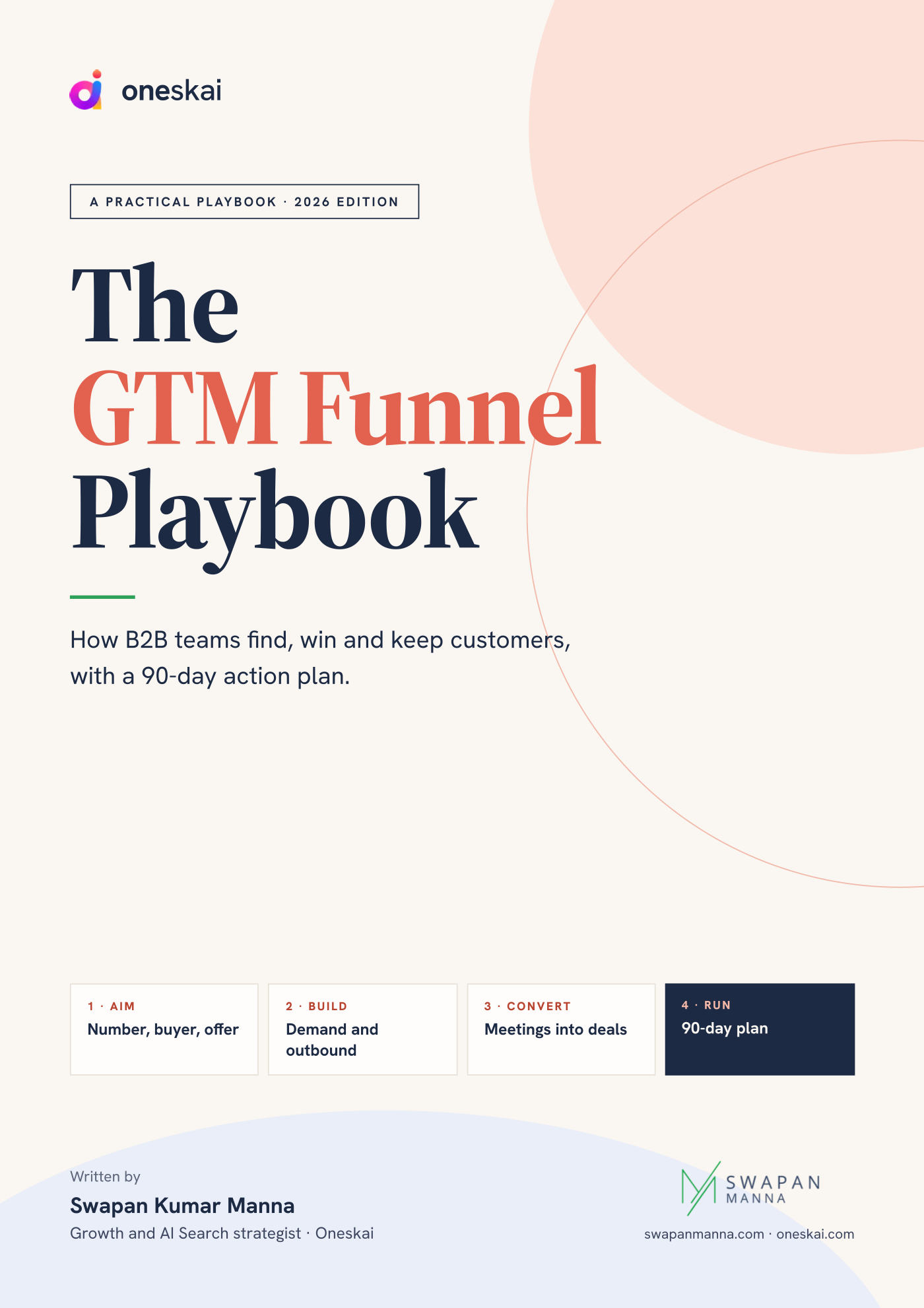
The GTM Funnel Playbook
How B2B teams find, win and keep customers, with a 90-day action plan. Seven funnel stages, one owner each, from the revenue number to the clients you keep.
Earn outside evidence that readers can inspect
Outside coverage can help buyers see beyond the company's own claims. The value depends on what it says and the proof behind it.
A careful review with a clear test method offers more information than a list that repeats product details. A customer account with dates, context, and limits offers more than an anonymous compliment.
I would focus on making useful material available: a demo someone can test, a real case shared with consent, or an original analysis whose method is visible. Let others reach their own conclusions.
Do not turn this into a quota for planted comments or flattering mentions. A public record built from disguised promotion can mislead readers and leave the brand with claims it cannot defend.
Outside evidence may include criticism. If it identifies a real product gap, the best response is to understand and address it. A reputation does not improve simply because a team tries to replace every negative statement with a positive one.
Relevance still matters when a brand is well known
A known name cannot meet every buyer's needs. A famous tool may be too expensive, lack a needed integration, or be a poor match for a small team.
OpenAI's shopping guidance describes product selection in relation to user intent and context, including information from first- and third-party sources. This applies to its shopping experience, not a published formula for every kind of AI answer.
The practical lesson is to keep product fit visible. If the user needs a particular feature on a limited budget, the content should make the plan and price basis clear.
Google's AI Search guidance also keeps SEO foundations and useful original content relevant. Brand work does not replace pages that answer real questions or basic access that lets search systems find them.
Measure understanding as well as visibility
Choose a small set of questions that represent genuine needs in your market. Include category questions, comparisons, and important use cases. Avoid only asking questions that name your brand.
Keep a record of the platform, date, wording, and answer. Separate mentions from citations and recommendations. Check whether the description is correct before celebrating a higher count.
If an answer confuses your company with another, look for unclear facts in the public material. If it describes an old feature, check current pages and the linked source. A correction to your site may help readers, but it will not ensure every engine updates immediately.
Branded search is another useful signal, but it needs context. It can rise after a campaign, a product launch, or bad publicity. More searches for your name do not always mean more trust.
Check these findings against what customers tell you and how the business performs. Ask what people understood about the brand before they contacted you and which evidence helped them decide.
Start with the public record you can stand behind
I would begin with one narrow review: can a new reader tell who you are, what you help with, and why a claim is credible?
Fix naming conflicts and unclear product details. Improve the evidence behind the most important claims. Then choose ways to share that evidence where relevant people can inspect and discuss it.
A smaller brand does not need to imitate the entire public footprint of a large competitor. It needs a useful offer and a clear record that serves the people it wants to reach. Start with the questions those people care about.
The Ahrefs study makes brand presence worth examining. It does not prove that brand has replaced fit, quality, or technical SEO. My priority would be to make a known name mean something: a name connected to clear work, useful evidence, and an honest view of fit.
For more practical guides on search, AI, and growth, join The Agentic Pivot newsletter.
Frequently Asked Questions
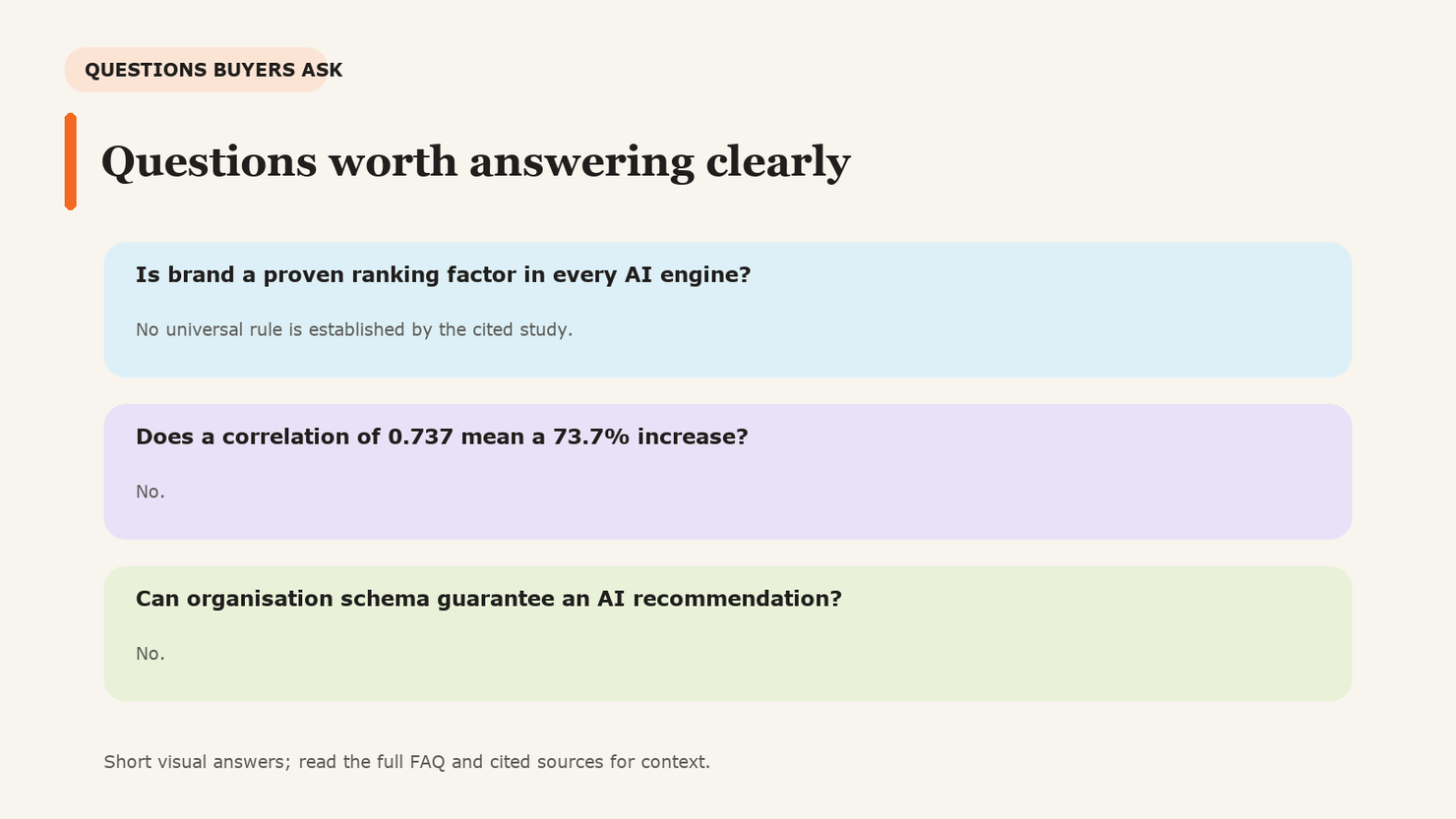
Is brand a proven ranking factor in every AI engine?
Does a correlation of 0.737 mean a 73.7% increase?
Can organisation schema guarantee an AI recommendation?
What should a small brand improve first?
Put this into practice
The GTM Funnel Playbook
How B2B teams find, win and keep customers, with a 90-day action plan. Seven funnel stages, one owner each, from the revenue number to the clients you keep.
Frequently Asked Questions
Is brand a proven ranking factor in every AI engine?
Does a correlation of 0.737 mean a 73.7% increase?
Can organisation schema guarantee an AI recommendation?
What should a small brand improve first?

Swapan Kumar Manna
Go-to-market & AI search strategist
Swapan Kumar Manna is a go-to-market and AI search strategist and Founder & CEO of Oneskai. He has spent 14+ years helping companies get found, get chosen and grow.