Part of the Demand Generation and Brand Authority: How Companies Become the Brand Buyers (and AI) Already Know series
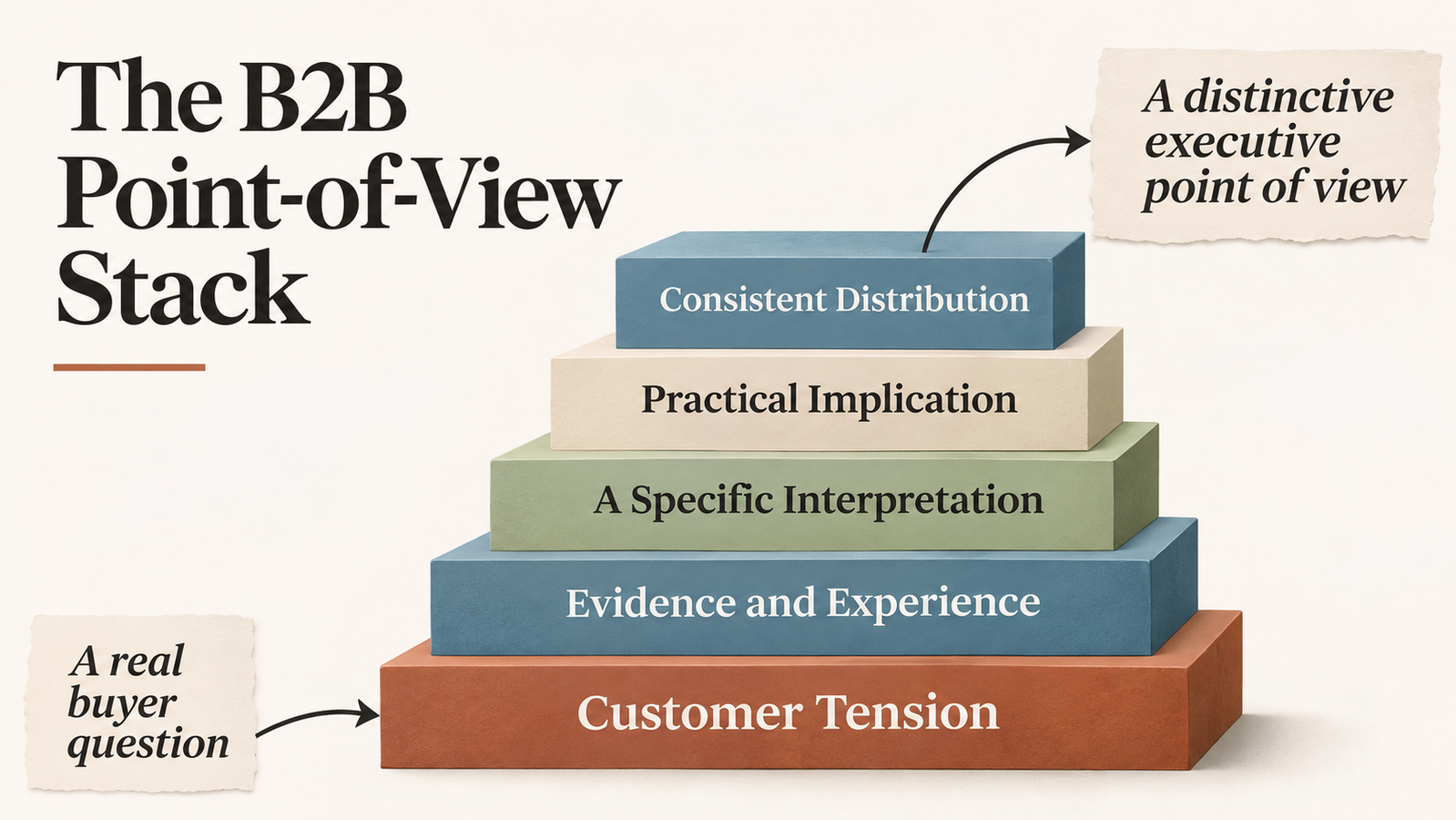
A strong B2B executive point of view starts with a real buyer tension, combines evidence and experience, explains a specific interpretation, and offers a practical implication. Review claims for accuracy and fairness, then distribute the idea in useful formats.
Key Takeaways
- Begin with a buyer problem that matters.
- Separate observed facts, research, interpretation, and recommendation.
- Make the argument specific, fair, and clear about its limits.
- Review evidence and confidentiality before publication.
- Adapt distribution to the audience and measure usefulness beyond reach.
Playbooks
Frameworks you can put to work
Growth marketing, LinkedIn presence, and more — delivered as PDFs.
Browse the playbooksA B2B executive point of view is a clear, evidence-aware interpretation of a market issue that helps a defined audience understand what is changing and what it could mean for them. It goes beyond a slogan or a prediction. A useful point of view starts with a buyer’s real question, draws on relevant evidence and experience, explains a specific implication, and gives the reader a sensible next step.
This guide provides a practical framework for building that point of view, checking its quality, and distributing it in ways buyers can use. It is part of the demand generation and brand authority pillar and connects to the guide on founder-led marketing.
What makes a B2B point of view useful
A point of view is not valuable because it is provocative. It is valuable when it makes a complicated question easier to examine. It identifies a tension buyers recognize, explains why common assumptions may be incomplete, and offers a defensible interpretation. It should help the reader think or act more clearly, even if they ultimately reach a different conclusion.
The 2026 Edelman-LinkedIn B2B Thought Leadership Impact Report reports that 82% of surveyed decision-makers believe thought leadership is becoming more valuable as AI is used more for business answers and advice; 57% say an important role is providing original research, data, or perspectives not found elsewhere. These results are from the report’s survey, not a universal guarantee of how every buyer behaves. They do underline the value of specific thinking over generic claims.
The five layers of an executive point of view
Start with a buyer tension: a question, risk, or trade-off that matters in a real decision. Use conversations, support questions, sales feedback, customer interviews, or credible research to understand the issue. Avoid manufacturing urgency where the evidence does not support it.
Next, assemble evidence and experience. Separate what the company observed directly from third-party research and from the founder’s interpretation. Include dates, audience scope, and limits when they matter. If the point relies on confidential or proprietary information, use it only with appropriate approval and make clear what can be shared.
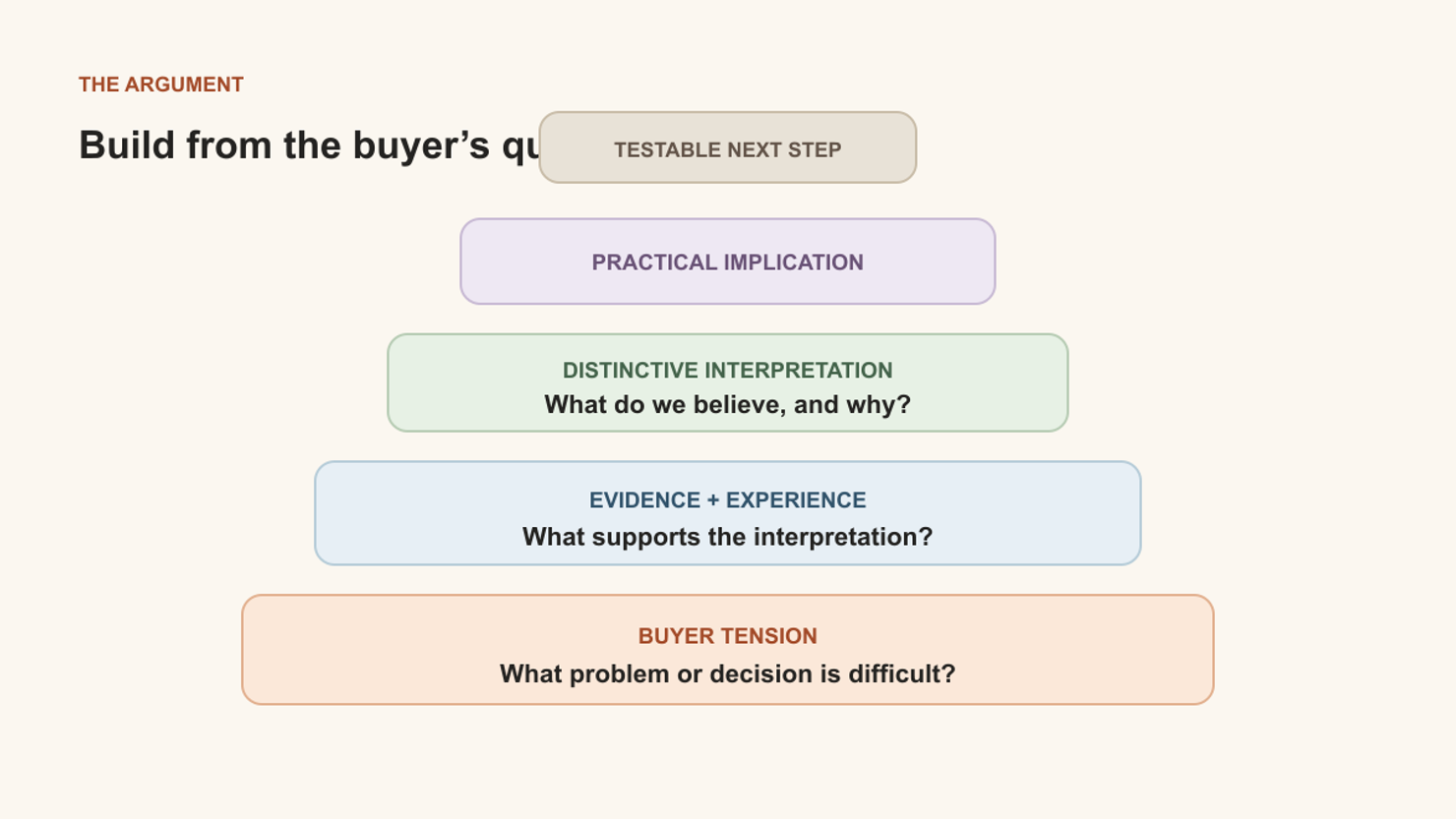
Then state the interpretation. What do these observations suggest? Why might this matter now? Which buyers or situations does it apply to? A strong interpretation can be distinctive without claiming that everyone else is wrong. Make the reasoning visible so the reader can assess it.
Finally, explain the implication. What should a buyer investigate, measure, or discuss with colleagues? A practical implication turns commentary into something usable. It might be a diagnostic question, a comparison framework, or a decision to test. It should not become an unsupported promise about results.
How to develop the core argument
Write the argument in one plain sentence before drafting. A helpful template is: “When [specific condition] occurs, [audience] should reconsider [assumption] because [evidence and reasoning], then [practical step].” The sentence is a working brief, not a formula for publication. Remove jargon, narrow broad categories, and test whether a buyer would recognize the situation.
Ask what evidence could change your mind. This question helps surface uncertainty and prevents advocacy from outrunning the facts. If the evidence is mixed, say so. If the point is a hypothesis, identify it as a hypothesis and describe how it could be tested. If it is a lesson from one company, do not imply that it applies to every market.
A useful argument also makes room for alternatives. Explain where another approach may work better, which conditions change the answer, and what the reader should compare. Fair treatment of alternatives strengthens credibility because it shows the point of view is meant to guide a decision, not merely promote a company.
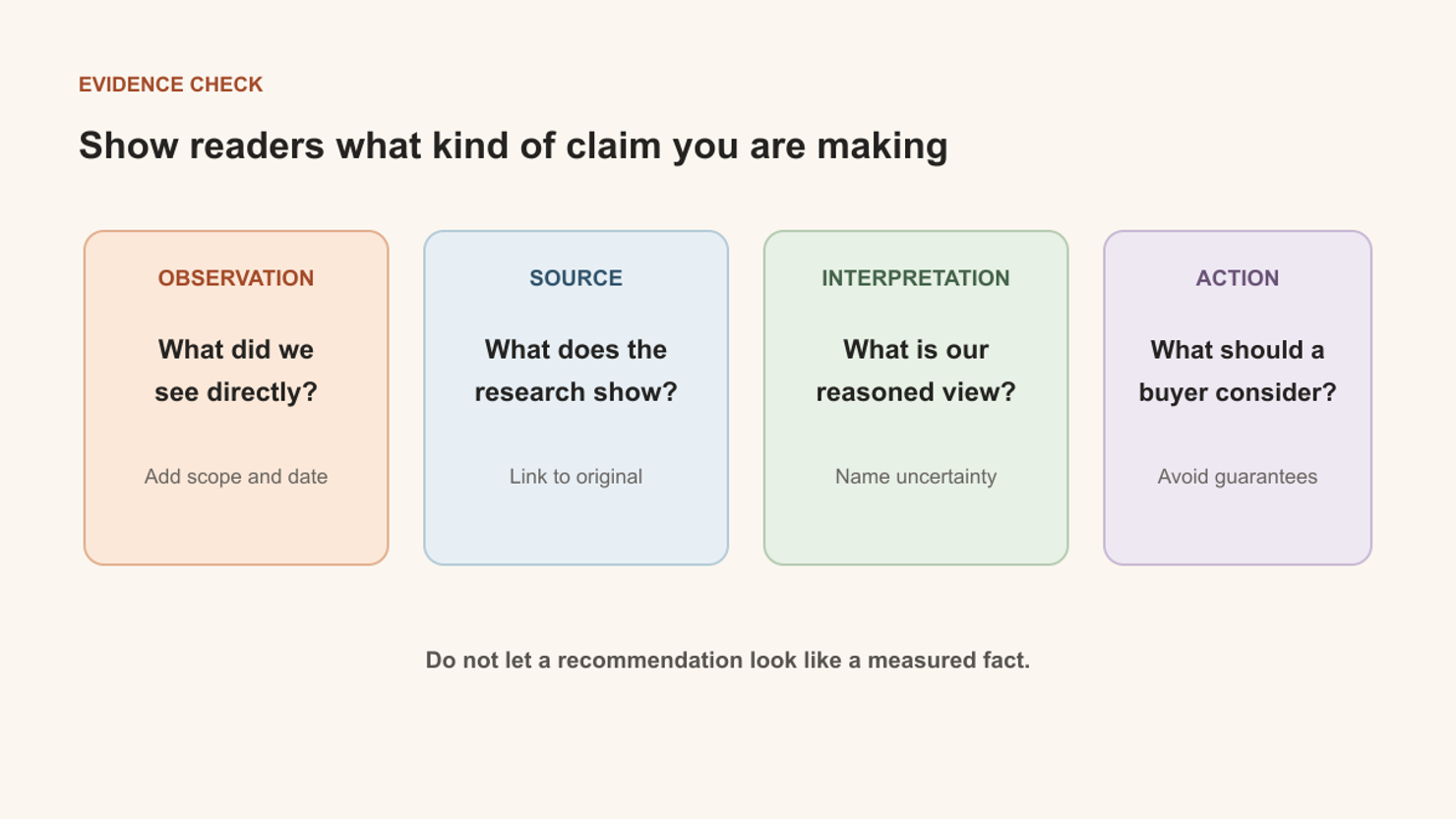
Distinguish evidence from interpretation
Use labels and wording that signal the type of statement. “In our customer interviews” describes a source of observation. “The survey found” introduces a study result and should link to the original study. “We believe this suggests” signals interpretation. “A team could test” frames a recommendation rather than a proven outcome.
When citing research, link to the original source and preserve its scope. The Edelman-LinkedIn report describes a survey of more than 1,100 management-level professionals across seven countries. Do not restate a sample finding as a universal law or omit context that changes what the number means. Google’s guidance for Search also emphasizes original, reliable, expert-led information over commodity content; see its AI search guidance.
Make the point of view readable and fair
Lead with the question or conclusion the article answers. Define terms that different teams use differently. Organize the reasoning so each section advances the same argument. Short examples help when they illuminate a decision, but label hypothetical examples clearly and never imply that an invented scenario is a client case study.
Avoid false binaries, sweeping predictions, and deliberately inflammatory framing. A counterintuitive position can be useful, but it needs evidence and a careful explanation. Replace vague statements such as “the old playbook is dead” with the actual condition, audience, and consequence. Name what is known, what is uncertain, and what may vary across company size or industry.
Before publication, test the argument
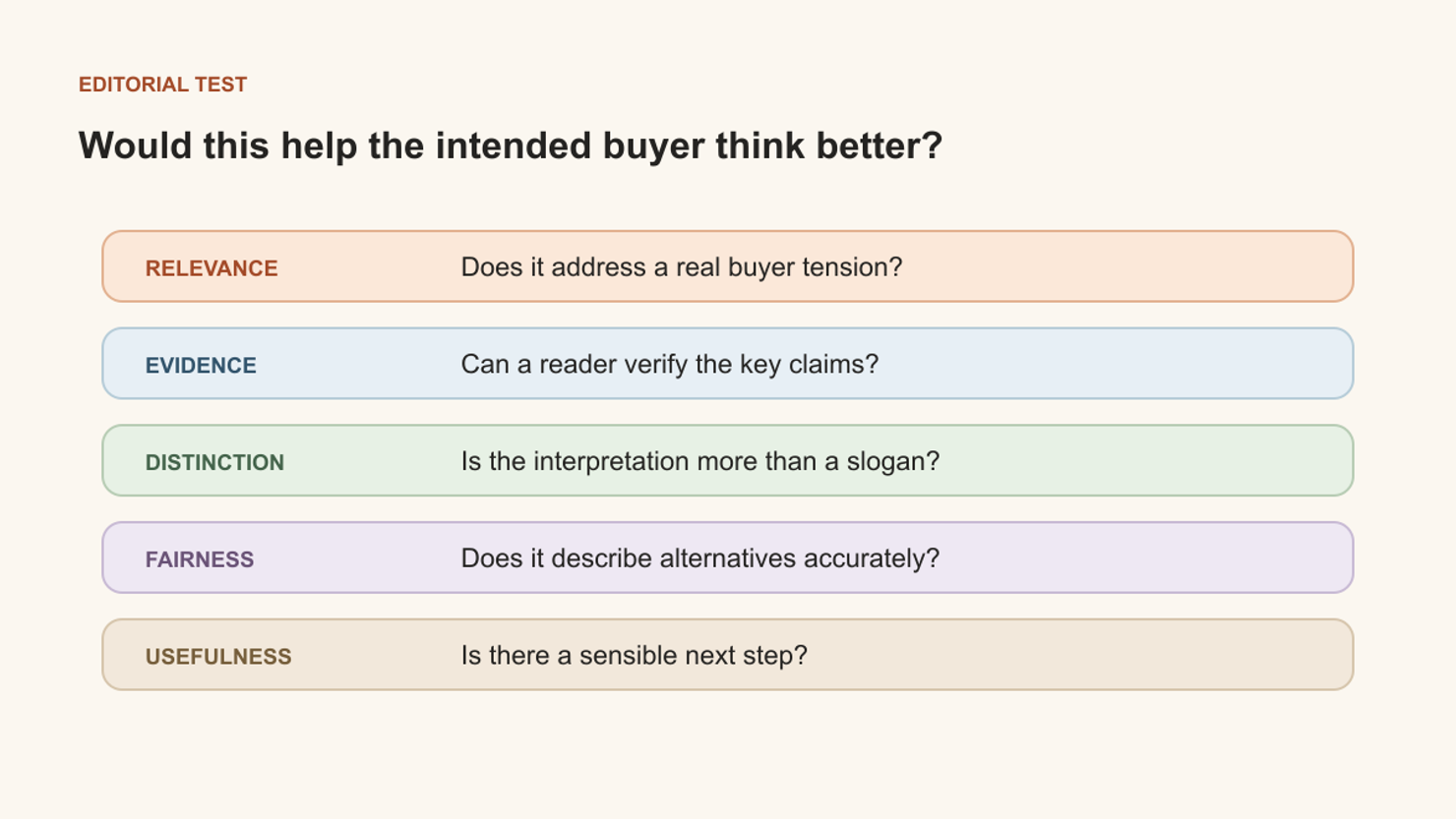
A senior editor or subject expert should check whether the intended buyer is clear, the evidence supports the main claim, the interpretation is meaningfully distinct, and the recommendation follows from the reasoning. Review quotations, numbers, sources, conflicts of interest, confidentiality, and any statements about named companies. Check whether the headline promises more than the content delivers.
For search and AI discovery, prioritize a clear, crawlable page that answers the real question and adds expert value. Google says its existing search guidance applies to generative features, and recommends useful, non-commodity content. It does not require a special “AI writing” format or every possible query variation. Do not create many near-identical pages around slight wording changes.
Distribute the idea without flattening it
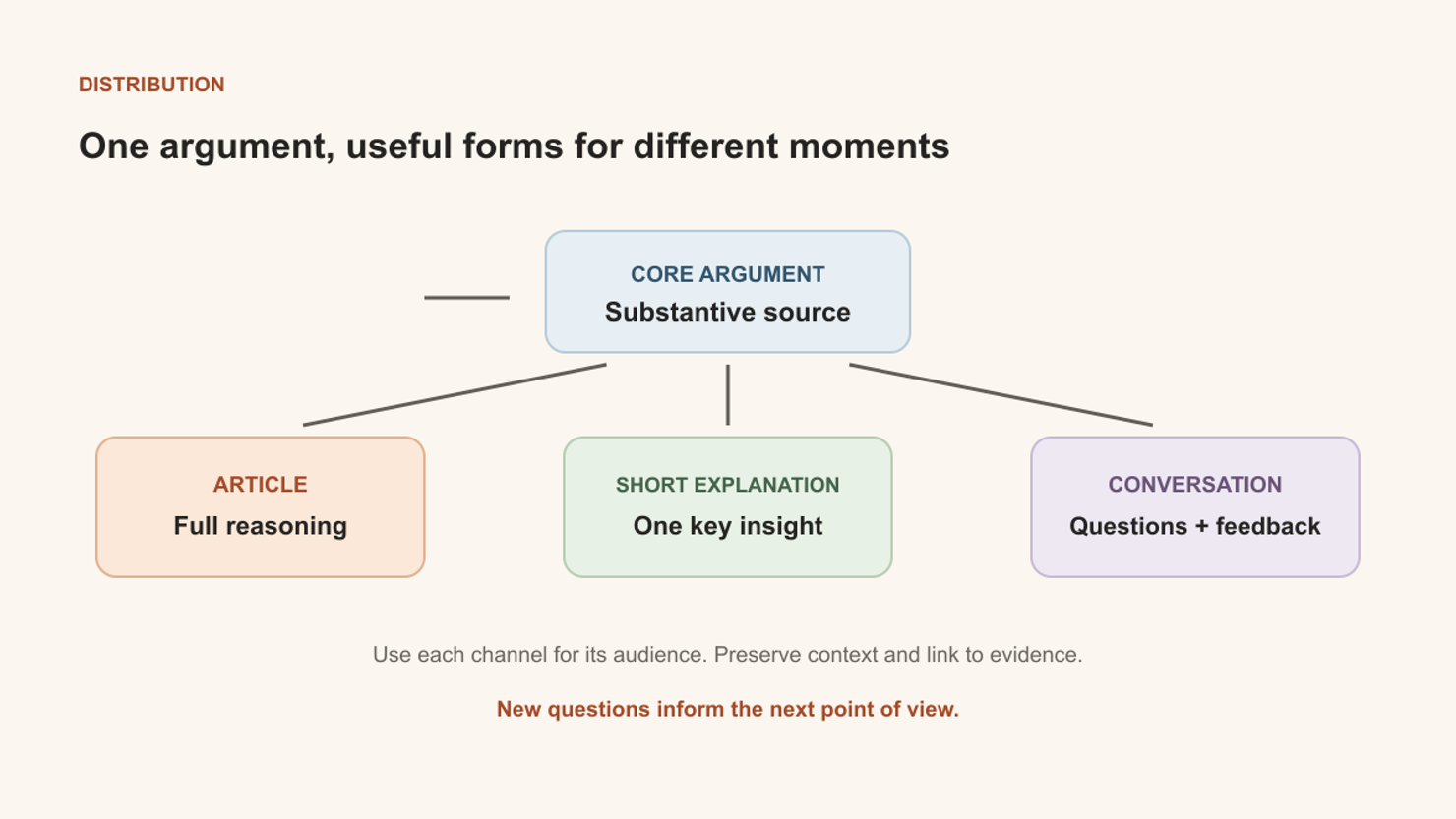
Give the full argument a lasting home when it deserves one, such as an article, research note, or practical guide. Adapt the core idea for relevant channels: a concise explanation can introduce the question, an interview can explore the trade-offs, and a presentation can help a team discuss the decision. Each adaptation should retain the context and point readers to the source when useful.
Distribution is not simply copying the same paragraph into every account. Consider what the audience needs in each format, where a real conversation can happen, and what the team can maintain. Use feedback and recurring questions to refine the argument. Do not seek artificial mentions or endorsements.
A practical example
Suppose a B2B software founder hears that finance leaders are delaying automation because teams cannot explain how exceptions will be handled. The founder reviews anonymized support themes, interviews customers with permission, and checks relevant research. The point of view might be that evaluation should include exception handling and human review, not only time saved on routine tasks.
The article can show the reasoning, identify what the evidence does and does not establish, and offer questions procurement teams can ask vendors. It should not imply that all finance teams face the same problem or promise a quantified saving without validated data. The example is illustrative, not a reported client result.
Measure whether the idea is useful
Measure more than impressions. Look at whether the intended audience engages with the argument, whether people share it in relevant professional discussions, what questions it prompts, and whether prospects or customers say it helped them evaluate an issue. If the content supports a commercial goal, track appropriate downstream activity while noting other influences and the long, shared nature of B2B decisions.
A point of view can be strategically useful even if it does not produce an immediate form fill. Conversely, a spike in engagement does not by itself prove market trust. Define what success means before publication, use a baseline, and interpret results in the context of audience and channel.
Frequently asked questions
Frequently Asked Questions
What is an executive point of view in B2B?
How is a point of view different from thought leadership?
How do you build an executive point of view?
Does a strong point of view need to be controversial?
How can a company support an executive point of view with evidence?
How should a B2B company measure thought leadership?
Research and further reading
Edelman and LinkedIn: 2026 B2B Thought Leadership Impact Report examines how buyers use thought leadership in discovery and vendor evaluation.
Google Search: Guide to AI features in Search outlines Google’s current guidance on expert-led, helpful content for generative features.
Frequently Asked Questions
What is an executive point of view in B2B?
How is a point of view different from thought leadership?
How do you build an executive point of view?
Does a strong point of view need to be controversial?
How can a company support an executive point of view with evidence?
How should a B2B company measure thought leadership?

Swapan Kumar Manna
Go-to-market & AI search strategist
Swapan Kumar Manna is a go-to-market and AI search strategist and Founder & CEO of Oneskai. He has spent 14+ years helping companies get found, get chosen and grow.