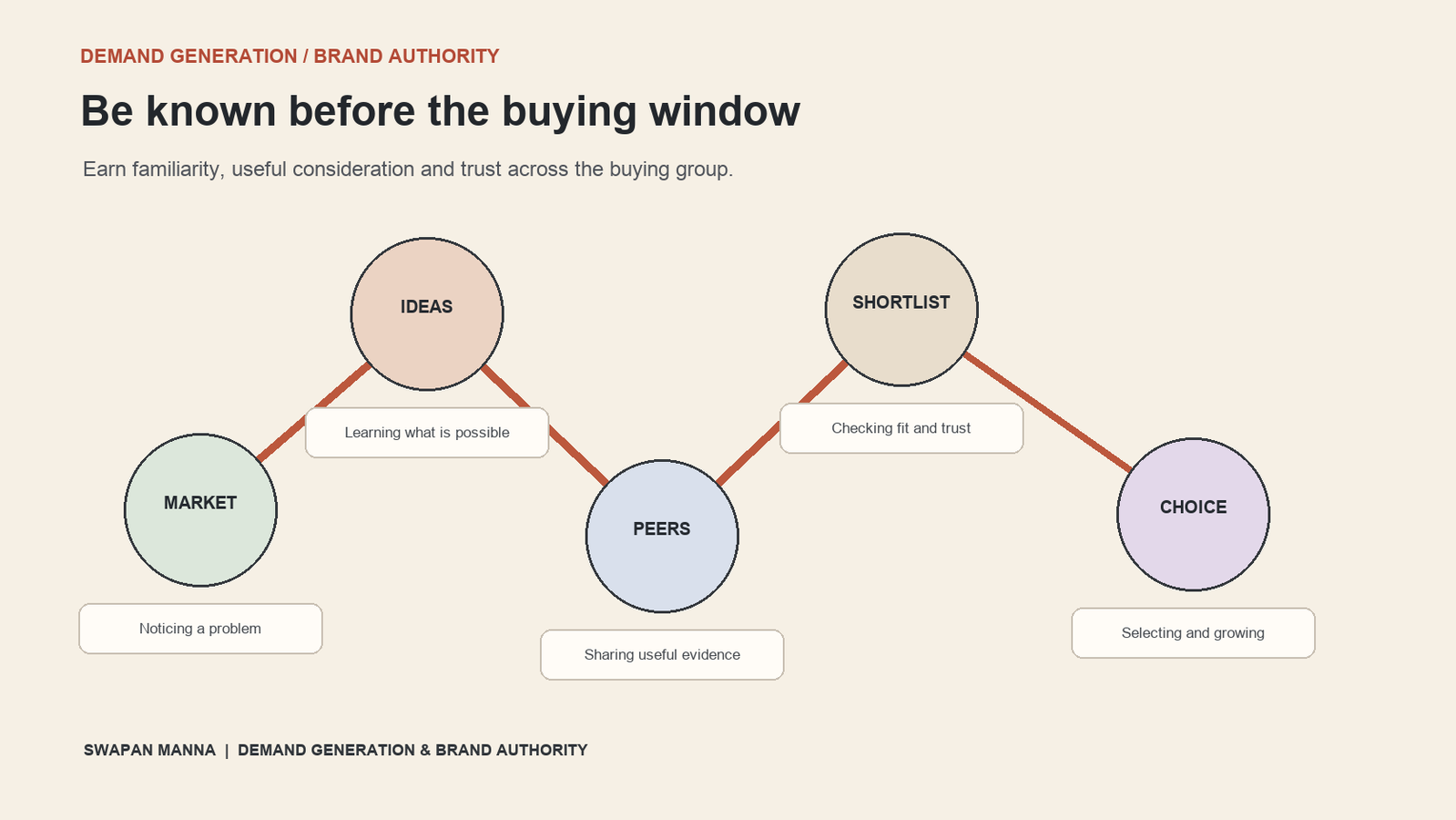
Demand generation creates qualified interest before and during active buying, while brand authority helps buyers recognize and trust the company. Build both through useful, evidence-led insight, clear company facts, relevant buying-group content, and measures that separate familiarity from business outcomes.
Key Takeaways
- Demand generation includes lead capture but also builds interest and understanding before a buyer identifies themselves.
- Support a clear brand position with relevant expertise, proof, and consistent public information.
- Create content for the whole buying group and its distinct evaluation questions.
- Treat AI discovery as one part of buyer research; no optimization can guarantee a recommendation.
- Measure familiarity, consideration, demand, and value separately, with attribution limitations stated.
- Use customer and business evidence to adapt the program rather than copying generic benchmarks.
Playbooks
Frameworks you can put to work
Growth marketing, LinkedIn presence, and more — delivered as PDFs.
Browse the playbooksDemand generation is the work of creating and sustaining qualified interest in a company’s products or services. It helps buyers recognize a problem, learn about possible approaches, understand the company’s point of view, and choose whether to evaluate a solution. Brand authority supports that work when the market can recognize what the company does, understand why its perspective is credible, and find evidence that supports its claims.
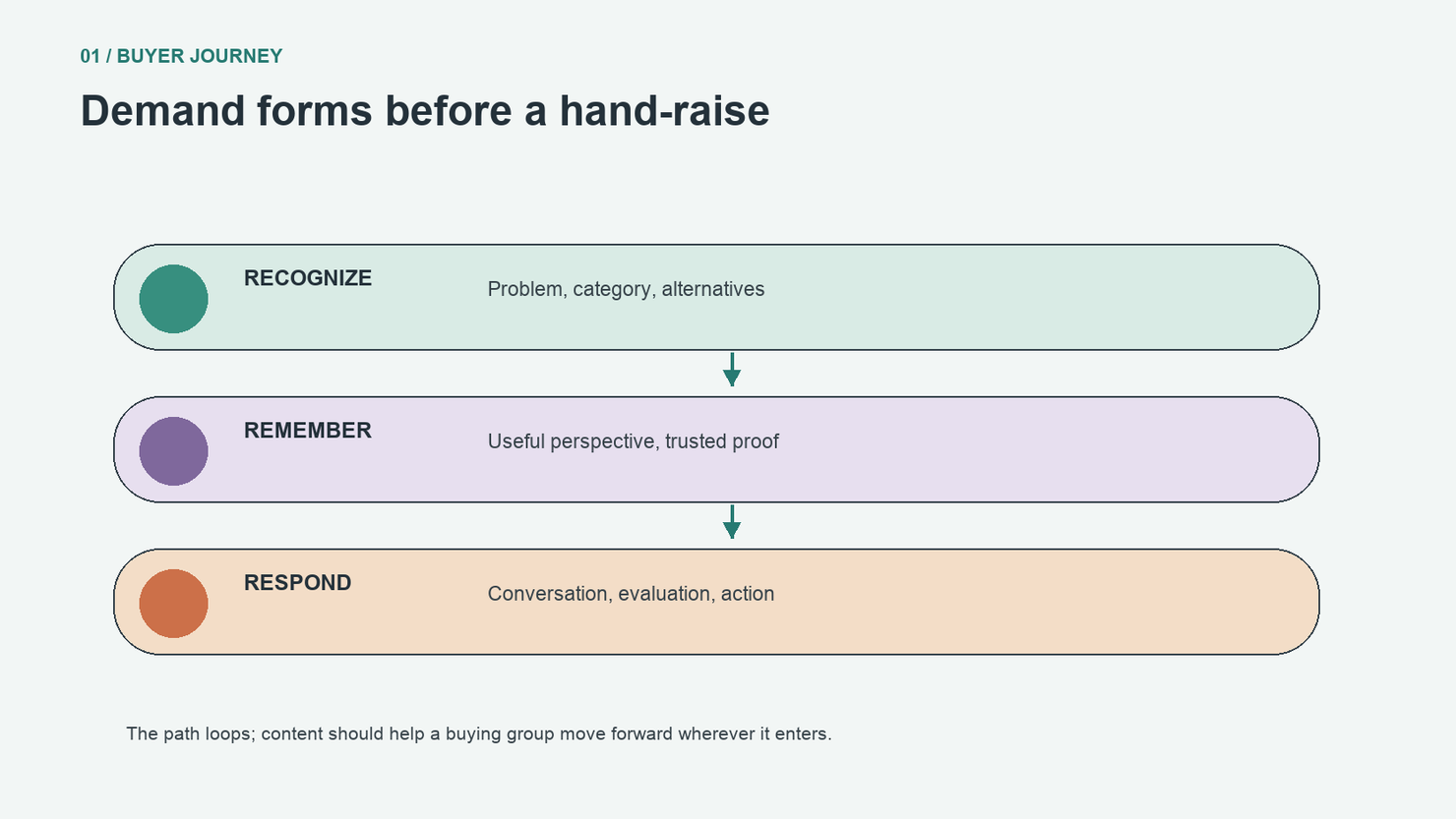
For many B2B purchases, demand develops before a person fills out a form or speaks with sales. People ask colleagues, research independently, read reviews, attend events, compare vendors, and increasingly consult AI search tools. A useful demand-generation strategy earns familiarity and trust across those moments, then makes the next step straightforward when a buyer is ready.
This guide explains how to connect brand building and demand capture, engage the full buying group, strengthen the evidence around your market position, and measure progress without mistaking impressions or attribution for revenue causality.
Demand generation is broader than lead generation
Lead generation captures identifiable responses, such as a form submission, event registration, or demo request. Demand generation also creates understanding and preference among people who may not be ready to identify themselves. It includes the content, reputation, relationships, and experiences that help buyers recognize a need and evaluate vendors over time.
Lead generation can be an important part of demand generation, but it is an incomplete proxy for it. A person may learn from a public guide, share an insight privately with a colleague, return through a branded search, and only later contact sales. Some of these interactions are difficult to observe with standard analytics. A program that counts only gated downloads may undervalue useful work and encourage teams to put a form in front of every answer.
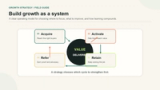
The broader business system is explained in the growth strategy pillar, which connects demand creation with acquisition, activation, retention, and revenue.
Build familiarity before the buying window
Not every potential customer is actively evaluating a purchase at the same time. A company that waits for explicit intent may enter the conversation only after a buyer has formed opinions about the category and the alternatives. Consistent, useful presence can make the company more familiar before the project begins, although awareness alone does not guarantee inclusion or preference.
The strongest demand work starts from the problems and decisions customers face. It explains what is changing, what choices are available, what trade-offs matter, and where a particular approach is suitable or unsuitable. Repeated product claims rarely create authority. Relevant insight and substantiated evidence give an audience something useful to remember and share.
Create a reason to remember the brand
Choose a defined market and articulate a position the business can support. Explain who the offer helps, which problem it addresses, what makes the approach distinct, and what evidence backs the promise. Use the same underlying facts across the website, sales material, profiles, customer stories, and public discussions. Adapt the format to the channel while keeping the meaning consistent.
A brand is not only its visual identity or tagline. It is also the associations people form through their product experience, customer support, public expertise, customer evidence, reviews, and the way employees describe the company. If those signals contradict one another, more advertising may increase reach without resolving uncertainty.
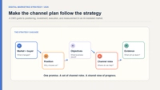
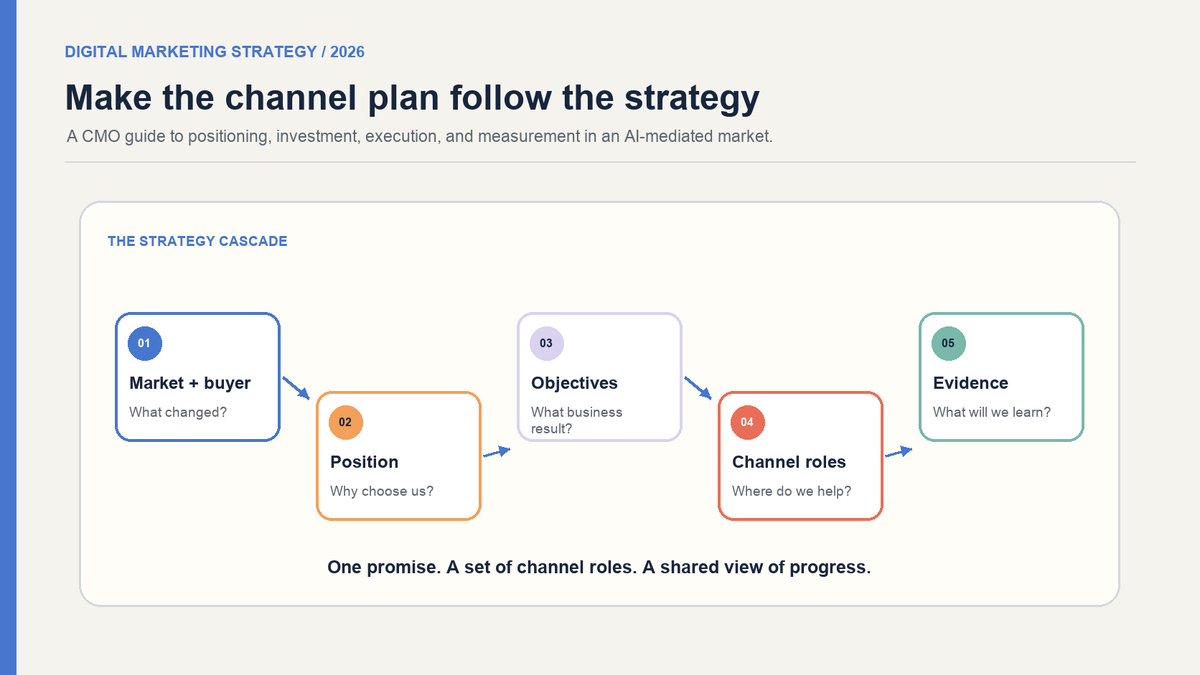
The digital marketing strategy guide covers the positioning, channels, budget, and measurement choices that support this work.
Make authority useful to the whole buying group
B2B decisions often involve people with different priorities. A user may ask whether a solution improves the daily workflow. A technical reviewer may focus on integration, reliability, and security. Finance may ask about cost and risk. An executive may consider strategic fit. Operations may assess implementation and adoption. The roles and decision authority vary from one organization to another, so research actual buying groups rather than relying on a universal persona template.
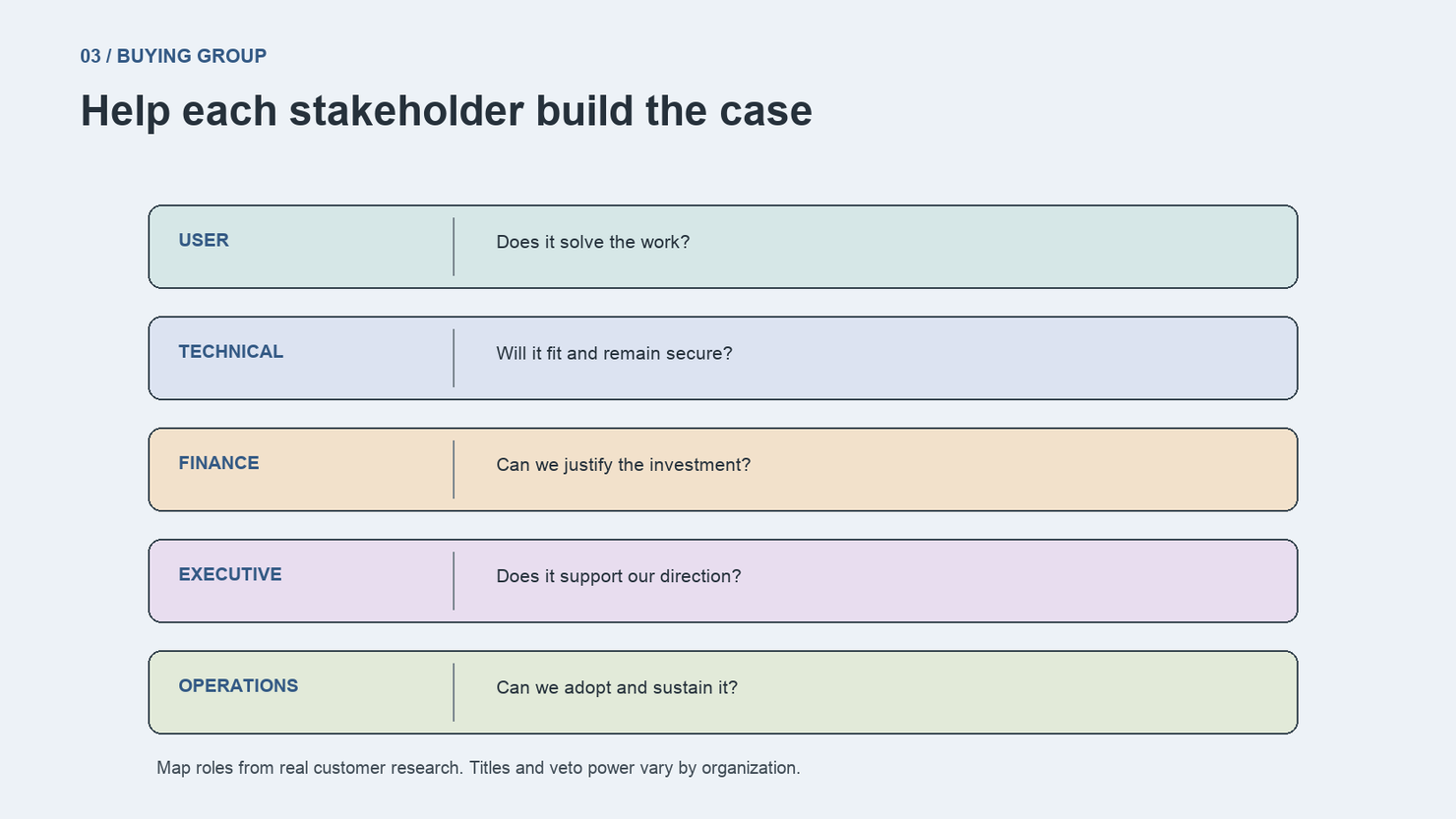
Create evidence that helps those people discuss the decision together. An executive summary may frame the problem and trade-offs. A detailed implementation guide may answer technical questions. A transparent comparison can show where approaches differ. A documented customer example can help a buyer assess context and relevance, provided it is accurate and permissioned.
Edelman and LinkedIn’s 2026 B2B Thought Leadership Impact Report surveyed 1,135 business executives across seven countries. Among the B2B decision-makers in the survey (n=1,063), 82% said thought leadership was becoming more valuable as AI becomes a more common way to get answers, ideas, and advice. The report also found that 57% valued original research, data, or perspectives not found elsewhere, and 51% valued context, nuance, and human judgment.
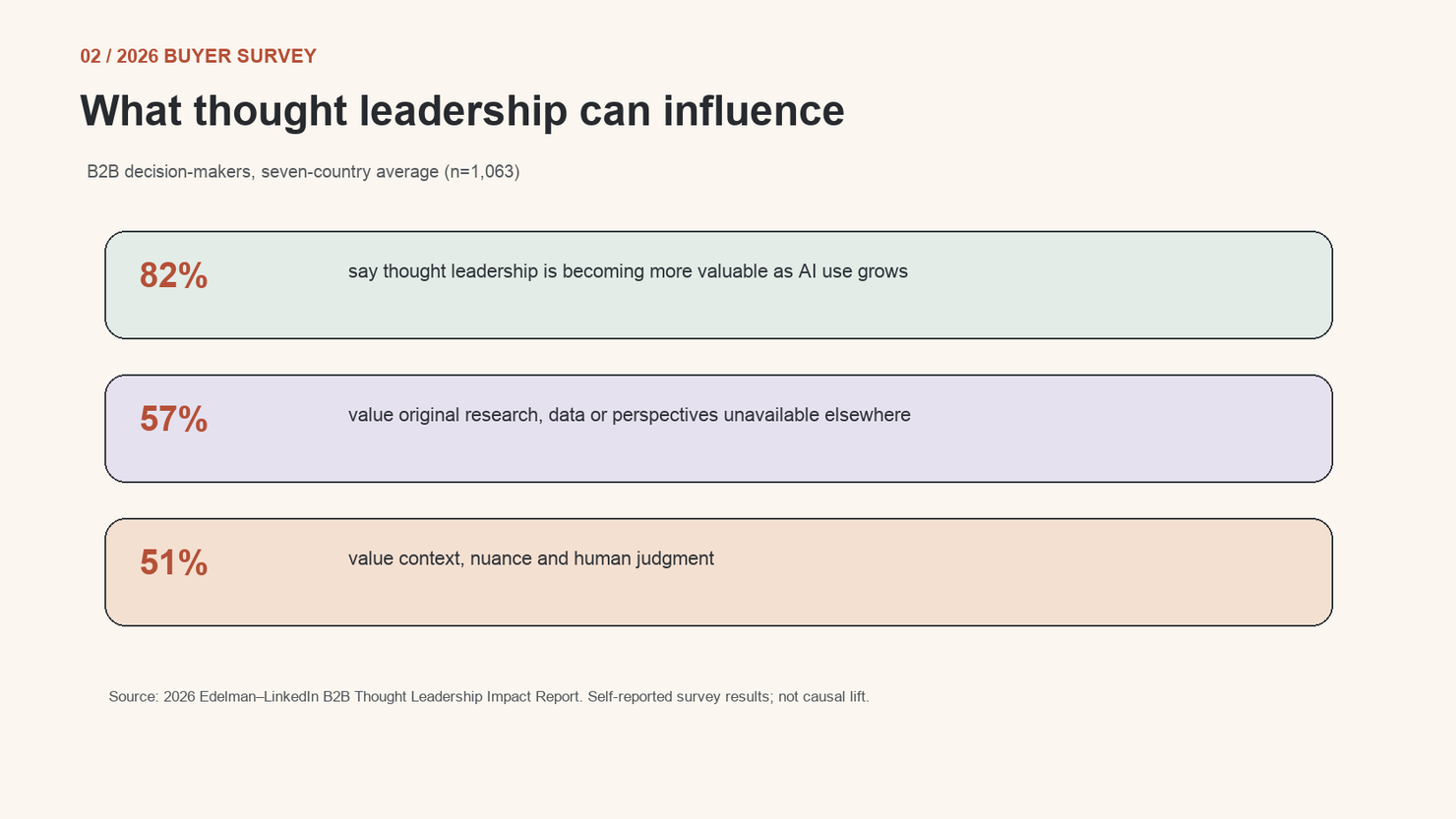
Read the 2026 Edelman–LinkedIn B2B Thought Leadership Impact Report for its questions and methods. These are respondents’ self-reported views, not a causal estimate of revenue or a prediction for every market.
The findings provide a reason to make expertise more useful and distinctive, not to publish more opinion pieces. The report suggests that thoughtful work can help buyers assess fit and discuss a vendor. It does not show that every content format, channel, or claim creates the same effect. Apply the insight through interviews and evidence from your own customers.
Use thought leadership to answer a real market question
Thought leadership is useful when it changes how a reader understands a challenge, evaluates options, or chooses a next step. It should be grounded in a clear point of view and supported by experience, original evidence, or careful reasoning. It may challenge a common assumption, but it should also show why the alternative is credible and where it has limits.
Start with questions that matter to customers and the business. Ask sales what causes evaluation to stall. Ask customer success what changes after implementation. Ask product what users misunderstand. Review search queries, support questions, community discussions, and customer feedback. Look for a problem with practical consequences, not simply a topic trending in a marketing feed.
Do not imply first-hand research when the article is only summarizing other sources. If a viewpoint comes from a documented client engagement, obtain permission and describe the scope accurately. If an example is hypothetical, say so. Authority depends on dependable evidence and clear disclosure, not on a confident tone.
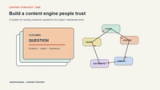
The content strategy pillar describes how to turn customer questions and verified expertise into a maintained library of useful material.
Earn a consistent presence across search, AI, reviews, and peers
A buyer’s understanding of a brand can be shaped by owned pages and by independent sources. Product documentation, case studies, expert articles, customer reviews, media coverage, professional communities, and partners each contribute different evidence. The company can improve the accuracy of its own information, but it cannot control every mention or dictate what an AI system will recommend.
Keep core company facts clear and current: category, products, target customers, use cases, geographies, limitations, integrations, and proof. Maintain pages that answer meaningful buyer questions, and ensure internal links connect related guidance. Make evidence easy to inspect, cite its source, and explain its date and scope where relevant.
Google says its existing Search foundations continue to apply to AI features. See the guide to generative AI features in Search for current guidance. No markup, phrase, or publishing cadence can guarantee inclusion in search or an AI answer.
For a wider explanation of discovery changes, see the Future of Search pillar, and for a practical source-readiness approach, see the
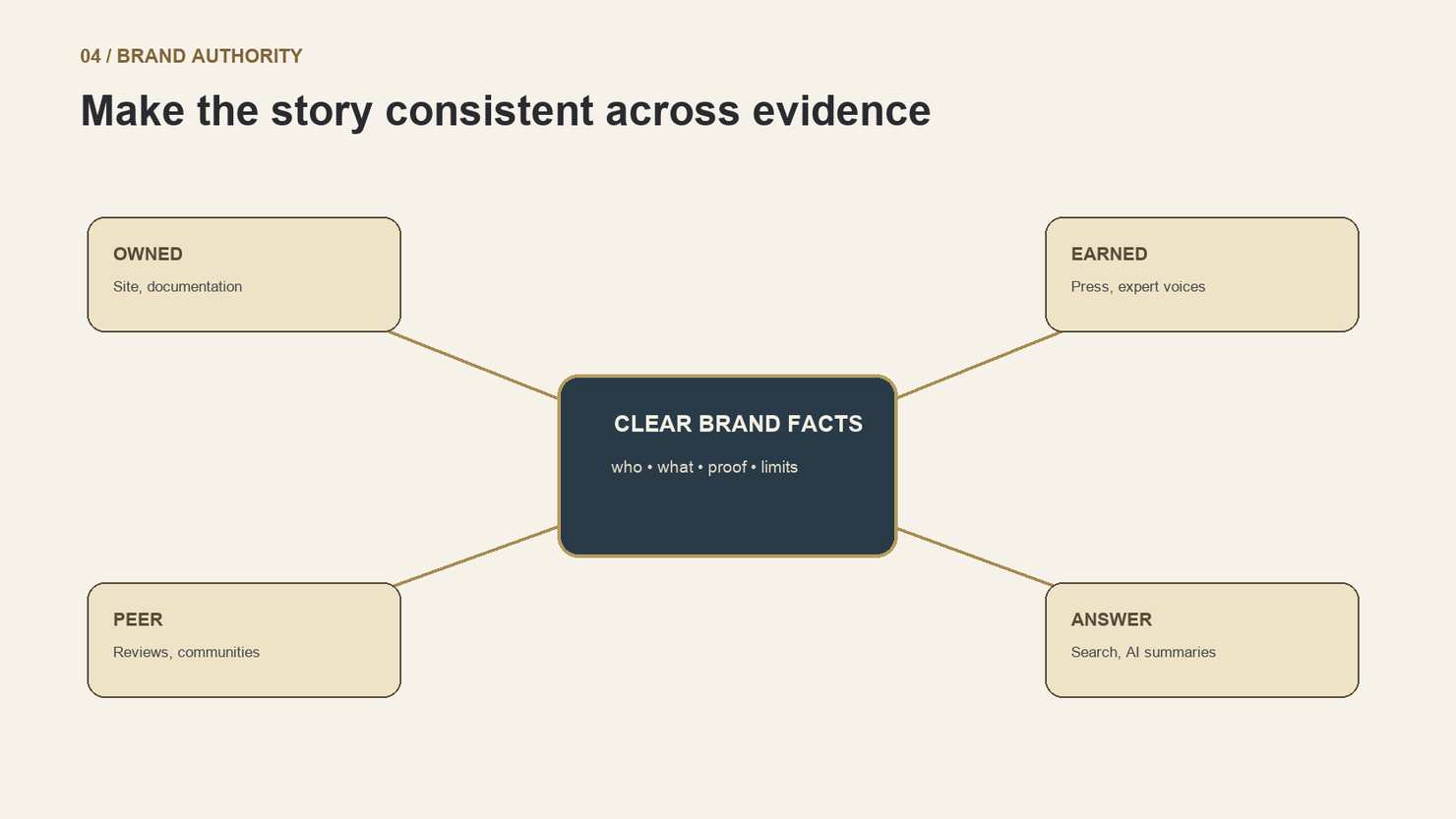
For AI search visibility, track a defined set of relevant questions at specific times and platforms, record what sources appear, and interpret the results as a sample. Public answer outputs can vary by query wording, user context, location, and system updates. A small set of observations is not a complete measure of all buyers or a promise that an answer will remain stable.
The AI search visibility guide explains how to observe brand representation across answer interfaces and relate it to broader search and business measures.
Put this into practice
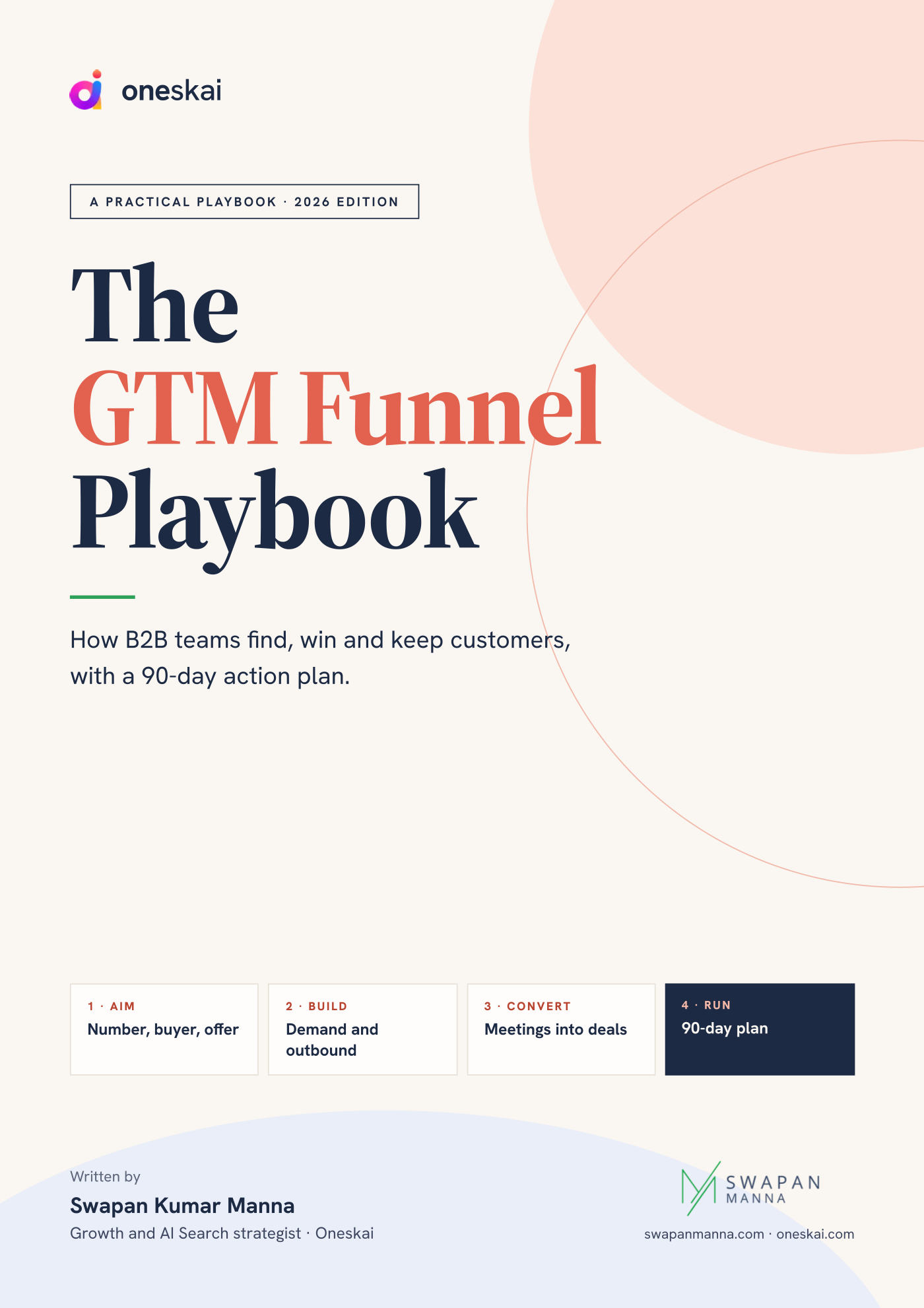
The GTM Funnel Playbook
How B2B teams find, win and keep customers, with a 90-day action plan. Seven funnel stages, one owner each, from the revenue number to the clients you keep.
Connect demand creation with demand capture
Demand creation helps people understand a problem and why it matters. Demand capture helps people who are already evaluating take a useful next step. Both can be necessary. A clear product page, pricing explanation, trial, consultation, or demonstration can capture active interest; relevant educational material and credible proof can make the company more familiar and easier to assess earlier.
Map the experience across channels. A person who sees an expert perspective may later search the company name, read a comparison, review customer evidence, and discuss the option internally. The content and the experience should reinforce one another. If a campaign promise is missing from the landing page, or a sales conversation contradicts public product details, the team has a trust and consistency problem.
Keep forms proportionate to the value being offered. Gating every useful guide may restrict peer sharing and reduce access for buyers who are still learning. Reserve forms for experiences that justify an exchange, such as a personalized assessment, a substantive event, or a tool that provides additional value. Be clear about what the person will receive and how their information will be used.
Build a demand program around a few strong plays
A practical demand program can combine an audience-specific point of view, useful public content, customer proof, relevant expert participation, and a simple path to learn more. Choose channels based on where the audience seeks answers and what the team can sustain. Do not assume that paid media, social distribution, SEO, events, or email has the same role for every company.
For a focused campaign, define the audience, business problem, offer, evidence, channel roles, owner, timing, and expected next action. Coordinate marketing and sales on the questions the campaign is meant to address and on how relevant responses will be handled. Give sales current proof and guidance to continue the conversation without repeating a generic pitch.
Use paid distribution to extend a message that has a clear audience and useful destination, or to test a hypothesis with a defined learning goal. Paid reach can create exposure, but it does not establish brand authority by itself. Earned trust and credible experience still matter.
Measure familiarity, consideration, demand, and value separately
Use a measurement model that connects indicators to decisions. Familiarity measures whether the intended market can recognize the brand. Consideration measures whether buyers explore, compare, or trust it. Demand measures qualified actions and progress. Business value measures outcomes such as pipeline contribution, revenue, retention, and expansion. The chain is useful for diagnosis, but it is not proof that one measure caused the next.
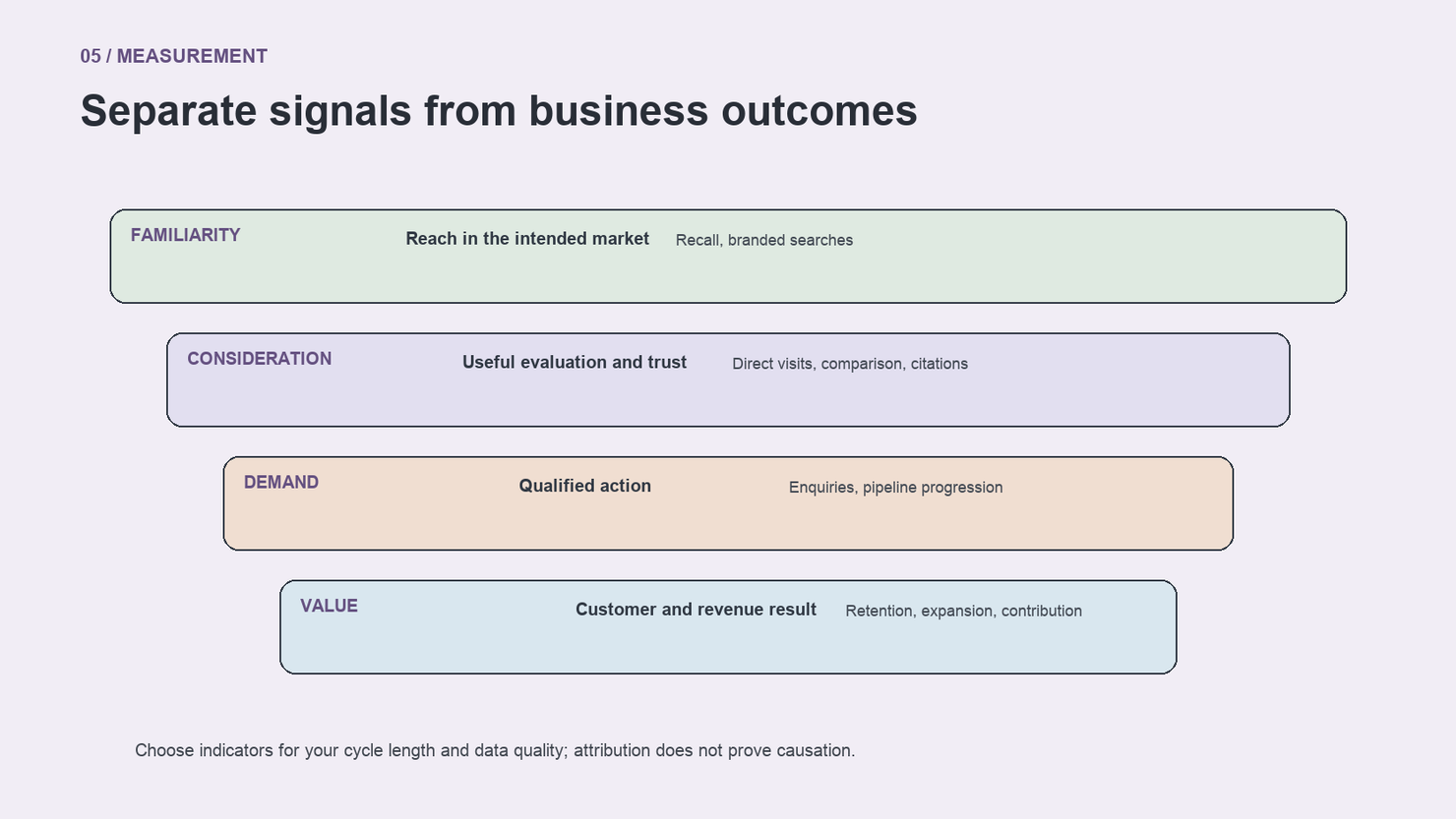
Select a small number of leading indicators and business outcomes. Depending on the buying cycle, that may include branded search, qualified direct visits, engagement with comparison pages, influenced opportunities, win rate by segment, sales-cycle progression, or renewal and expansion. Define how each is counted, what attribution can and cannot show, and the period required before a decision is meaningful.
Combine quantitative data with what customers and sales say. A rise in search impressions may reflect a platform change or a broader market trend. A rise in branded search can be a useful signal, but it does not reveal why the person searched or whether they are a qualified buyer. Use interviews, win-loss analysis, account feedback, and experiments to check your interpretation.
When evaluating a campaign, document the audience, creative, investment, exposure period, landing experience, and the other programs running at the same time. Use holdouts or other appropriate tests when feasible. Where causal testing is not practical, report the result as an association or contribution signal rather than claiming exact incremental revenue.
A 90-day plan for building demand and authority
In the first 30 days, clarify the priority segment and the most important buying-group questions. Review company facts and proof across the website and other public sources. Interview customers and internal teams. Identify one or two gaps where the company has evidence or experience to add value.
In days 31 to 60, publish or improve the assets that address those gaps. Make the material easy to discover and share, connect it to relevant product and comparison information, and prepare sales or customer teams to use it. Invite credible outside experts or customers to contribute when there is a genuine reason and clear permission.
In days 61 to 90, review reach, usage, qualitative response, buyer conversations, and relevant business outcomes. Compare results with a baseline where possible. Keep what helps a defined audience, revise what creates confusion, and stop activity that cannot be connected to a meaningful task or learning goal.
The timeline is a planning example, not a guaranteed launch sequence. Complex purchases, limited research access, or long sales cycles can require a longer window. The important practice is to make the hypothesis, evidence, and next decision explicit.
The standard for demand generation in an AI-shaped market
Become easier to recognize by being clear about the company’s work. Become easier to trust by showing evidence and acknowledging limits. Become easier to choose by helping the buying group answer the questions that matter. These foundations support search visibility, peer sharing, and AI-mediated discovery, but no channel or optimization method can force a recommendation.
Demand generation earns attention before a buyer is ready and supports evaluation when the buying window opens. Brand authority grows when the business repeatedly contributes useful, accurate information and delivers the experience it promises. Together, they make marketing more resilient than a program built only around capturing forms.
Frequently Asked Questions
What is demand generation?
What is the difference between demand generation and lead generation?
How does brand authority help demand generation?
How can a B2B company build brand authority?
How should thought leadership support B2B demand generation?
How can AI search affect brand discovery?
Which metrics should demand generation teams track?
How long does demand generation take to show results?
Put this into practice
The GTM Funnel Playbook
How B2B teams find, win and keep customers, with a 90-day action plan. Seven funnel stages, one owner each, from the revenue number to the clients you keep.
Frequently Asked Questions
What is demand generation?
What is the difference between demand generation and lead generation?
How does brand authority help demand generation?
How can a B2B company build brand authority?
How should thought leadership support B2B demand generation?
How can AI search affect brand discovery?
Which metrics should demand generation teams track?
How long does demand generation take to show results?
In this series
Every article in the Demand Generation and Brand Authority: How Companies Become the Brand Buyers (and AI) Already Know series.

Swapan Kumar Manna
Go-to-market & AI search strategist
Swapan Kumar Manna is a go-to-market and AI search strategist and Founder & CEO of Oneskai. He has spent 14+ years helping companies get found, get chosen and grow.