Part of the Modern SEO Strategy: A Practical Guide for the AI Era series
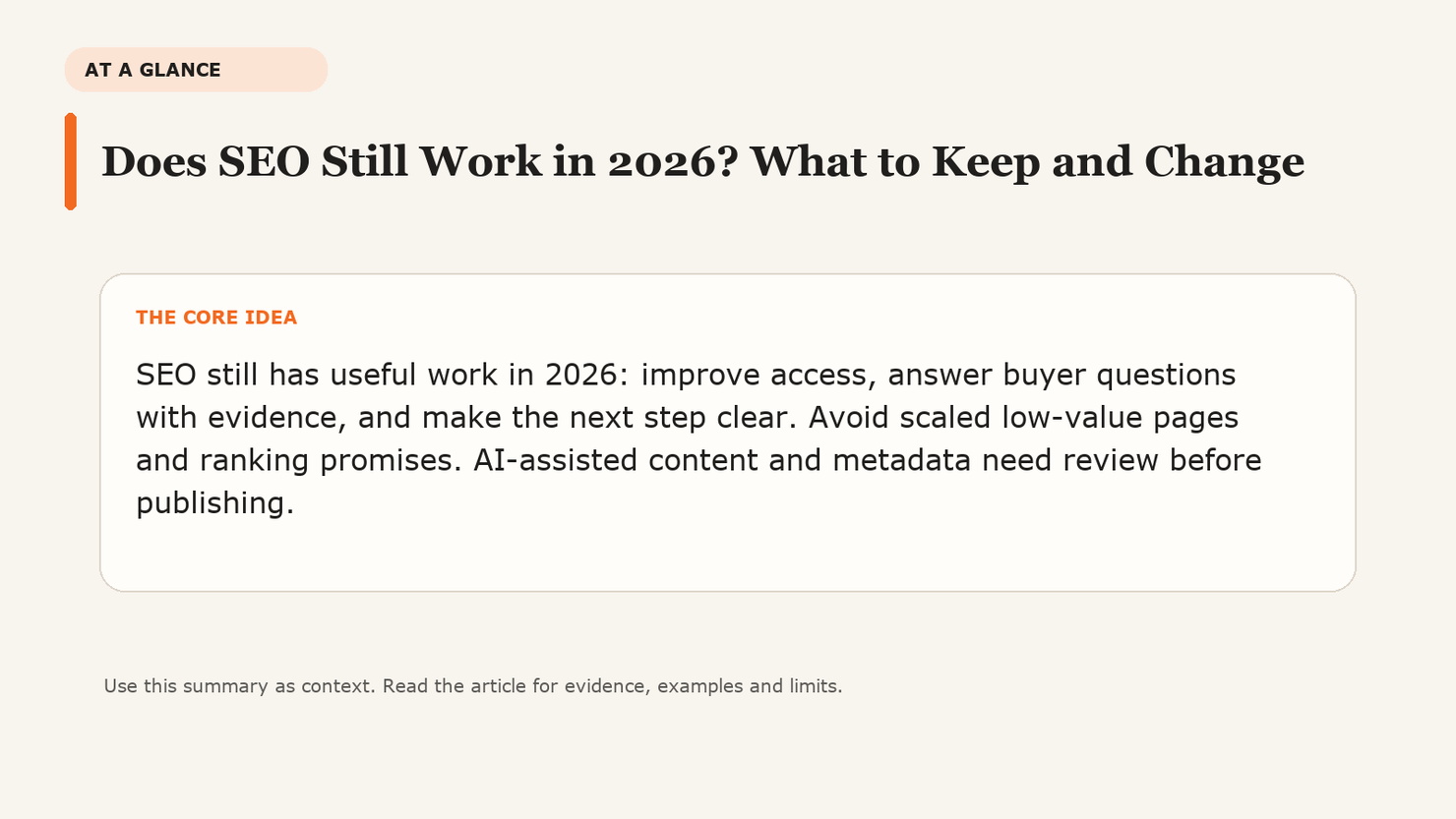
SEO still has useful work in 2026: improve access, answer buyer questions with evidence, and make the next step clear. Avoid scaled low-value pages and ranking promises. AI-assisted content and metadata need review before publishing.
Key Takeaways
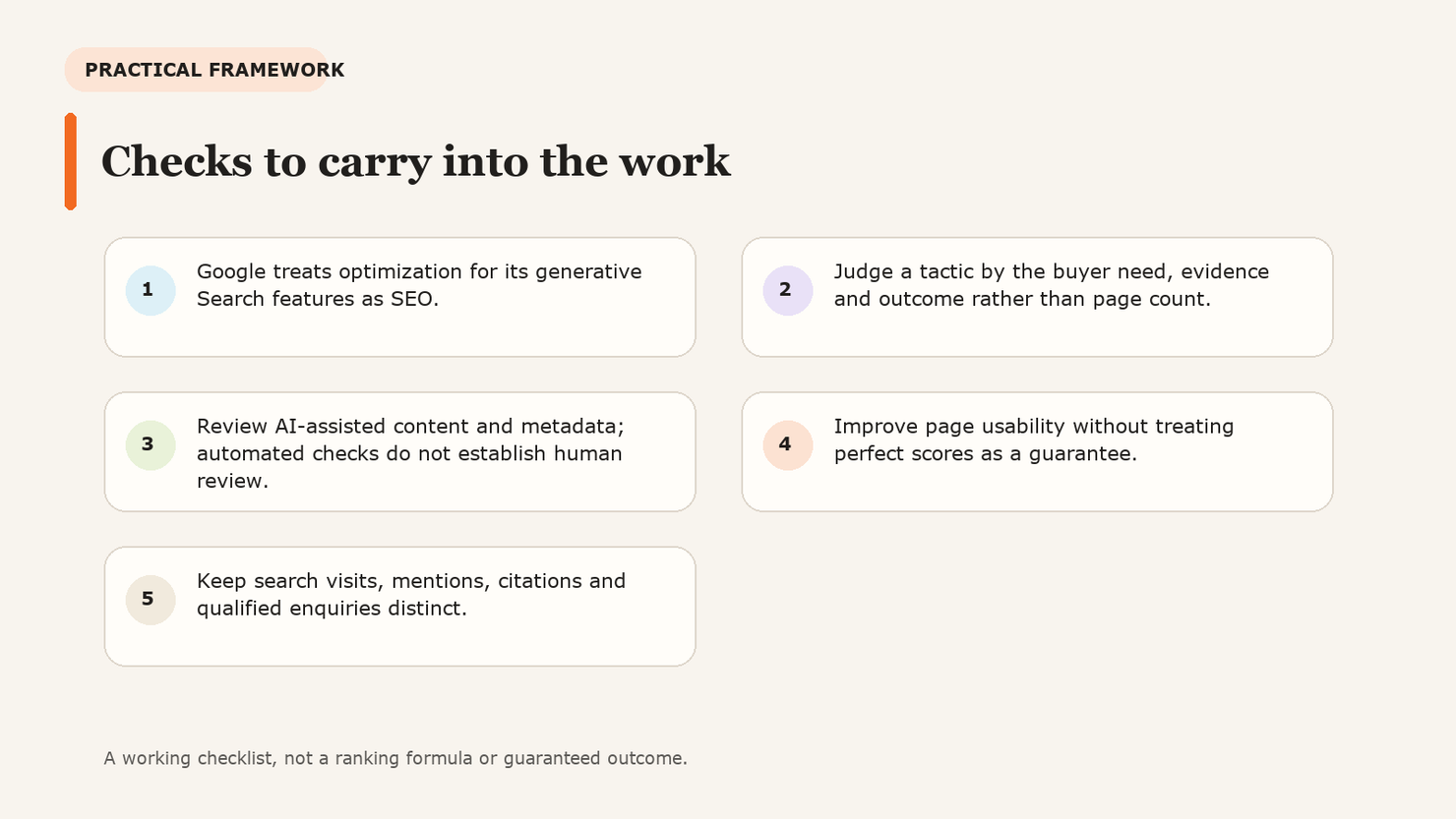
- Google treats optimization for its generative Search features as SEO.
- Judge a tactic by the buyer need, evidence and outcome rather than page count.
- Review AI-assisted content and metadata; automated checks do not establish human review.
- Improve page usability without treating perfect scores as a guarantee.
- Keep search visits, mentions, citations and qualified enquiries distinct.
Playbooks
Frameworks you can put to work
Growth marketing, LinkedIn presence, and more — delivered as PDFs.
Browse the playbooksSEO still has a role in 2026. Search engines need useful pages they can discover and understand, and buyers need reliable answers. AI search changes how those answers appear. It does not make the work of improving a website pointless.
The business question is more specific: is your SEO work helping the right people find you and make a decision? A rising traffic chart cannot answer that on its own. Neither can an AI mention or a long list of keywords you now rank for.
I would judge a tactic by the problem it solves, the evidence behind it, and the outcome you can inspect. Keep work that improves access, answers, and useful next steps. Stop treating page count or a new acronym as proof of progress.
This article reviews those choices. It is not a claim that one tactic wins every market, or that AI Overviews caused every recent traffic loss.
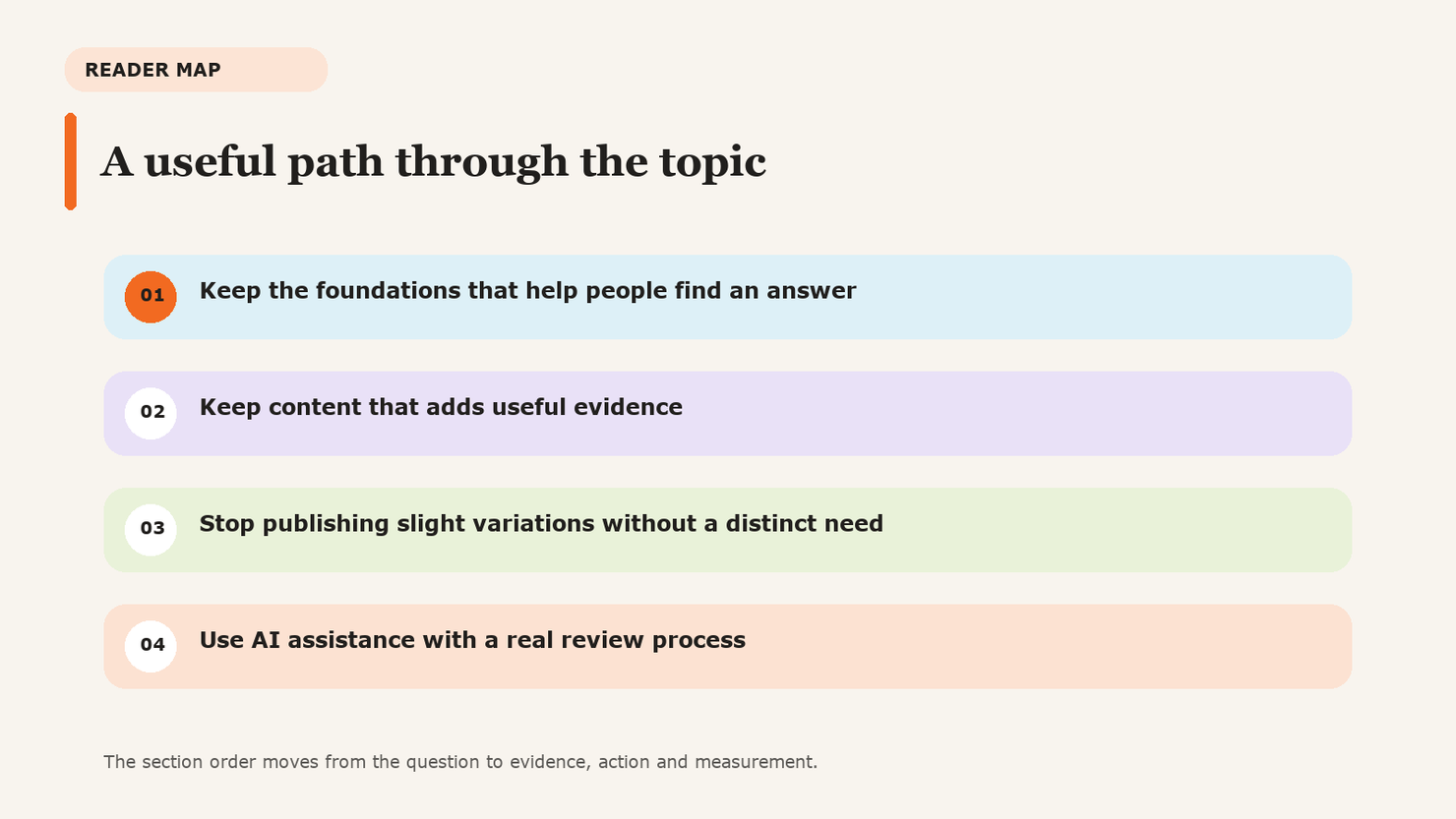
Keep the foundations that help people find an answer
Google's current AI search guide says its generative Search features rely on core Search ranking and quality systems. Google treats optimization for those experiences as SEO. That supports continuing the foundations, rather than assuming AI answers make them obsolete.
A clear product page, useful guide, and sensible internal links still have jobs to do. So does checking whether an important page can be reached and read. If a setup guide is blocked by mistake, publishing another article will leave the original problem in place.
Google's SEO Starter Guide covers discovery, readable content, links, and other basic improvements. It offers no method that automatically places a site first. A tactic can be worthwhile without producing a guaranteed ranking gain.
For a small team, I would begin with a few pages that answer valuable buyer questions. Review the facts, access, and path to the next useful answer. That is a more concrete job than asking everyone to improve SEO without naming the gap.
Keep content that adds useful evidence
A familiar topic can still deserve a strong page if you have something useful to add. A worked example, current product fact, documented test, or clear explanation of tradeoffs can help a reader do more than a summary of common advice.
Google's helpful content guidance asks creators to provide original value and satisfy the intended audience. It also warns against writing to a presumed preferred word count. The useful question is whether the page resolves the need, not whether it reaches a target length.
Consider a hypothetical CRM company serving small sales teams. Its buyers want to know how to move active deals from spreadsheets. A generic post about CRM benefits may attract attention while leaving that practical concern unanswered.
A better page could explain which fields transfer, how to check the imported data, and what needs manual work. Those details need current product evidence. The page can also state when the process is a poor fit, rather than promising an effortless move for every buyer.
I would keep that work because it helps a real decision. Whether it later gains more search visibility remains something to measure. The reader value exists before the ranking report arrives.
Stop publishing slight variations without a distinct need
More pages do not always mean better coverage. Five articles about moving deals from spreadsheets may compete for the same reader's time while repeating much of the same information. They also create more places for product facts to become outdated.
Ask what new task each proposed page serves. A detailed guide for a different data source may have a clear role. A headline that swaps “spreadsheet migration” for “CRM import” may simply describe the same job.
Google's spam policies address scaled content abuse, keyword stuffing, and link schemes. These concerns are not a new list of tactics that AI Overviews suddenly killed. They are reasons to avoid work aimed at manipulating visibility without useful value.
Templates and automation can still help a team work. The test is the resulting page and its purpose. A repeatable structure with accurate, distinct information is different from a large batch of pages that mainly change a place name or keyword.
Use AI assistance with a real review process
Google's February 2023 guidance focused on content quality regardless of how it was produced. It did not declare all AI-generated content spam. That historical position should be read alongside today's more specific instructions.
The current generative AI content guide calls for manual fact-checking before publishing. The review includes titles, descriptions, structured data, and image alt text. Google's documentation log records an update to that guide on October 1, 2026.
For the CRM example, review the import steps against current docs or a documented test. Check that the title does not promise a result the page cannot support. An accurate body can still be undermined by a misleading description.
A person who knows the subject should review the material before it goes live. Automated source checks can help prepare a draft, but they do not establish that a human checked it. Clear sources and plain language are useful; neither makes that review unnecessary.
Keep the site usable without chasing perfect scores
A page that ranks can still lose a reader through a slow layout, a hard-to-read table, or a form that fails on a phone. Review the main path yourself instead of relying only on a tool score.
Google’s page experience guidance says Core Web Vitals are used by its ranking systems. It also says good scores do not guarantee top rankings, and a perfect score may not be the best use of time.
For a small team, fix issues that prevent people from reading or taking the next step. Give the technical team an affected page and a clear problem to reproduce. That makes the work easier to judge than a request to make every report green.
Stop buying promises about secret AI formats
A service called AEO or GEO should describe its work clearly. Ask which search product it addresses, what it changes, and what evidence would show progress. A new service name alone tells you little about whether the task is worth doing.
Google's AI search guide says its Search systems do not use llms.txt to improve visibility or rankings. That statement has a defined scope. It does not establish whether another service uses the file, and it does not turn the file into a requirement for your blog.
I would apply the same scrutiny to fixed paragraph lengths, mandatory question headings, or guarantees of citations. Choose structure because it helps the reader follow the answer. A concise definition can be useful, but it cannot force a system to select it.
A documentation change also needs to be read carefully. New wording about review is not, by itself, evidence of a new ranking penalty or proof that your traffic changed because of that wording. Separate the instruction from claims about its effects.
Keep measurement tied to the page's job
A broad educational guide and a product comparison may serve different needs. Review their results accordingly. A useful comparison could matter to qualified buyers even if it produces fewer visits than a popular definition page.
For the CRM company, I would watch relevant search visits, use of the import guide, and qualified enquiries. I would also ask sales whether the guide resolves recurring questions. Those views can inform one decision without pretending they measure the same thing.
My B2B SaaS content strategy guide explores that link to pipeline. The key is to define what counts as a useful enquiry before celebrating more form submissions.
If visits fall, check demand, page access, content changes, and the search experience before assigning a cause. If AI answers matter, inspect a defined set of questions and record the product and conditions. A mention, citation, referral, and sale remain distinct outcomes.
A practical test for the next SEO task
Before approving more work, write down the page, the buyer question, the missing answer or obstacle, and the expected outcome. Name the evidence you need and the person responsible for checking it. A colleague should be able to understand the task without an SEO glossary.
For our hypothetical CRM guide, the task might be adding verified details about fields that do not transfer. The next step is to check the facts, update the guide, and see whether it helps buyers assess the move. It is not to publish three more versions of the same advice.
SEO still offers useful work when the choices are clear. Keep the foundations, add evidence, review the whole content package, and judge results against the need the page serves.
Start with one important page and the unanswered question it should resolve. That gives the next audit a concrete purpose and the team a change it can inspect.
Frequently Asked Questions
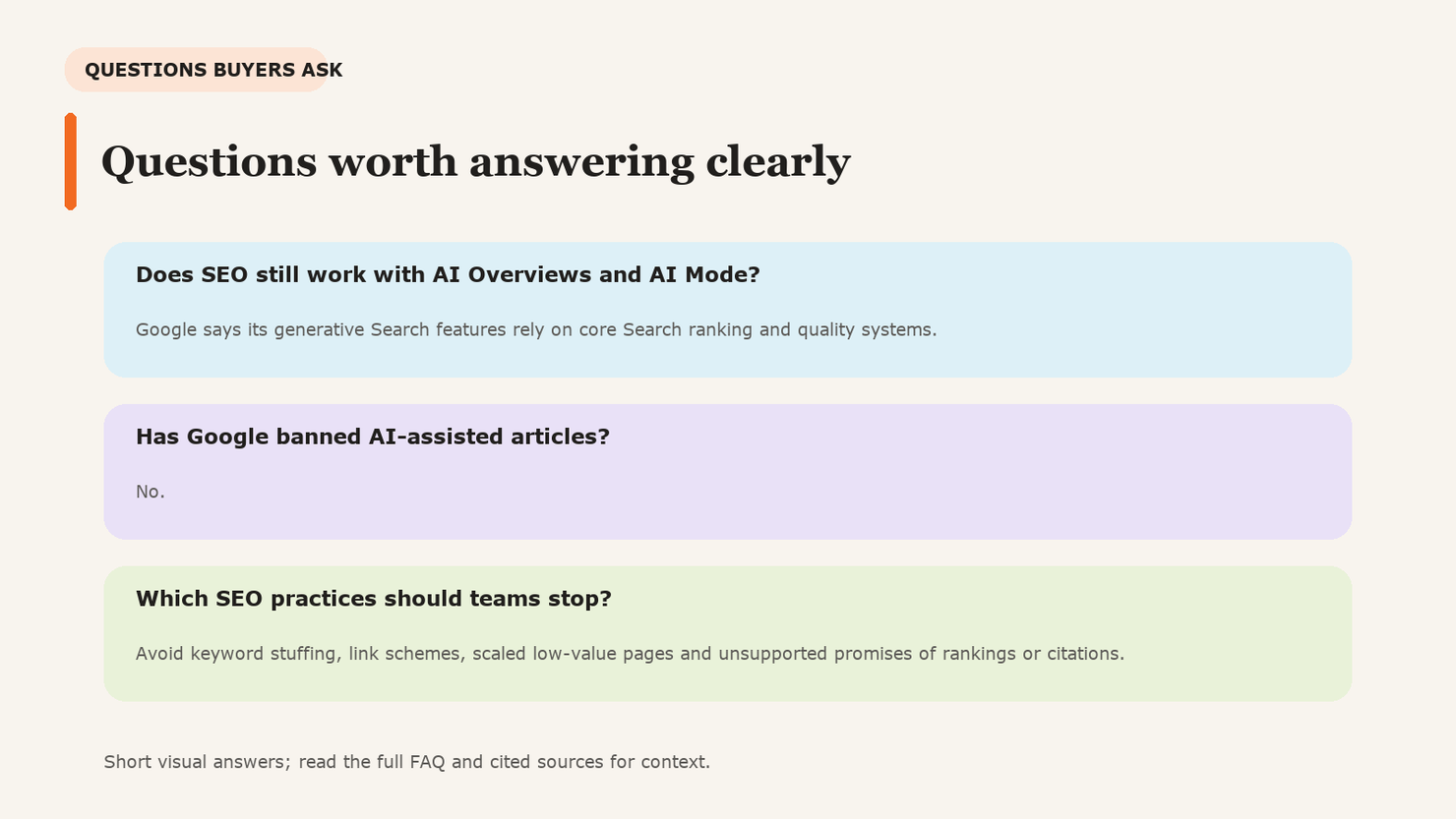
Does SEO still work with AI Overviews and AI Mode?
Has Google banned AI-assisted articles?
Which SEO practices should teams stop?
Is Google Play’s AI content policy a rule for website SEO?
Frequently Asked Questions
Does SEO still work with AI Overviews and AI Mode?
Has Google banned AI-assisted articles?
Which SEO practices should teams stop?
Is Google Play’s AI content policy a rule for website SEO?

Swapan Kumar Manna
Go-to-market & AI search strategist
Swapan Kumar Manna is a go-to-market and AI search strategist and Founder & CEO of Oneskai. He has spent 14+ years helping companies get found, get chosen and grow.