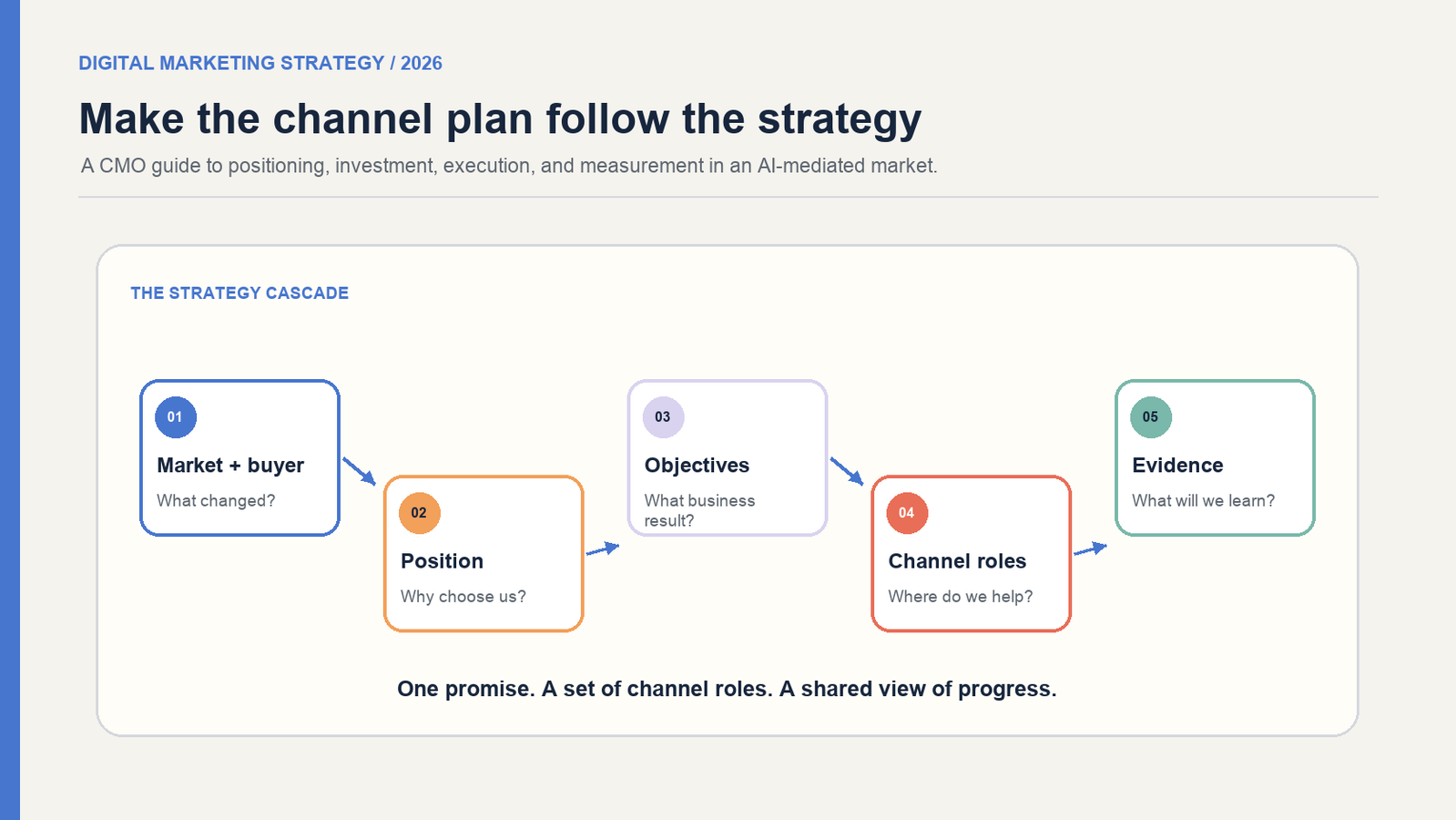
A digital marketing strategy connects business goals to a priority market, credible position, channel roles, budget choices, and measurement. Diagnose the main constraint, invest according to evidence and time horizon, and review the customer and business outcomes before changing the plan.
Key Takeaways
- Start with the business outcome and the constraint that is limiting it, not a channel calendar.
- Clarify positioning and proof before adapting the message for different buyer questions and platforms.
- Give every digital channel a role and compare it by audience fit, trust, learning speed, cost, and dependency.
- Allocate budget to protect proven work, test uncertainties, and build capabilities without copying another company’s percentages.
- Measure channel activity, buyer response, business contribution, and retention separately, with definitions and limitations.
- Use AI to improve defined work while keeping human accountability for customer context, claims, privacy, and consequential decisions.
Playbooks
Frameworks you can put to work
Growth marketing, LinkedIn presence, and more — delivered as PDFs.
Browse the playbooksA digital marketing strategy is the set of choices that connects a business objective to a specific market, a credible position, a useful customer experience, and a coordinated mix of digital channels. It explains where to invest, what each channel should do, how performance will be judged, and when the team should change course.
A marketing plan turns those choices into activity, owners, budgets, and timing. The distinction matters. Teams can publish, advertise, and automate at a high pace without a clear reason those activities should produce the business result leadership needs. A strategy should tell people what not to do as well as what to do.
In 2026, the plan also needs to account for buyers discovering and evaluating brands across search engines, AI answers, social platforms, communities, reviews, events, and direct conversations. The right mix varies by market and buying process. This guide lays out a practical CMO framework for making those choices, funding them, and learning from their results without treating every new platform as a must-have.
What belongs in a digital marketing strategy
A digital strategy sets the role of marketing in the wider business plan. It identifies the customers and markets to prioritize, the position the company can credibly hold, the outcomes marketing supports, the channels that suit the buyer journey, and the evidence that will guide investment. It should also say which capabilities the team needs, where sales and customer success connect, and how the plan will adapt when the market or economics change.
A digital marketing plan is more operational. It converts the strategic choices into programs, calendar dates, creative, campaigns, owners, budget lines, and reporting. Strategy should precede the channel calendar. If a proposed campaign cannot be tied to a target customer, positioning, or business outcome, it may be activity without a strategic job.
This distinction overlaps with the broader growth strategy guide. Growth strategy addresses how the company creates repeatable customer and business value; digital marketing strategy specifies how digital channels and experiences help reach, convince, convert, and retain the chosen market.
Start with a business outcome and a diagnosis
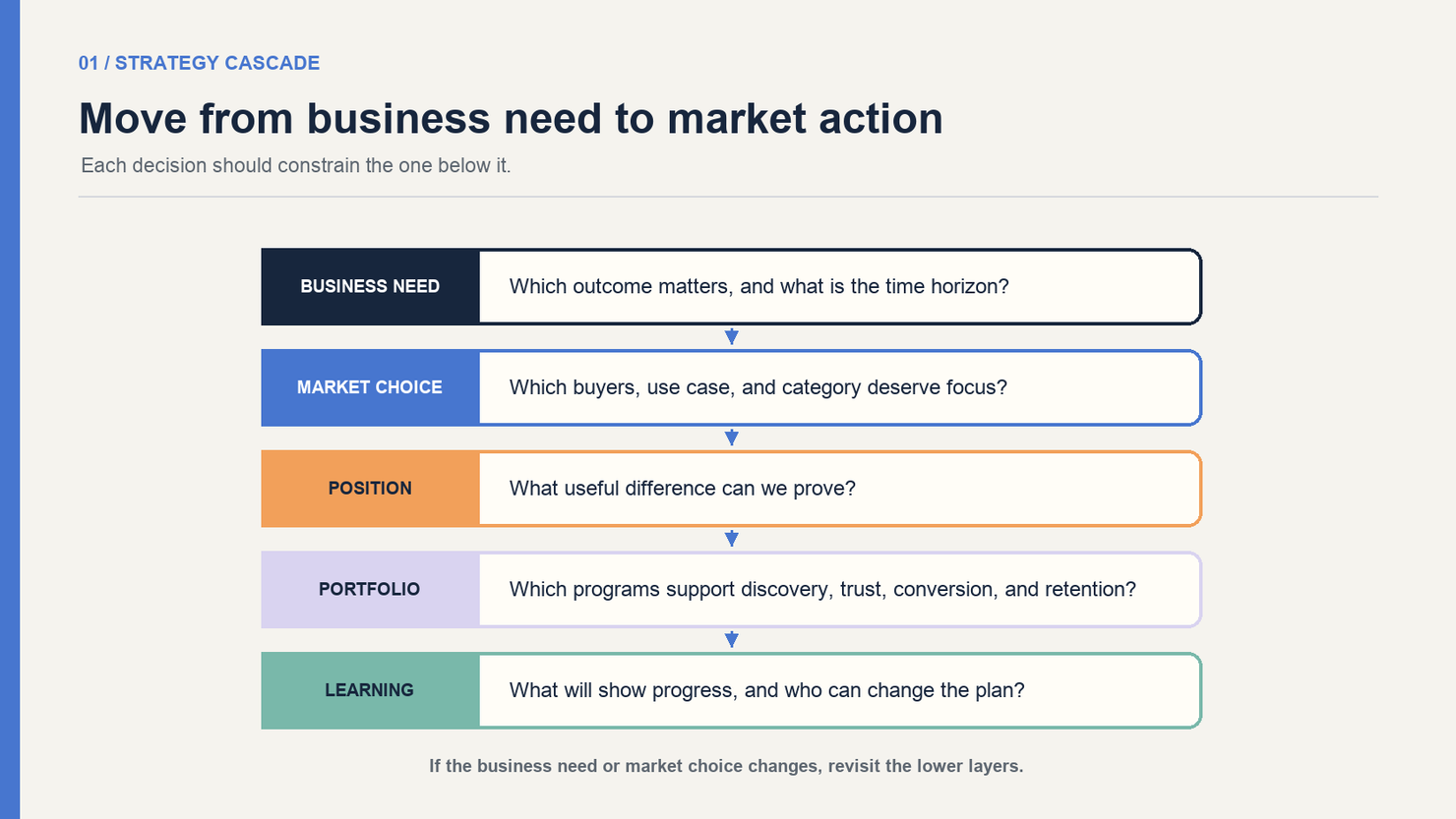
Start with the business question, not the media plan. Leadership may need qualified demand in a new segment, a stronger position in an existing category, shorter time to first value, improved retention, or a more dependable path to pipeline. Identify the outcome, time horizon, financial constraints, and the part marketing can influence. A revenue target alone is too broad to tell a marketing team what to change.
Then diagnose the current situation. Review the market, customer segments, product adoption, competitive alternatives, sales feedback, channel performance, customer retention, available proof, and internal delivery capacity. Compare sources rather than letting one dashboard or one stakeholder’s strongest opinion determine the answer. Separate established facts from assumptions, and note the quality and date of the evidence.
Ask what is limiting progress now. The answer could be that the right buyers do not recognize the problem, that the company is not clearly differentiated, that evaluation is difficult, that onboarding does not deliver the promised value, or that a channel is too dependent on a platform outside your control. A plan focused on the actual constraint is more useful than an equal list of goals for traffic, leads, followers, and brand awareness.
Make a deliberate choice about scope. Which segment and use case will receive the clearest focus in the next planning period? Which opportunity will you delay? What assumption must be tested before the business invests more heavily? A strategy becomes actionable when leaders can explain those choices and their reasons in language the marketing, sales, product, and customer teams share.
Clarify the position before you select channels
Positioning explains who the offer is for, what problem it addresses, how it differs from alternatives, and why a buyer should believe the promise. It is more than a slogan. It should inform product pages, sales conversations, campaigns, partner materials, customer proof, and the terminology the company uses across public sources.
A buyer often encounters the company in more than one place before visiting the site. Search results, comparison articles, customer reviews, social posts, communities, partner recommendations, and AI answers may each present part of the company’s story. Inconsistent descriptions create friction: a system or a person may struggle to tell whether the brand serves a particular buyer, category, geography, or use case.
The strategic aim may be to become a default answer for a well-defined category question. Treat this as an ambition, not a claim that any brand can force a recommendation. Make the category, audience, product facts, proof, and limitations clear; then measure how the company is represented in actual buyer research and platform answers. The Future of Search guide covers the wider discovery shift, and the GEO guide covers the work of improving source readiness across AI answers.
Use one core promise across channels, then adapt the explanation to the audience, format, and decision stage. Consistency does not mean pasting the same copy everywhere. A technical buyer may need integration detail; an executive may need risk and economic context; a practitioner may need a workflow. The facts and position should remain aligned while the material answers each person’s real question.
Map the buyer's research and decision path
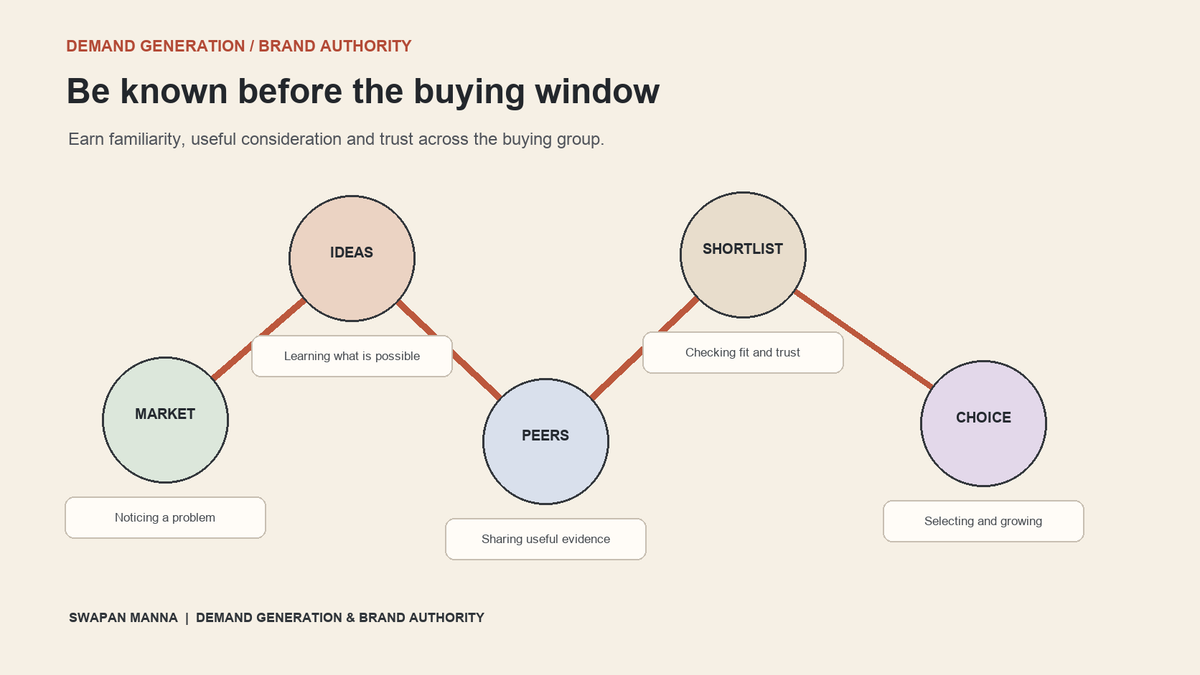
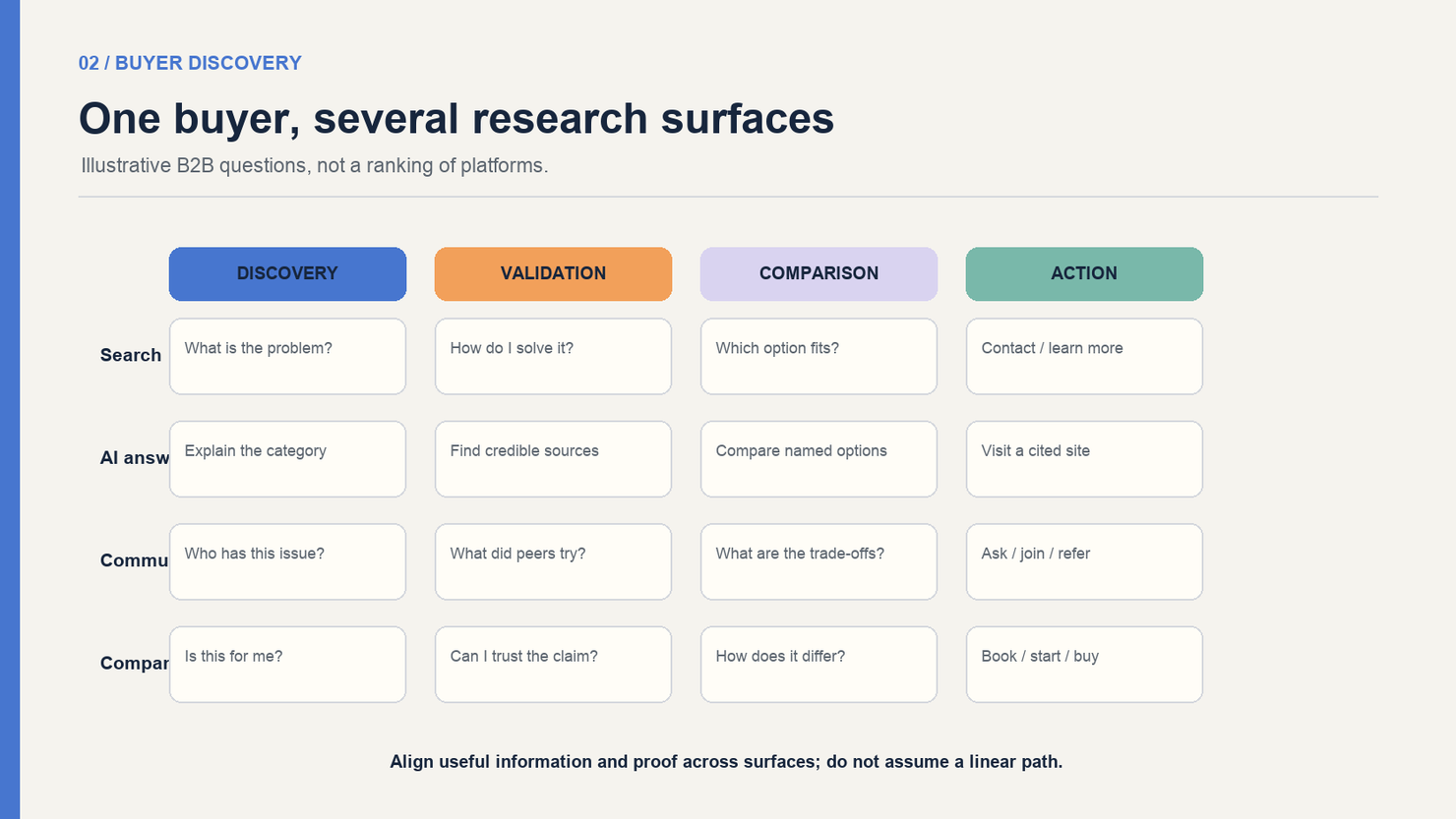
A B2B buyer may learn about a problem in a peer conversation, search for a solution, ask an AI assistant to summarize options, check a review site, visit a vendor’s product page, and later return through a direct or sales-assisted conversation. That path can loop or skip steps. A strategy should meet buyers with useful information where a decision is being made rather than assume that every prospect follows a single funnel.
Map the questions buyers ask at discovery, validation, comparison, and action. For each question, record what source the buyer trusts, what proof would help, what experience the company can provide, and which team member owns the response. The matrix below is illustrative: platforms change, buyers use them differently, and no row implies that each customer will use every surface.
For search and AI research, connect the content strategy to the overall company position. The modern SEO strategy outlines the technical and content foundations. Google’s current guidance says the same Search foundations still apply to its generative Search experiences; it also says content should be original, useful, and people-first. Google does not require special AI schema, and the guidance does not guarantee that a page will be selected.
Competitive analysis should help you make a decision. Review how alternatives describe their offer, which proof appears in category discussions, what buyers value in reviews, and what questions remain unanswered in your content or sales process. Compare customer jobs and evidence, not just competitor keyword counts or social follower totals.
When analyzing AI answers, search results, and social discussions, record the platform, query or question, date, location, mode, and method. Answers vary and public tools do not expose every impression or buyer interaction. Treat a small sample as a directional view, not a complete market-share report. Use it to find a hypothesis, then validate that hypothesis with customer interviews, conversion data, or sales feedback.
Competitor visibility is useful only when it clarifies where your business can compete. A gap may reveal that buyers lack a practical explanation or credible proof. It does not prove that the company should enter a market, copy an offer, or publish another page. Check the size and value of the customer problem, your ability to deliver, and the cost of building a credible position.
Give every channel a strategic role
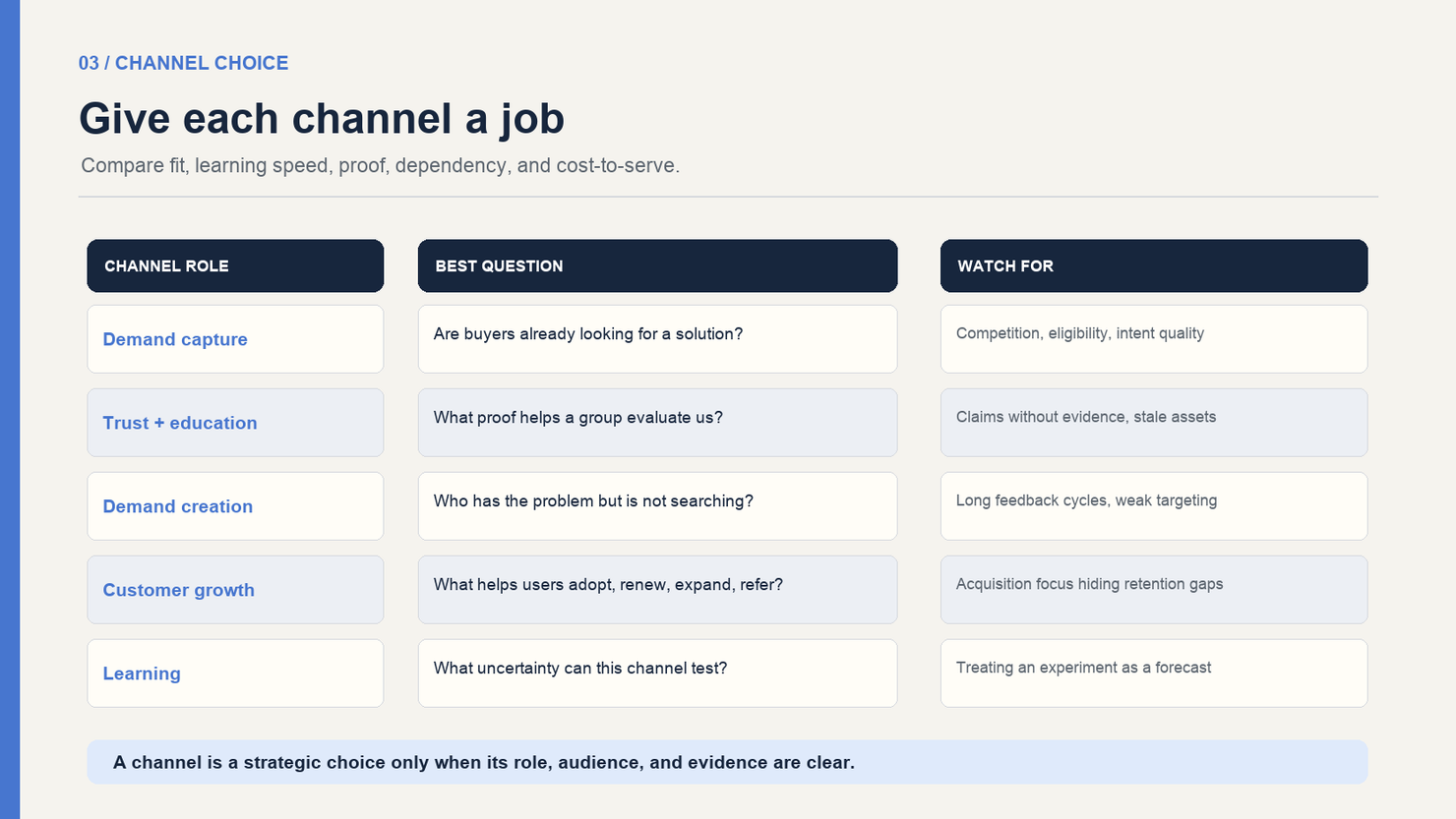
Choose channels because they fit the audience, offer, buying process, team, and economics. Digital channels can help capture existing demand, explain an unfamiliar problem, build trust, support comparison, close a transaction, or improve customer adoption. A channel may serve more than one role, but the team should know which role it is expected to perform in a given program.
Search can help buyers find information when they already have a question. Social media and communities can help people discover ideas, learn from peers, and discuss trade-offs. Email can support an ongoing relationship when people have agreed to hear from the company. Paid campaigns can provide reach or test a message. A website or application can help a prospect evaluate, transact, onboard, and return. Partnerships can contribute access and proof. None is a substitute for a useful offer or an experience that meets the promise.
Compare the candidates by qualified reach, intent fit, trust, speed of learning, contribution to other programs, cost to serve, measurement quality, and dependency risk. A dashboard with low-cost clicks can still conceal poor-fit visitors. A channel that takes longer to develop may become strategically useful if it produces durable customer relationships or credible proof. The right answer depends on the question and evidence, not a generic channel ranking.
Avoid treating “digital” as a collection of disconnected channel owners. The same campaign often touches creative, web, sales, analytics, product, and customer success. Map the handoffs. If a paid ad promises an outcome the landing page does not explain, the problem is not only advertising. If marketing delivers leads that sales cannot follow up in time, the strategy needs an operating decision across teams.
Integrate digital marketing with go-to-market execution. Agree with sales on which accounts, roles, and buying signals matter. Agree with product and customer success on the value customers should reach after purchase. Agree with finance on the definitions used for pipeline, revenue, margin, and payback. When those definitions differ by team, marketing can appear to improve a local metric while the business outcome remains unchanged.
The first handoff is often the website or a human conversation. Make sure the campaign promise, landing-page content, sales narrative, product capability, and onboarding experience describe the same value. Give a buyer a useful next step for their stage rather than a generic request to book a call. Review the full path when a program produces attention but not qualified progress.
For an example of a seven-step 2026 planning sequence across market research, audience, positioning, channels, budget, execution, and measurement, see Semrush’s current marketing strategy guide. It is a useful editorial reference, not a universal answer. Your company's customer, product, economics, and ability to serve should determine the final priorities.
Allocate the budget by role, evidence, and time horizon
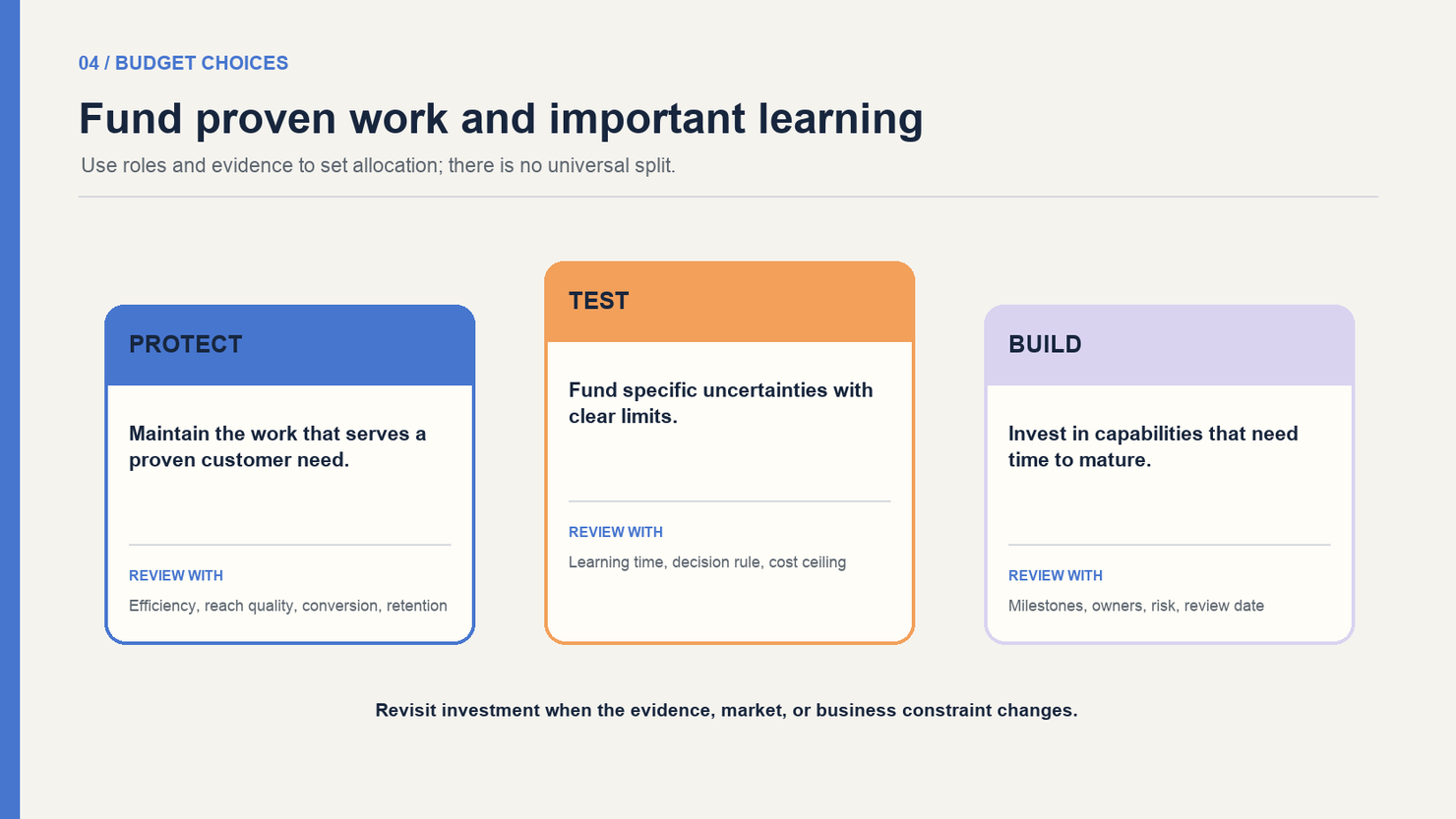
There is no universally correct percentage for brand, performance media, search, content, events, technology, or AI tools. The split depends on the company’s stage, cash, demand, margins, sales cycle, brand position, customer lifetime, and the reliability of the available data. A percentage borrowed from another company can be a starting question, not a budget recommendation.
Organize investment into three roles. Protect work that consistently serves a proven buyer need and produces useful business outcomes. Test material uncertainties with bounded budgets, a clear learning goal, and a decision rule. Build capabilities that matter strategically but require time, such as customer research, original proof, a useful content library, lifecycle communication, or data quality. These roles help leadership discuss the purpose of spending without pretending that all programs return at the same speed.
When planning, include the full cost of execution: media, people, agencies, production, technology, measurement, legal review, localization, and support. A campaign can look attractive if only the media spend is counted. A customer-acquisition estimate can mislead if it ignores sales effort or implementation cost. Keep assumptions visible and show the period over which a return is expected.
Revisit allocations when new evidence changes the priority, when customer demand shifts, or when a platform alters access. Do not swing the entire budget because one monthly number moved. Check the data definition, seasonality, campaign changes, and quality of the customers behind a result. A budget review should create a decision: maintain, reduce, expand, or investigate.
Put this into practice
The Growth Marketing Playbook
A step-by-step guide to planning, running, and optimizing campaigns that drive real revenue — not just clicks and followers.
Balance brand building with performance
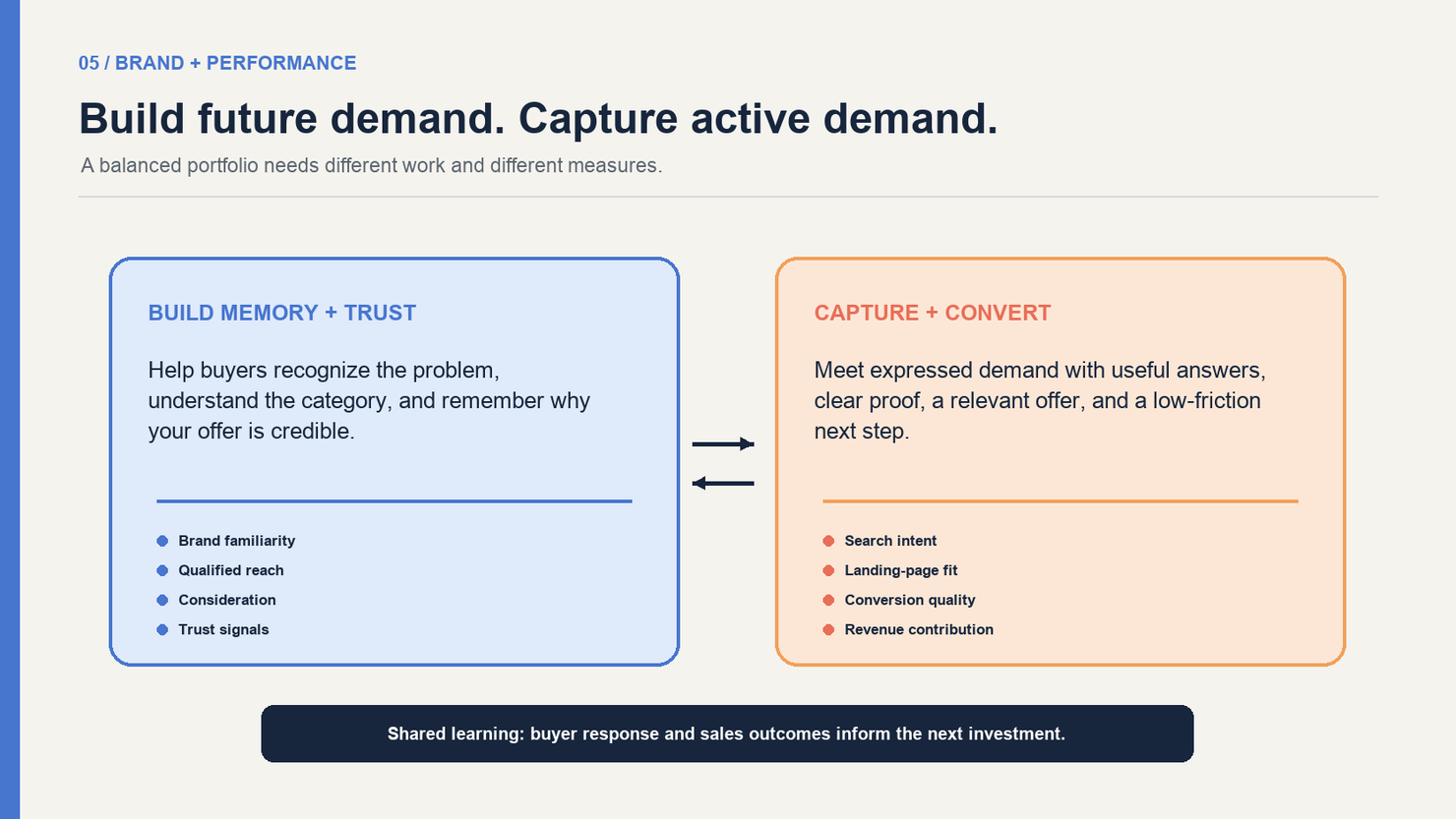
Brand and performance work answer different but connected questions. Brand-building work helps more of the relevant market recognize and trust the company over time. Performance activity helps capture an existing need or prompt a measurable next action. A company may need both, but the balance depends on whether it has an identifiable audience, sufficient evidence, working conversion paths, and the time and budget to sustain longer-term investments.
Measure the work according to its role. For demand capture, review qualified conversions, sales acceptance, pipeline quality, contribution margin, and repeat purchase or retention where relevant. For brand work, use indicators such as qualified reach, recognition among the intended audience, branded search patterns, message understanding, or later influence on consideration. These measures are not interchangeable, and none by itself proves that a campaign caused a sale.
Use shared learning to connect the two. Performance data can show which messages and audiences produce useful actions, but short-term response alone may overvalue people already ready to buy. Brand activity can improve familiarity or trust, but a rise in awareness does not automatically produce viable demand. Bring both into the same business review and state where the evidence is directional, delayed, or incomplete.
Adapt the strategy to company stage and geography. A company still testing product-market fit needs fast access to customer feedback and a focused segment. A company with a repeatable sales motion may need to widen reach, strengthen brand familiarity, improve pipeline quality, or expand channels without losing efficiency. A larger organization may need clearer coordination, localization, data access, and governance. These are planning prompts; revenue stage alone cannot prescribe the right budget or team.
For Indian B2B companies selling to US or UK buyers, make the proof easy to evaluate in that market. Explain the buyer use case, service coverage, commercial terms, implementation process, data handling, customer support, and relevant references. A translation of the website may not address differences in procurement, category language, proof requirements, or decision-making. Confirm those needs in actual buyer conversations rather than assuming one region behaves like another.
Define the level at which each program can work. A small team may not have the capacity to maintain six channels, create local proof, run experiments, and coordinate response to every lead. Choose a manageable portfolio and name what must be stopped or delayed. Improve one handoff or customer experience before expanding the scope if current delivery quality is inconsistent.
Set measurement that separates activity from outcomes
A practical measurement system links channel activity to buyer response and business outcomes while making its limits visible. Organize metrics by what they describe: delivery and visibility, engagement and site behaviour, qualified actions, pipeline or revenue, and customer retention or expansion. Choose a small set that supports a decision. More metrics do not automatically produce better attribution.
Define each measure before the campaign begins. Record its source, audience, time period, numerator and denominator where relevant, conversion event, exclusions, and owner. If a metric changes because a definition or tracking setup changed, mark the break in the series. When a channel influences people who later arrive directly, report referral data alongside buyer feedback and other sources rather than assigning all of the outcome to one touch.
AI search visibility is one part of this picture, not a complete marketing outcome. Google Search Console and Bing Webmaster Tools have their own platform-specific reports. Prompt tests and third-party tools measure different samples. Referral analytics only see visits that reached the site and were recorded. The AI visibility measurement guide explains how to separate exposure, answer presence, audience response, and business contribution.
Treat causal claims carefully. A campaign can coincide with an increase in branded searches, leads, or revenue without causing all of it. Use a reasonable comparison design when a high-stakes budget decision depends on incremental impact. Otherwise describe the result as observed, associated, or directional and explain what evidence is still missing.
What current marketing research can and cannot tell you
Recent industry surveys can show what marketing teams are prioritizing, but they should not be mistaken for independent proof of channel effectiveness. HubSpot’s 2026 State of Marketing survey says it gathered responses from more than 1,500 marketers across industries, regions, and company sizes. In that survey, 40.6% identified adapting SEO to search changes as a current trend. The same report lists measuring marketing ROI among the challenges respondents named. These are marketers’ reported priorities, not a controlled measurement of customer behavior or channel return.
Salesforce’s tenth State of Marketing summarizes a survey of nearly 4,500 marketers. The report says 83% recognize a shift toward personalized two-way messaging, while only about one in four are satisfied with how they use data to power those interactions. This suggests that teams should inspect the quality and accessibility of customer data before promising highly personalized programs. The result describes respondents to Salesforce’s survey; it does not establish the readiness of every team or market.
Both surveys are useful context for planning questions: Can our team act on the data it has? Can it respond to customers instead of sending more one-way messages? Can we demonstrate value across the customer path? Use the underlying reports for their sample and wording, and do not turn a survey percentage into an investment rule.
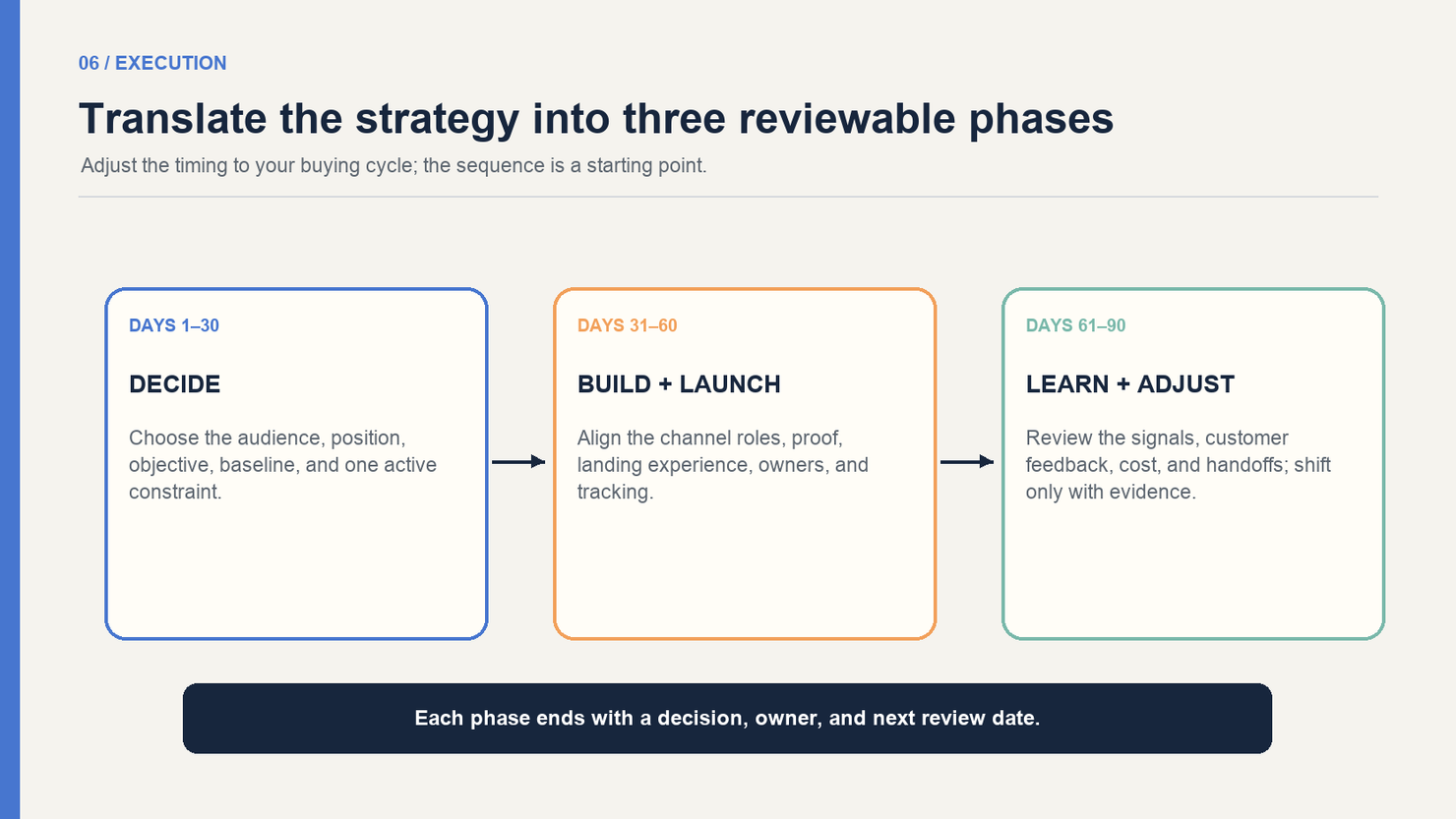
Plan the next 90 days
A 90-day plan can translate strategy into a manageable set of decisions and delivery milestones. The time period is a planning convention, not a promise that the market will produce a meaningful result on schedule. If the sales cycle is long or the available sample is small, use the period to establish evidence and improve a process rather than claim a final return.
- Days 1–30: agree on the business outcome, priority customer, positioning, baseline, constraints, and one important uncertainty. Confirm tracking and ownership before launching new activity.
- Days 31–60: build or adjust the channel programs, proof, landing experience, sales handoffs, and customer follow-up required by the strategy. Keep the work small enough to review.
- Days 61–90: compare results with the baseline, listen to customer and sales feedback, identify measurement gaps, and make a documented decision to scale, adapt, stop, or continue learning.
Set a review rhythm that fits the business. Weekly working reviews remove blockers and inspect active work. Monthly reviews compare channels and customer outcomes. Quarterly strategy sessions revisit the market, position, budget, and major assumptions. A decision log helps teams remember why an investment changed, not just that it changed.
Adapt the strategy for AI-mediated discovery
AI can affect how buyers summarize options, research a problem, create content, analyze campaign results, or complete repetitive tasks. It can also make it cheaper to generate material that looks finished but adds little new value. The response should not be to automate every touchpoint or produce more material. Start with the customer problem and decide where a tool improves usefulness, speed, insight, or service.
For Google Search generative features, Google’s guide to generative AI Search says conventional Search best practices remain relevant, that original and people-first content matters, and that special AI markup, tiny content chunks, or pages for every prompt variation are not required. It also states that meeting the technical and policy requirements does not guarantee crawling, indexing, or serving. These statements apply to Google Search; do not assume other platforms use the same rules.
Human review still matters for customer context, claims, privacy, and decisions with financial or reputational consequences. Establish who approves the output, where source facts come from, how sensitive data is handled, and what happens when the system is uncertain. Evaluate an AI tool by the quality of the work and the cost or risk it changes, not by how many processes can be labeled automated.
AI readiness is an operating decision within the strategy. The broader shift in discovery is covered in The Future of Search; the search foundations appear in modern SEO strategy and the GEO guide. Keep those workstreams connected to marketing’s wider goals, and use the measurement guide to distinguish visibility from demonstrated business impact.
For planning into 2027, make the CMO agenda specific to your own evidence. Stop programs that no longer support a customer or business outcome. Start only the experiments or capabilities that address a named uncertainty. Scale work that produces useful customer value and credible economic results. Record the signal that would make you reverse the decision so the plan can respond to new evidence.
The survey findings above are a reason to inspect data quality, coordination, and search adaptation in your organization, not a checklist to adopt every trend. AI capability, budget pressure, and channel changes affect companies differently. A disciplined strategy explains what the team will defer, which leaders own the choices, and how often those choices will be revisited.
If you need to prioritize a specific business constraint, connect this plan to the broader growth strategy guide. For a narrower review of what AI and search visibility contribute, use the AI visibility measurement guide. The topic clusters under this pillar can later provide deeper detail on positioning, channel choice, budget, marketing plans, brand and performance, B2B stage, global positioning, and executive priorities without turning this cornerstone into twelve duplicate articles.
A digital marketing strategy should make trade-offs clear
A strong strategy gives the team an understandable reason for its audience, message, channel mix, budget, and measures. It connects marketing with the buying and customer experience that follow an impression or click. It names the assumptions the business is willing to test and the signals that will trigger a change.
Do not chase every channel, trend, platform, or metric. Choose work that supports a real customer need and a business outcome, then build a review process that can adapt as evidence improves. That is how the plan remains useful when the market changes.
Frequently Asked Questions
What is a digital marketing strategy?
How do I create a digital marketing strategy?
What is the difference between a marketing strategy and a marketing plan?
How should a company choose digital marketing channels?
How much of a marketing budget should go to brand versus performance?
How should AI change a digital marketing strategy?
Which marketing metrics should a CMO track?
How often should a digital marketing strategy be reviewed?
Put this into practice
The Growth Marketing Playbook
A step-by-step guide to planning, running, and optimizing campaigns that drive real revenue — not just clicks and followers.
Frequently Asked Questions
What is a digital marketing strategy?
How do I create a digital marketing strategy?
What is the difference between a marketing strategy and a marketing plan?
How should a company choose digital marketing channels?
How much of a marketing budget should go to brand versus performance?
How should AI change a digital marketing strategy?
Which marketing metrics should a CMO track?
How often should a digital marketing strategy be reviewed?

Swapan Kumar Manna
Go-to-market & AI search strategist
Swapan Kumar Manna is a go-to-market and AI search strategist and Founder & CEO of Oneskai. He has spent 14+ years helping companies get found, get chosen and grow.