Part of the The Future of Search: How Discovery Works When Answers Replace Rankings (2026 Guide) series
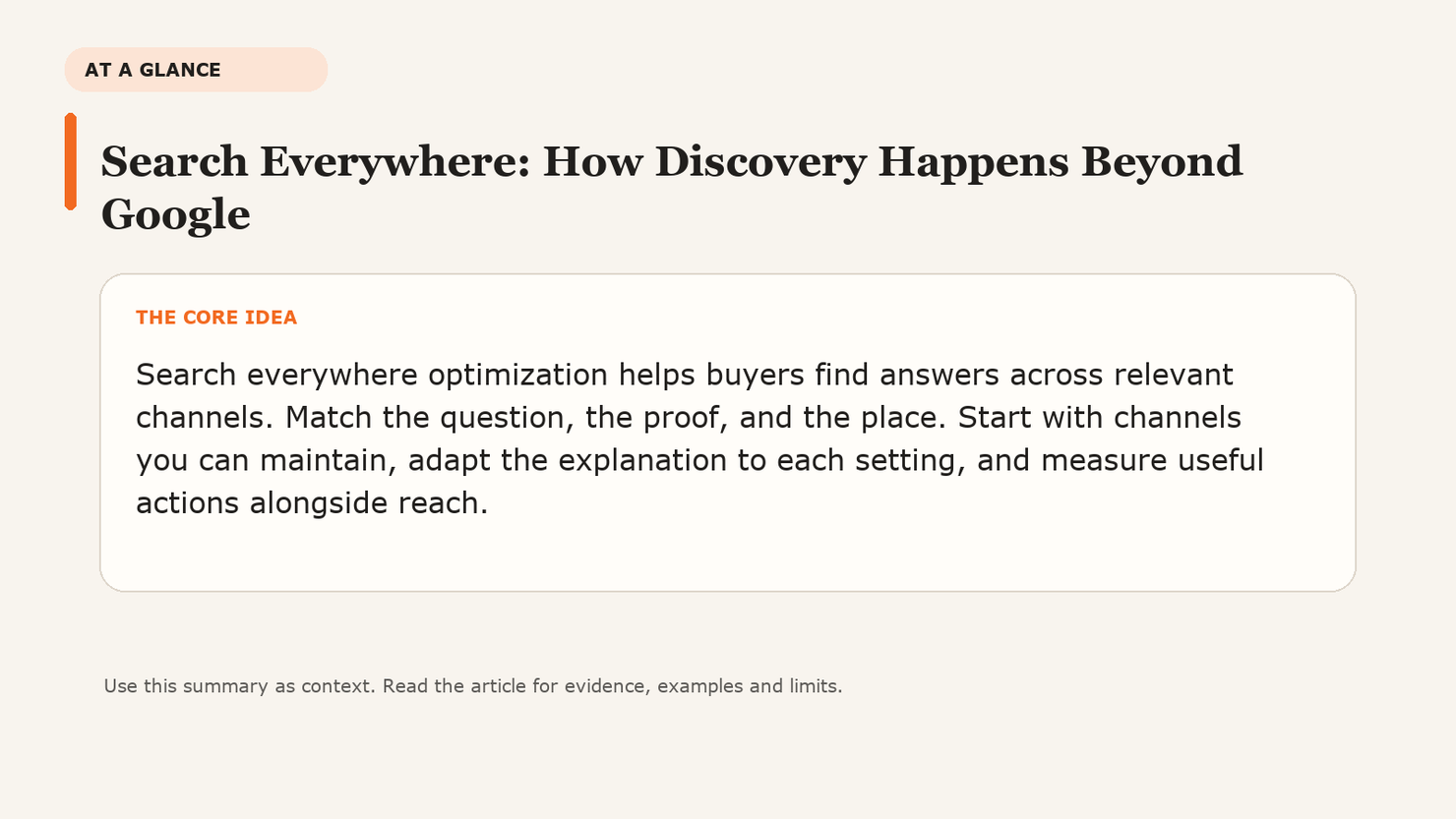
Search everywhere optimization helps buyers find answers across relevant channels. Match the question, the proof, and the place. Start with channels you can maintain, adapt the explanation to each setting, and measure useful actions alongside reach.
Key Takeaways
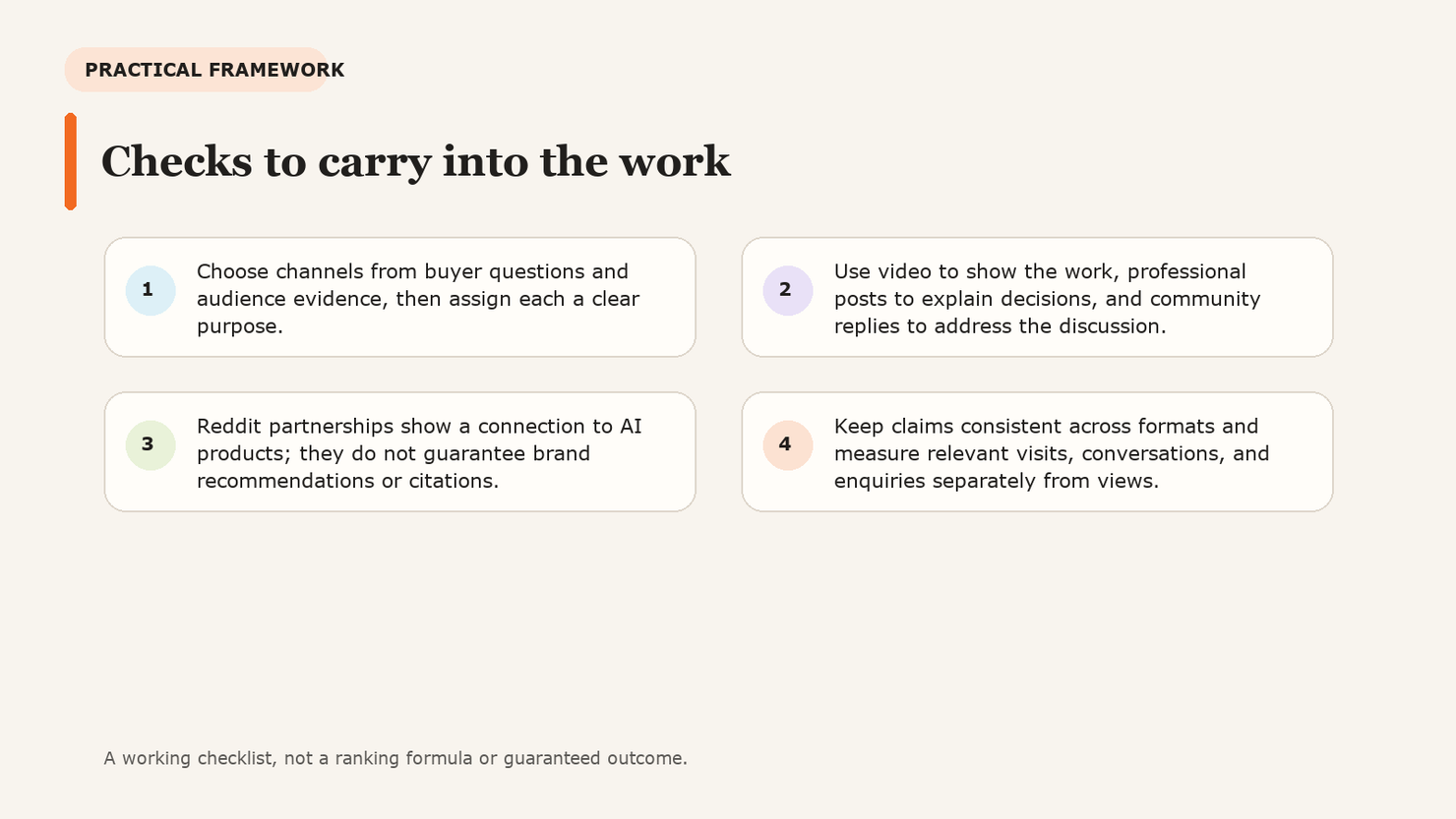
- Choose channels from buyer questions and audience evidence, then assign each a clear purpose.
- Use video to show the work, professional posts to explain decisions, and community replies to address the discussion.
- Reddit partnerships show a connection to AI products; they do not guarantee brand recommendations or citations.
- Keep claims consistent across formats and measure relevant visits, conversations, and enquiries separately from views.
Playbooks
Frameworks you can put to work
Growth marketing, LinkedIn presence, and more — delivered as PDFs.
Browse the playbooksSearch everywhere optimization means helping people find useful answers across the places they use to research a problem. That includes your website and Google, but also video platforms, communities, professional networks, and AI tools.
The name can make this sound like a demand to publish everywhere. I would approach it more carefully. Pick the places where your buyers ask important questions, then give them evidence that suits the setting.
A buyer looking for software might want a written comparison, a working demo, and an honest account of the effort involved. One blog post may serve only part of that need. This article builds on my guide to the future of search and discovery, with a focus on choosing where your content belongs.
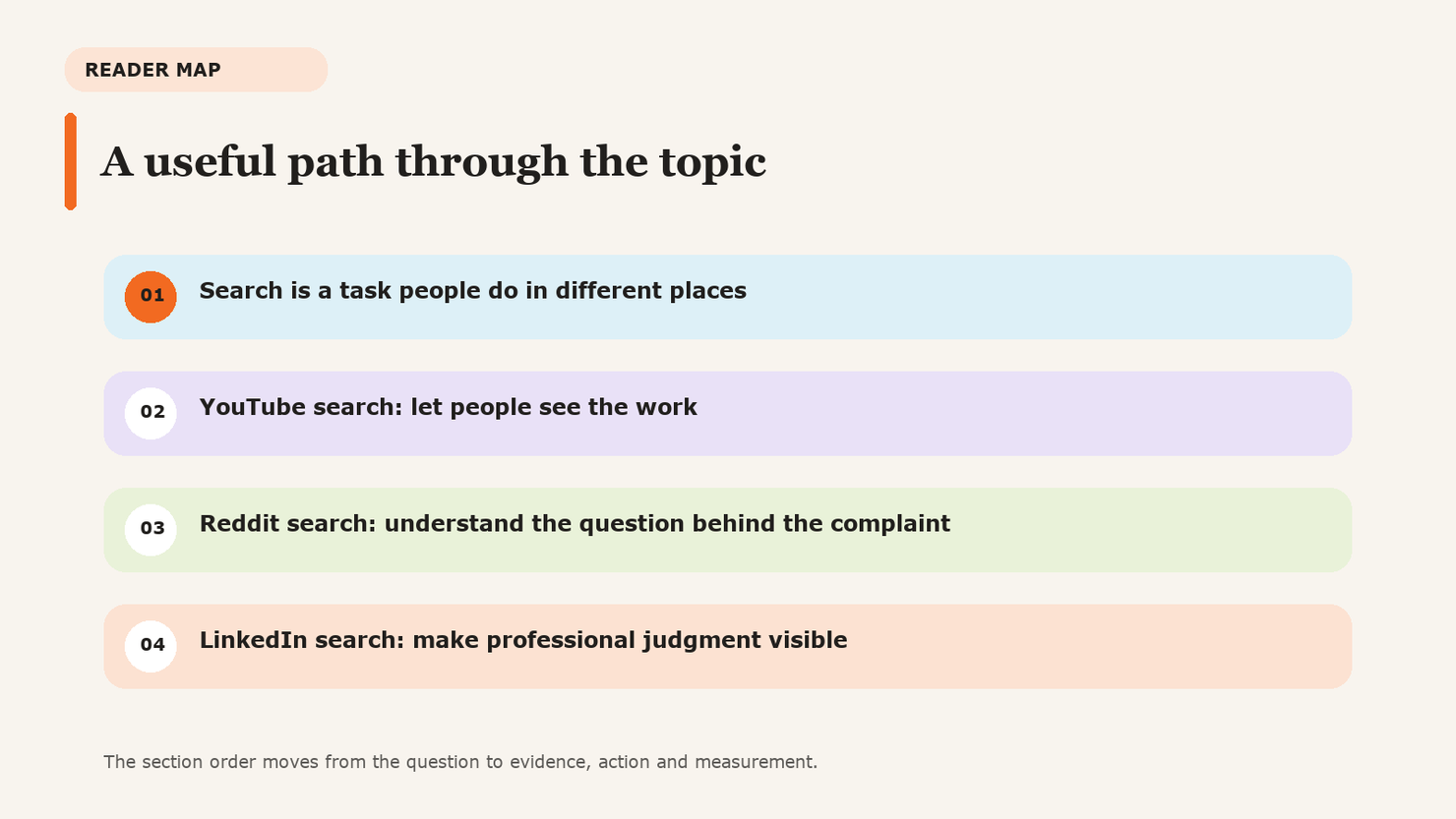
Search is a task people do in different places
Search begins with a need: learn a skill, check a claim, compare options, or find someone who can help. The place a person chooses can depend on the kind of answer they want.
A video can show a process that is hard to explain in text. A discussion can raise questions that a product page leaves out. A professional post can help a reader assess how someone thinks.
These are reasons to explore different channels, not proof that every buyer uses all of them. Your own customer conversations should guide the decision. Ask where people looked, what they searched for, and what helped them move forward.
It also helps to separate search from discovery through a feed. A person who types a question has a stated need. Someone who sees a recommended post may have no such need yet. The same piece can reach both, but those visits mean different things.
YouTube search: let people see the work
YouTube describes its search system in terms of relevance, engagement, and quality. It considers how well the title, description, and video content match a query, among other factors. Search and watch history can also affect results.
For a marketing team, my first concern would be whether the video delivers what its title promises. A viewer searching for a product setup needs to see the setup, including any parts that are awkward.
Imagine a project management tool with a complex approval step. A short demo could show how a request moves from a team member to a manager. Use a realistic example and show what happens when the manager asks for a change.
That is more useful than a glossy tour that skips the hard part. The value comes from proof the viewer can inspect. A clear title helps them recognise that proof before they click.
Keep a fuller written guide on your site for details that change, such as plan limits and supported features. Let the video show the process and the guide explain the conditions.
Reddit search: understand the question behind the complaint
Reddit lets people search posts, comments, communities, media, and people. Searches can also be limited to a community. That makes it possible to explore a topic in the setting where people discuss it.
For a brand, I would begin by reading. Look for the gap between the language in your product copy and the language people use when they are stuck.
In our hypothetical approval tool example, the brand might talk about “workflow efficiency.” A user might ask why their manager keeps missing requests. The second version points to a concrete problem that the content should address.
A discussion is useful evidence of a question, but it is not a market survey. A few loud complaints cannot tell you how common the problem is. Check those themes with support, sales, and customers before building a whole campaign around them.
If you take part, follow the community's rules and disclose relevant ties. Answer what you can, including where your product falls short. A thread should not become a disguised landing page.
LinkedIn search: make professional judgment visible
LinkedIn supports searches for member posts, with filters that can narrow results by factors such as date, author, and content type. Searchable posts give a team another place to explain how it approaches a business problem.
I would use this channel to show the reasoning behind a choice. For the approval tool, a useful post might explain when adding another manager slows work without reducing risk.
Give the reader a specific situation, a trade-off, and a view they can assess. If the advice comes from a real project, explain what you can share and what the case does not establish. If it is an example, label it as one.
A post saying “teams need better collaboration” gives a reader little to work with. A post explaining which decisions need approval, and which should stay with the team, starts a more useful conversation.
Keep names, roles, and product descriptions consistent with your website. That helps readers check who is speaking and what the business does.

Put this into practice
LinkedIn Personal Branding Playbook for CXOs
A strategic guide to thought leadership, founder visibility, and pipeline that follows — written for CEOs, CMOs, and founders who refuse to be invisible on the world's largest professional network.
TikTok search: choose a question a short video can answer
TikTok documents search across content such as videos, creators, and sounds. That confirms a search use case, but it does not make the platform the right choice for every business.
Check availability and audience fit in the markets you serve. Then ask whether a short visual answer can solve a real part of the buyer's problem. If it cannot, another channel may deserve the effort.
For the approval tool, a brief video might show one common mistake: sending a request without the detail needed to approve it. A before-and-after example could make the lesson clear.
It would be a poor format for a full security review or a detailed pricing comparison. Those questions need more room and evidence. Keep the topic narrow enough to answer honestly, then point interested viewers to the fuller explanation.
Social search works best as a content planning lens when it respects the user's task. Shortness alone is not a reason to turn every topic into a short video.
How off-site content can connect to AI answers
Content outside your website can also be part of the information available to search and AI products. There is documented evidence of that connection for Reddit.
In May 2024, OpenAI announced a Reddit partnership to bring Reddit content into ChatGPT and other products through access to Reddit's data API. Google also announced expanded Reddit access in February 2024.
Those agreements do not mean a brand can post a comment and expect an AI recommendation. They do not prove that all social platforms feed every answer engine in the same way.
I would treat AI visibility as a possible additional outcome of useful public content. The first test is whether the content helps people in the place where it appears. A genuine explanation still has value when an AI tool never cites it.
For Google's AI features, official guidance keeps SEO relevant and emphasises useful, original content. There is no sound reason to replace that work with a campaign of repeated brand mentions.
A practical way to choose your first two channels
My planning rule is to match the question, the proof, and the place. Start with one important buyer question, decide what would answer it well, and choose the place where that answer makes sense.
Consider our hypothetical software company with a small content team. Its buyer wants to know whether approvals will create more work. A demo and a clear written guide may answer that better than four social accounts posting the same claim.
The team could use YouTube to show the process and its website to explain limits. LinkedIn could follow once it has a useful point of view about approval design. Reddit might remain a listening channel until there is a relevant discussion it can help.
This creates a clear order of work. Each new channel needs a purpose, an owner, and time for replies and updates. A channel with no one responsible for maintaining the answer is a weak investment.
Choose based on the buyer's need and your ability to serve it. A rival's busy posting schedule is not enough evidence to copy their channel mix.
Reuse the evidence, then adapt the explanation
Start from one sound source of facts: a tested demo, a current guide, or an approved case study. Use it to keep claims consistent across formats.
Then adapt the explanation. A video should show the work. A professional post should explain the decision. A community reply should address the question in the thread without forcing the reader through a sales pitch.
Link to deeper material when it helps. Make the next step clear, whether that means checking a plan limit, using a template, or booking a demo.
Measure those steps separately from reach. A view, a useful conversation, a relevant site visit, and a qualified enquiry are different outcomes. Track what each channel contributes, and ask prospects which content helped them decide.
After a focused trial, keep the channels that answer real questions and produce useful signals. Improve or pause the rest. Search everywhere optimization should give your team a clearer plan for discovery, not a longer list of places to fill.
For more practical thinking on search, AI, and growth, join The Agentic Pivot newsletter.
Frequently Asked Questions
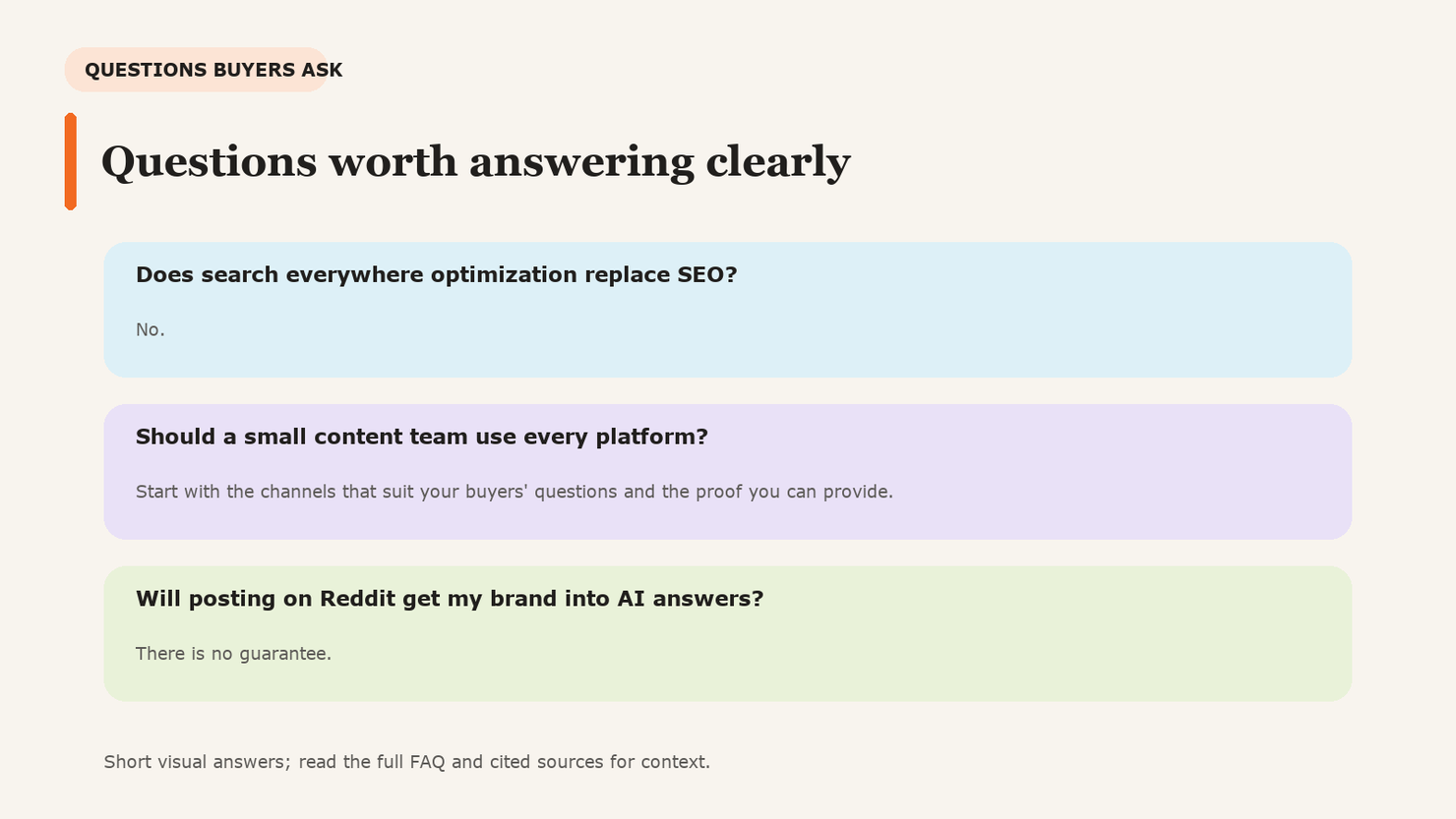
Does search everywhere optimization replace SEO?
Should a small content team use every platform?
Will posting on Reddit get my brand into AI answers?
How should I measure discovery beyond Google?
Put this into practice
LinkedIn Personal Branding Playbook for CXOs
A strategic guide to thought leadership, founder visibility, and pipeline that follows — written for CEOs, CMOs, and founders who refuse to be invisible on the world's largest professional network.
Frequently Asked Questions
Does search everywhere optimization replace SEO?
Should a small content team use every platform?
Will posting on Reddit get my brand into AI answers?
How should I measure discovery beyond Google?

Swapan Kumar Manna
Go-to-market & AI search strategist
Swapan Kumar Manna is a go-to-market and AI search strategist and Founder & CEO of Oneskai. He has spent 14+ years helping companies get found, get chosen and grow.