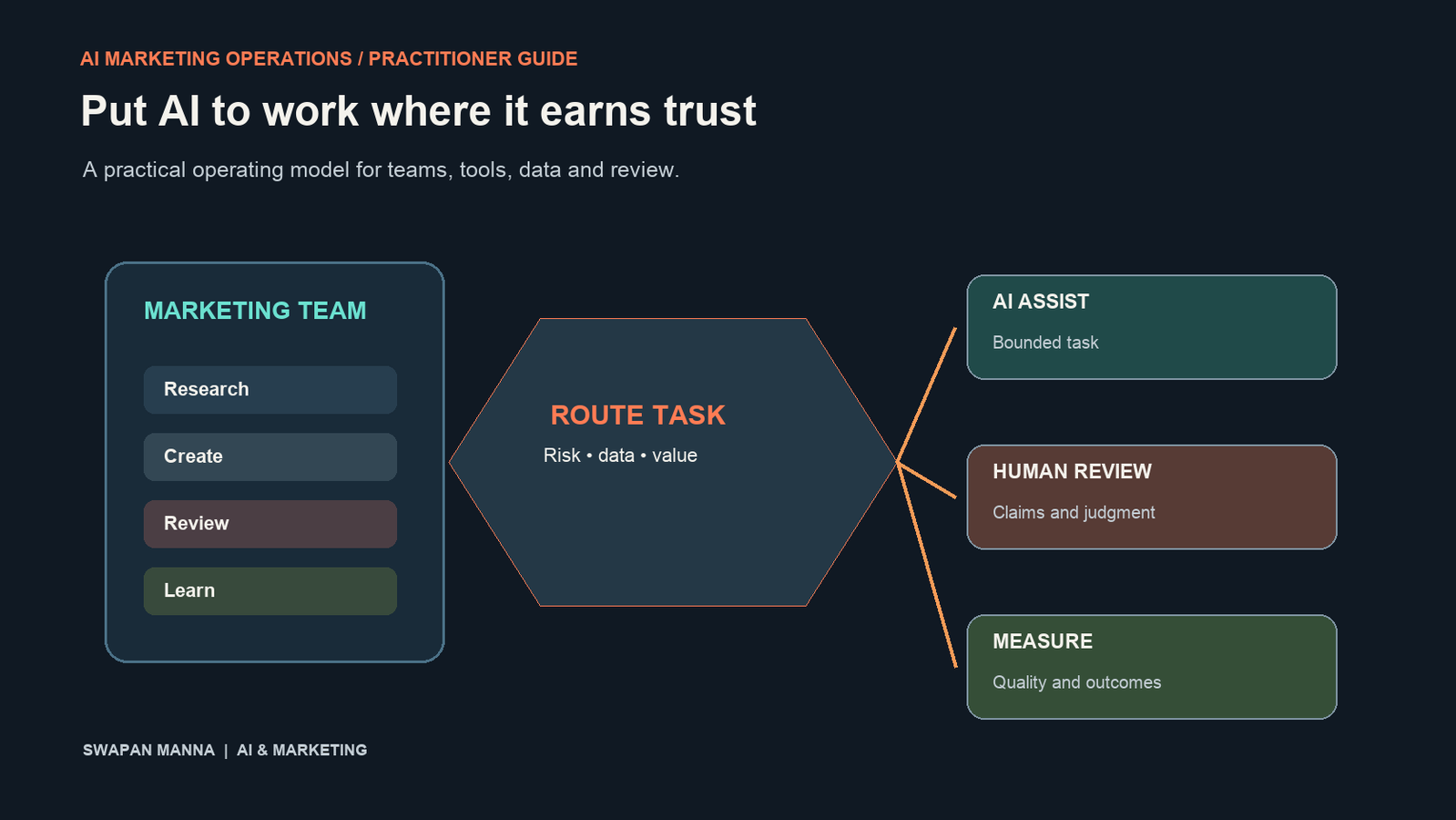
AI marketing operations works best when teams start with a bounded business task, assess its value and risk, control its data and permissions, and measure quality against a baseline. Keep accountable human review where customer context, claims, or consequences require judgment.
Key Takeaways
- Begin with a specific recurring task and define its business or customer purpose.
- Assess value, error consequences, data sensitivity, and reviewability before automating.
- Design the complete workflow, including approved inputs, checks, permissions, logging, and fallback.
- Assign an accountable owner and involve the right privacy, security, legal, and analytics reviewers.
- Pilot against a baseline and measure quality, net time, risk, and customer or business value.
- Use AI for content only when human expertise adds substantive value for readers.
Playbooks
Frameworks you can put to work
Growth marketing, LinkedIn presence, and more — delivered as PDFs.
Browse the playbooksAI marketing is the deliberate use of artificial intelligence to improve marketing decisions and work, from research and analysis to content operations, customer interaction, and measurement. A useful AI marketing strategy begins with a business or customer task, chooses an appropriate level of automation, and sets clear standards for data, review, accountability, and outcomes.
The practical question for a CMO is not how many AI tools the team can adopt. It is where AI can reduce friction or improve a customer experience without creating unacceptable errors, privacy exposure, brand inconsistency, or hidden operational costs. This playbook explains how to select use cases, design workflows, govern risk, and decide whether a pilot should expand.
What AI marketing operations includes
Marketing operations includes the processes, people, data, technology, and decision rules that allow a marketing team to plan and deliver its work. AI may support research synthesis, segmentation, drafting, asset adaptation, campaign operations, customer service, analytics, and internal knowledge retrieval. The right use depends on the task and the system’s performance in that context.
Generative AI creates or transforms material such as text, images, audio, and code. Predictive models estimate outcomes from data. Rules-based automation follows explicit conditions. Agentic systems may plan or take a sequence of actions through connected tools. These categories overlap in products, so evaluate the capabilities and permissions in the actual workflow rather than relying on a product label.
Start with the wider business objectives in the digital marketing strategy framework and make sure an AI investment serves a defined marketing or customer outcome.
Choose use cases by task, value, and risk
Build a list of recurring marketing tasks and describe the job each one performs. A task should be specific enough to observe: summarize approved research, classify inbound requests, create a first draft from verified product facts, or flag a campaign anomaly for review. “Use AI to improve marketing” is too broad to test or govern.
For each task, estimate the potential value, the consequences of a mistake, data sensitivity, variability of the input, and the ability to review or reverse the output. Start with tasks where the work is repetitive, the source material is approved, and a person can check the result. Be more cautious when the workflow changes customer eligibility, pricing, claims, or a consequential decision.
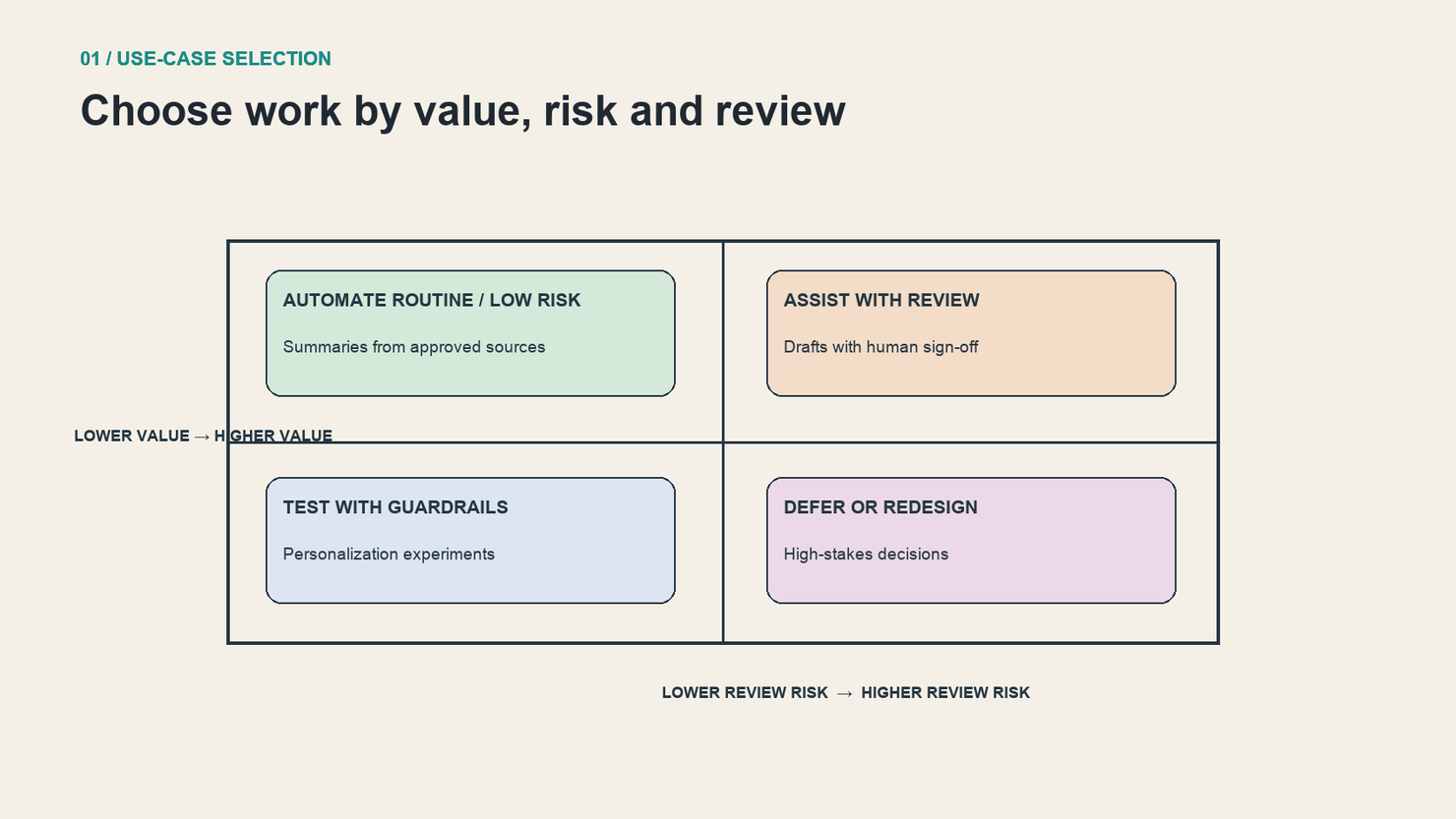
A practical first-pass triage
A low-risk support task might produce a structured summary of public market research for an analyst to check. A moderate-risk task might draft a customer email from approved product facts, with a marketer reviewing the content before send. A higher-risk workflow could autonomously personalize claims using sensitive customer data or make a decision without meaningful oversight. That task needs redesign, stronger controls, or a decision not to automate.
These examples are not universal risk ratings. The same workflow can carry different risk depending on the audience, data, market, product, and consequences. A useful triage records why the team believes the task is safe enough to test and what condition would stop the pilot.
Design an AI workflow with a human checkpoint
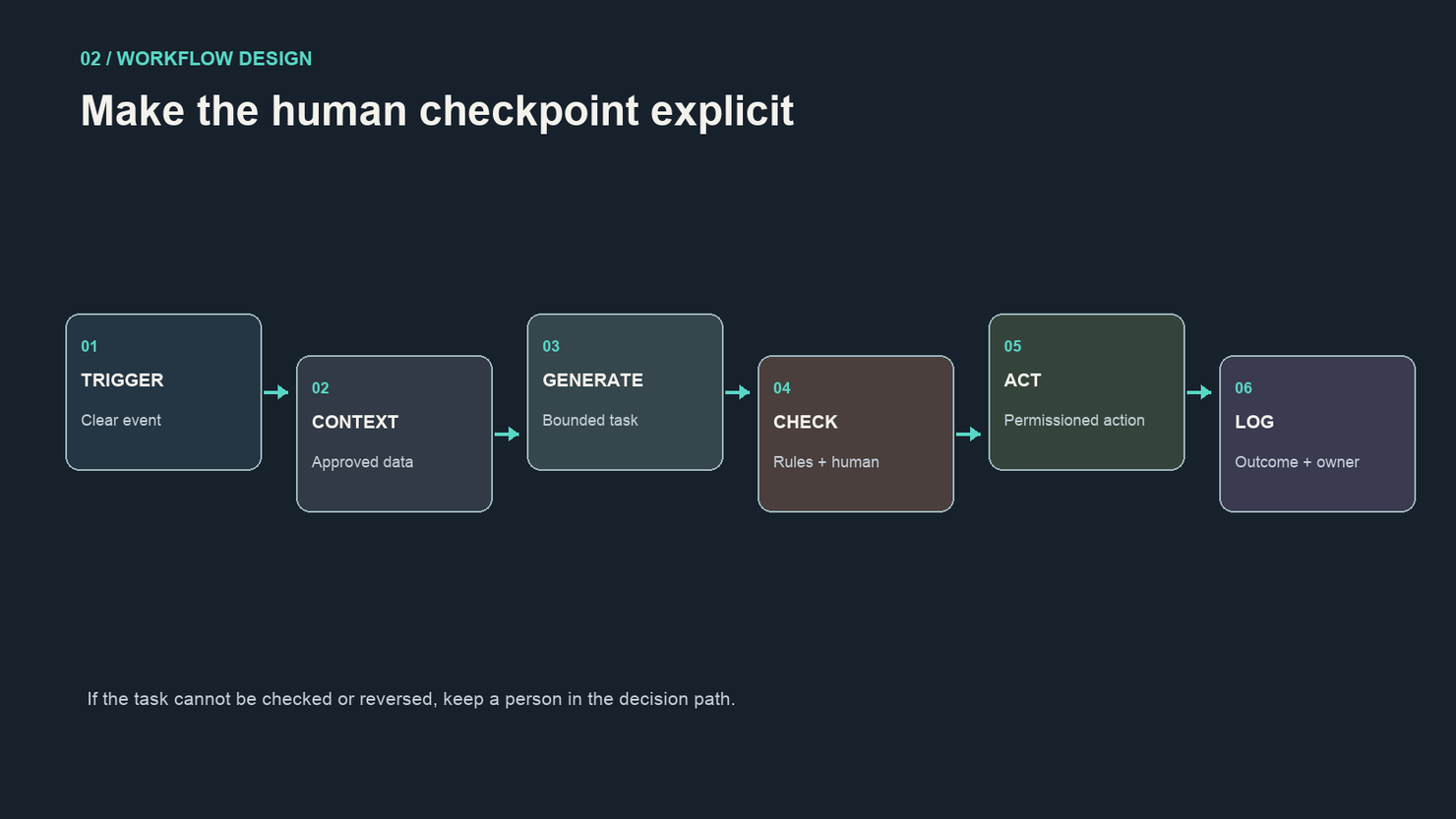
Map the whole process, not only the prompt. Identify the event that starts the workflow, the data it can read, the system that generates or classifies an output, the checks that run before action, who approves the result, what the workflow can change, and how the team records what happened. Specify a fallback for missing, conflicting, or uncertain information.
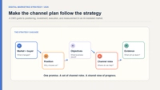
The diagram shows a bounded sequence: trigger, approved context, a defined AI task, checks, permissioned action, and an outcome log. Review should happen at the point where it can prevent a poor result from reaching a customer or changing a system. A final audit after an irreversible action is not an adequate substitute.
Human review must be meaningful. Give the reviewer enough source context, time, and authority to correct or reject the output. If review becomes a rubber stamp because the queue is too large, narrow the workflow or lower its autonomy. Record who owns the decision and how exceptions are handled.
Protect data, brand trust, and customer expectations
Before connecting a model or agent to marketing systems, map the data involved. Identify the source, sensitivity, permission, retention period, access controls, vendor handling, and whether the information may be sent outside the organization. Use the minimum information required for the task, and follow applicable privacy and security requirements in the markets where the business operates.
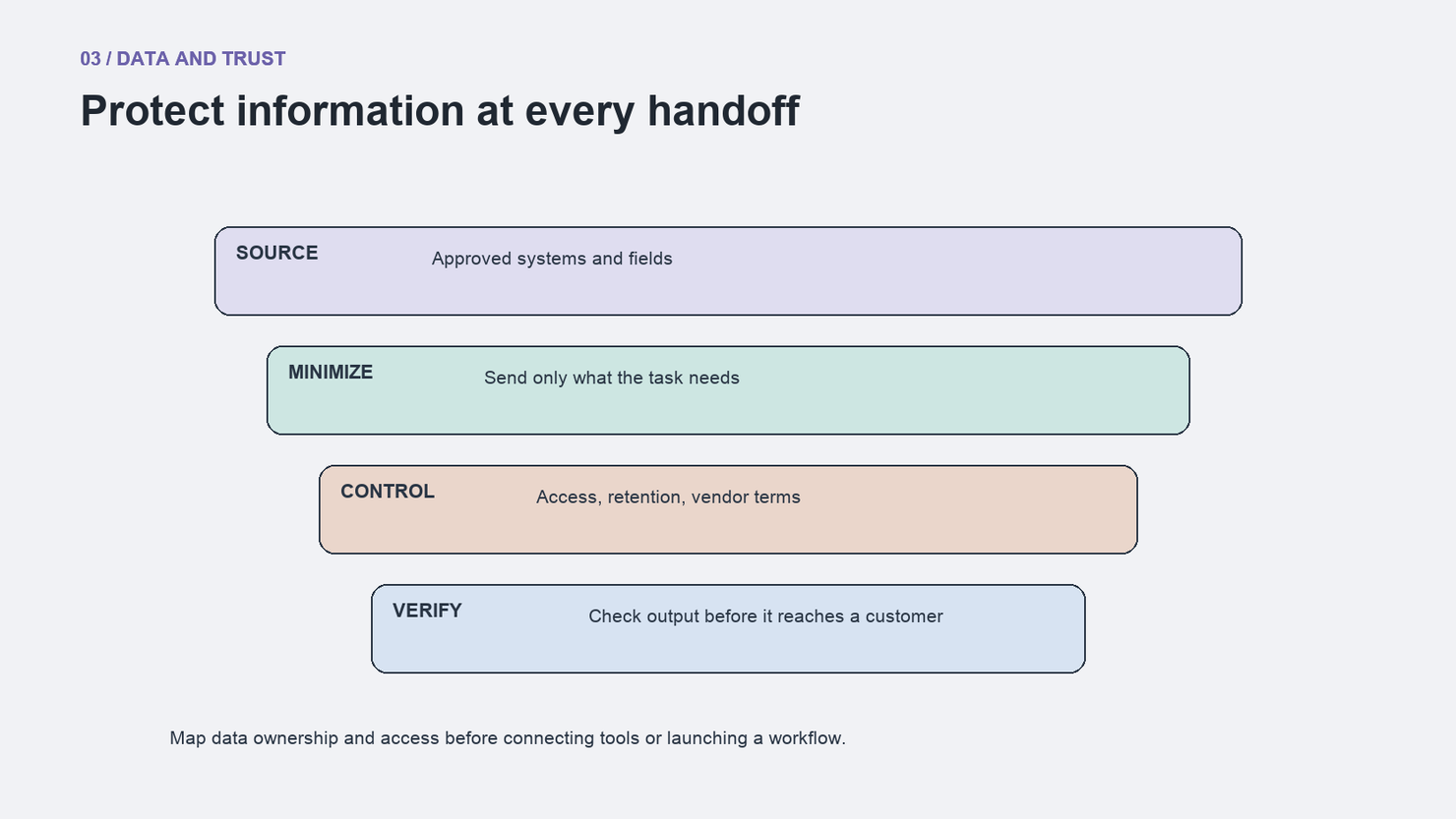
Separate public information from customer records, employee data, confidential plans, and regulated information. A tool’s interface may make a workflow feel simple while the underlying terms, logging, retention, or training use remain important to assess. Have the appropriate privacy, security, and legal reviewers assess the proposed use before sensitive data or consequential actions are involved.
NIST’s Generative AI Profile is a voluntary resource for identifying and managing generative AI risks across design, use, and evaluation. See the NIST AI RMF Generative AI Profile; tailor any controls to your organization and jurisdiction.
Marketing claims still need evidence. Do not describe a product as accurate, unbiased, autonomous, secure, or capable of a particular result unless that statement is supported and properly qualified. Review AI-assisted copy for invented statistics, altered meaning, misleading comparisons, fabricated testimonials, and claims the business cannot substantiate.
For United States advertising basics, review the FTC advertising and marketing guidance. Legal obligations vary by jurisdiction and product category.
Set an operating model and ownership
Every production workflow needs an accountable business owner. The owner defines the task, the acceptable output, the approval point, the escalation route, and the measure of success. Marketing may own usefulness and brand quality; IT or security may own access and vendor review; privacy or legal may assess data and claims; analytics may define evaluation and monitoring. The exact roles depend on the work.
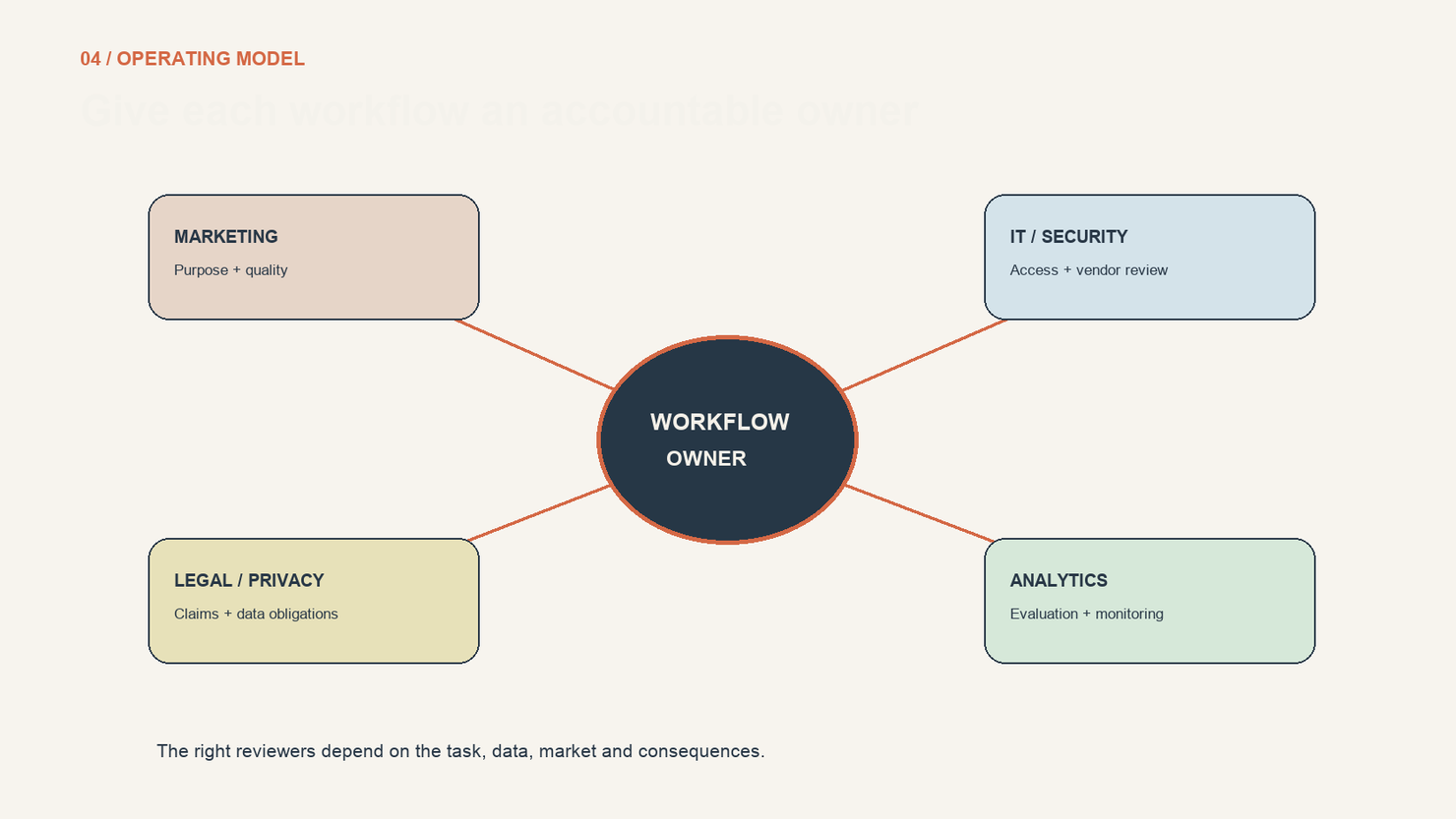
Create a lightweight register for each AI use case: purpose, users, data, connected tools, risk assumptions, owner, review method, vendor terms, evaluation results, and last review date. Include the specific model or product version where it matters. A short written record helps the team understand why a workflow exists and what would require reapproval.
Access should follow the task. A drafting assistant usually does not need permission to send messages or edit customer records. An agent that can make changes should have narrow permissions, limits on actions, logs, and a reliable stop mechanism. Test what happens when the input is wrong, the tool is unavailable, or an instruction conflicts with policy.
Integrate AI with the marketing stack carefully
Avoid adding a new AI service to every team’s workflow without understanding what data and processes already exist. Map the systems of record, approved sources, identity permissions, integrations, and existing automation. Decide whether a use case needs a standalone assistant, a workflow integrated with the CRM, a retrieval layer over trusted internal material, or no new tool.
Keep the source of truth explicit. If an AI system uses product facts, pricing, positioning, or policy material, establish who maintains those facts and how stale versions are removed. A connection to a large volume of internal files does not make the output trustworthy. Retrieval can surface relevant material, but it does not guarantee that the material is current or interpreted correctly.
For source readiness across content and answer interfaces, see the content strategy pillar and the
Pilot one workflow before scaling
A pilot should test one defined task with a clear baseline, a representative sample, and a stop condition. Record how the work is done today, the quality standard, the time and cost involved, and the types of error that matter. Then measure the assisted workflow on the same criteria. Include the effort spent on prompt design, review, exception handling, integration, and maintenance.
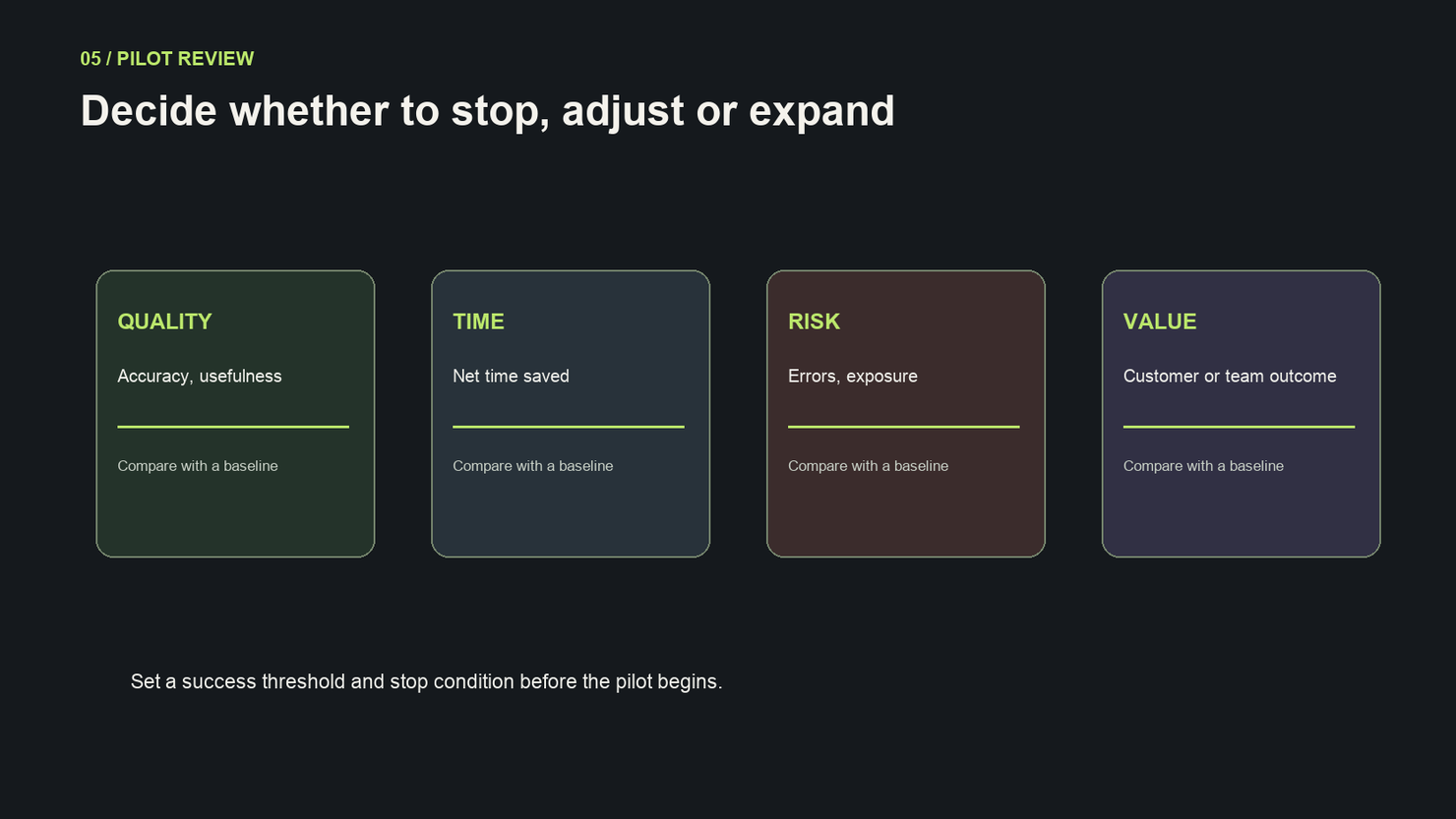
Evaluate quality and operational cost together. A workflow that generates a draft quickly but requires extensive correction may not save time. A system that performs well on a small clean sample may fail on edge cases, multiple languages, incomplete records, or a changed product. Test the conditions likely to occur in production and document the limitations.
Decide in advance what success, adjustment, and failure look like. If quality is good but reviewer capacity is constrained, reduce volume or narrow the use. If customers receive a confusing experience, stop and investigate. If the workflow meets its threshold and remains manageable, expand gradually while continuing to monitor errors and drift.
Measure outcomes without overstating impact
Measure the task at several levels: output quality, net time, exception rate, risk events, customer response, and the business result the workflow is meant to influence. Establish how each measure is calculated and where the data comes from. Separate correlation from causation, especially where multiple marketing and sales activities contribute to the same outcome.
HubSpot’s 2026 State of AI in Marketing report surveyed 1,754 marketers across North America, Europe, Asia, Australia, and Latin America. The report describes common adoption and perceived use cases among its respondents. It is vendor-sponsored survey research and does not establish that the same use cases will improve performance for every company.
See the HubSpot 2026 State of AI in Marketing report for survey details and findings. Use such industry data as context; set your investment based on your own workflow evidence.
Use AI for content without turning out scaled low-value pages
AI can help organize research, generate alternative outlines, transform a source into another format, or assist with editing. A human must verify the facts, add the organization’s expertise, check rights and attribution, and make sure the finished material answers the reader’s question. Generating more pages is not itself a content strategy.
Google’s guidance on generative AI content says using AI is not inherently against its Search guidance, while generating many pages without added value can fall under its scaled content abuse policy. The distinction is the value and purpose of the work, not whether a tool was used.
This aligns with the wider principles in the marketing growth strategy framework: select a meaningful customer problem, build a differentiated response, and learn whether the work contributes to the business instead of accumulating activity.
A 30-day implementation sequence
In week one, inventory tasks and systems, choose one contained use case, and check data and vendor conditions. In week two, design the workflow, approved inputs, review rules, owner, fallback, and baseline. In week three, test with representative cases, including edge cases, and record quality and reviewer effort. In week four, decide to stop, revise, or expand to a limited production group.
The sequence is a starting point rather than a universal timeline. Security and privacy review, procurement, integration, or customer testing may take longer. Do not bypass an important control to meet a launch date. A slower pilot is preferable to an automation that creates customer harm or unmanaged operational risk.
The standard for an AI-ready marketing operation
An AI-ready team knows which work matters, what data the workflow can use, who is accountable, how outputs are checked, and what evidence would justify continued investment. It uses automation selectively, preserves human judgment where context matters, and keeps customers’ expectations in view.
Adopt AI when it improves a real task and the team can operate it responsibly. Keep the process observable, permissions narrow, and claims accurate. Expand only when measured quality and value justify the added complexity.
Evaluate vendors and integrations before launch
A vendor comparison should follow the workflow requirements, not a feature checklist. Confirm the model or service used, where data is processed, retention settings, subprocessors, access controls, audit logs, model-change notices, export options, uptime expectations, and how the organization can remove data or terminate the integration. Ask what the product does with prompts and outputs under the specific plan and configuration being considered.
Test candidate products on the same set of representative tasks. Include normal inputs, ambiguous requests, missing facts, unusual formatting, and likely edge cases. Have subject experts score outputs against a shared quality rubric. Record setup time, training, review burden, integration work, and limitations. A polished demonstration is not evidence that a workflow will perform reliably in production.
Do not connect a tool simply because it offers an integration. Review the permissions requested, the fields and records it can read or change, and whether access can be restricted. Start in a test environment with synthetic or appropriately de-identified data where possible. Require a clear path to disable the integration and restore prior behavior.
Treat retrieval and agent permissions as design choices
Retrieval-augmented generation gives a model access to selected documents or records when generating an answer. It can help a team use approved product or policy information, but the result still depends on the quality, access rights, freshness, and relevance of those sources. Make citations or source previews available to the reviewer when the task requires evidence. Set a response rule for when the material does not answer the question.
An agent that can read untrusted external text may encounter instructions embedded in that text. Treat outside messages, web pages, and uploaded files as data to analyze, not automatically as instructions to follow. Limit available tools, separate reading from action, require approval for consequential changes, and test adversarial or conflicting inputs. Security controls should be designed with the platform and your technical team.
The same principle applies to CRM and campaign actions. An agent can prepare a suggested update without receiving permission to modify every customer record. Use narrow permissions, action thresholds, duplicate checks, rate limits, and an audit trail. Test whether a user can stop the process and whether the workflow can recover from a partial failure.
Prepare the team for operating changes
A workflow changes the work around it. Marketers may move from drafting each asset to setting requirements and reviewing outputs. Operations teams may need to maintain approved data and monitor integrations. Leaders need time to evaluate exceptions and train staff. Include those responsibilities in the business case instead of counting only the time saved by generation.
Explain which tasks are supported by AI, what information staff may enter, what review is required, and how to report errors. Give employees a sanctioned tool and a safe way to ask questions. A rule that says only “do not use AI” may push work into unapproved tools without making data handling more visible. Local requirements and company policies still apply.
Measure adoption alongside usefulness. Low usage may indicate a poor fit, unclear training, or an incomplete workflow. High usage does not prove value if people are correcting outputs privately or if quality has declined. Hold regular reviews with the people who use the system and update the workflow when their evidence changes.
Set a review cadence and an escalation route
Review a workflow when the model, vendor terms, data source, permissions, audience, or business purpose changes. Track error patterns, customer feedback, overrides, and unusual output shifts. Define who investigates an incident, who can pause the integration, and how the team will communicate a material customer impact. The response should be proportionate to the task and the potential harm.
Some use cases need a human decision for every output. Others may permit sampling and exception-based review after the workflow has demonstrated stable quality. That change should be based on documented performance and a risk assessment, not merely pressure to increase volume. Recheck the decision when the product, data, or context changes.
For teams planning into 2027, treat AI capability as part of the operating system for marketing rather than as a standalone innovation program. Maintain a short prioritized use-case portfolio, fund the controls and data work that make it usable, and stop experiments that cannot show sufficient quality or value. The right pace depends on your resources and risk tolerance.
Frequently Asked Questions
What is AI marketing?
How should a marketing team start using AI?
Which marketing tasks are suitable for AI automation?
What is the difference between AI automation and an AI agent?
How can a company use AI in marketing safely?
Can AI-generated marketing content affect Google rankings?
How should a CMO measure AI marketing ROI?
When should a marketing team avoid using an AI agent?

Swapan Kumar Manna
Go-to-market & AI search strategist
Swapan Kumar Manna is a go-to-market and AI search strategist and Founder & CEO of Oneskai. He has spent 14+ years helping companies get found, get chosen and grow.