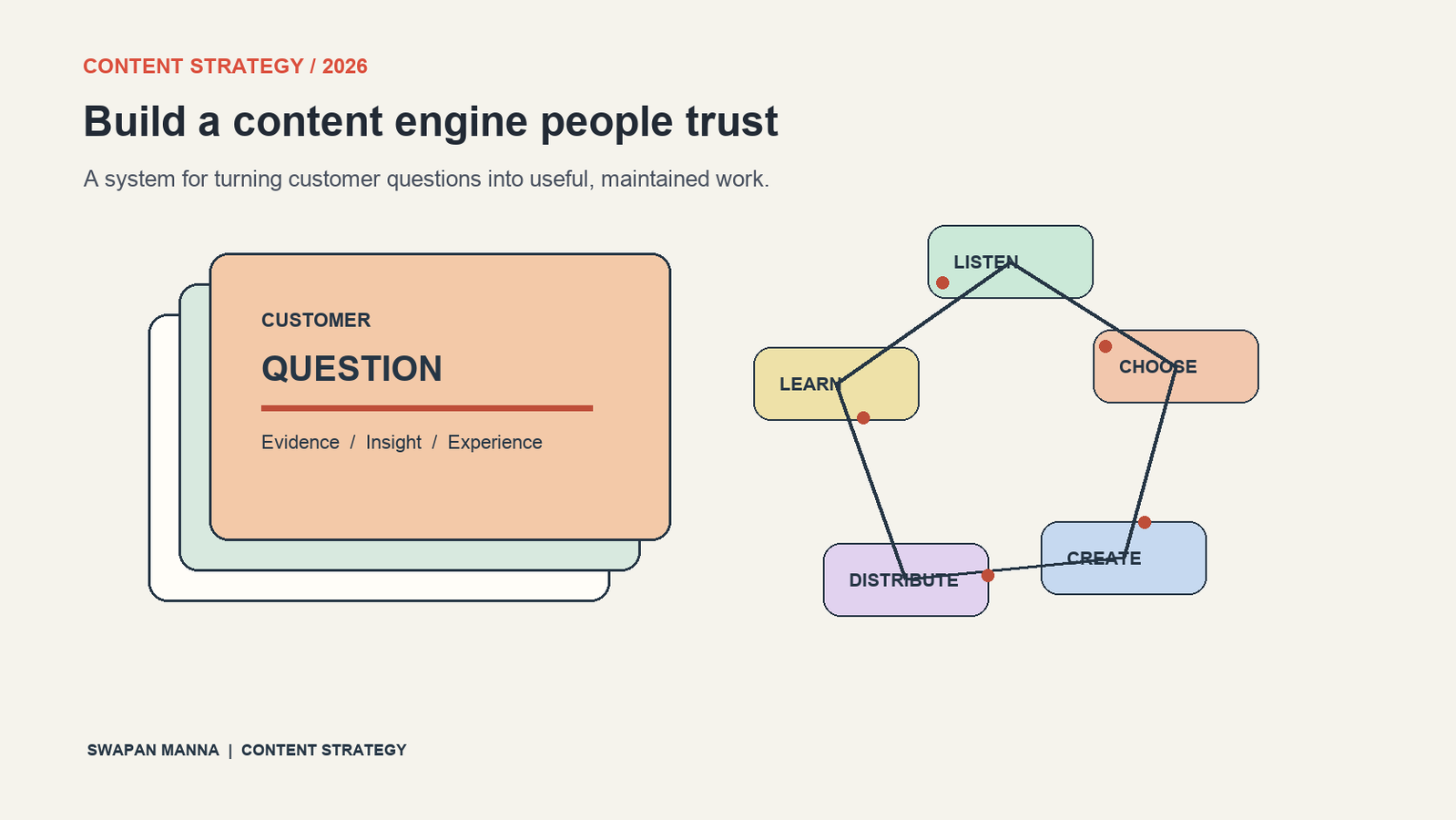
A useful content strategy connects real customer questions to original, well-supported content and a clear distribution and maintenance plan. Prioritize reader value over publishing volume, assign ownership, and measure each asset against its purpose.
Key Takeaways
- Start with customer questions and decisions, not a publishing quota.
- Choose topics where the business can add useful evidence, experience, or analysis.
- Give every page a distinct purpose and connect related content for the reader.
- Adapt distribution to each channel and verify AI-assisted versions before use.
- Measure reach, use, action, and trust separately; attribution alone does not prove causality.
- Assign owners and review triggers so important pages remain accurate.
Playbooks
Frameworks you can put to work
Growth marketing, LinkedIn presence, and more — delivered as PDFs.
Browse the playbooksA content strategy is the set of choices that connects a business goal to a defined audience, a useful point of view, the content that helps people make decisions, and the way that content is distributed and maintained. It explains what the company will create, who it is for, why the work deserves attention, and what evidence will show whether it helped.
In the AI era, publishing more pages is not the strategy. Buyers move between search engines, AI assistants, communities, reviews, social platforms, peers, and vendor websites. A durable content program starts with the questions and decisions people actually have, then adds reliable evidence, first-hand expertise, and clear ownership. This guide gives marketing leaders a practical system for doing that without turning content into an output quota.
What a content strategy should decide
A content strategy clarifies the audience and the needs the organization can credibly serve. It defines the topics where the business has a right to contribute, the position or evidence it can add, and the formats and channels that fit the reader’s task. It also sets editorial standards, ownership, distribution, measurement, and a process for updating or retiring work.
A content calendar is one execution tool inside that system. It records what is planned and when. It cannot resolve a weak audience choice, a crowded topic, unclear claims, or a lack of subject expertise. The strategy comes first; the calendar makes selected work visible and accountable.
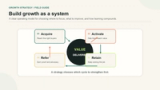
A broader business plan also connects content to acquisition and retention. The growth strategy framework explains how content fits inside a compounding growth system rather than operating as a separate publishing team.
Start with the customer and the decision
Begin with the moments when a customer needs to understand, compare, choose, implement, or improve something. Talk to sales, customer success, support, product, and customers. Review call notes, onboarding questions, search queries, lost-deal reasons, support tickets, reviews, and community discussions. These sources help distinguish a real customer question from a topic that merely sounds popular.
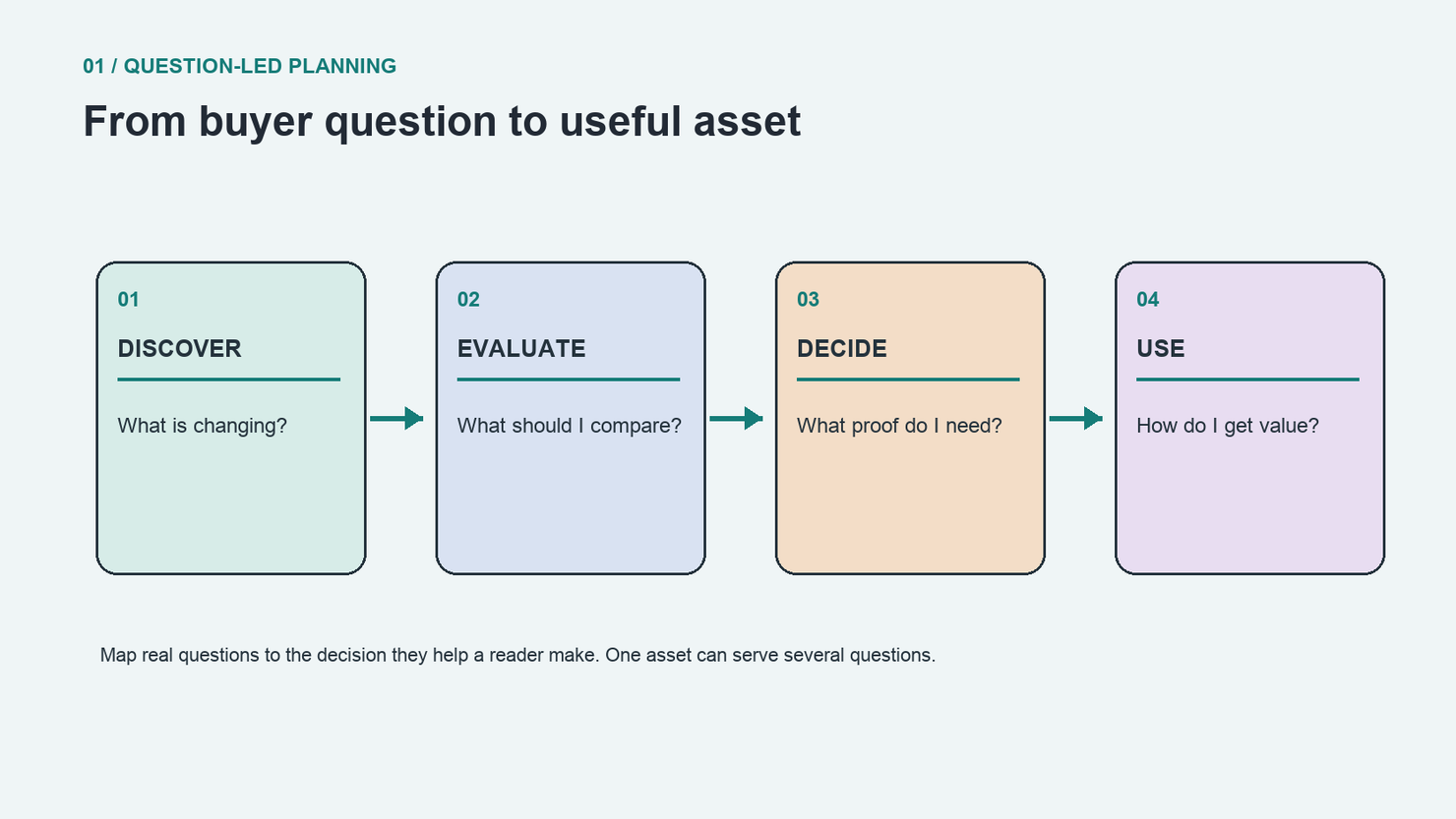
Record the question in the customer’s language and the decision it supports. “What is content marketing?” may represent early exploration. “How should a small team measure content contribution to pipeline?” implies a practical decision. The answer may require a guide, template, comparison, expert explanation, or no new page at all.
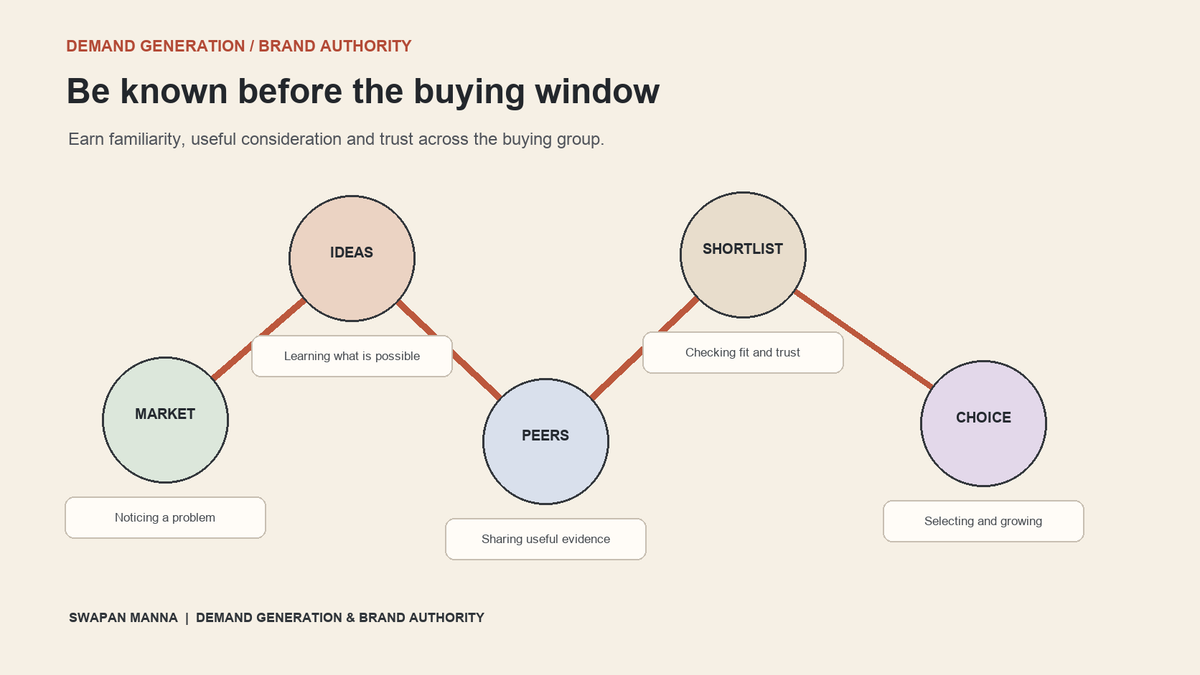
The question map below is a planning aid, not a universal buyer journey. People often skip stages, return to earlier questions, or ask several at once. Use actual research to revise the sequence for your market.
Turn listening into a short list of priorities
Score candidate topics against audience importance, business relevance, evidence available, distinctiveness, and the cost of producing a genuinely useful answer. Keep the reasoning visible. Search interest can help prioritize, but a keyword estimate is not proof that a topic will create qualified demand. If the evidence is thin, use a customer interview or a small publishing test before commissioning a large asset.
Look for the unmet need behind a query. Existing results may define a concept well but fail to explain trade-offs, implementation, exceptions, or what a buyer should do next. That gap can create an original contribution. A gap is not automatically an opportunity: check whether the reader matters to the business and whether the organization can answer accurately.
Choose a point of view you can support
A strong content program makes it easier for a reader to understand the company’s position and expertise. That does not mean every article should be promotional. Define the audience, problem, alternatives, value, proof, and limitations. Then identify the experience, analysis, data, or example that can make the explanation more useful than a generic summary.
Google’s people-first guidance asks publishers to create material for an existing or intended audience, demonstrate first-hand knowledge where relevant, and leave readers with enough information to achieve their goal. It also cautions against publishing many pages on unrelated topics or creating content to satisfy a word-count target. These are useful editorial checks, not a formula for ranking.
Use Google’s helpful-content self-assessment when deciding whether a new page has a clear audience, purpose, original value, and satisfying answer.
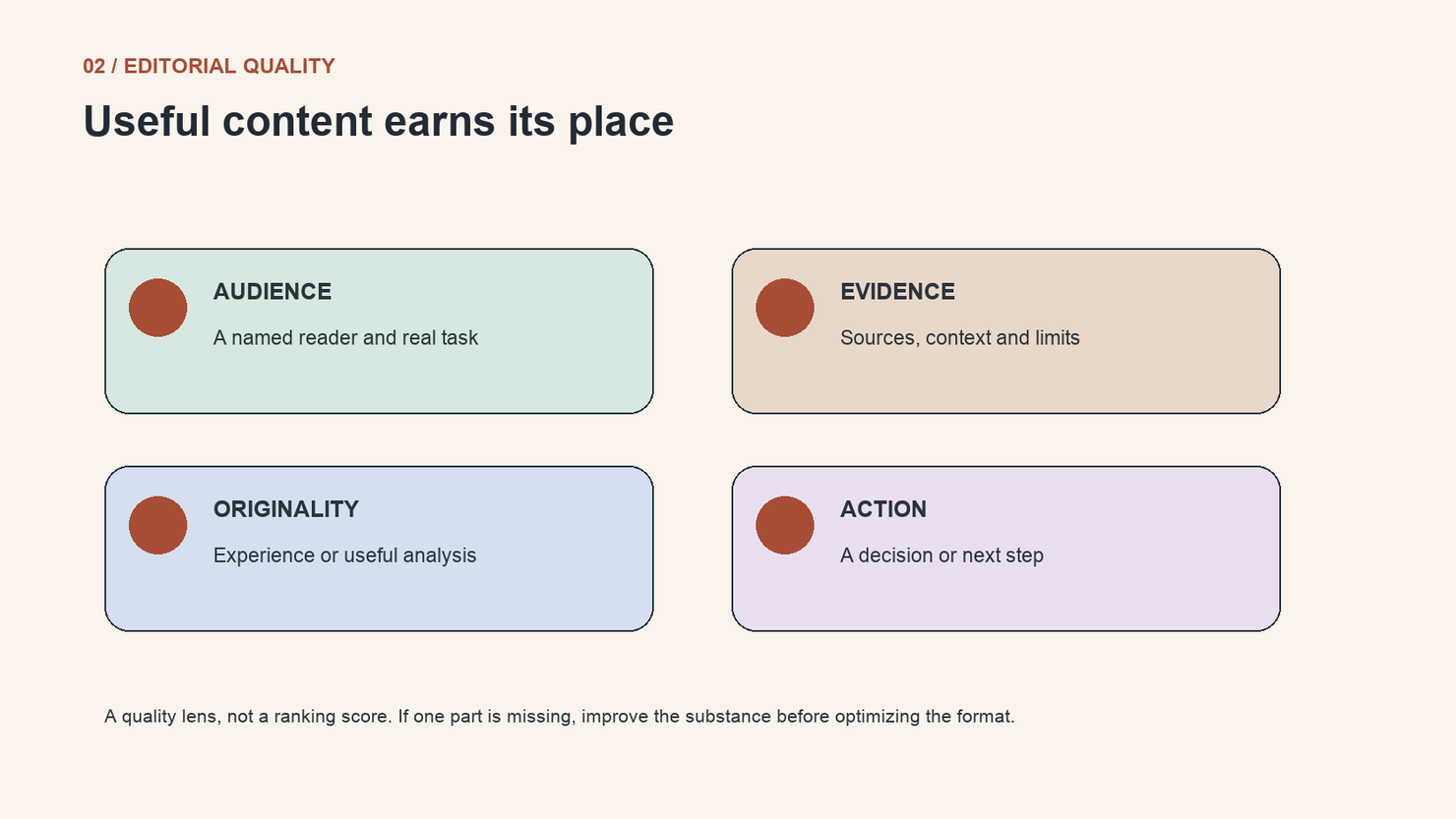
Originality can come from applied experience, a useful decision framework, a well-explained limitation, a careful synthesis, or an example built from verified facts. It should not be manufactured by inventing a proprietary model, claiming results that have not been documented, or presenting an illustrative example as a client case study.
Build a connected library, not a pile of posts
Organize content around the decisions your audience faces. A pillar page can orient readers across a broad problem; cluster pages can go deeper into distinct questions. The relationship should help a person navigate. It is not a quota that requires one page for every phrase, prompt, or slight variation of intent.
Give each page one main job. A cluster on content measurement, for example, should answer a narrower measurement question with useful detail. The pillar can explain where measurement fits, then point to the specialist article when it exists. If two pages answer the same query in the same way, combine or distinguish them based on reader need.
Search and AI visibility work best when the site has clear, connected explanations. The modern SEO guide covers the technical and editorial foundations that help search engines discover and understand useful content.
Use internal links where they make the reader’s next step clearer. Link from the pillar to live cluster pages and back from clusters to the parent where useful. Use descriptive anchor text, keep the destination relevant, and check that it resolves. Do not add links to planned URLs as if those articles already exist.
Write for readers first, then make the answer easy to find
A useful article gives the reader orientation early. State what the term means or answer the main question, then explain how the answer changes by context. A definition without assumptions can mislead; a practical guide should name the relevant decision factors, trade-offs, examples, and limits.
Use headings to express the argument, not to repeat keyword variations. H2s should divide major parts of the response. H3s should sit beneath a relevant H2 and add detail. Moderate paragraph length, plain language, useful examples, and a small number of purposeful lists make the page easier to use on a phone.
AI-assisted discovery raises the value of clear, verifiable explanations, but there is no special writing trick that guarantees a citation. Google’s current guidance says its existing Search fundamentals still apply to generative features. A page should be useful and crawlable; it should not be split into thin fragments or multiplied into near-duplicate prompt pages.
For a platform-specific view, see Google’s guide to generative AI features in Search. The wider shift across search and answer interfaces is covered in the
For source-readiness and answer visibility methods, see the GEO framework and the
Put this into practice
The Growth Marketing Playbook
A step-by-step guide to planning, running, and optimizing campaigns that drive real revenue — not just clicks and followers.
Create a repeatable editorial process
A practical workflow assigns a responsible owner at each stage. The researcher gathers customer questions and evidence. The subject expert checks accuracy. The writer shapes the answer. An editor checks the argument, originality, claims, structure, links, and reader experience. A publishing owner checks metadata, image rendering, accessibility, and the live page.
A brief should identify the intended reader, their task, the main question, what the page will and will not cover, sources to verify, internal destinations, and the evidence or example that makes it worth publishing. It should also name risks such as changing product details, survey limits, legal claims, or a topic that overlaps with another page.
HubSpot’s 2026 State of Marketing surveyed more than 1,500 marketers and reported that teams are adapting channels and formats as AI use and content expectations change. Such a vendor survey is useful context about marketer practice, not proof that any specific format or volume will work for your company. Use your own reader and business evidence to choose the format.
See the HubSpot 2026 State of Marketing report for its methods and survey findings. Treat the reported preferences as respondents’ answers, not universal buyer behavior.
Distribute the idea in ways that fit each channel
Publishing is the beginning of distribution. Start from the core insight and adapt it to the context: a complete answer on the site, a concise observation in a social feed, an email that adds context for subscribers, or a sales note that helps answer a current objection. Each version should have a useful purpose and respect the channel’s audience.
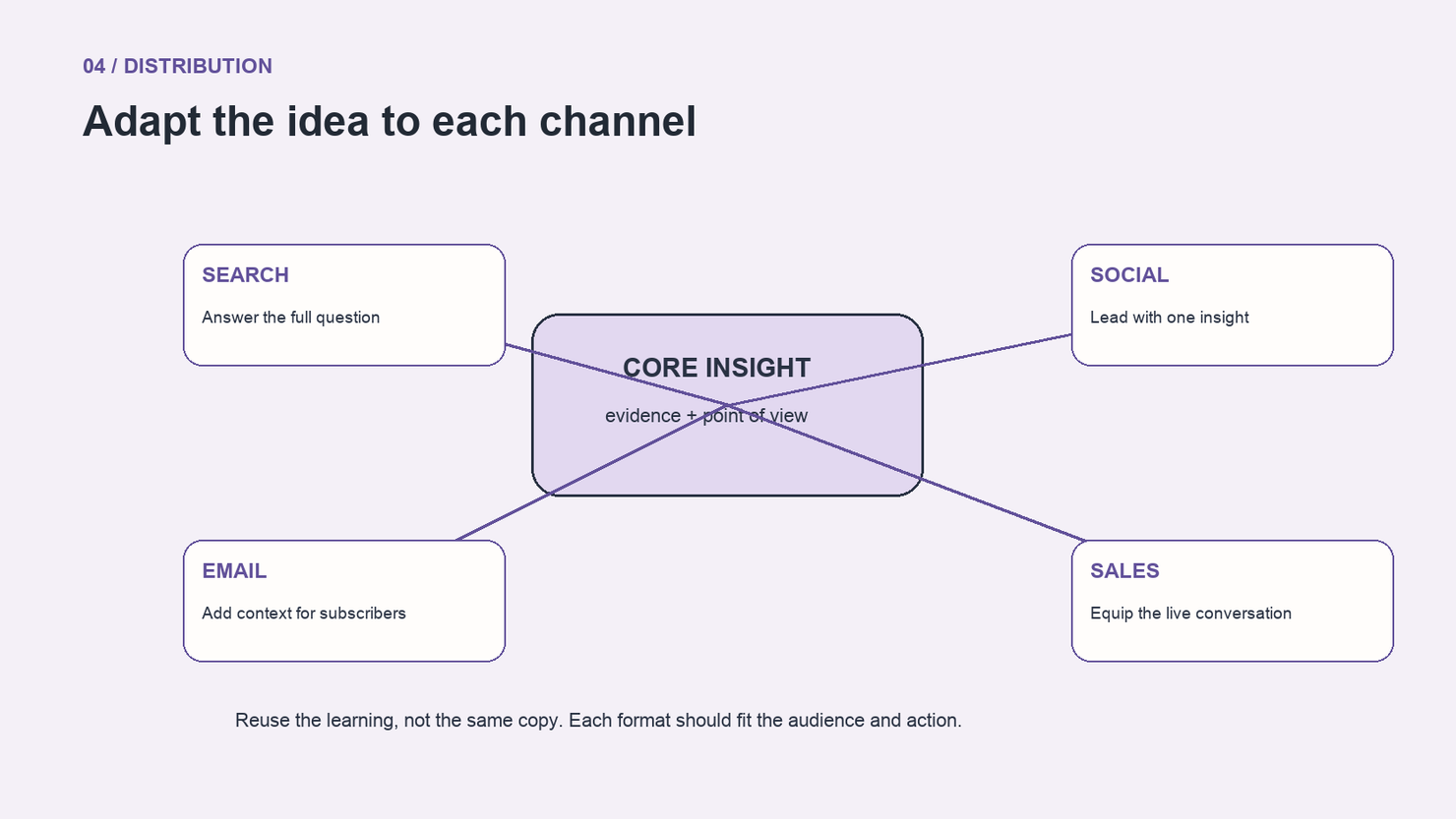
Repurposing should preserve meaning while changing the format and emphasis. Copying one post everywhere can ignore different reader expectations. A short video may show a process; an email can add a point of view; a checklist can support implementation. AI can help with transformations, but a person should verify factual accuracy, tone, attribution, and whether the new version works on its own.
Do not confuse distribution with repeatedly placing links in unrelated communities. Participate where the business can add value, follow each community’s rules, and disclose affiliation. Earned attention grows from useful contributions and relevant relationships, not automated posting or link schemes.
Measure reader value and business contribution
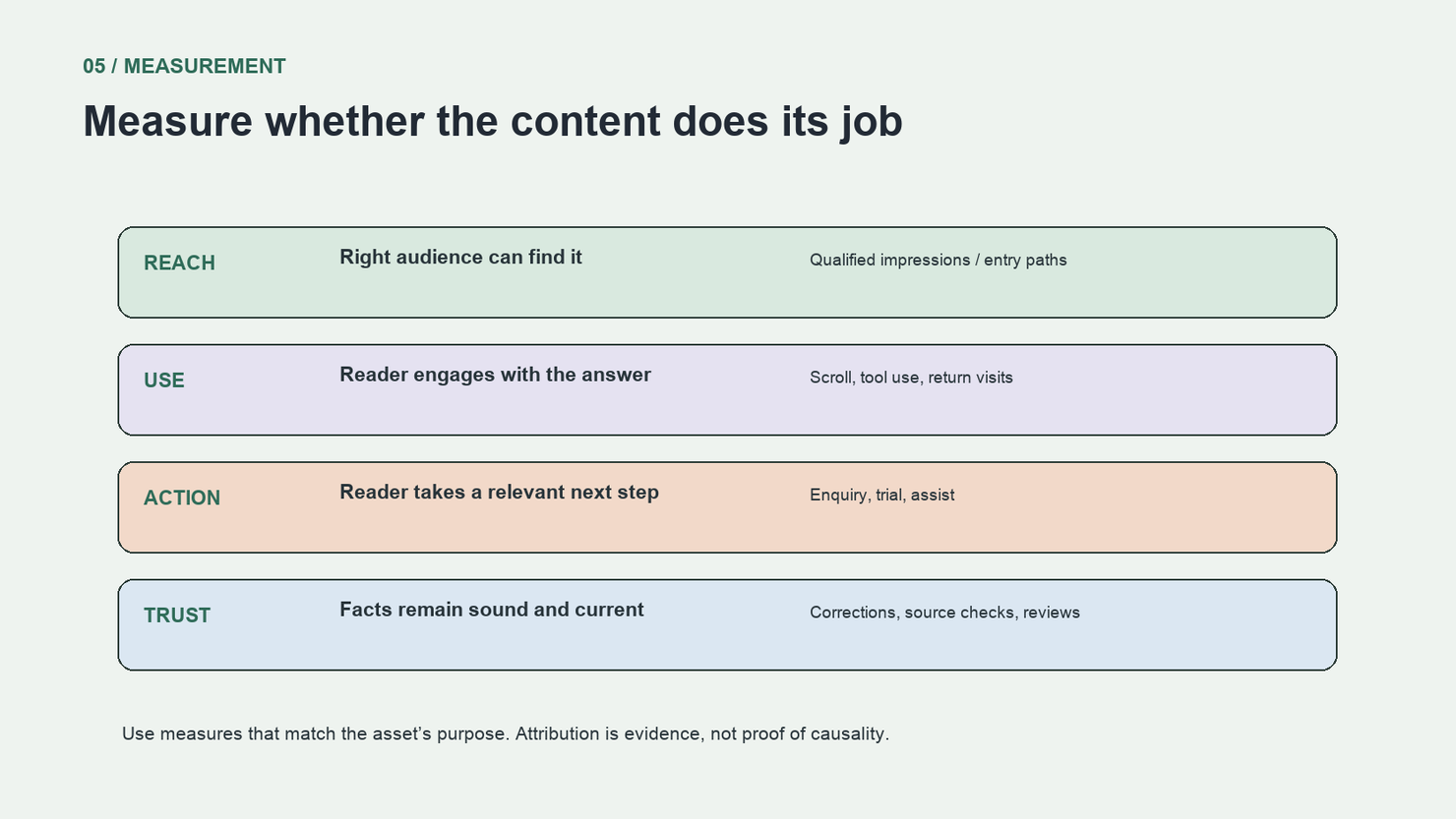
Choose measures for the job of each asset. Reach measures whether the intended audience can encounter it. Use measures whether people engage with the answer or return to it. Action measures whether a reader takes a relevant next step. Trust measures whether the facts remain accurate and the page earns confidence. No single metric answers every question.
Separate leading signals from business outcomes. Search impressions, qualified visits, time engaged, subscriptions, enquiries, assisted opportunities, and customer retention describe different parts of the relationship. Define each metric, its source, its time window, and its limitations. A page that appears in an attribution path may be associated with a sale without having caused it.
Review qualitative evidence as well as dashboards. Ask sales whether the material helps answer objections. Ask support whether it resolves repeated questions. Check which pages people use before a meaningful action. Where possible, compare a change against a sensible baseline or test; be careful about seasonality, low volume, and other changes happening at the same time.
The broader AI search visibility measurement guide explains how to interpret search and AI visibility signals without treating mentions as guaranteed revenue.
Maintain, update, combine, or retire content
A content library becomes less trustworthy when facts age and no one owns review. Assign an owner, a last-checked date, and a review trigger for each important page. Triggers may include product changes, policy updates, new research, broken links, a shift in the audience’s question, or evidence that two pages now overlap.
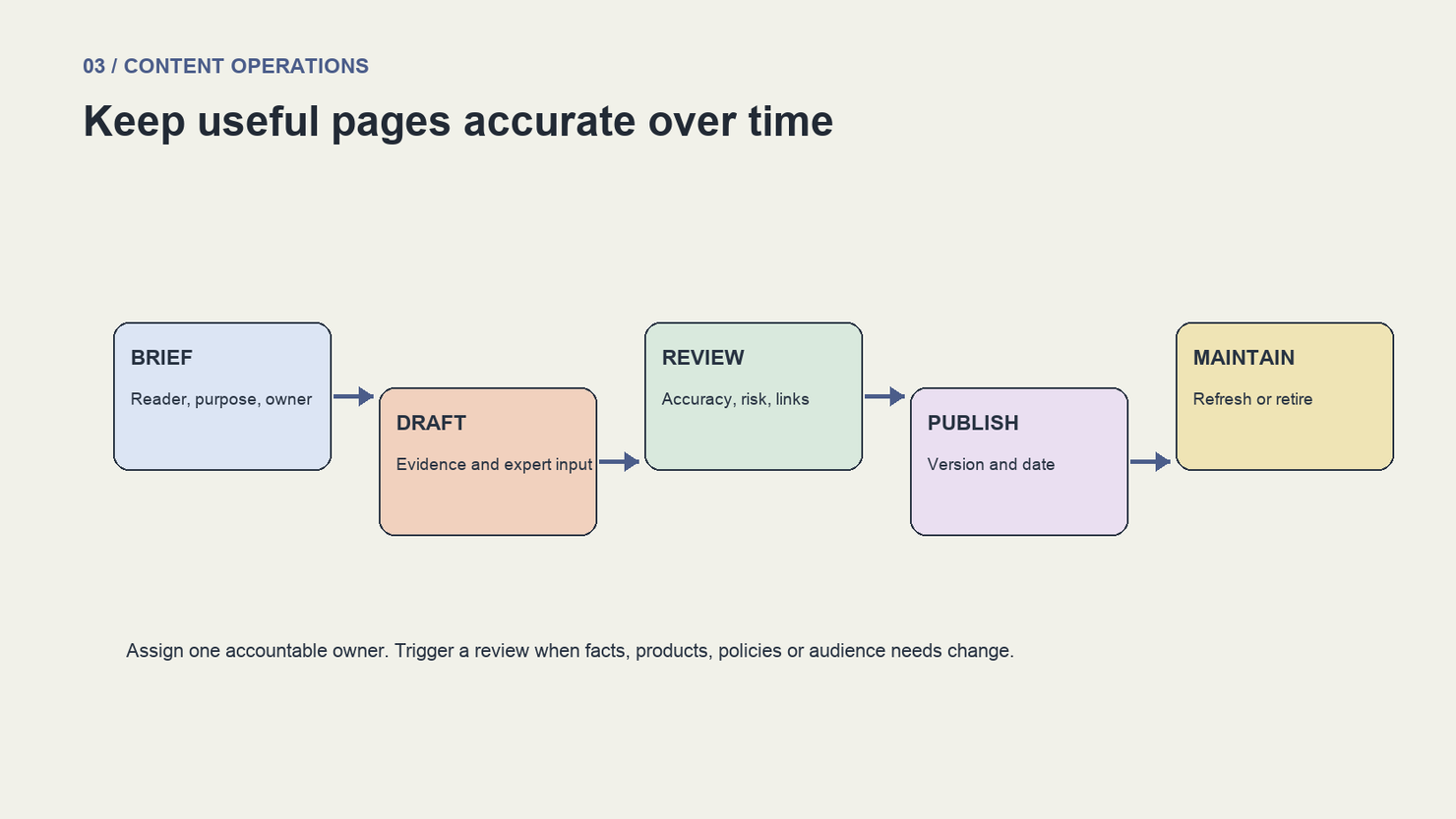
Update a page when the change materially improves its accuracy, usefulness, or fit. Preserve a publication date honestly and show an updated date only when the page has meaningfully changed. Combine pages when they duplicate the same reader task. Retire a page when it no longer serves a reader and cannot be made useful; consider redirects and links so visitors do not hit dead ends.
Content governance is a practical way to reduce avoidable errors. It does not require a large committee. A small team can keep a simple register of owner, purpose, priority, source record, review date, status, and next decision. The important thing is that responsibility is clear and the register is actually maintained.
A 90-day starting plan for a small team
In the first month, interview customers and colleagues, review existing pages, map the most important questions, and select a narrow set of priorities. During the second month, build or refresh the pages that address real gaps, verify their claims, and connect them with appropriate internal links. In the third month, distribute the work through relevant channels, observe reader response, and revise the plan based on evidence.
Do not treat this timeline as a universal publishing cadence. A regulated subject, a complex enterprise sale, or a team with limited expert time may need a slower process. The right objective is to produce a smaller number of accurate, distinctive assets consistently and learn whether they serve the intended reader.
The content strategy test
Before approving a new asset, ask: Who needs this? What are they trying to decide or do? What can we add that is accurate and useful? What evidence supports the important claims? Where will the asset be distributed? Who owns its review? What would make us update, combine, or retire it?
If those answers are clear, the team has a basis for making the work. If they are not, more copy or another AI-generated draft will not resolve the strategic problem. Build the content system around customer understanding, substantiated expertise, and decisions the business is prepared to own.
Frequently Asked Questions
What is a content strategy?
How do I create a content strategy?
What is the difference between a content strategy and a content calendar?
How should AI change a content strategy?
How can content be more visible in AI search?
How many articles should a content strategy include?
How often should website content be updated?
How do you measure content marketing performance?
Put this into practice
The Growth Marketing Playbook
A step-by-step guide to planning, running, and optimizing campaigns that drive real revenue — not just clicks and followers.
Frequently Asked Questions
What is a content strategy?
How do I create a content strategy?
What is the difference between a content strategy and a content calendar?
How should AI change a content strategy?
How can content be more visible in AI search?
How many articles should a content strategy include?
How often should website content be updated?
How do you measure content marketing performance?

Swapan Kumar Manna
Go-to-market & AI search strategist
Swapan Kumar Manna is a go-to-market and AI search strategist and Founder & CEO of Oneskai. He has spent 14+ years helping companies get found, get chosen and grow.