Part of the Demand Generation and Brand Authority: How Companies Become the Brand Buyers (and AI) Already Know series
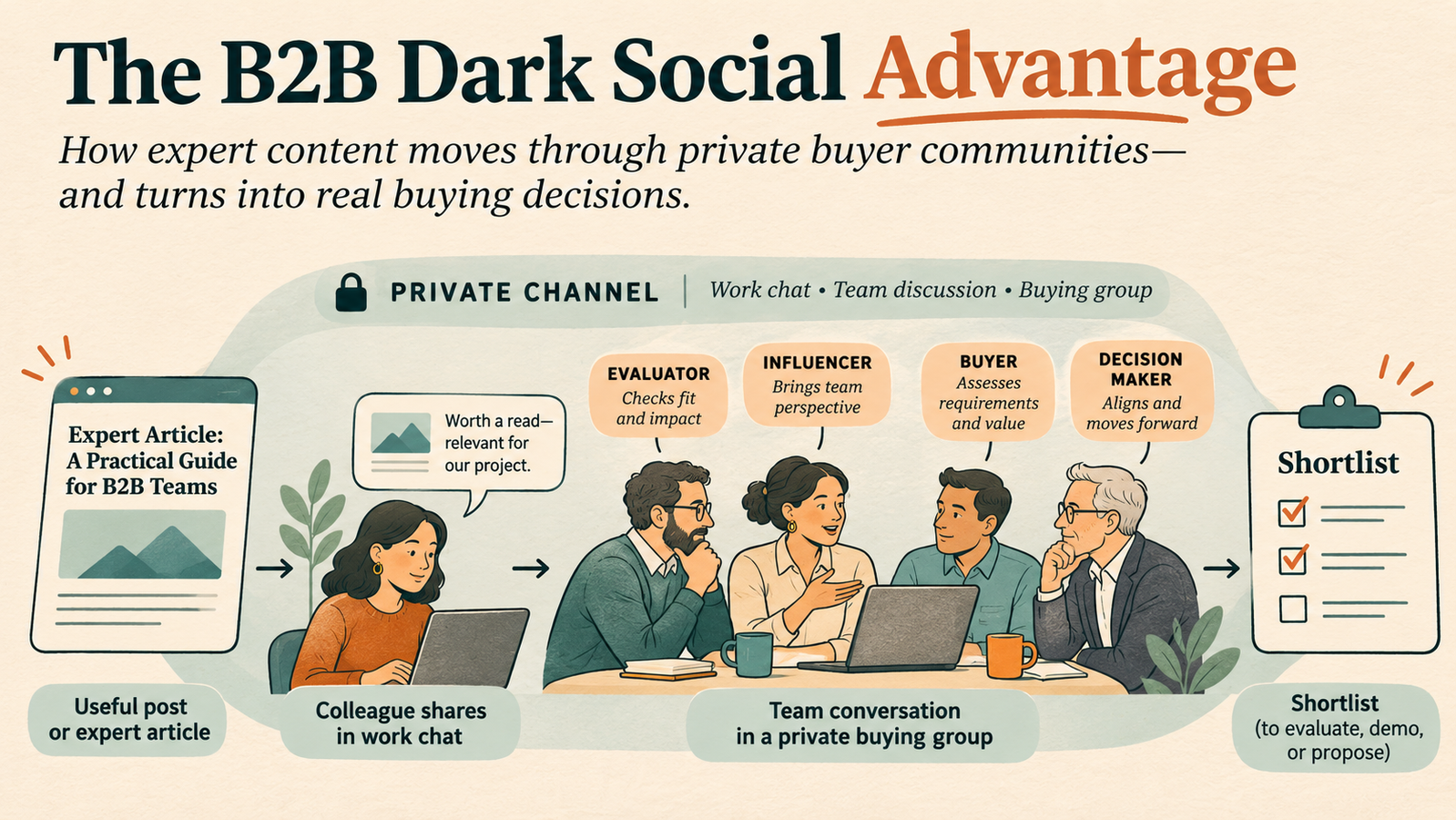
B2B buyers often share useful ideas privately in work chats, email, meetings, and professional communities. Analytics cannot capture every share, so combine clean tracking with neutral buyer questions and sales feedback, and avoid claiming complete or causal attribution.
Key Takeaways
- Private conversations can influence how buyers discover and discuss ideas.
- Direct traffic is not a precise measure of dark social.
- Combine tagged links, buyer recollection, interviews, and sales feedback.
- Participate in communities by following their rules and respecting privacy.
- Treat attribution as incomplete unless a causal design supports stronger claims.
Playbooks
Frameworks you can put to work
Growth marketing, LinkedIn presence, and more — delivered as PDFs.
Browse the playbooksDark social describes sharing and discussion that happen in private or poorly tracked channels, such as work chats, direct messages, email, meetings, and professional communities. In B2B, a useful article or recommendation may move between colleagues long before a website visit or sales conversation makes the source visible. “Dark” refers to limited measurement, not suspicious behavior.
This guide explains how private sharing affects B2B discovery, what analytics can and cannot show, and how to build a respectful measurement approach. It belongs to the demand generation and brand authority pillar and connects to the guides on B2B brand visibility and LinkedIn for B2B authority.
Why private sharing matters in B2B
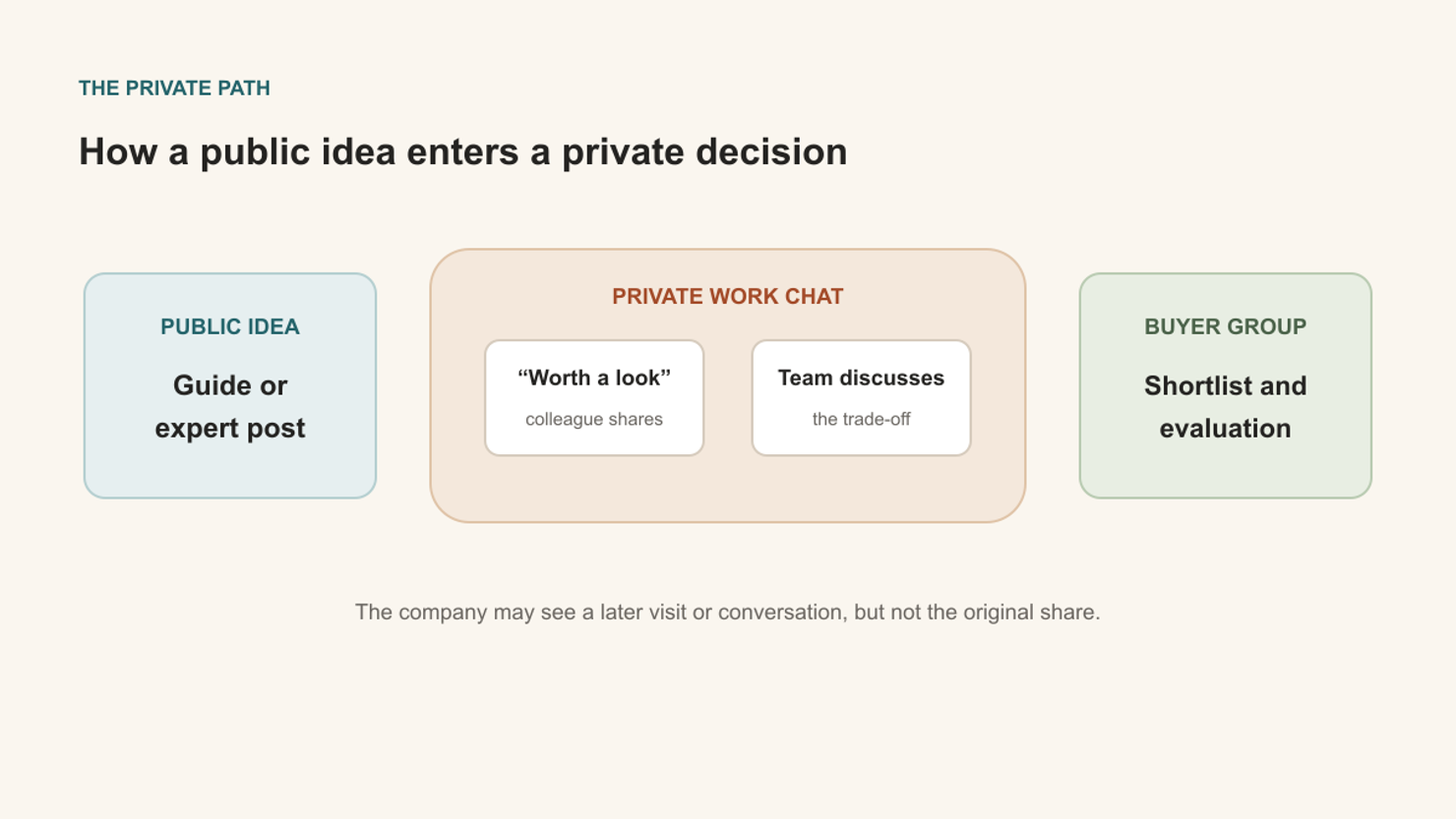
Buyers often share useful ideas with colleagues to explain a risk, compare an approach, or prepare for a decision. The 2026 Edelman-LinkedIn B2B Thought Leadership Impact Report found that among surveyed decision-makers who had shared thought leadership, 89% had shared it through a private channel, compared with 67% who had shared it through a public online channel. The survey question allowed respondents to select these options; they are not exclusive categories. The result is based on 1,051 B2B decision-makers who had shared thought leadership across a seven-country sample. See the report and its methodology.
The finding does not mean every B2B purchase is driven by a private message, or that every buyer shares the same way. It does show why public likes and shares cannot describe the whole path. A buyer may read something, forward it privately, return to the website later, and tell sales they heard about the company from a colleague.
What analytics miss
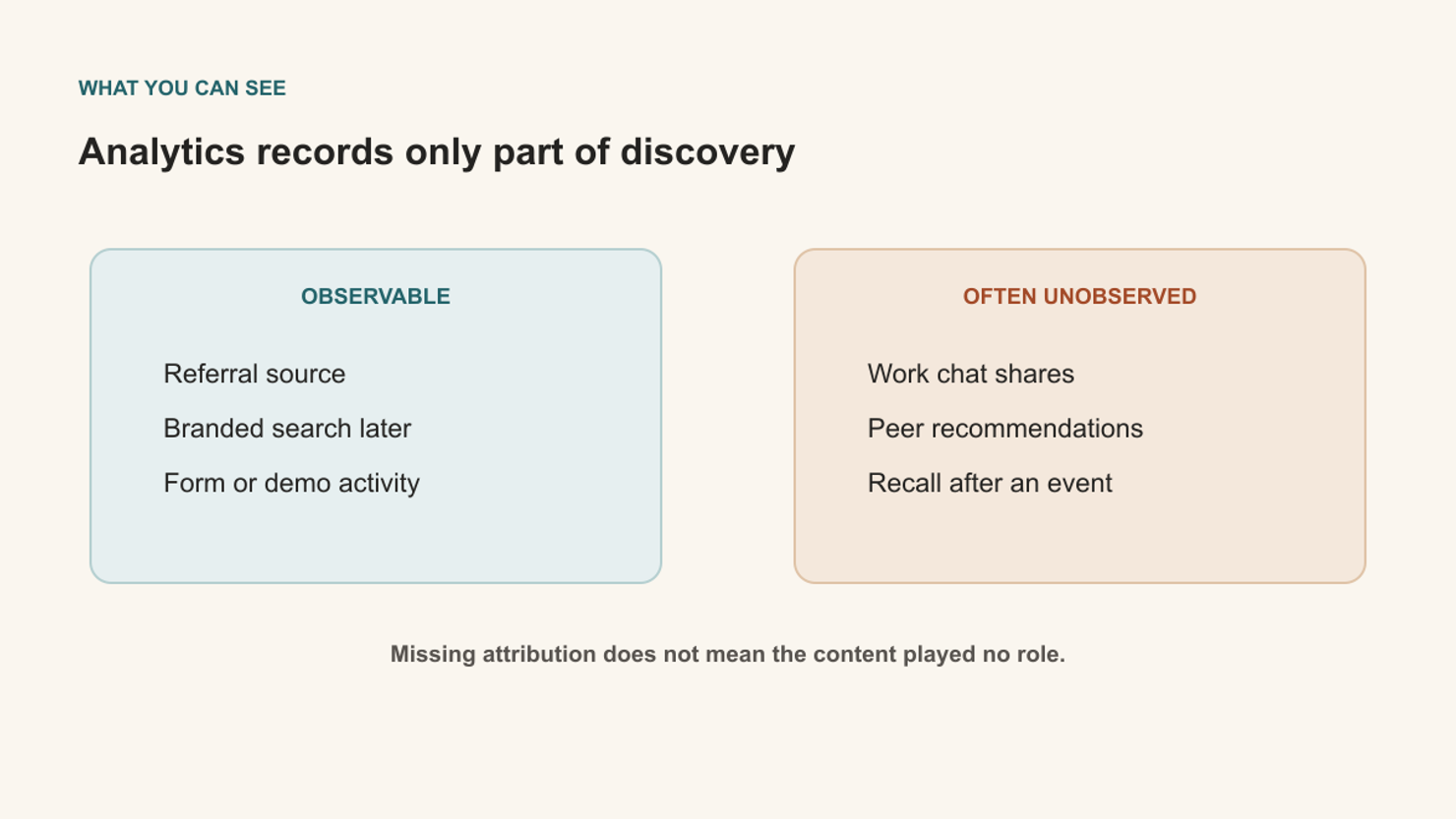
Web analytics can record a referral source when the browser passes it along, but some private shares do not carry clear source data. Google Analytics classifies traffic as direct when it has no clear referral source. Its documentation notes that missing campaign tags, redirects, offline documents, and ad blockers can all affect source information. “Direct” therefore does not always mean someone typed the address or used a bookmark.
A source report is still useful. It can show patterns in tagged campaigns, referrals, search, and visits. It cannot reliably identify every private conversation or prove why someone returned. Avoid treating direct traffic as a clean proxy for dark social; the category includes multiple behaviors and technical causes.
Make community participation useful and respectful
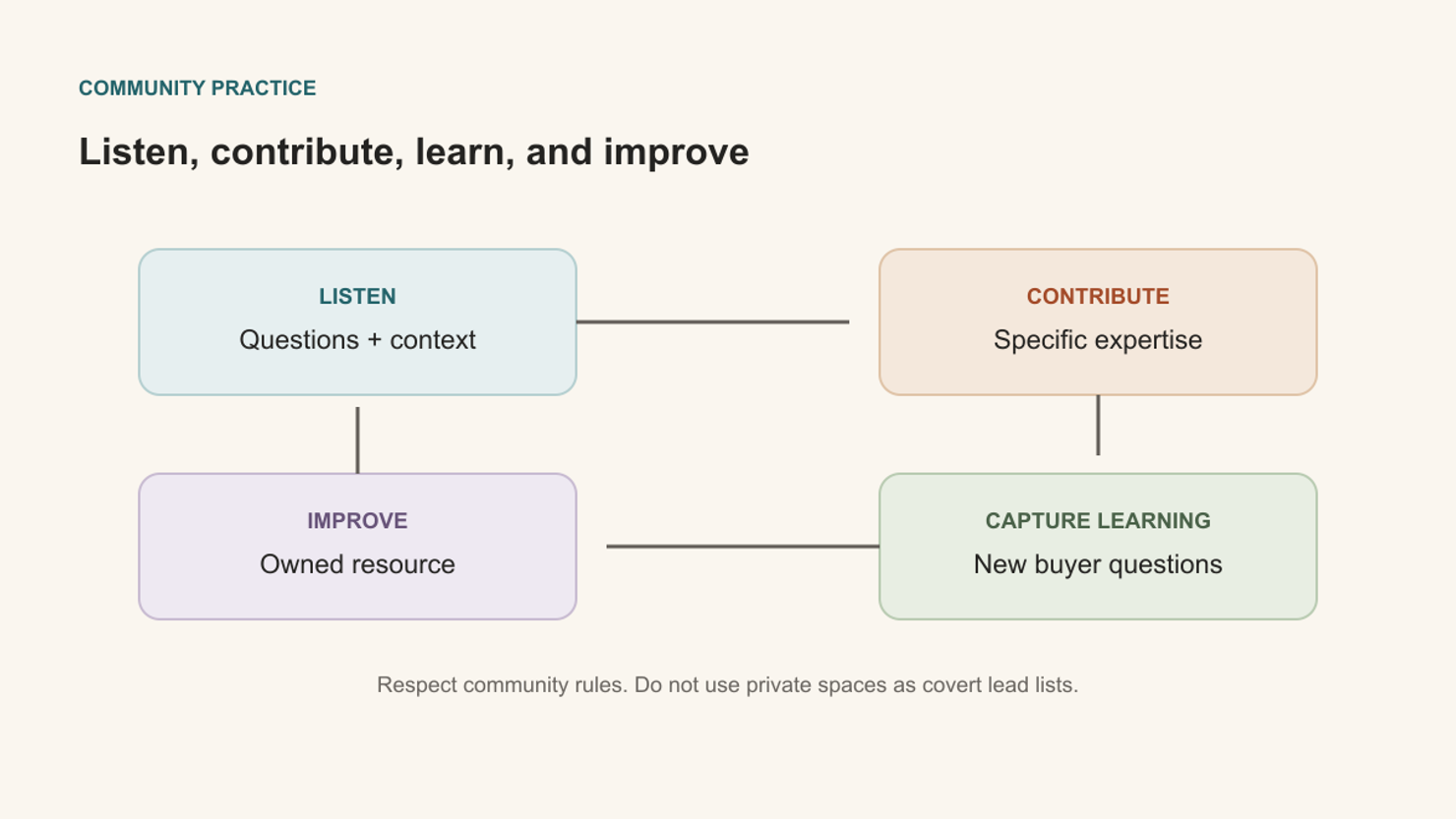
Professional communities can help a company understand buyer language, unanswered questions, and how peers evaluate trade-offs. Listen before posting. Follow each community’s rules, disclose professional affiliations when relevant, answer the question being discussed, and contribute without turning the space into a covert prospect list. Do not scrape member information or send unsolicited pitches based on private community participation.
Use what you learn to improve public resources. If people repeatedly ask how to compare two approaches, publish a clear explanation with supporting sources. If they challenge an assumption, investigate before repeating it. A good community practice improves understanding for members and helps the company create more relevant material.
Measure dark social without pretending it is fully visible
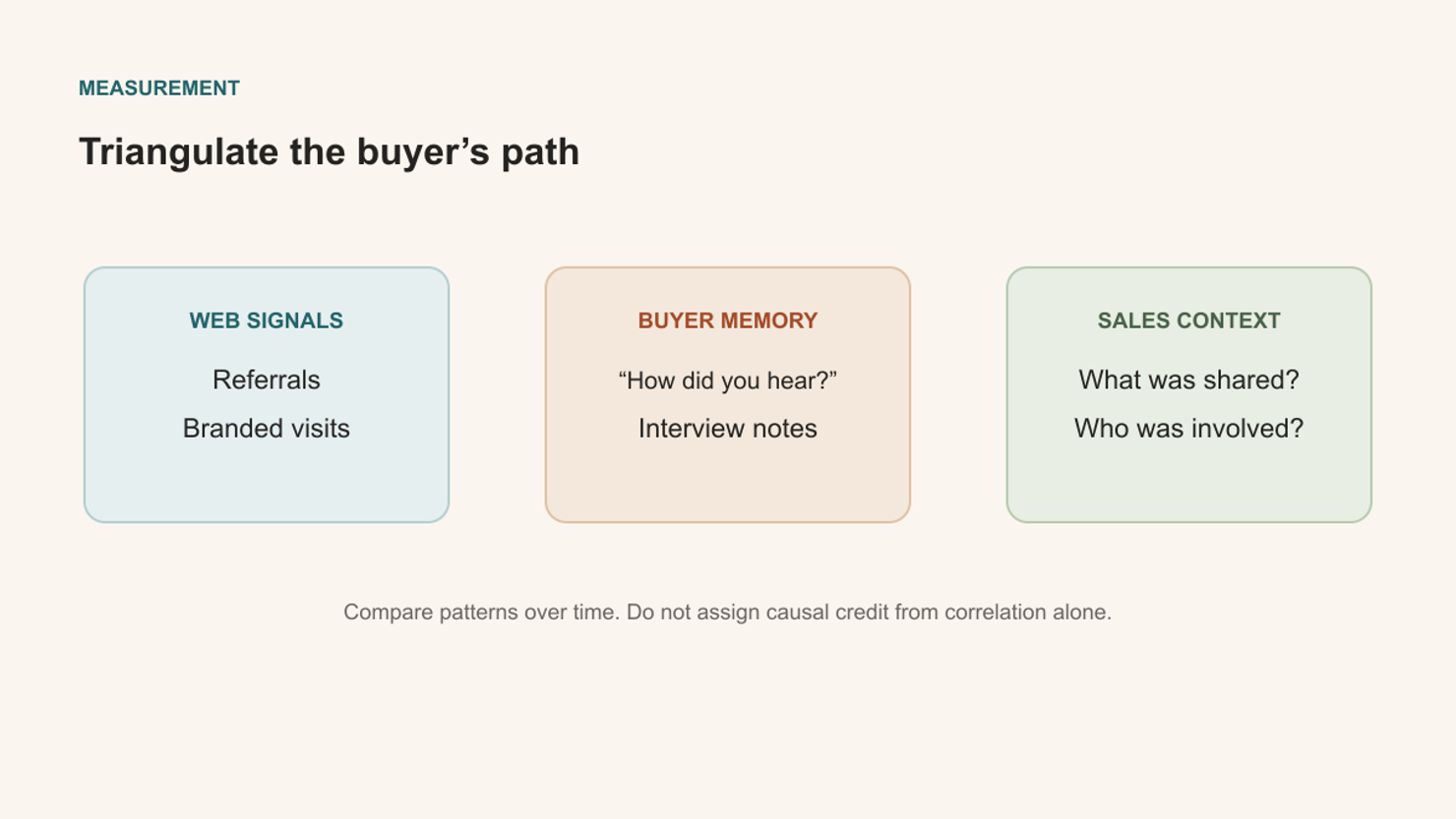
Use several imperfect signals together. Add consistent campaign tags to links the team controls, preserve tags through redirects, and document how analytics classifies referral, direct, email, and social traffic. Ask customers and qualified prospects an open-ended question such as “How did you first hear about us?” and record their exact answer before offering a list of options.
Include follow-up prompts: Who shared the resource? What were they trying to understand? Which colleagues became involved? What material was useful? Avoid leading questions that pressure someone to credit a specific campaign. Sales notes and customer interviews can add context that analytics does not capture, but those records also have recall limits and should not be treated as perfect attribution.
Compare patterns across time, segments, content, and conversations. For example, an increase in branded searches alongside more self-reported peer recommendations may be worth investigating. It does not establish that a particular article caused the change. If a business needs a causal estimate, design an experiment or comparison that can support that question instead of assigning certainty to a dashboard trend.
Give people something worth sharing
Content is more likely to help in a private conversation when it answers a real question, makes the evidence easy to check, and gives colleagues a shared way to discuss the issue. Useful formats include decision guides, clear comparisons, original analysis, examples with permission, and practical explanations of risk. The 2026 report suggests that many respondents value thought leadership that brings original research or a perspective they cannot find elsewhere.
Make the resource readable when it is forwarded without surrounding context. State what it covers, who it is for, where the evidence comes from, and what the limits are. Use a descriptive title and stable page URL. Avoid misleading headlines or gated material that demands personal details before a reader can assess whether it is useful.
Keep public and private channels connected
A company can publish a substantive resource on its website, share a short explanation on a relevant public channel, and support sales or customer teams with a version they can send when it answers a real question. Keep the same factual claims and source material across those formats, while adapting the context to each audience.
Do not try to force private sharing through engagement bait or incentives that distort the discussion. Do not claim complete dark-social measurement. A more honest goal is to improve the signals available, ask better questions, and understand how buyers describe their research and conversations.
A practical measurement plan
Begin with a baseline of tagged referral sources, direct traffic, branded search trends, and self-reported discovery from recent customer conversations. Define the market or segment and use the same questions each quarter. Keep answer options neutral and include “colleague or peer,” “private message or work chat,” and “not sure” where appropriate.
Review the results alongside sales feedback and the resources shared in actual conversations. Ask which material helped a buyer understand a decision, rather than only which link they clicked. Summarize the evidence with its limitations, then decide whether to improve a resource, the distribution, or the research method. This process makes dark social more understandable without claiming to observe every conversation.
Frequently asked questions
Frequently Asked Questions
What is dark social in B2B marketing?
Why is dark social difficult to measure?
Does direct traffic mean dark social?
How can B2B marketers measure private sharing?
What did the 2026 Edelman-LinkedIn report find about private sharing?
How can a company create content people will share privately?
Research and further reading
Edelman and LinkedIn: 2026 B2B Thought Leadership Impact Report reports private and public sharing among surveyed decision-makers who had shared thought leadership.
Google Analytics: Understand direct and none traffic explains reasons Analytics may not receive clear referral information.
Frequently Asked Questions
What is dark social in B2B marketing?
Why is dark social difficult to measure?
Does direct traffic mean dark social?
How can B2B marketers measure private sharing?
What did the 2026 Edelman-LinkedIn report find about private sharing?
How can a company create content people will share privately?

Swapan Kumar Manna
Go-to-market & AI search strategist
Swapan Kumar Manna is a go-to-market and AI search strategist and Founder & CEO of Oneskai. He has spent 14+ years helping companies get found, get chosen and grow.