Part of the Demand Generation and Brand Authority: How Companies Become the Brand Buyers (and AI) Already Know series
Measure brand visibility by tracking where the brand appears, whether intended buyers recognize or recall it, and what they associate with it. Use consistent audience definitions and methods across search, media, communities, and AI answers, then compare findings with qualified buyer activity without claiming causation from a single signal.
Key Takeaways
- Visibility, awareness, and perception describe different brand outcomes.
- Measure search, media, reviews, communities, and AI answers separately.
- Ask unprompted recall before prompted brand recognition in surveys.
- Keep audience, query set, time period, and competitor definitions consistent.
- Treat share of search and AI answer checks as indicators, not proof of market share or causality.
Playbooks
Frameworks you can put to work
Growth marketing, LinkedIn presence, and more — delivered as PDFs.
Browse the playbooksBrand visibility describes how readily a brand appears in the places its intended buyers use to learn, compare, and make decisions. Measuring it well requires more than counting impressions. Track where the brand appears, whether the right people recognize or recall it, what they associate with it, and whether those signals accompany meaningful buyer activity.
Visibility, awareness, and perception are connected but distinct. A brand can appear often without being remembered, or be well known for the wrong reason. This guide offers a practical way to measure those differences across search, media, social and community channels, and AI answers. It complements the demand generation and brand authority pillar with a focused measurement plan.
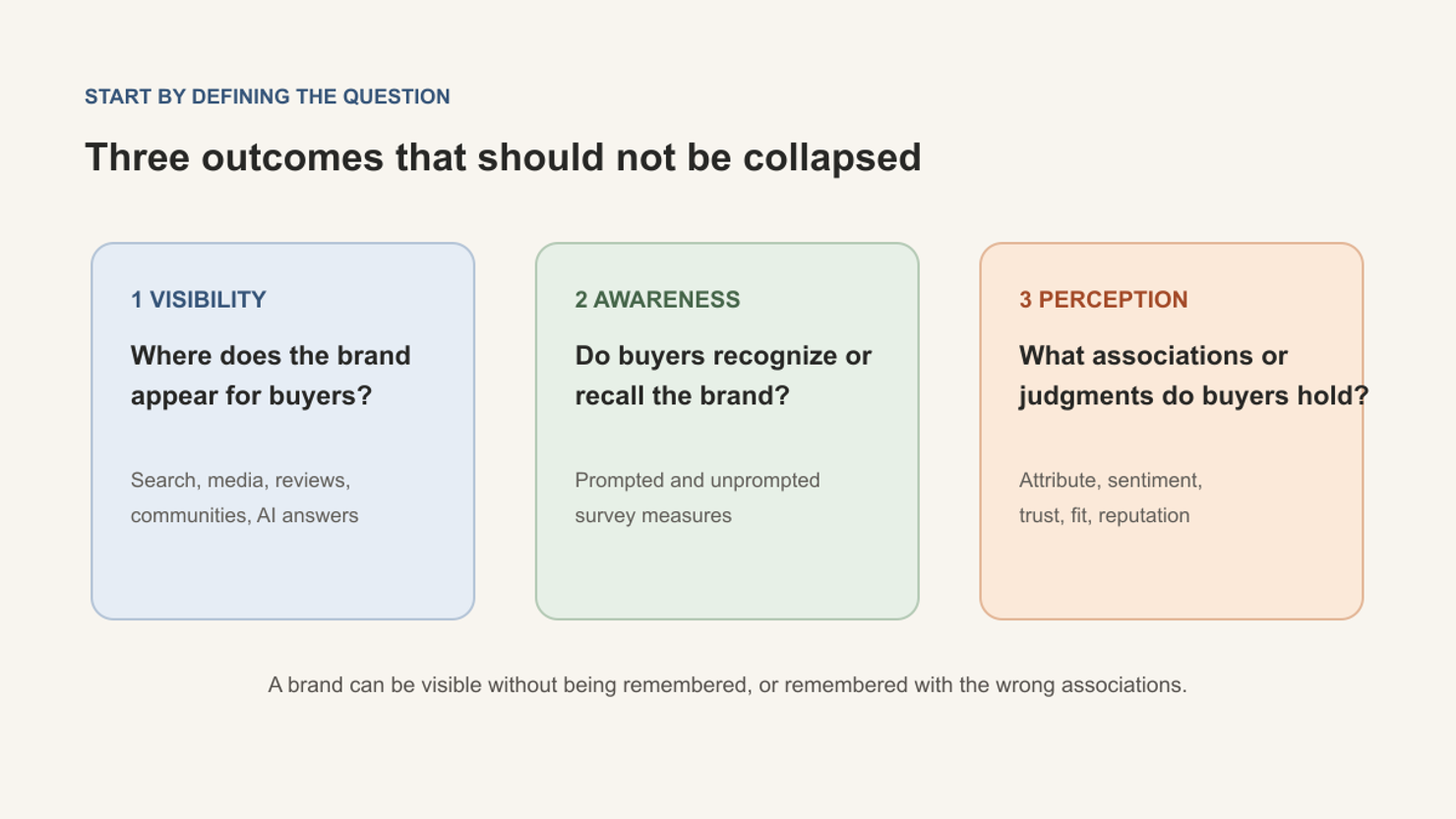
Brand visibility, awareness, and perception answer different questions
Visibility asks where and how often a brand is discoverable in relevant contexts. Evidence can include search results, trade coverage, review platforms, community discussions, partner mentions, and AI-generated answers. The surface matters: a brand may be prominent on one channel and absent from another.
Awareness asks whether buyers recognize the brand or bring it to mind. Surveys can measure prompted recognition, where a respondent sees a name on a list, and unprompted recall, where the respondent names brands without seeing a list. These questions measure different things and should not be merged into one “awareness” score.
Perception asks what people believe or feel about the brand. Useful measures depend on the positioning and buying decision: perceived expertise, trust, relevance, quality, or fit may matter. Reputation and sentiment provide context, but a positive average does not prove that the brand is considered for the right category or use case.
The Ehrenberg-Bass Institute describes mental availability as how easily a brand comes to mind in buying situations. The institute explicitly distinguishes it from awareness. Use this idea as a useful lens for recall and category relevance, not as a substitute for measuring where the brand is visible or what people think of it. Read its explanation of mental availability and awareness before adopting the terminology.
Choose measures for each discovery surface
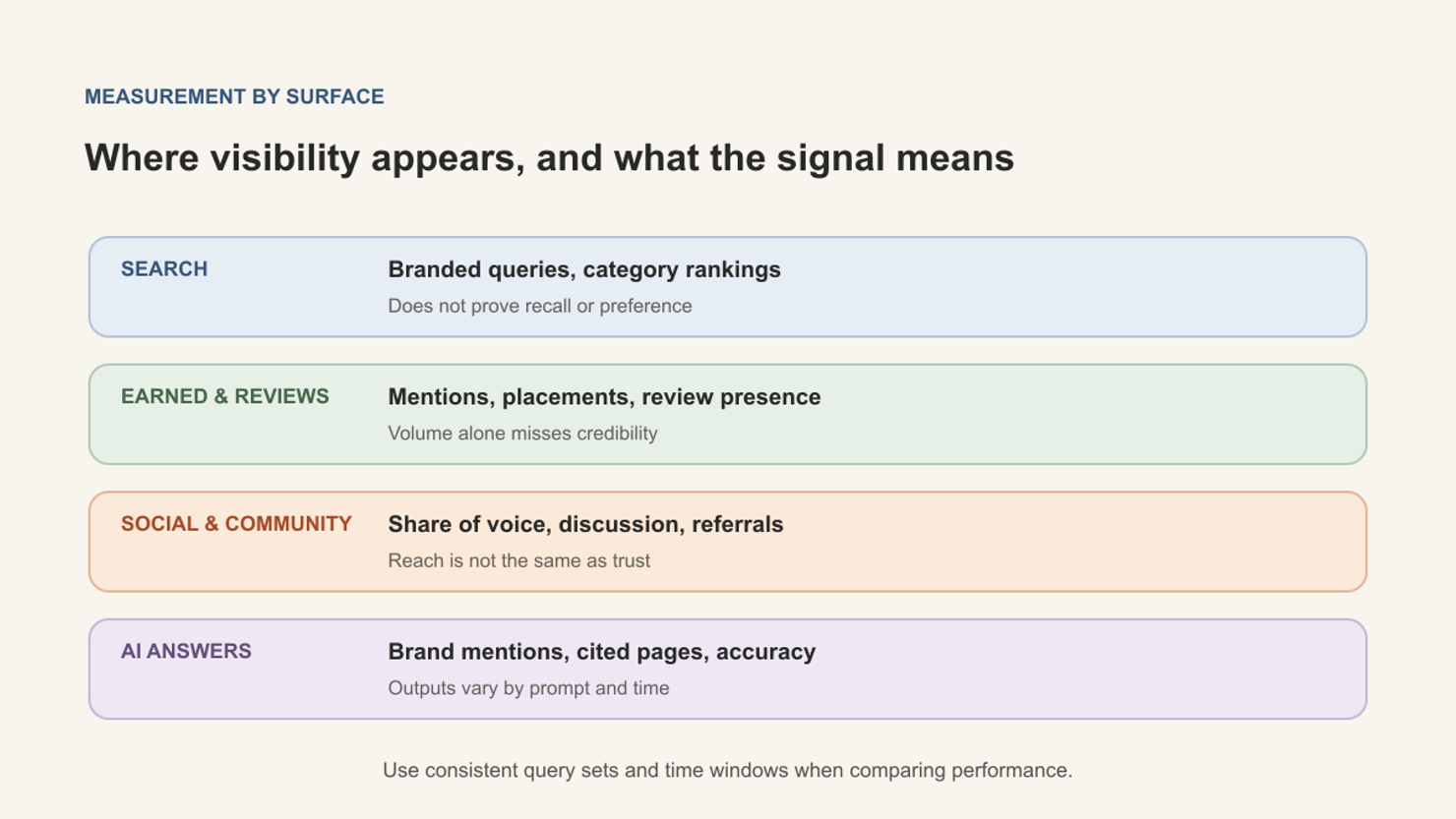
Search can show whether people are looking for the brand, whether category pages appear for relevant queries, and how visible those pages are against a defined competitor set. Branded query trends are a useful signal of active interest, but can also change because of campaigns, news, seasonality, product launches, or other outside events. Record the period, market, and query definition.
Earned media and reviews can show whether relevant third parties mention the company and whether buyers encounter independent evidence. Track the source, context, audience relevance, and quality of the mention. A large number of low-relevance mentions may mean less than a smaller number of trusted references.
Social platforms and professional communities can reveal who discusses the brand, what questions appear, and whether experts or customers share its material. Reach and engagement are not the same as recognition or trust. Review a sample of conversations and referrals instead of relying only on follower totals.
AI answer tools add another research surface, but the output is variable and may change with the wording, date, user context, or system. A manual or tool-assisted prompt audit can track whether a brand is mentioned, whether a page is cited, and whether its description is accurate. Treat a prompt set as a repeatable observation sample, not as a complete view of what all users see.
Google’s Modern Brand Measurement Playbook describes a mix of survey-based measures and observed data such as share of search. Share of search compares a brand’s share of brand-related searches with a defined competitive set. It can help monitor relative interest over time, but results depend on the market, query set, and competitors included. It does not directly measure market share, preference, or campaign causality.
How to build a repeatable brand measurement plan
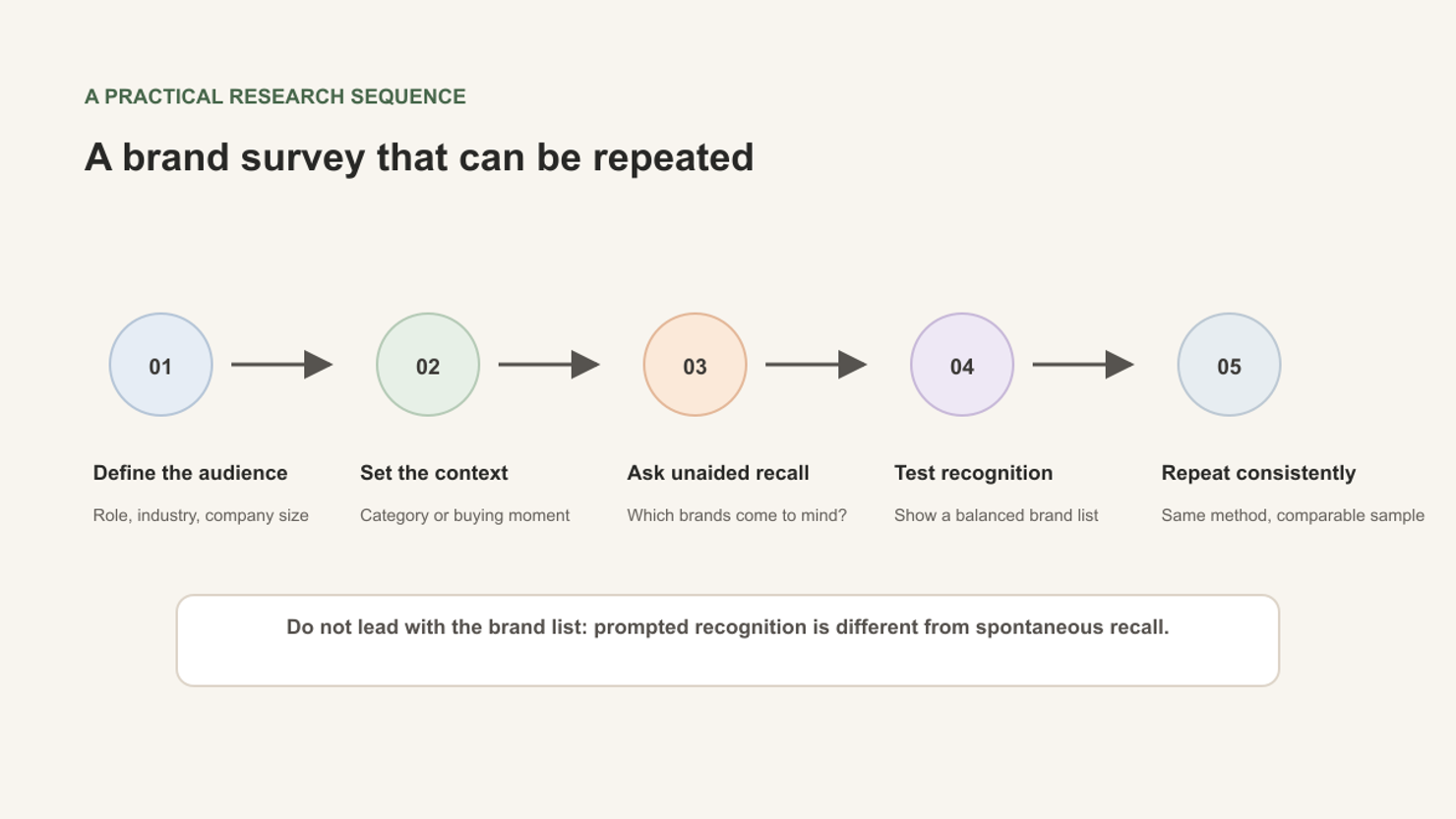
First, define the audience and buying context. Specify the industry, company size, geography, and roles you want to understand. Then describe the situation that prompts a buyer to look for a solution. Without these boundaries, broad awareness results can hide whether the company is reaching the people it intends to serve.
Second, record a baseline before changing the program. Choose a small set of methods that fit the budget and the decision. A recurring survey may be appropriate for a larger market; a structured customer-interview sample may be more useful for a small specialist audience. Search Console, analytics, media monitoring, review sites, and AI prompt checks each answer narrower questions.
Third, keep the method stable. Use the same question wording, sample definition, time window, and competitor list when comparing periods. If the method changes, document the change so a new result is not presented as a direct trend. For surveys, record how participants were recruited, the sample size, and whether responses are weighted.
Fourth, ask recall questions before showing a brand list. An unprompted question such as “Which providers come to mind when your team needs to solve this problem?” gives a different signal from asking respondents to select familiar names from a list. Follow with prompted recognition, then ask what each brand is known for and whether respondents would consider it.
Fifth, choose a reporting rhythm that matches the signal. Search, mentions, and referral activity can be reviewed monthly, while a brand survey may need a longer interval to gather enough responses and avoid overreacting to noise. Do not compare a weekly spike in a platform dashboard with a quarterly survey as if they were interchangeable.
Sixth, connect visibility to commercial evidence without overstating attribution. Compare changes with qualified inbound conversations, opportunity sources, sales feedback, and customer-reported discovery. Look for patterns across multiple periods and audiences. Where feasible, use experiments or geographic comparisons to test whether an intervention changed an outcome; otherwise label the result as an association.
Put this into practice
The GTM Funnel Playbook
How B2B teams find, win and keep customers, with a 90-day action plan. Seven funnel stages, one owner each, from the revenue number to the clients you keep.
A monthly review should explain what moved
A useful review begins with the question, not the dashboard. Did the brand become more visible in the places buyers use? Did recognition or recall change among the intended audience? Did the associations become more accurate? Did meaningful buyer activity move in a way that is consistent with those changes? The answers may differ by segment or surface.
Use a short table or scorecard with the measure, audience, data source, period, comparison point, and limitation. For example, a rise in branded searches may be worth investigating, but it should be viewed alongside paid campaigns, public announcements, and broader category interest. A rise in AI mentions should be checked for accuracy and prompt sensitivity rather than treated as a ranking score.
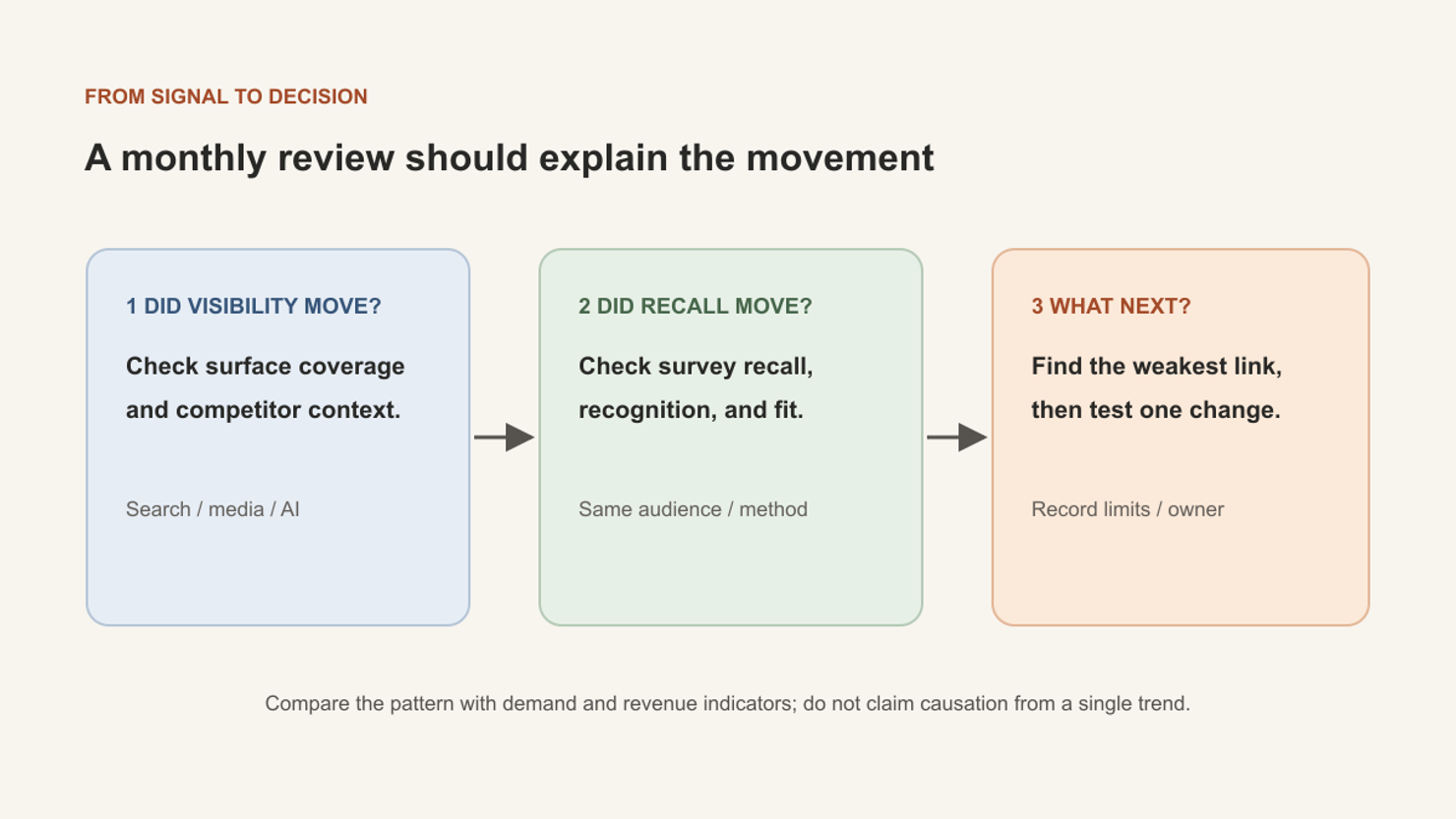
If the brand is visible but not recalled, test whether the message and distinctive assets are consistent and relevant to the buying situation. If respondents recall the brand but do not understand what it does, clarify the category, use case, and evidence across the website and sales material. If perception is positive but consideration is low, investigate product fit, access, pricing, and the alternatives buyers compare.
The digital marketing strategy guide covers channel roles and measurement. The content strategy guide explains how customer questions and expert evidence can support a useful, maintained content program.
How to improve brand visibility without chasing every channel
Start with the places your buyers already use and where your company can provide accurate, useful information. Make the company’s offer, audience, proof, and limitations easy to understand on its own site. Keep important company facts current and consistent, and make genuinely useful pages accessible to search engines and people.
Build distinctive recognition through consistent use of real brand assets and clear language. A color, slogan, or logo is not distinctive merely because it belongs to the brand; buyers need to associate it with the company. Check recognition with research rather than assuming that internal familiarity reflects market familiarity.
Make the expertise visible in formats buyers can use: practical explanations, comparisons, documented examples, interviews, or research with transparent methods. Encourage subject-matter experts to contribute where they have real knowledge. Third-party mentions and reviews should be earned through useful work and customer experience, not manufactured through link schemes or misleading incentives.
Prioritize a small set of channels and maintain them well. A focused mix of search, useful content, relevant events, partner activity, customer evidence, and community participation may be more practical than a thin presence everywhere. Choose based on customer evidence, operational capacity, and the business goal, then review where qualified audiences actually engage.
A hypothetical example
Consider a specialist software company selling compliance workflow tools to mid-sized banks. It wants to know whether risk leaders can find it, recognize its name, and understand what makes the product relevant. The team tracks a defined group of non-branded search queries, a small review set of regulatory publications and industry associations, and quarterly interviews with target buyers.
The survey asks unaided recall before showing names, then asks about familiarity and perceived fit. The company also samples a fixed set of AI research questions each month and records mentions, citations, and factual errors. It compares those observations with qualified conversations and notes what prospects say influenced their shortlist.
If search visibility improves but recall remains unchanged, the team can investigate whether the search pages reach the intended roles or explain the company clearly. If interview participants recall the company but confuse its category, the next change may be clearer positioning rather than more distribution. The example is illustrative, not a reported client result; the appropriate methods depend on market size and access to buyers.
Common measurement mistakes
Avoid one blended score that hides whether a change came from search exposure, brand recall, or sentiment. Avoid interpreting direct traffic as a precise measure of awareness because analytics may classify sources inconsistently and direct visits can have several causes. Avoid reading a share-of-search increase as proof of market-share growth.
Do not compare survey results from different audiences or question wording without saying so. Do not treat AI answers as stable rankings or assume a mention means a recommendation. Do not report a trend from a tiny sample without showing the sample size and uncertainty. When the evidence is limited, a clear statement of the limits is more useful than a confident but unsupported conclusion.
Frequently Asked Questions
What is brand visibility?
How is brand visibility different from brand awareness?
How do you measure B2B brand visibility?
What is share of search?
How can a small B2B company measure brand awareness?
Can AI visibility tools measure brand awareness?
Research and further reading
Think with Google: Modern Brand Measurement Playbook outlines survey and observed-data measures, including share of search, and the need to define the competitive set.
Ehrenberg-Bass Institute: Mental availability is not awareness explains why these terms refer to different constructs.
Semrush: How to build brand visibility in AI search offers a channel-by-channel practitioner example. Treat vendor-specific tool recommendations as examples, not neutral endorsements.
Put this into practice
The GTM Funnel Playbook
How B2B teams find, win and keep customers, with a 90-day action plan. Seven funnel stages, one owner each, from the revenue number to the clients you keep.
Frequently Asked Questions
What is brand visibility?
How is brand visibility different from brand awareness?
How do you measure B2B brand visibility?
What is share of search?
How can a small B2B company measure brand awareness?
Can AI visibility tools measure brand awareness?

Swapan Kumar Manna
Go-to-market & AI search strategist
Swapan Kumar Manna is a go-to-market and AI search strategist and Founder & CEO of Oneskai. He has spent 14+ years helping companies get found, get chosen and grow.