Part of the Demand Generation and Brand Authority: How Companies Become the Brand Buyers (and AI) Already Know series
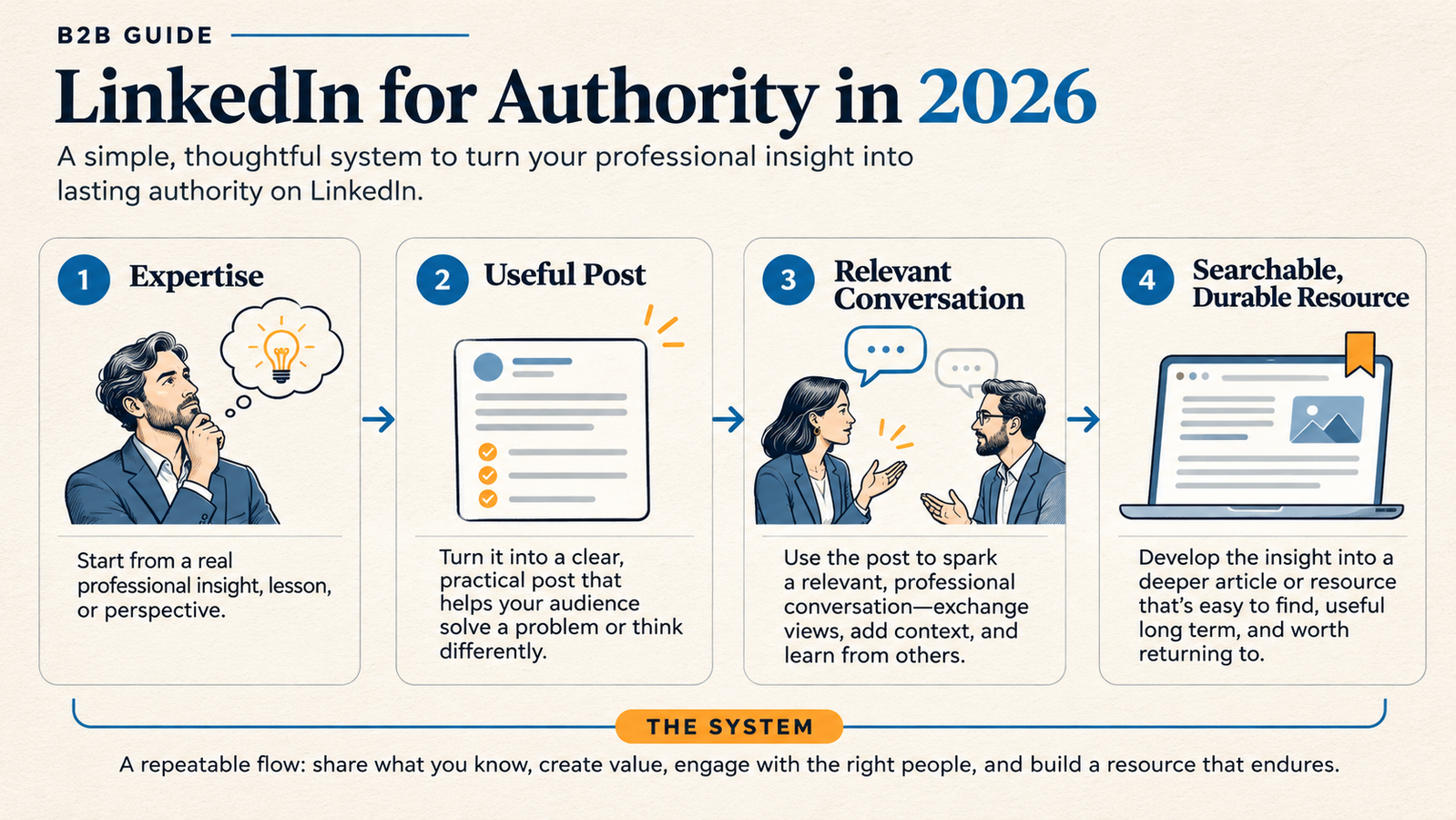
Build B2B authority on LinkedIn by clarifying your expertise, publishing useful and supported ideas, taking part in real professional discussion, and measuring relevant audience and buyer signals. LinkedIn’s 2026 Feed updates do not provide a guaranteed reach formula.
Key Takeaways
- Clarify the audience and area of expertise.
- Use buyer questions and evidence to shape useful content.
- Choose format and cadence based on reader needs and team capacity.
- Avoid automated comments, engagement pods, and recycled engagement bait.
- Measure relevant audience and buyer signals, not reactions alone.
Playbooks
Frameworks you can put to work
Growth marketing, LinkedIn presence, and more — delivered as PDFs.
Browse the playbooksLinkedIn can help B2B professionals share expertise, learn from peers, and join conversations with people beyond their immediate network. Building authority there takes more than a posting schedule. It depends on a clear area of expertise, useful contributions, credible sources, and real interaction with the professional community a business wants to reach.
This guide explains how to use LinkedIn for B2B authority in 2026, including what LinkedIn says has changed in Feed recommendations, how to plan content, and what to measure. It is part of the demand generation and brand authority pillar and connects to founder-led marketing and the guide to building an executive point of view.
What changed in LinkedIn discovery
LinkedIn said in March 2026 that it was rolling out feed recommendation updates using generative recommenders and large language models to understand what posts are about and how member interests change. Its company announcement also says LinkedIn is reducing recycled, low-substance content, engagement bait, automated comments, and engagement pods. These are the platform’s stated product changes, not a public checklist that guarantees reach. Read LinkedIn’s Feed update and its engineering explanation of Feed recommendations.
For marketers, the practical implication is to make the subject, audience, and usefulness of a post clear, then participate in genuine professional discussion. The Feed is personalized; the same post may be useful to one group and irrelevant to another. No public post can promise distribution, and reverse-engineering supposed ranking tricks is unlikely to build a durable reputation.
Build a clear area of expertise
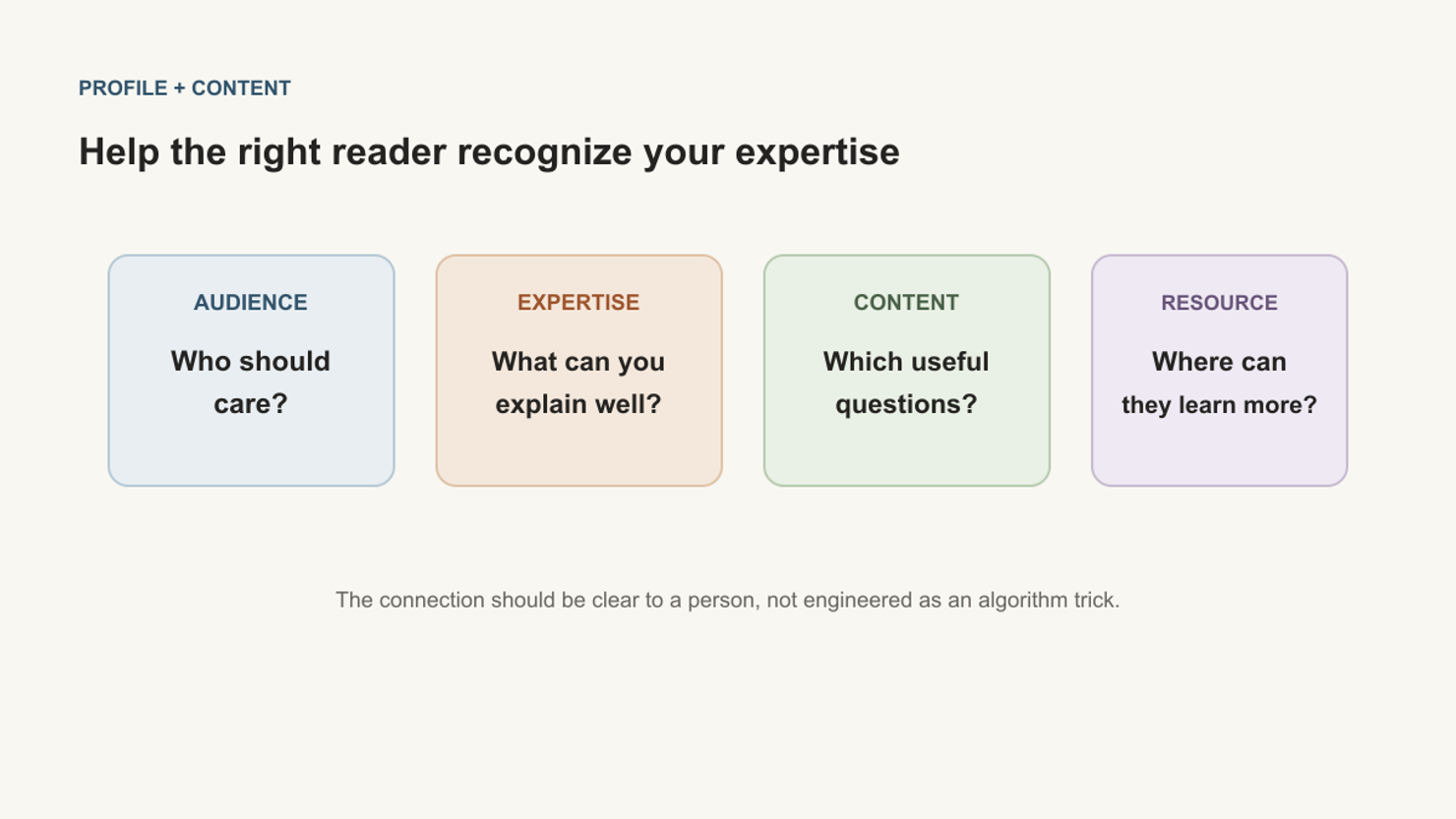
Decide which buyers or professional roles the profile and content are meant to help. Describe the expertise in plain language and connect it to a recognizable problem, market, or decision. A broad headline such as “growth expert” gives a reader little to verify. A more informative description names the kinds of companies, situations, or questions the person works with, provided the claim is accurate.
Keep profile details, company information, and published material consistent. Use the featured section or relevant links to direct readers to substantive evidence, such as a guide, research note, case study with permission, or a service description. A profile should help a person assess relevance and credibility, not make unsupported claims about being the best or guaranteed to deliver results.
Choose content that deserves a reader’s attention
Start with questions buyers actually ask: how to compare approaches, what risks to evaluate, which assumptions may be outdated, or how a decision works in practice. Use evidence from direct experience, customer questions you are allowed to share, original research, and reliable third-party sources. State when an example is hypothetical, and separate observation from interpretation.
The 2026 Edelman-LinkedIn Thought Leadership Impact Report says 82% of surveyed B2B decision-makers believe thought leadership is becoming more valuable as AI becomes a more common source of business answers and advice. The report also says 57% value original research, data, or perspectives they cannot find elsewhere. These are survey findings, not a guarantee of LinkedIn performance. They reinforce the case for useful, distinctive expertise over generic posts. See the 2026 report.
A strong post can explain one idea with a concrete example, show a trade-off, or raise a question that invites informed discussion. Avoid “comment to agree” prompts, recycled motivational lines, and claims that ask readers to trust an assertion without evidence. A useful discussion is not the same as a manufactured engagement tactic.
Pick a format for the reader’s need
Short posts can introduce a focused observation or explain why a change matters. Articles and newsletters can provide more context, evidence, and nuance. Documents or diagrams can clarify a process when the information is genuinely easier to understand visually. Video or live discussion can help when the audience benefits from hearing an expert explain or answer questions. Format alone does not make content useful.
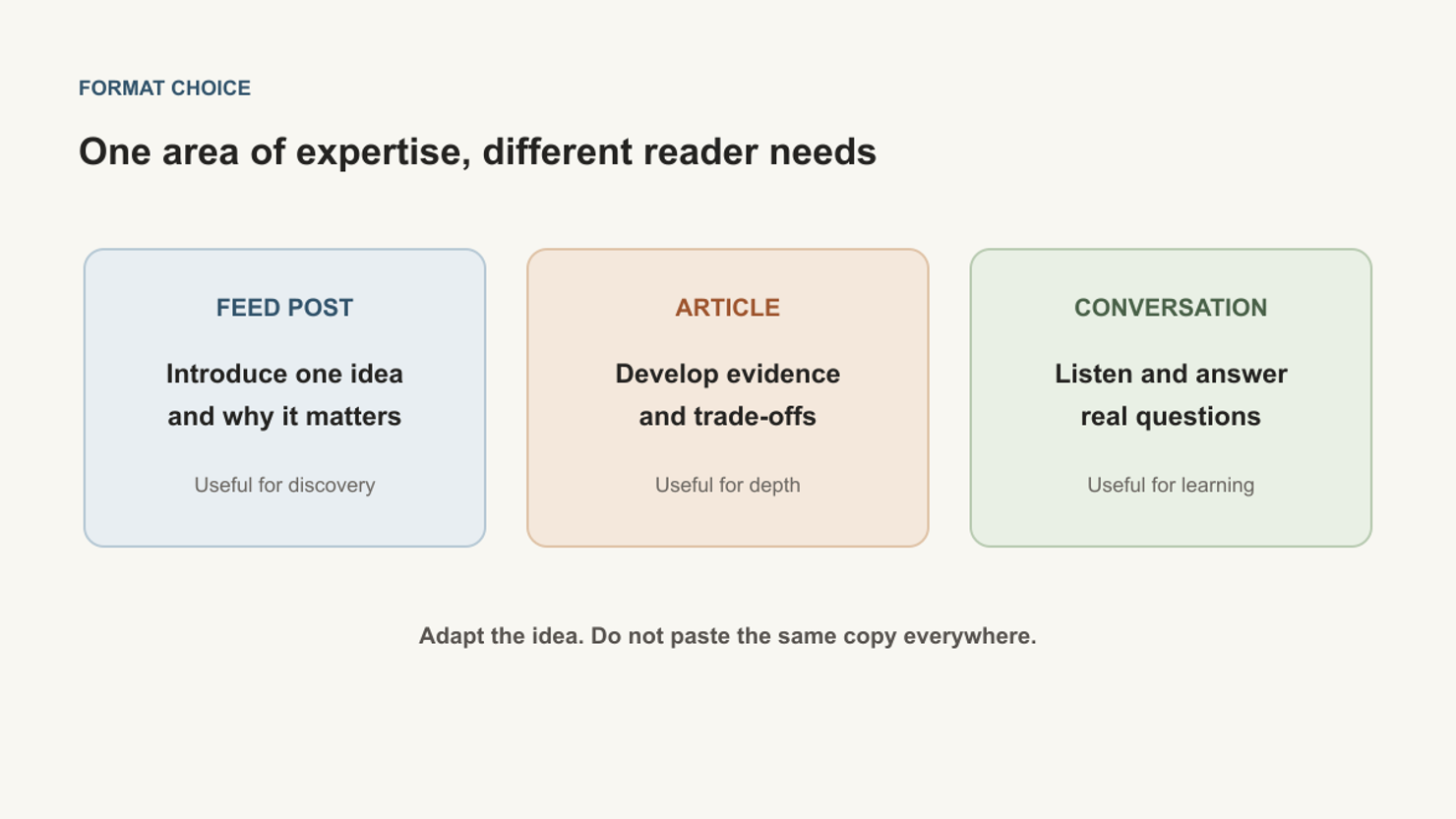
Give an important idea a durable home on the company website when it merits a fuller treatment. Adapt the idea for LinkedIn by adding context for that channel instead of copying the exact same passage everywhere. Link naturally to the detailed resource when it helps a reader continue learning. For measurement, see the guide to B2B brand visibility.
Use a manageable publishing rhythm
Choose a cadence that fits the expertise and the team’s time. One thoughtful post each week may be more sustainable than daily updates that repeat the same point. A monthly conversation with a founder or subject expert can produce several distinct materials: an article, a short post, and an answer to a recurring buyer question. Edit each piece for its audience and check claims before publication.
Respond to relevant comments with additional detail, sources, or a thoughtful question. Join conversations where there is something useful to add. Do not automate comments, use engagement pods, or ask colleagues to leave empty reactions. LinkedIn says it is acting against these practices, and they also make the professional interaction less credible.
Put this into practice
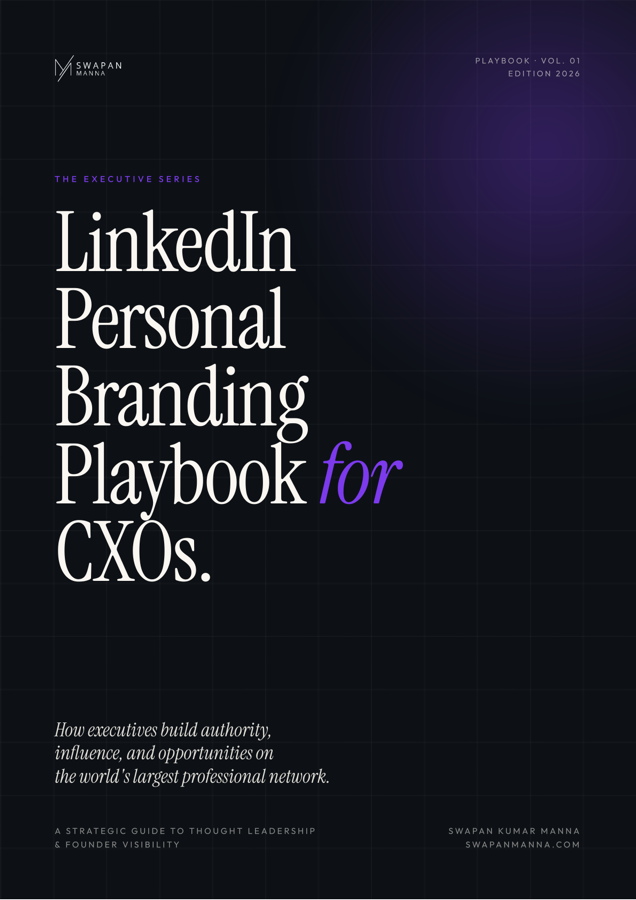
LinkedIn Personal Branding Playbook for CXOs
A strategic guide to thought leadership, founder visibility, and pipeline that follows — written for CEOs, CMOs, and founders who refuse to be invisible on the world's largest professional network.
Use LinkedIn as one part of a discovery system
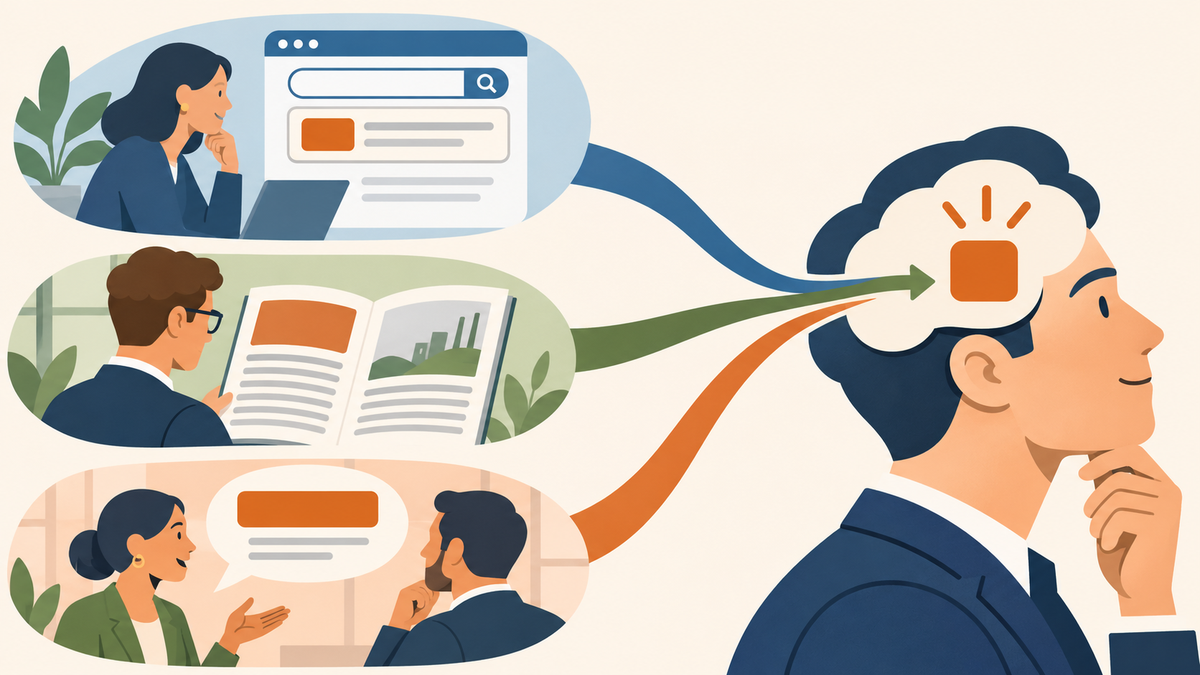
LinkedIn can expose a useful idea to professionals who have not met the author, but it is one channel among search, industry publications, events, customer communities, podcasts, and direct referrals. The right mix depends on where the intended buyers learn and which formats the team can maintain. Keep important expertise and company information available on owned pages, so it remains accessible outside a feed.
For AI-assisted discovery, write accurate, specific material that is publicly accessible where appropriate, and make company facts clear across authoritative pages. Do not promise that a post will be cited by ChatGPT or another answer system. Visibility can vary by platform, query, date, and source access. Measure observed mentions as a sample, not a guaranteed outcome. Google’s guidance prioritizes useful, expert-led material and does not require separate writing tricks for generative features.
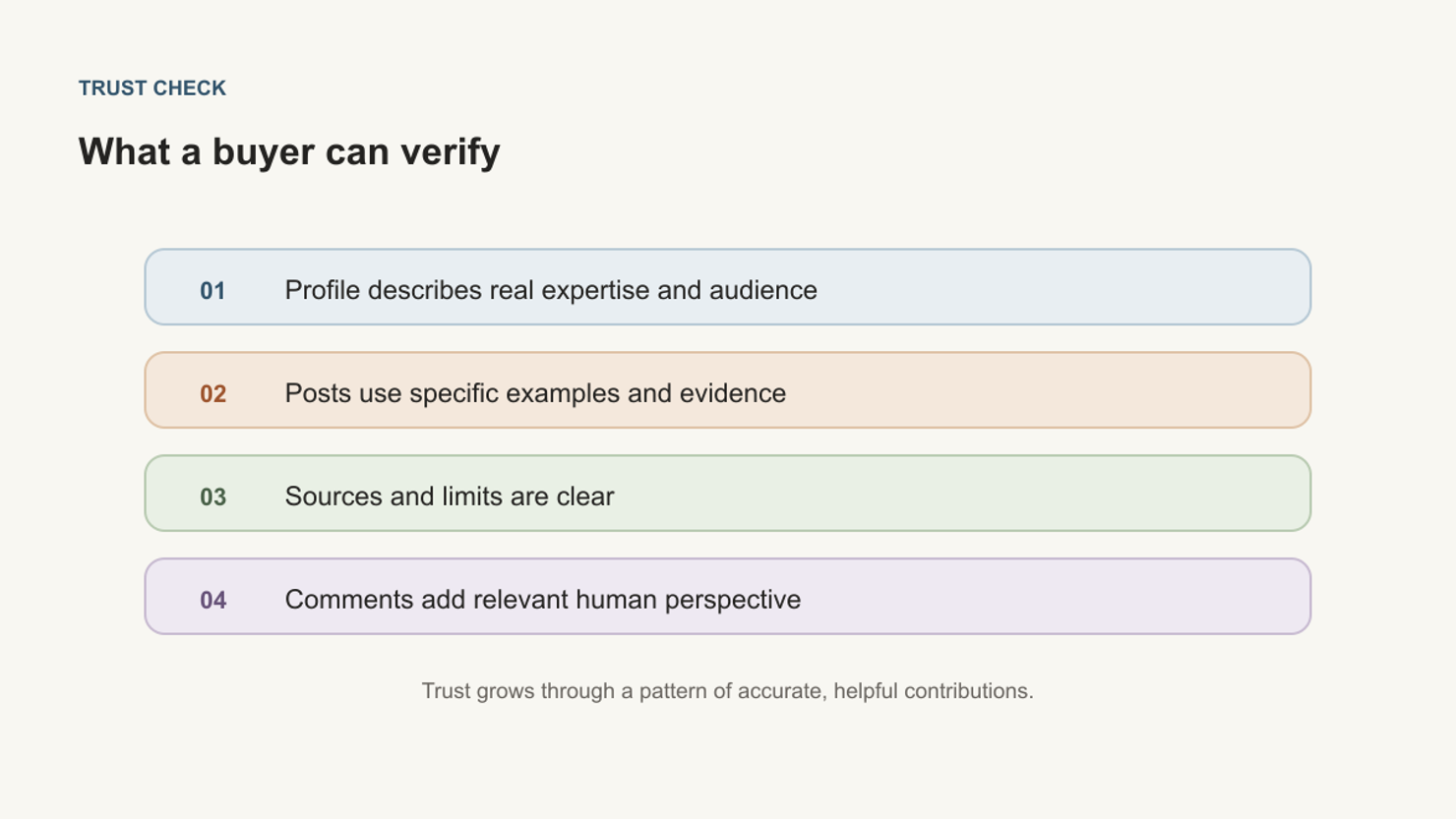
What buyers can verify
A potential customer may check the author’s background, the company’s website, the sources behind a claim, and how the author responds to disagreement. Make those checks easy. Be clear about professional roles, disclose relevant commercial relationships, and correct errors openly. If you use AI to help edit or organize a draft, review the facts and make sure the final post reflects a real point of view.
Measure relevant progress
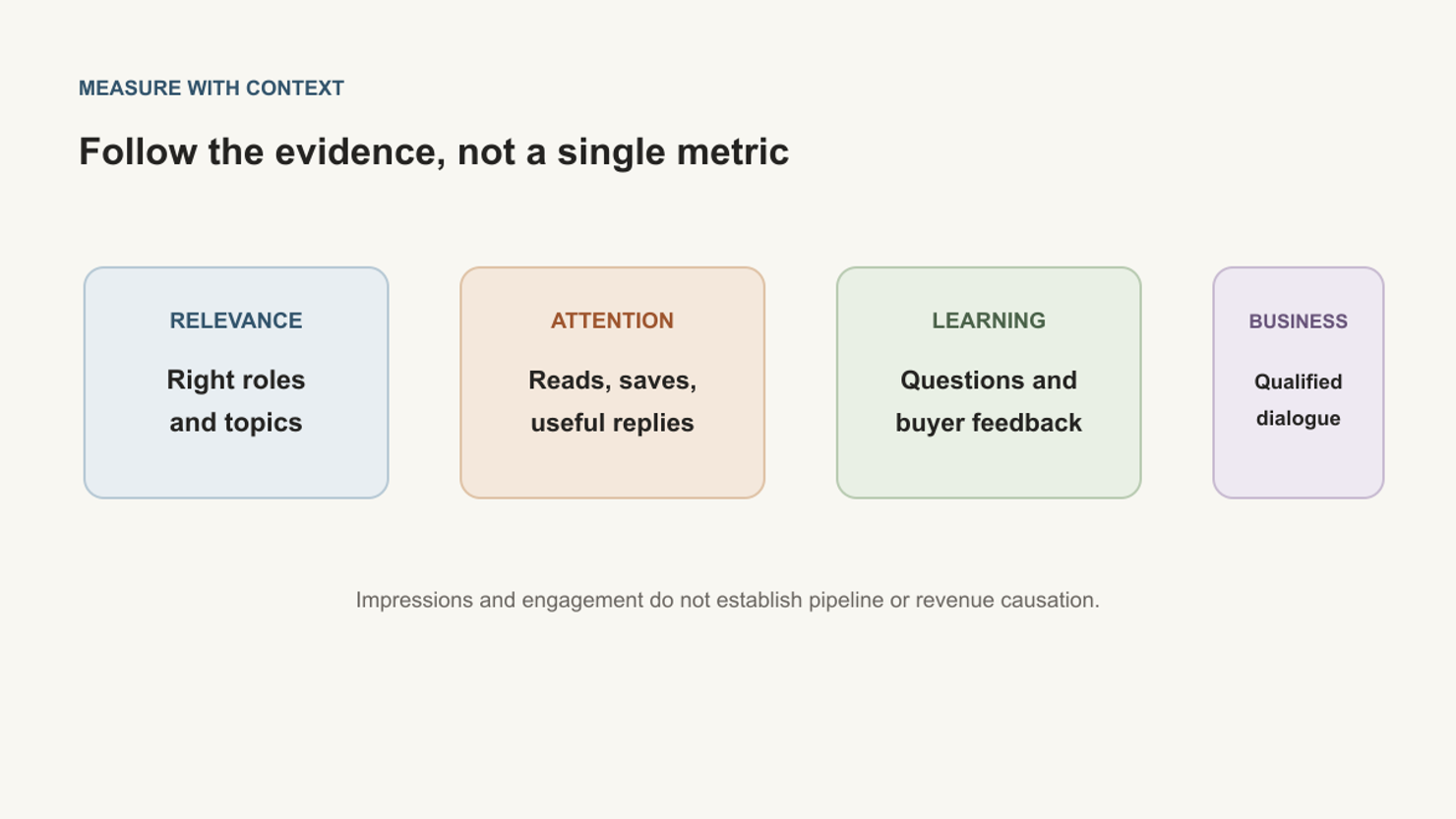
Start with a defined audience and a purpose. If the goal is awareness among a specific buyer group, track whether relevant people view and engage with the content, not just total impressions. If the goal is learning, record which questions and objections appear. If the goal is commercial, combine LinkedIn analytics with website activity, qualified conversations, sales feedback, and what buyers say influenced their evaluation.
Compare similar posts, audiences, and time periods. Keep a record of format, topic, and distribution so the team can interpret changes. A rise in clicks or followers may be useful context, but it does not by itself establish trust, pipeline, or revenue. LinkedIn’s own research on thought leadership notes that some sharing happens privately, so public reactions alone may miss part of the story.
A practical four-week start
In week one, choose a specific audience and list recurring questions. In week two, gather sources and interview a subject expert about what the team has learned. In week three, publish a useful explanation in a suitable format and respond to substantive discussion. In week four, review the audience, feedback, and business signals, then refine the next topic. This is a starting point, not a fixed posting formula.
Frequently asked questions
Frequently Asked Questions
How can B2B companies build authority on LinkedIn?
How often should a B2B company post on LinkedIn?
What content works best for B2B on LinkedIn in 2026?
How does LinkedIn’s 2026 feed algorithm work?
Can LinkedIn posts appear in ChatGPT or Google AI answers?
How should a B2B team measure LinkedIn authority?
Research and further reading
LinkedIn: How the Feed is improving for relevant, authentic professional content describes 2026 feed updates and LinkedIn’s position on relevance, authenticity, and engagement bait.
LinkedIn Engineering: The next generation of LinkedIn’s Feed explains its recommendation architecture and relevance signals.
Edelman and LinkedIn: 2026 B2B Thought Leadership Impact Report presents the survey findings cited in this guide.
Put this into practice
LinkedIn Personal Branding Playbook for CXOs
A strategic guide to thought leadership, founder visibility, and pipeline that follows — written for CEOs, CMOs, and founders who refuse to be invisible on the world's largest professional network.
Frequently Asked Questions
How can B2B companies build authority on LinkedIn?
How often should a B2B company post on LinkedIn?
What content works best for B2B on LinkedIn in 2026?
How does LinkedIn’s 2026 feed algorithm work?
Can LinkedIn posts appear in ChatGPT or Google AI answers?
How should a B2B team measure LinkedIn authority?

Swapan Kumar Manna
Go-to-market & AI search strategist
Swapan Kumar Manna is a go-to-market and AI search strategist and Founder & CEO of Oneskai. He has spent 14+ years helping companies get found, get chosen and grow.