Part of the Demand Generation and Brand Authority: How Companies Become the Brand Buyers (and AI) Already Know series
Demand generation builds understanding and qualified interest across a market. Lead generation captures an identifiable response when a buyer is ready for a next step. Use both, and measure market signals, qualified responses, and downstream outcomes separately.
Key Takeaways
- Demand generation builds familiarity and understanding across a market; lead generation records identifiable responses.
- Lead volume alone cannot represent all buyer learning or prove business impact.
- Offer public, useful information and reserve forms for exchanges with a clear value to the reader.
- Agree on definitions and handoffs for responses, qualified leads, accepted meetings, and opportunities.
- Combine market, capture, and outcome measures while stating attribution limits.
Playbooks
Frameworks you can put to work
Growth marketing, LinkedIn presence, and more — delivered as PDFs.
Browse the playbooksDemand generation creates qualified interest and understanding across a market. Lead generation invites a person to identify themselves through an action such as a form, event registration, or demo request. The two work best together: build useful familiarity before a buyer is ready, then make the next step clear when they are.
The distinction matters because a contact count cannot show all the learning, preference, and peer discussion that may precede a buying conversation. This guide explains what each motion is for, where they overlap, how to connect the work, and what to measure. For the broader brand and buying-group context, see the demand generation and brand authority pillar.
What demand generation and lead generation mean
Demand generation is the coordinated work of helping an intended market recognize a problem, understand possible approaches, become familiar with a company, and develop a reason to consider it. It can include thought leadership, useful ungated content, events, public conversations, search visibility, customer education, and advertising. It spans more than a single funnel stage because interest and trust can develop before, during, and after active evaluation.
Lead generation is the process of earning an identifiable response that gives a company permission or a business reason to follow up. A form submission, demo request, webinar registration, or direct sales inquiry may be a lead-generation event. The action is observable, but it is not automatically a qualified opportunity. The person may be researching for someone else, seeking a resource, or not ready to speak with sales.
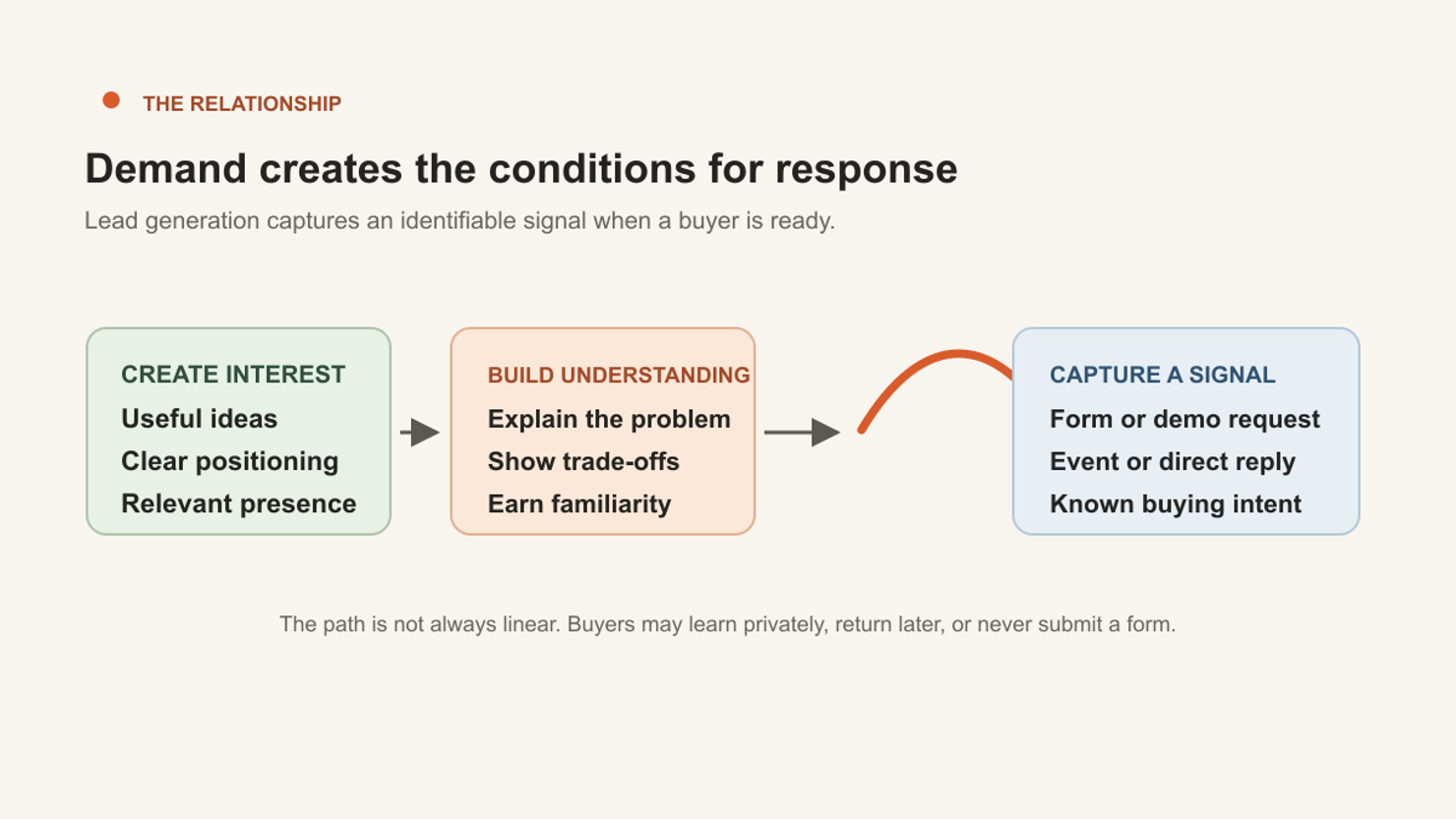
A practical way to distinguish the two is to ask what the activity is designed to change. If the work aims to make the market more informed or more likely to remember the company, it is demand creation. If it asks a buyer to identify themselves and take a defined next step, it is lead capture. One campaign can do both, but the team should be clear about which outcome it expects from each part.
How the two motions differ
The difference is not simply “brand versus performance” or “top of funnel versus bottom of funnel.” Demand programs can create demand close to purchase, and lead-generation programs can capture interest early. The useful distinction is the primary job and the evidence used to assess it.
Demand work usually serves a wider group than the people who are ready to fill out a form today. It may be measured through indicators such as reach in a defined audience, branded search, returning visits, content engagement, event participation, or feedback from sales and customers. These indicators can show movement in familiarity or consideration, but none alone proves that marketing caused revenue.
Lead-generation work is easier to count because a response is recorded. Typical measures include the number of responses, the share that match the target audience, accepted meetings, progression to opportunity, and cost per qualified outcome. A large number of low-fit contacts can look productive in a dashboard while creating extra work for sales and operations.
Why lead volume is an incomplete picture
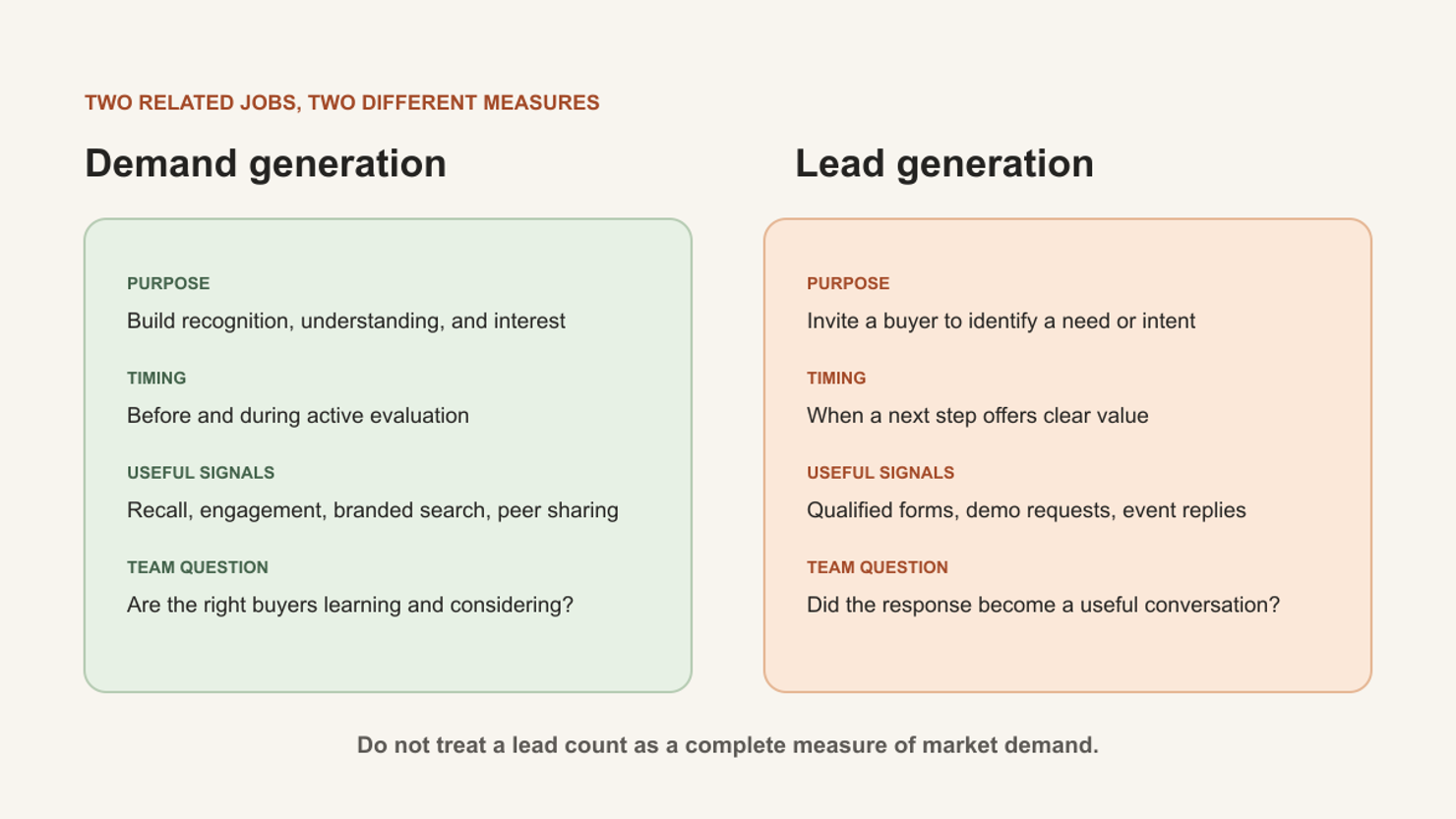
Many buyers learn without leaving a trackable signal. They read an article, ask a colleague, watch a talk, compare vendors, or revisit a company later through a branded search. In a B2B purchase, several people may research different parts of a decision before one person contacts a vendor. Analytics and CRM records capture only some of that path.
This does not make lead data useless. It means the data should be interpreted for what it records: known responses and their later outcomes. Treating form fills as the full measure of demand can encourage teams to gate helpful material too early, optimize toward low-intent downloads, and ignore the experience of people who are not ready to identify themselves.
Content Marketing Institute’s 2025 B2B benchmark reports that surveyed marketers use content for several purposes, including demand and lead generation, audience nurturing, loyalty, and sales. The results are self-reported measures of perceived effectiveness, not an experiment proving that content caused a particular revenue outcome. Its methodology and findings are useful context for why teams should define the job of each program before choosing a metric.
A B2B buyer path is not a neat sequence of forms
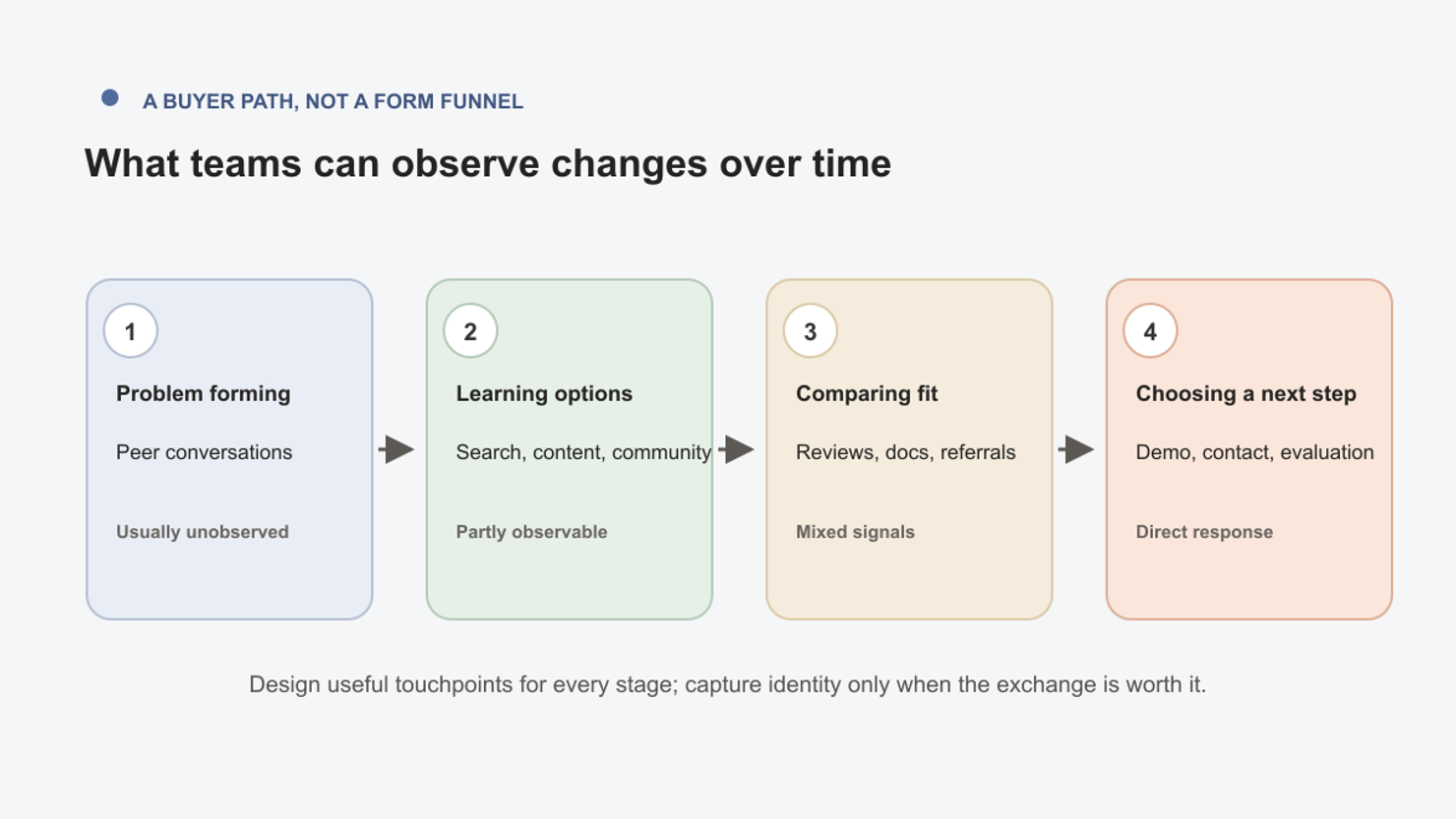
A buyer may move from recognizing a problem to comparing approaches, then pause while the organization evaluates timing or budget. Another stakeholder may enter later and restart part of the research. Some interactions are public and measurable; others happen in private conversations or internal documents. A useful plan offers relevant information at each stage without assuming that every reader should become a lead immediately.
Edelman and LinkedIn’s 2025 study surveyed 1,934 global business executives. In the U.S. sample, 55% of hidden decision-makers said they use thought leadership when vetting vendors, and 71% said they have relatively little or no interaction with sales. These are self-reported survey responses, not a measure of how every B2B purchase works, but they illustrate why public information can reach people a sales-led process may not.
The Edelman–LinkedIn report also frames thought leadership as a way to influence people who may not be directly engaged with sales. Use the findings as a prompt to investigate your own buying groups, not as a forecast of your team’s results.
How to connect demand creation and lead capture
Start with the problem and audience. Describe the buyers, their roles in the decision, the situation that prompts research, and the questions that make evaluation difficult. Check this understanding with customer interviews, sales conversations, product feedback, search queries, support questions, and market evidence. Do not build the plan around a persona label if the real decision involves several functions.
Give the market useful information before requesting contact details. Publish clear explanations, comparisons, implementation guidance, and evidence that helps a reader make progress. Gate a resource only when the exchange is fair: the resource provides meaningful additional value and the follow-up matches what the person requested.
Create a clear next step for people who are ready. This may be a demo, consultation, evaluation, event, or a request for a specific resource. Explain what happens after the action, who will follow up, and what information is needed. Avoid sending every response into the same nurture sequence without considering the buyer’s intent and the promise made at the point of conversion.
Agree on what happens after a response. Marketing and sales should define the difference between a response, a qualified lead, an accepted meeting, and an opportunity. Set reasonable follow-up ownership and timing, document disqualification reasons, and feed those reasons back into targeting and content decisions.
Review both kinds of evidence. Look at market-level signals and direct response data alongside opportunity progression, win or loss patterns, and customer feedback. No single dashboard will reveal every influence, so combine quantitative indicators with structured conversations and state what the measurement cannot establish.
A useful measurement approach
Use a small scorecard that answers three questions. First, are the intended people encountering and remembering the company? Second, are interested buyers taking a meaningful next step? Third, are those conversations progressing toward business outcomes that fit the strategy? Choose a small number of measures for each question and define the segment, time window, and data source.
Market indicators might include branded search trends, reach within target accounts, repeat engagement, event participation, or customer-reported familiarity. Capture indicators might include qualified inquiries, accepted meetings, resource requests, and evaluation activity. Business outcomes might include opportunity creation, progression, win rate by segment, sales-cycle patterns, and retention where relevant.
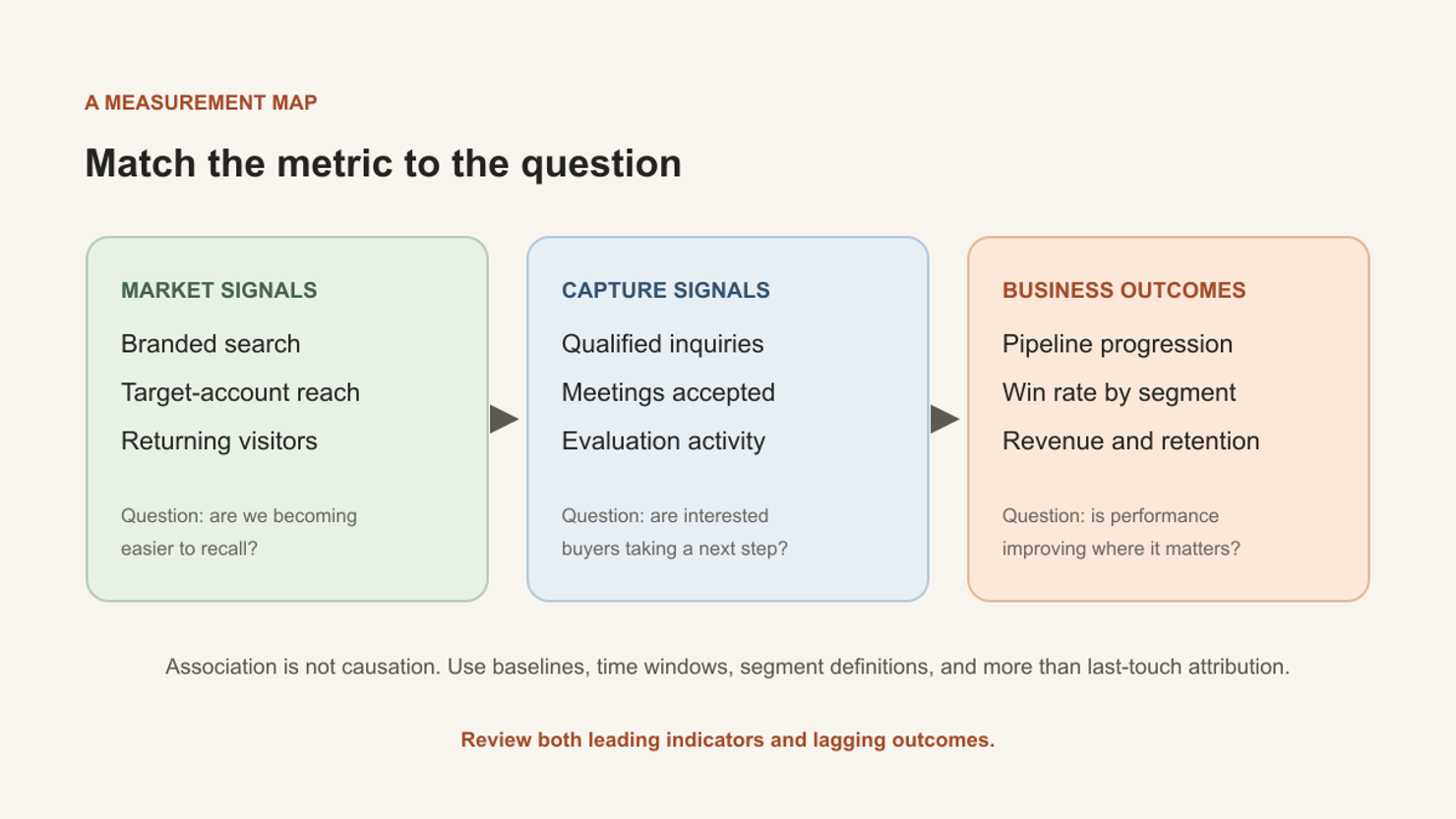
Separate observation from attribution. A branded search increase can coincide with a campaign without being caused by it. Last-touch attribution can identify the final recorded interaction, but it may miss earlier public or private influence. Use consistent definitions, compare against a relevant baseline or holdout when practical, and avoid claiming causal impact from correlation alone.
For teams building a wider commercial measurement system, the revenue systems guide covers shared definitions and handoffs across marketing, sales, and operations. The growth strategy guide explains how demand programs fit into a broader growth model.
A hypothetical example
Imagine a B2B software company selling workflow tools to finance teams. Its demand work includes a public guide to common approval bottlenecks, a monthly practitioner roundtable, and useful commentary from its specialists. The goal is to help finance leaders understand the problem and recognize the company’s point of view, including people who may not be planning a purchase this quarter.
The company also offers a workflow assessment for teams actively reviewing processes. The assessment asks for work email and a few details because a specialist will return a tailored review. That is a lead-generation exchange: the visitor has a reason to identify themselves, and the company has a defined next action.
The team reviews whether target buyers engage with the public material, whether assessment requests match the intended audience, whether follow-up produces useful conversations, and whether opportunities progress. If requests rise but fit declines, it revisits the offer and targeting. If conversations mention material that analytics did not record, the team captures that feedback as qualitative evidence rather than assigning unsupported revenue credit.
The example is illustrative, not a reported client result. The exact channels, offers, and measures should reflect the company’s audience, sales cycle, and ability to follow through.
Common mistakes to avoid
Do not treat demand generation and lead generation as competing philosophies. A business needs to build market understanding and make it easy for ready buyers to respond. The mix changes with market maturity, sales capacity, buying complexity, and the clarity of the offer.
Do not gate every useful answer. A form can help with a genuinely valuable exchange, but making basic information inaccessible can reduce trust and sharing. Do not equate a large contact list with a healthy pipeline; look at fit, progression, and the workload created for the team.
Do not promise that awareness will convert on a fixed timetable. Results depend on factors such as buyer urgency, product fit, market access, competition, budget, and execution. Keep the measurement honest and use what you learn to improve the next decision.
Frequently Asked Questions
What is the main difference between demand generation and lead generation?
Can demand generation work without gated content?
Which should a B2B company invest in first?
How do you measure demand generation?
Are MQLs a demand-generation metric?
Does demand generation mean not collecting leads?
Research and further reading
HubSpot: What is demand generation? defines demand generation and discusses how it differs from capture-focused activity.
Content Marketing Institute: 2025 B2B Content Marketing Benchmarks reports surveyed marketers’ stated use and perceived effectiveness of content programs.
Edelman and LinkedIn: 2025 B2B Thought Leadership Impact Report describes the survey sample and findings on thought leadership and buying groups.
Frequently Asked Questions
What is the main difference between demand generation and lead generation?
Can demand generation work without gated content?
Which should a B2B company invest in first?
How do you measure demand generation?
Are MQLs a demand-generation metric?
Does demand generation mean not collecting leads?

Swapan Kumar Manna
Go-to-market & AI search strategist
Swapan Kumar Manna is a go-to-market and AI search strategist and Founder & CEO of Oneskai. He has spent 14+ years helping companies get found, get chosen and grow.