Revenue operations connects the people, processes, data, and systems supporting the customer and revenue lifecycle. Start by mapping where customer progress breaks down, then improve handoffs, definitions, data ownership, and review cadence before adding more tools or automation.
Key Takeaways
- Treat RevOps as cross-functional coordination across the customer lifecycle, not simply a CRM project.
- Map real customer progress and diagnose friction before changing tools.
- Make each handoff explicit about context, ownership, timing, and feedback.
- Document CRM field and metric definitions, data sources, access, and owners.
- Use a review cadence suited to decisions and sales-cycle timing.
- Test AI only after the underlying process and data are sufficiently clear.
Playbooks
Frameworks you can put to work
Growth marketing, LinkedIn presence, and more — delivered as PDFs.
Browse the playbooksRevenue operations (RevOps) is the way a company coordinates the people, processes, data, and systems that support the customer and revenue lifecycle. It connects the work of marketing, sales, service or customer success, finance, and operations so that teams can act on shared definitions and useful information.
RevOps is not just a CRM project, a reporting team, or a new org chart. Its purpose is to reduce avoidable friction across the path from first contact through purchase, delivery, renewal, and expansion. That means clarifying the handoffs, keeping customer data dependable, agreeing on how performance is measured, and making sure each team knows who owns the next step.
This guide offers a practical operating framework for diagnosing revenue leaks, designing cleaner handoffs, connecting customer context across systems, and building a review cadence. It also explains where AI can help and why reliable data and human accountability remain essential.
What revenue operations does
A revenue system covers the decisions and processes that shape customer progress. Marketing creates awareness and supports evaluation. Sales helps buyers assess fit and make a purchase. Delivery, service, or customer success helps customers achieve the intended outcome. Finance and operations support pricing, contracting, forecasting, billing, and governance. The exact functions vary by business model.
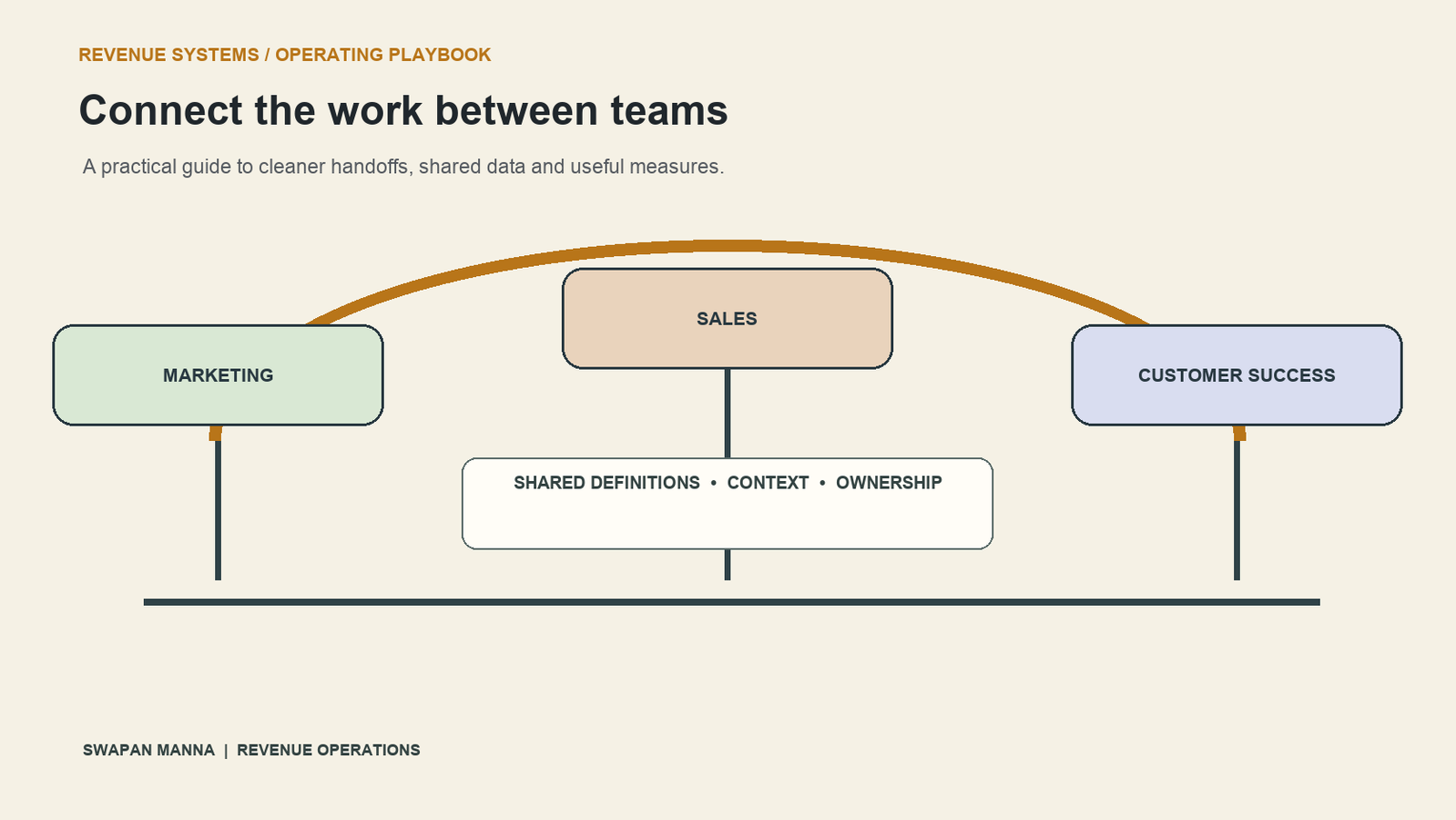
RevOps brings shared processes and information across those functions. Some companies create a centralized team; others coordinate the work through existing leaders. There is no single organizational structure that suits every company. The essential part is that cross-functional responsibilities are explicit and decisions do not depend on incompatible metrics or disconnected handoffs.
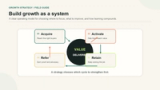
A revenue system should support the company’s wider growth strategy, including acquisition, activation, retention, and revenue economics.
Diagnose friction across the customer lifecycle
Start by mapping how a customer moves from recognizing a need to evaluating, purchasing, adopting, and renewing. For each transition, write down the event that signals progress, the information the next team needs, who owns follow-up, and what the customer experiences. Compare the documented process with actual CRM records, customer conversations, support cases, and lost or stalled deals.
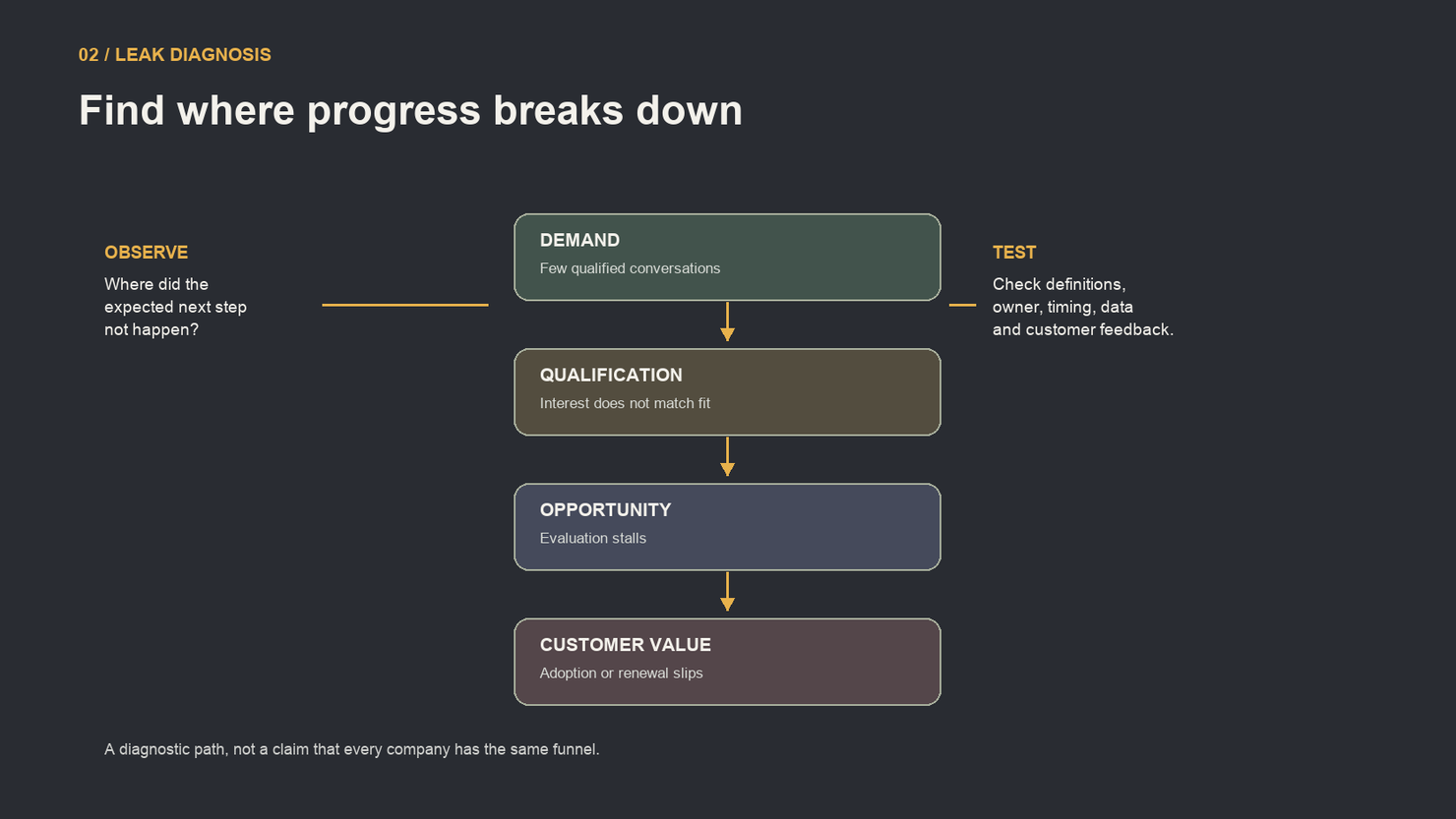
Look for evidence at each point. Do qualified conversations fail to progress? Are opportunities accepted but left without a next step? Do buyers repeat information because context is missing? Does a signed customer wait too long for onboarding? Are renewals discussed only after a problem appears? These observations suggest where to investigate, not the cause on their own.
A revenue leak is a gap between intended customer progress and what actually happens. It may come from unclear qualification, inconsistent response, inaccurate stage data, pricing friction, product fit, implementation capacity, or customer expectations set by marketing and sales. Fix the underlying process before adding another tool or dashboard.
Define clean handoffs between teams
A handoff is a commitment, not simply a change in CRM ownership. The sending team should provide relevant context, the receiving team should know what action is expected, and the customer should understand what happens next. Define the conditions that trigger a handoff, required information, response expectations, the escalation path, and how feedback returns to the sending team.
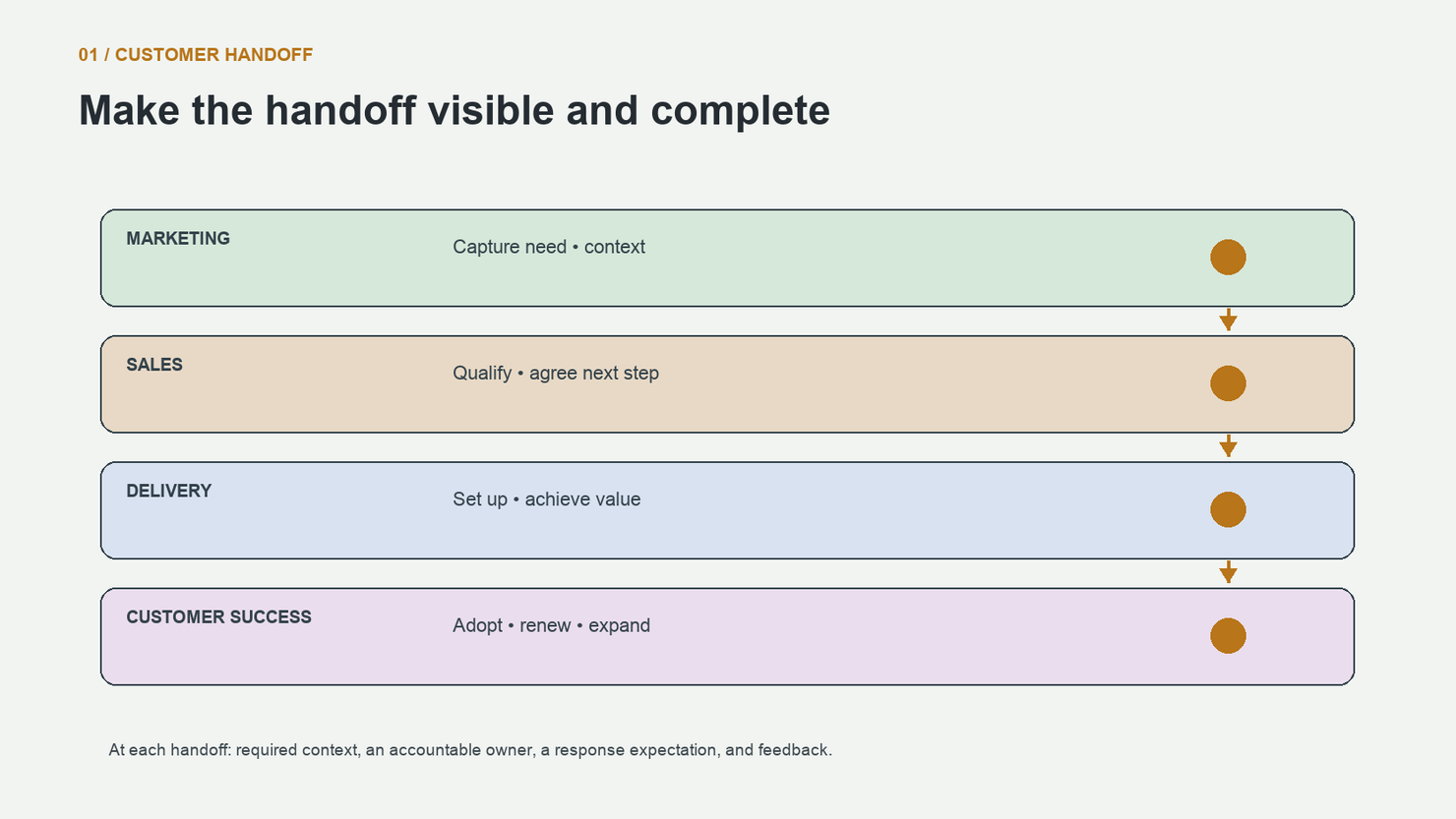
Agree on shared service expectations
A service-level agreement (SLA) can document who responds, how quickly, with what information, and what happens when the expectation is missed. Keep the agreement practical. It should reflect staffing, business hours, geography, customer value, and urgency. A target that teams cannot meet can encourage workarounds and make the data less trustworthy.
Marketing and sales should agree on terms such as qualified lead, accepted opportunity, target account, source, and disqualification. Write down the criteria and review examples together. If the definitions change, update the CRM rules and reporting at the same time. Otherwise teams may debate results that were calculated using different assumptions.
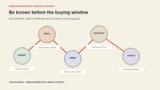
Demand creation and brand trust also affect how buyers arrive and what they expect. See the demand generation and brand authority guide for the earlier parts of the buyer journey.
Make the CRM support the actual process
A CRM should reflect how the business works, not force teams to enter fields nobody uses. Start with the decisions the system should support: routing an enquiry, understanding account activity, preparing a forecast, coordinating onboarding, or identifying renewal risk. For each decision, define the minimum information needed, its source, its owner, and when it must be updated.
Keep lifecycle stages distinct from opportunity stages. A contact’s marketing status, a company’s buying status, and a sales opportunity’s progression may describe different things. Define each object and field so teams know what the value means. Avoid overloading one status field with multiple meanings or using a lead score as a substitute for an agreed qualification decision.
Duplicate accounts, missing records, inconsistent names, stale contact details, and undefined source values can distort reports and hinder customer service. Create data ownership and cleanup rules. Decide how records are created, matched, merged, corrected, and retired. Use validation where it improves consistency without blocking necessary work.
Connect data around the customer and the decision
Connecting systems does not mean copying every field into one database. Map which systems are authoritative for product use, billing, customer identity, sales activity, campaign interaction, support, and renewal. Define the keys used to connect records, the consent and access rules that apply, update timing, and the process for resolving conflicts.
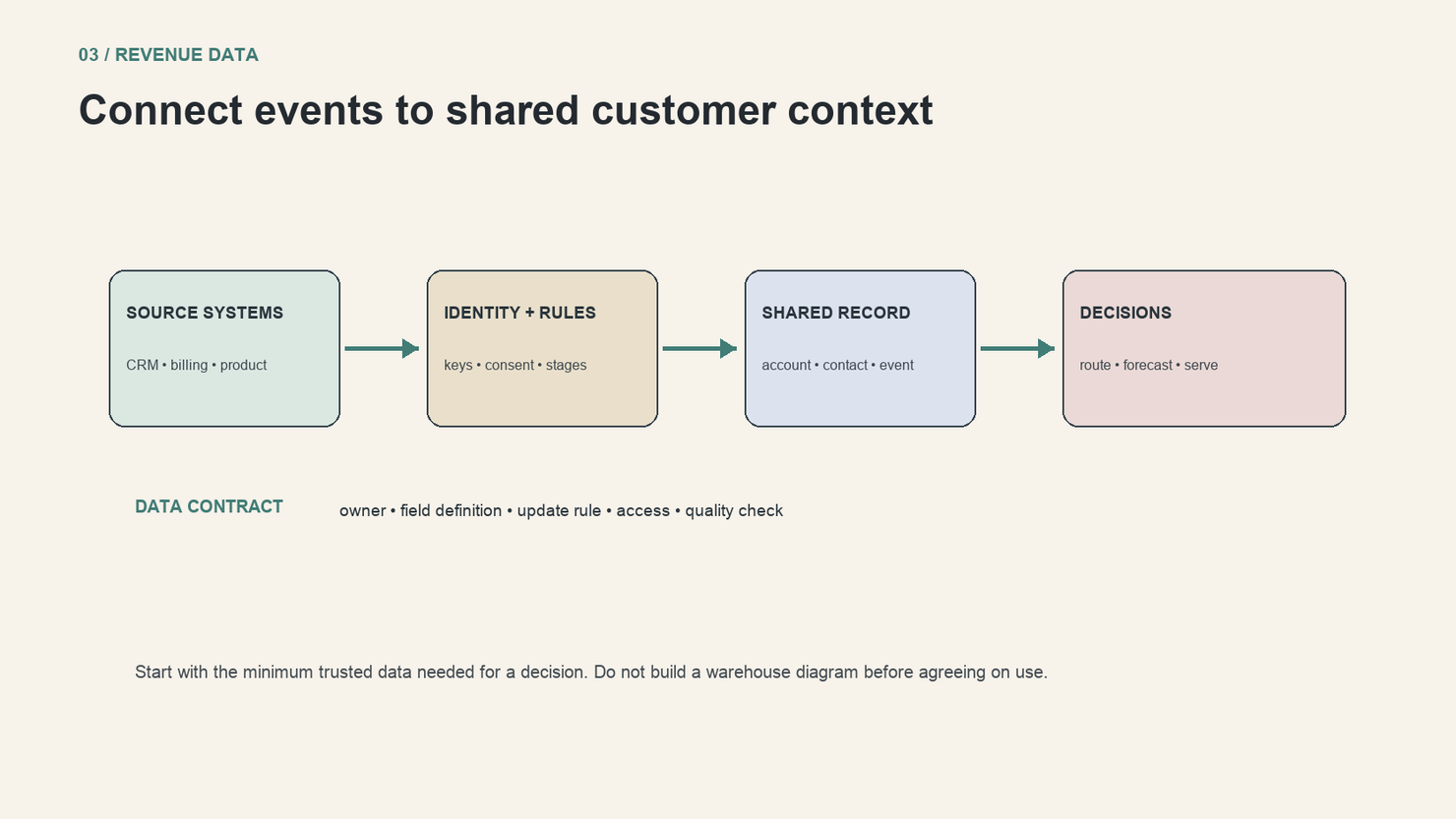
A data contract makes the expectations explicit: what a field means, who maintains it, which system is the source, how often it changes, who can use it, and how quality is checked. This is often more valuable than building a broad unified data model before teams agree on a business purpose.
Start with a high-value decision and the minimum context it requires. A seller preparing for a renewal may need product adoption, support history, contract terms, and the customer’s goals. A marketing analyst may need campaign exposure and a consented account segment. These use cases may need different access controls and update frequencies.
Protect customer data as it moves between tools. Apply appropriate permissions, retention, consent, and security requirements. Review vendor terms and integrations. Avoid giving every user or automated workflow broad access simply because a connection is technically available.
Use shared metrics with documented definitions
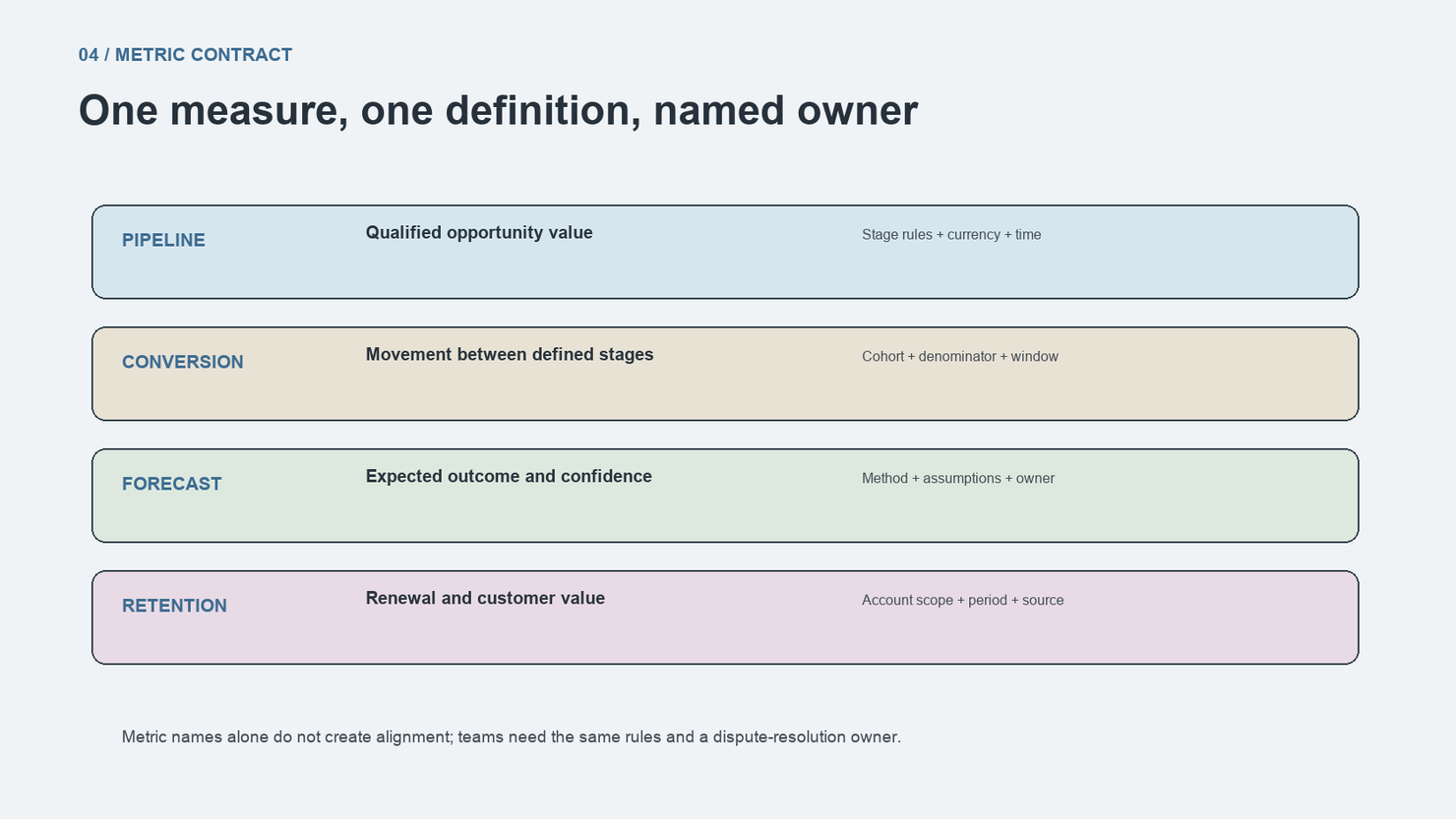
A metric is useful only when teams understand its definition and how it should influence a decision. Pipeline value needs stage criteria, currency treatment, and an as-of date. Conversion rate needs a defined cohort, numerator, denominator, and period. Retention needs an account scope and renewal rule. Forecast accuracy needs a forecast version and a comparison method.
Separate activity, customer progress, and business outcomes. Meetings booked and emails sent show activity. Accepted opportunities and completed onboarding indicate progress. Revenue, margin, retention, and expansion describe business results. A dashboard can show how the numbers relate, but it should not imply causality where the data only shows correlation or attribution.
Agree which system produces the official number and what happens when teams disagree. Maintain a metric dictionary and version changes. If a new definition alters a historical report, state whether the past data was recalculated. A shared metric should remain interpretable over time.
Improve forecasting and decision cadence
A forecast is a structured estimate based on evidence and assumptions. Establish what each stage means, what exit criteria apply, how slippage is recorded, and how managers assess confidence. Compare past forecasts with actual results to identify systematic error, but do not treat a forecast as a promise or a replacement for customer judgment.
Different conversations belong on different cadences. A weekly review can address exceptions and immediate next steps. A monthly review can look at conversion, pipeline, capacity, and customer friction. A quarterly review can revisit segments, targets, investment, and the operating assumptions behind the plan. Data quality and handoff issues need an ongoing owner.
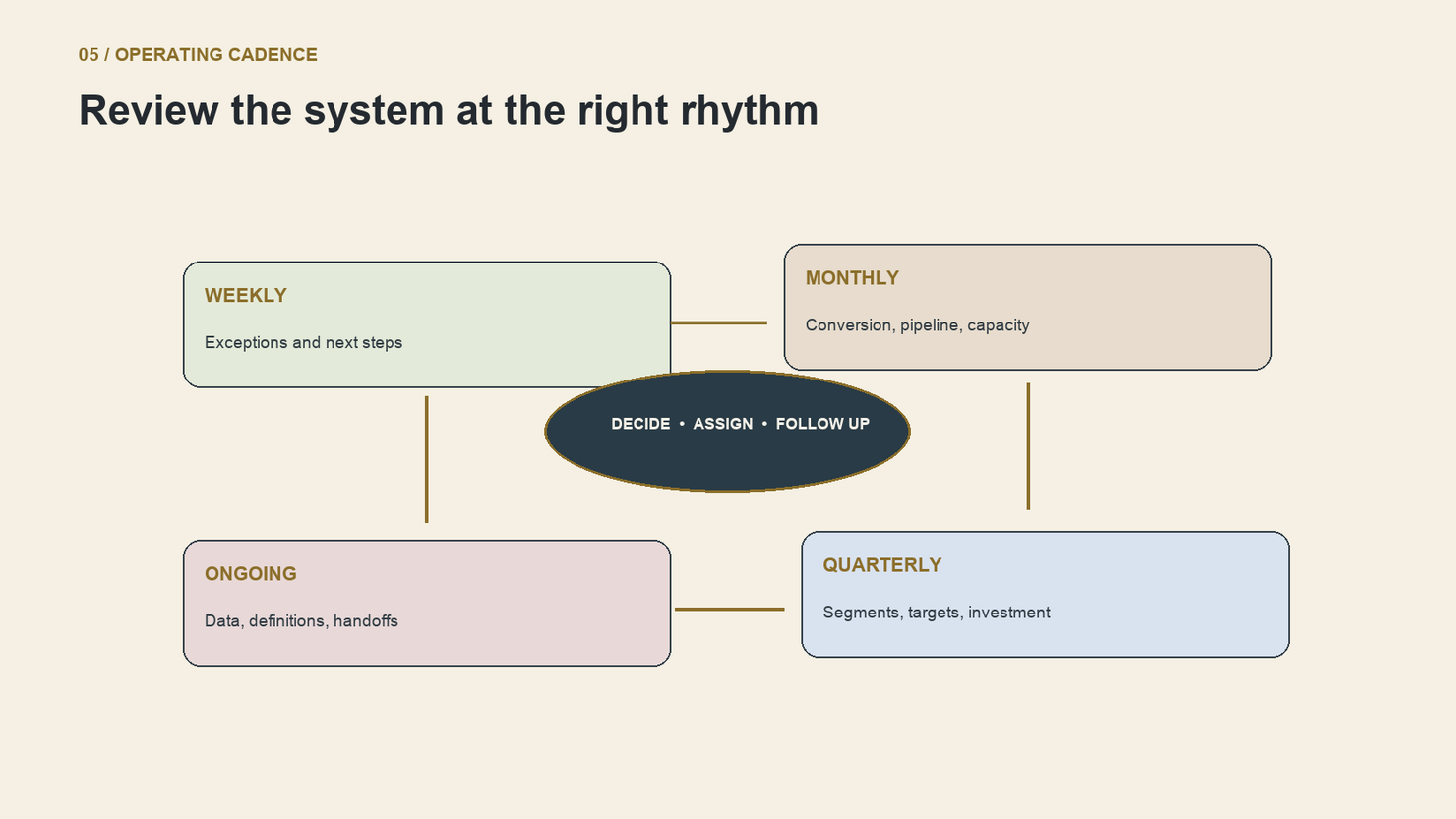
Meeting hygiene matters. Share definitions and source reports in advance, focus on decisions rather than reading the dashboard aloud, assign an owner to each action, and record what will be checked next time. If a measure does not prompt a decision, investigate whether it is needed.
What recent sales and marketing surveys can tell you
Salesforce’s seventh State of Sales report for 2026 surveyed 4,050 sales professionals across 22 countries in August and September 2025. It reports that respondents spent 40% of an average workweek selling and 60% on other activities, and that 51% of sales leaders with AI said tech silos delayed or limited those initiatives. These findings describe a vendor-sponsored survey sample; they do not establish how a particular organization allocates its time or whether adding technology will improve its results.
Review the Salesforce State of Sales report for its population and method. Run a local workflow review before using external benchmarks to justify a CRM or automation project.
Salesforce’s 2026 State of Marketing report is based on a global survey of 4,450 marketing professionals conducted in October and November 2025. The publisher reports persistent difficulty connecting customer data across functions. The practical lesson is to inspect access, definitions, and response processes in your own system rather than assume a unified platform will automatically solve coordination problems.
See the Salesforce State of Marketing report for report details. Treat relationships between data unification and performance as survey findings, not proof of causation.
Choose AI use cases only after the process is clear
AI may help summarize customer context, classify incoming requests, prepare a draft, identify unusual pipeline patterns, or support forecasting. Begin by documenting the current process and the data needed. If teams cannot agree on a stage definition or source of truth, automating it can make the inconsistency faster and harder to see.
For each proposed use, define the permitted data, actions, quality check, accountable owner, error threshold, and stop mechanism. Test against representative cases and measure review effort as well as time saved. Keep human approval for customer communications or changes that have meaningful commercial consequences until the workflow demonstrates reliable performance and governance permits greater autonomy.
The AI marketing operations playbook covers use-case selection, permissions, human review, and pilot measurement. For AI-mediated discovery earlier in the buyer journey, see the
A 90-day revenue operations improvement plan
In the first 30 days, agree on the lifecycle map, interview the teams who handle handoffs, inspect CRM definitions, and identify one or two points of friction supported by evidence. Select a metric that will indicate progress and record the baseline. Assign an executive sponsor and an operational owner.
In days 31 to 60, make a small process improvement. Clarify the handoff contract, remove redundant fields, correct a source definition, or create a shared view for a customer decision. Test the change with the teams and customers affected. Keep a record of the assumptions and any impact on reporting.
In days 61 to 90, review the process and outcome data, compare them with the baseline, and decide whether to keep, revise, or stop the change. Only then consider adding integrations or automation that address a verified need. The timeline is illustrative and should be adjusted for your systems, company size, procurement, data governance, and sales cycle.
The operating standard
Revenue operations helps teams work from the same customer context, agree on what progress means, and make reliable handoffs. It can expose where the customer experience or the internal process is breaking down. It cannot replace good positioning, a product that delivers value, or responsible decisions.
Start small, document the definitions, assign ownership, and build the review rhythm around decisions people need to make. When marketing, sales, delivery, and customer success can see how their work connects, the business is better equipped to find and fix avoidable friction.
Frequently Asked Questions
What is revenue operations (RevOps)?
What does a revenue operations team do?
How is RevOps different from sales operations?
How do you align marketing and sales operations?
What should a revenue operations dashboard include?
How do you improve CRM data quality?
How can AI help revenue operations?
How long does it take to implement RevOps?
In this series
Every article in the Revenue Systems: Connecting Marketing, Sales and CRM So Growth Doesn't Leak series.

Swapan Kumar Manna
Go-to-market & AI search strategist
Swapan Kumar Manna is a go-to-market and AI search strategist and Founder & CEO of Oneskai. He has spent 14+ years helping companies get found, get chosen and grow.