Generative engine optimization helps B2B teams make useful, accurate information easier for search and answer systems to find and interpret. It builds on SEO, but no checklist can guarantee that a platform will cite or recommend a brand.
Key Takeaways
- GEO is a planning term for improving the discoverability and clarity of useful information across AI-assisted search. It does not create control over platform answers.
- Strong technical SEO, useful content, evidence, and clear brand facts are durable foundations. Google says its generative search features use existing Search systems.
- Check access separately for each platform. OAI-SearchBot, Googlebot, and Perplexity's crawler serve different products and have different controls.
- Measure mentions, citations, answer accuracy, visits, and qualified outcomes as separate signals.
- Use a repeated set of real buyer questions to find gaps. Do not publish many near-duplicate pages or chase unsupported GEO hacks.
Playbooks
Frameworks you can put to work
Growth marketing, LinkedIn presence, and more — delivered as PDFs.
Browse the playbooksGenerative engine optimization (GEO) is the work of making a business’s accurate, useful information easier for search and answer systems to find, understand, and use when it fits a person’s question. It builds on technical SEO, clear content, and credible evidence. It cannot make an AI product cite or recommend your brand.
That distinction matters. Some GEO advice presents a new checklist as a way to force citations. The evidence does not support that promise. A better approach is to improve the quality of the information buyers can discover, check what each platform actually shows, and measure whether visibility reaches the right people.
This guide sets out a practical method for B2B teams. It connects the landscape in my guide to the future of search with the technical and content foundations in my modern SEO strategy guide.
What generative engine optimization means
GEO stands for generative engine optimization. In practice, the term describes work that can help a brand’s information become discoverable, understandable, and accurately represented in AI-generated answers. The phrase is useful as a planning label. It is not the name of one shared ranking system, and it does not describe a set of controls available to publishers.
AI-assisted search is not one uniform product. Google AI Overviews and AI Mode draw on Google Search systems. ChatGPT may search the web for some questions. Perplexity describes its experience as web research with linked sources. Copilot, Gemini, and other assistants have their own interfaces, data sources, and update cycles. A tactic that matters for one experience may not apply to another.
Google’s current guide calls AEO and GEO terms people use for work focused on AI search, while describing its own generative search optimization as part of Search. Its position is practical: follow the same core Search principles, publish useful information, and avoid unsupported shortcuts. Read Google’s guide to generative AI features in Search before buying a service that promises a separate Google GEO formula.
A related page on this site explains how AI search engines retrieve and synthesize information. For this guide, keep three terms distinct:
- SEO helps make useful pages accessible and relevant to search systems and people.
- AEO, or answer engine optimization, is a broad label for helping information answer direct questions in answer-led interfaces.
- GEO focuses on how useful information and brand evidence may be surfaced, cited, or described in generative answers.
These labels overlap. Teams do not need separate content calendars for each one. Start with the buyer’s question and decide what useful page, proof, or technical fix would serve it. A strong page can support conventional search, answer results, and a sales conversation without being rewritten into three versions.
How an AI-supported answer can use your information
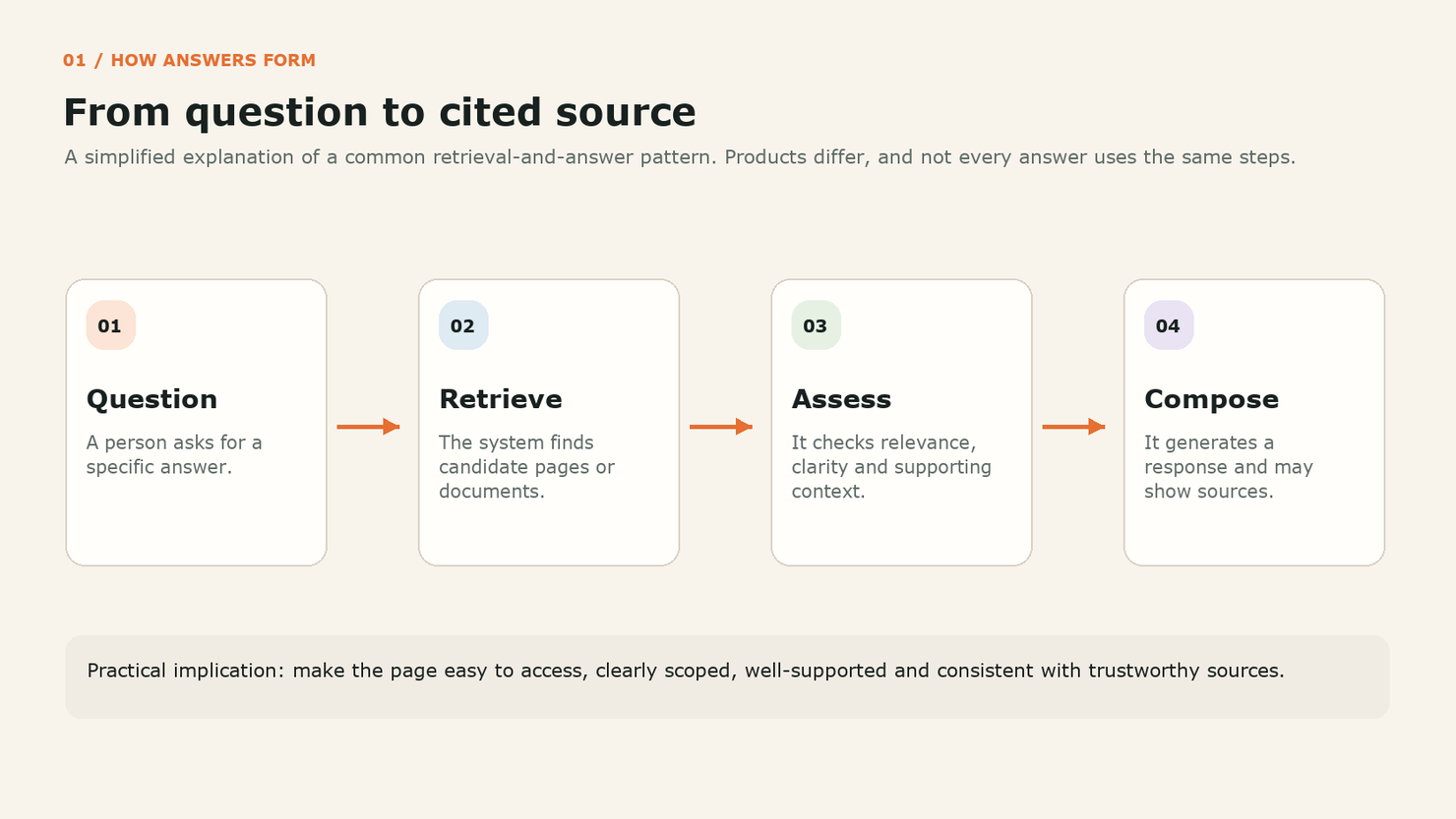
Search-enabled answer products may interpret a question, look for relevant information, select material, and produce a response. The exact steps and sources vary. Some responses draw on current web retrieval, some may use information learned earlier, and a product can mix both. A visible citation is evidence that a source is linked in that particular response. It does not reveal every internal step.
Google describes retrieval-augmented generation and related query expansion in its Search documentation. The concept is straightforward: a system can retrieve relevant pages or other data, then use that material to ground an answer. It may explore related questions when the original request has several parts. This explains why a page that answers a specific sub-question can be useful, even when the buyer’s first prompt is broad.
The process below is a simplified way to reason about one search-backed response. It is not a universal technical diagram for every assistant.
The original research paper that introduced GEO tested content changes against a benchmark of 10,000 queries and reported visibility gains in particular evaluations, including tests with Perplexity. That is useful evidence that presentation can affect experimental results. It is not proof that a fixed writing tactic will work across products, topics, or future versions. The study itself notes that results vary by domain. See the GEO research paper for its method and limits.
A separate Ahrefs analysis of 863,000 keyword search results and four million AI Overview URLs found that 38% of pages cited in an AI Overview also appeared in the top ten organic results for the same query. This suggests overlap, but not a one-to-one relationship. The analysis uses Ahrefs’ own data and covers Google AI Overviews, not every answer platform. It also does not show that rankings caused a citation. Review the study and methodology before applying the percentage to another market.
The Discoverability Ladder for a B2B brand
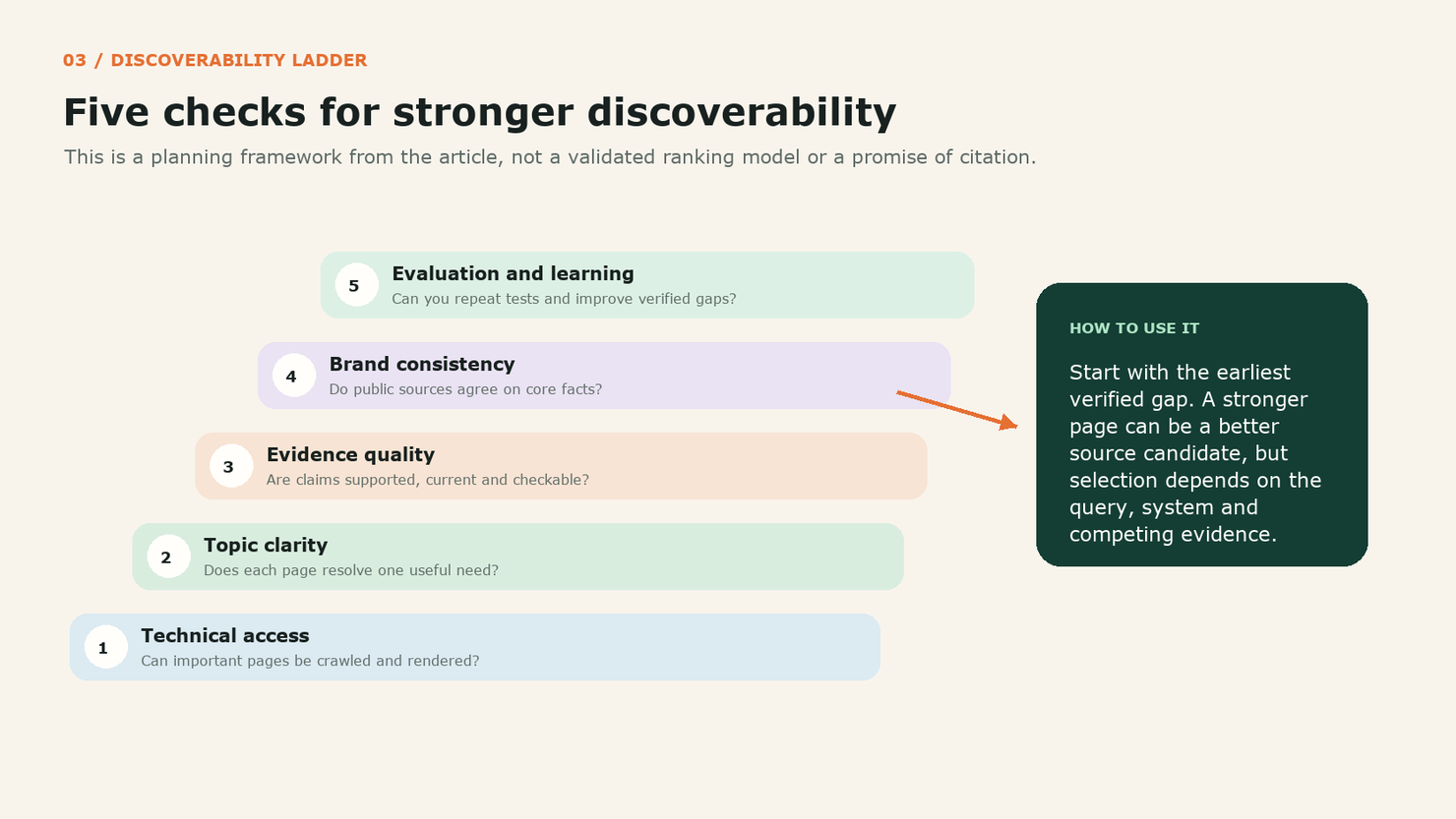
I use a simple planning model called the Discoverability Ladder to help teams locate the next useful piece of work. It is an editorial framework, not a validated ranking model. A ladder is helpful because strong content cannot compensate for every problem at once. If a page cannot be reached, revising its headline is unlikely to solve the access issue.
Move through these levels in order. At each level, look for evidence before deciding that it needs more work.
1. Technical access
Can the platform fetch the page? Can it render the main content? Is the page blocked, noindexed, canonicalized elsewhere, or orphaned from the site’s navigation? For Google AI features, a page must meet Search’s technical requirements and be eligible to appear with a snippet. Google also says the site needs to be included in its Search generative AI features in Search Console. These requirements are specific to Google Search.
For ChatGPT search, OpenAI says publishers should allow OAI-SearchBot and make sure their host or content delivery network is not blocking its published crawler traffic. OpenAI notes that visibility is not guaranteed. Perplexity publishes separate crawler and robots guidance. Check the current instructions for each platform, including any CDN or firewall rules. Do not assume that allowing Googlebot automatically allows every other crawler.
If your organization wants to opt out of one platform’s crawler, document that choice with whoever owns the site. Access and model training can have different controls. For example, OpenAI distinguishes OAI-SearchBot for search from GPTBot for potential training. Make the decision based on your policies and business needs, rather than copying another company’s robots.txt.
2. Topic clarity
Can a reader quickly tell what the business does, whom it serves, and what each page explains? Use consistent names for your company, products, services, locations, and important concepts. Explain uncommon terms. If two pages target the same question, choose their distinct roles or combine them. Conflicting or vague descriptions make it harder for buyers as well as software to follow the story.
A page should satisfy one meaningful reader need, not a list of loosely related keywords. State the answer early, then give context, examples, evidence, limits, and next steps. Use headings to make the argument easy to navigate. There is no required number of words, fixed paragraph length, or magic answer block that guarantees a citation.
3. Evidence quality
Support claims with information a reader can inspect. Link to primary sources near the claim. When you report a statistic, include the date, sample, geography, and what the number measures if those details are available. If the evidence is limited or contested, say so. Remove claims about customer results unless you can verify them and have permission to use them.
For B2B readers, evidence may include product documentation, pricing and implementation details, original analysis, a clearly described case study, or an expert’s explanation of a tradeoff. Generic statements such as “industry-leading” or “trusted by teams” are not a substitute for proof. Make the information current enough for the decision the page supports.
Experience and expertise should be visible through the work itself: a real method, a considered interpretation, useful examples, and honest limits. Use the site’s author profile and verified credentials. Do not add invented testimonials, unsupported client stories, or a biography repeated at the end of every page. E-E-A-T is a useful editorial lens, not a score to add to the page.
4. Brand consistency across sources
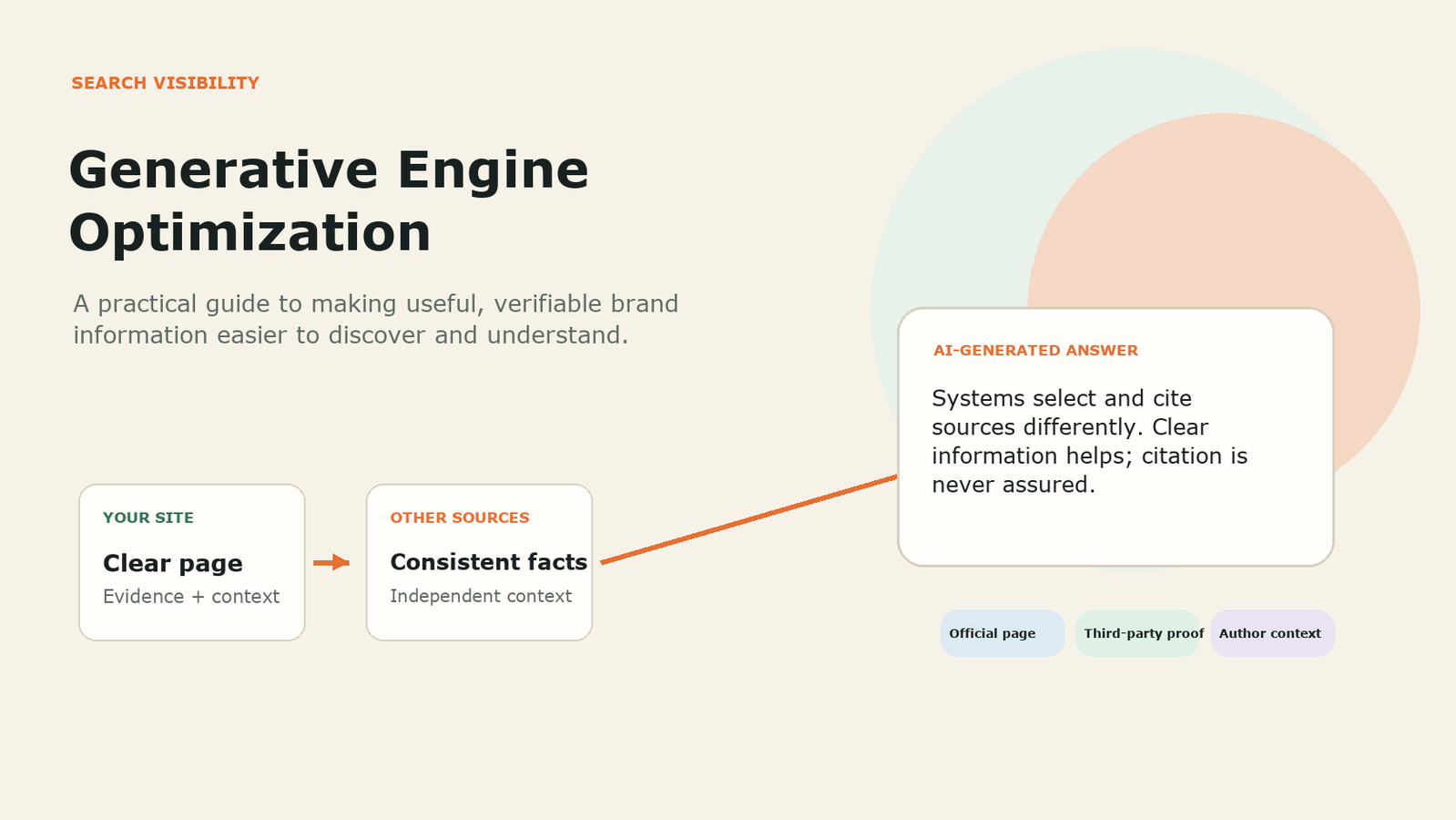
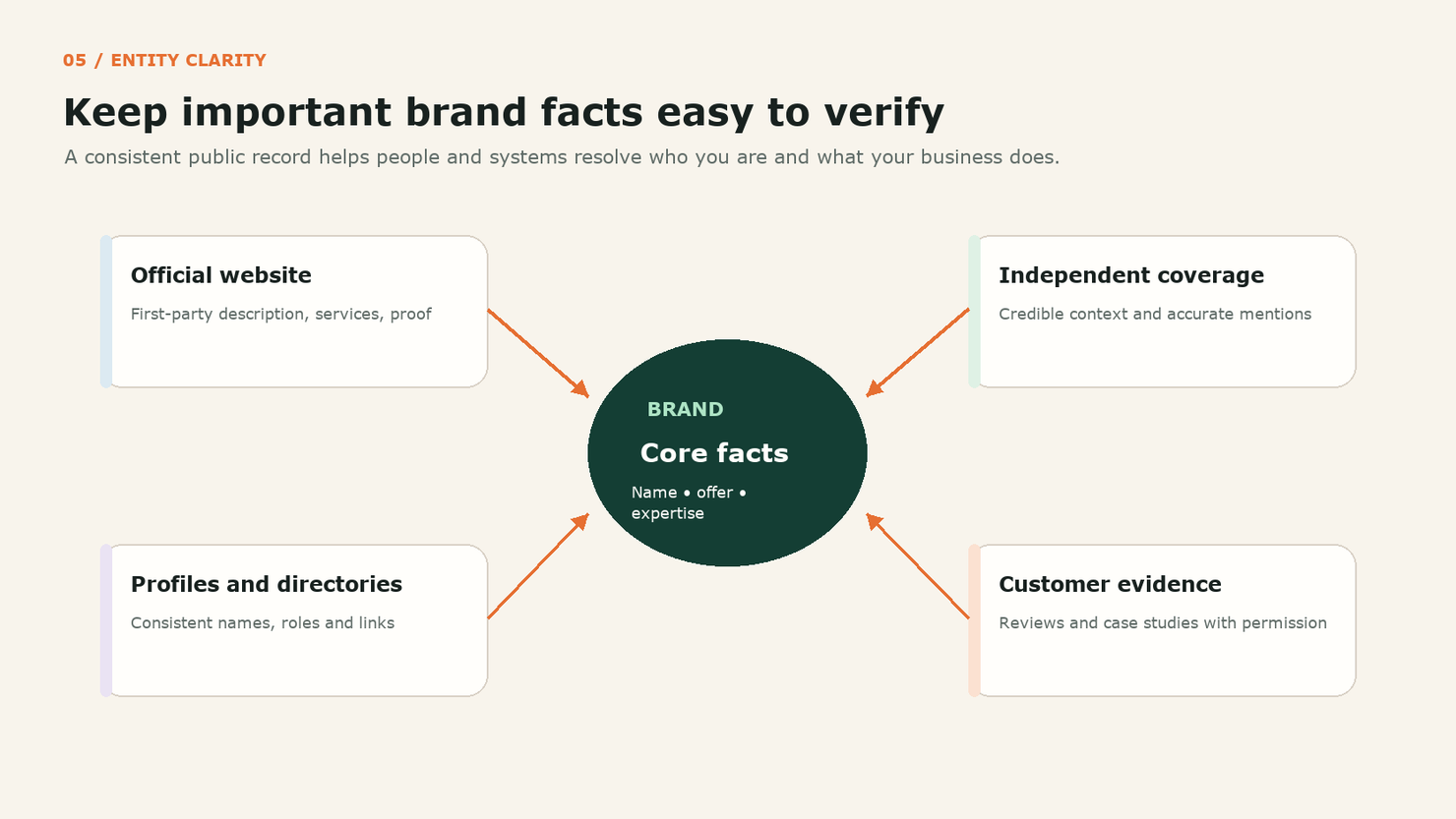
Your website is where you can explain your offer in depth. Independent sources can help buyers check that explanation. Keep company names, product descriptions, leadership details, locations, and category claims accurate across the sources you control. Review professional profiles, directories, partner pages, and press materials when an important fact changes.
Do not try to manufacture authority through bulk guest posts, paid mentions presented as independent reviews, or repeated brand insertions in pages that do not help readers. Google’s spam policies include rules against manipulative link schemes and scaled low-value content. Ask for accurate coverage and contribute information that is useful to the audience of the publication or community.
The visual below shows a practical evidence map. The sources do not need to repeat the same copy. They should agree on material facts and give people a way to verify them.
5. Evaluation and learning
Treat visibility as something to observe, not a switch to flip. Test real buyer questions, record the product and date, inspect the answer and sources, then decide whether the issue is access, relevance, evidence, or brand accuracy. A single answer is only one observation. Results can change with the question wording, user context, product, and time.
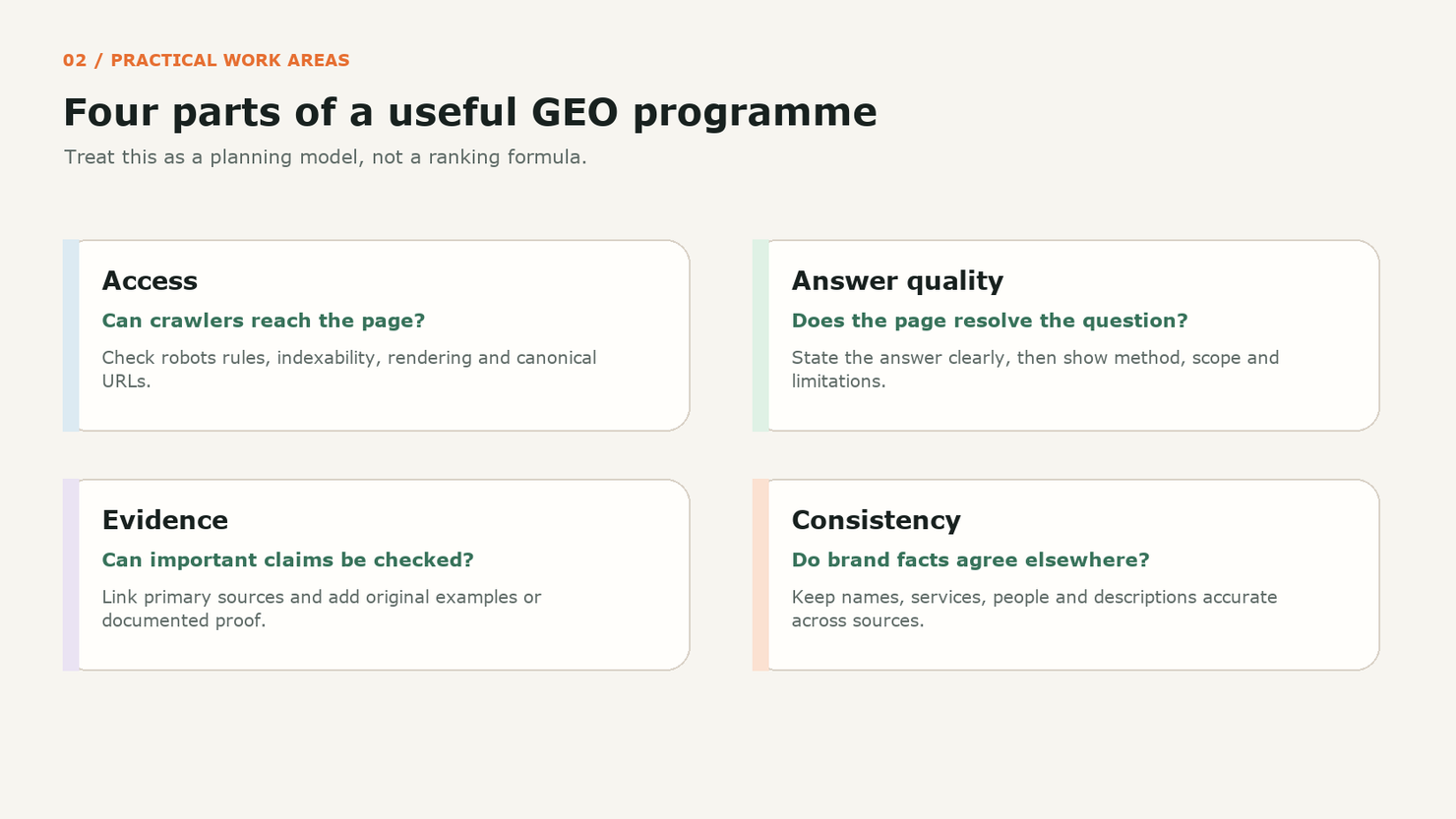
This ladder gives a better prioritization method than asking “What is the best GEO tactic?” It asks which gap is keeping the right information from being found or trusted, and what change could reasonably address that gap.
A practical on-site content method
Begin with questions buyers ask at different stages. A founder comparing agencies may want proof of experience. A marketing leader may need to explain the difference between AI visibility and search traffic to a board. A practitioner may be checking crawler access. Those are related topics, but they call for different pages or sections.
Use sales calls, customer interviews, support requests, Search Console queries, site search, and public discussions to collect language. Treat a prompt list as a working sample, not measured search volume. A tool estimate for AI prompts is not equivalent to a platform’s real user query count.
Then write a page that can stand on its own. A useful structure is:
- Open with a direct answer to the question in plain language.
- Explain when the answer applies and what would change it.
- Show a method, example, comparison, or decision rule the reader can use.
- Support factual claims with reliable, current sources.
- Explain limits and common exceptions instead of hiding them.
- Point to a relevant next step, tool, or related guide.
That structure is a writing aid, not a special format that AI systems require. Google explicitly says that publishers do not need special markup, AI text files, or to break a page into tiny chunks for its generative search features. It recommends making content useful and organized for the reader. See Google’s current guidance on AI features and your website.
Use structured data only when it accurately describes visible content and the page meets the feature’s requirements. It can clarify what a page contains for eligible search features. It is not a citation guarantee. FAQ content should answer real questions on the page, not be added to chase a rich result.
Originality also matters. Google’s guidance on generative AI content says the focus is on accuracy, quality, and relevance. Using AI to help organize or edit information is not itself the problem. Publishing many pages with little original value to manipulate rankings can violate the scaled content abuse policy. A human editor should verify facts, add judgment, and remove material that does not help the reader.
Put this into practice
The GTM Funnel Playbook
How B2B teams find, win and keep customers, with a 90-day action plan. Seven funnel stages, one owner each, from the revenue number to the clients you keep.
Build a brand evidence base off-site
A company’s own pages cannot answer every question about its reputation. Buyers may look for customer reviews, implementation partners, analyst commentary, professional communities, or independent reporting. You cannot control what those sources say, and you should not try to script them. You can make it easier for others to describe the company accurately.
Create source material worth referencing: original data with a clear method, a helpful public comparison, a documented product change, or a specialist’s informed explanation. Offer a useful comment to a journalist or community when you have relevant evidence. Make any commercial relationship clear. If you find an incorrect listing, request a correction with supporting details instead of creating another near-duplicate listing.
This is reputation work as much as search work. If a company is often described differently across its own site, a directory, and a customer review, fix the underlying information and clarify the offer. Do not assume that a high number of mentions means a buyer will understand why the company is relevant.
For more on measuring what the market sees, read Brand Visibility in AI Search: Recognition and Evidence. For definitions of the overlapping disciplines, see SEO vs. AEO vs. GEO.
Measure GEO without confusing activity with impact
A useful measurement plan separates several questions. Is the page accessible? Does the brand appear in relevant answers? Is it cited? Is the description accurate? Does a qualified person visit or take action? A single “AI visibility score” may summarize some of these, but it cannot replace the definitions behind it.
Build a small prompt set from actual customer questions. Include category discovery, comparison, implementation, and decision questions. Keep the prompt wording stable for a baseline, and add new questions only when buyer research supports them. Test more than one product if your audience uses more than one. Note whether web search was active and capture the links shown.
Track mentions and citations separately. A mention means the brand appears in answer text. A citation means a source link is attached. A source may be your site or another publisher. Review whether the answer says the right thing about your category, audience, pricing, and offer. The context is often more useful than a raw count.
For Google, use Search Console’s current reporting for generative AI features and review eligible search traffic. For Bing and supported Copilot surfaces, Microsoft’s AI Performance report provides citation and page-level observations. Microsoft says these are observational measures, not rankings or a quality score. OpenAI documents that search referral URLs can include `utm_source=chatgpt.com`, which can help separate this traffic in analytics. These reports describe different products and should not be combined as if they measured the same thing.
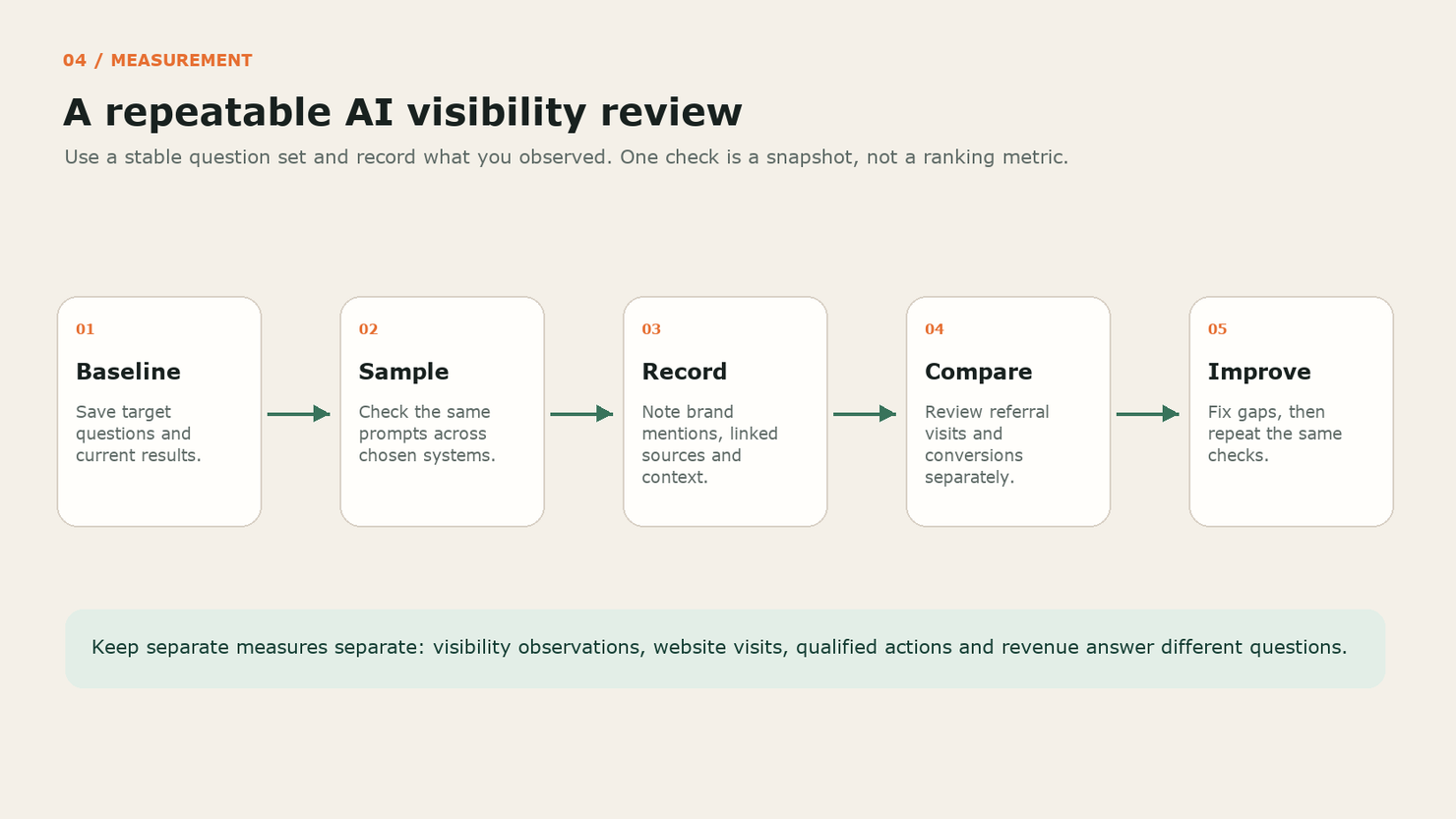
Connect visibility with business data carefully. A visit from an answer product may be useful, but one visit does not show that GEO caused a sale. A branded search can follow many activities. Use referral, landing-page, enquiry-quality, and pipeline data together, and report attribution limits to leadership.
The measurement loop should lead to a content decision. If the site is not accessible, fix the access issue. If it appears but the answer is inaccurate, clarify the source facts. If a citation is present but visits are not qualified, revisit the audience and the usefulness of the page. If the brand never appears for a topic buyers care about, check whether your content and independent evidence actually cover that need.
A 30-day starting plan
A month is enough to establish a baseline and resolve several known gaps. It is not a promise that AI systems will change their answers within 30 days.
Week 1: choose buyer questions
Interview a few recent customers and sales colleagues. Collect the questions that affect a shortlist or implementation decision. Group them by task and choose a small set where your team can offer useful evidence. Record the source of each question so assumptions do not look like measured demand.
Week 2: check access and current representation
Review the pages that matter for crawl and index status, canonical tags, internal links, and mobile rendering. Confirm crawler policies against each platform’s documentation and your organization’s preferences. Test a stable set of prompts in the products relevant to your audience. Save the date, question, result, and sources.
Week 3: improve one important page
Choose a gap the evidence supports. Improve the page’s answer, details, examples, proof, or clarity. Link to a useful source and relevant live pages. Remove claims you cannot verify. If the real gap is third-party evidence, do not rewrite a page to pretend it can solve that problem.
Week 4: review and decide
Repeat the same tests and compare observations. Look for accurate representation, useful citations, qualified visits, and next-step actions. Decide whether to keep the change, revise it, or investigate another level of the Discoverability Ladder. Keep notes on limitations and the next review date.
A simple scorecard can include these fields: question tested, platform and mode, date, brand mention, page citation, accuracy, referral or engagement signal, and action. Do not convert a small sample into a market-wide claim.
GEO mistakes that waste time
Creating a separate page for every prompt
Prompt variations often express the same need. Creating a large set of near-identical pages may confuse readers, compete with your own useful pages, and create low-value content. Cover distinct questions where the answer genuinely differs. Combine close variants where one thorough article serves the task better.
Treating citations as the business outcome
A citation is a useful observation, but it does not tell you whether a buyer is a good fit or whether a page influenced a decision. Keep source visibility separate from qualified traffic and pipeline. If you only report citations, you may optimize for broad questions that do not support your business.
Assuming every answer is search-backed
Some systems answer from model knowledge, some retrieve current web pages, and some combine different sources. Check the product’s interface and documentation. Do not assume that every mention came from a webpage a publisher can change.
Adding unsupported technical extras
Do not add new schema, AI text files, or unusual content fragments just because a vendor calls them mandatory for GEO. Follow official requirements for the particular platform. Google says there is no special schema or required chunking for its AI features. Other platforms may have their own crawler and content controls, so check their docs directly.
Copying a competitor’s answer format
A competitor’s structure can show what a reader may expect, but it does not tell you which claims are reliable or which section your buyers need. Build the page from your audience’s questions, evidence, and actual expertise. Review strong publishers such as HubSpot, Semrush, Backlinko, and Neil Patel for useful organization and examples, then create an original argument in your own voice.
How should a B2B team prioritize GEO?
Start with the foundation: make important pages reachable, clear, and supported by evidence. Build a repeated view of the questions your buyers ask. Improve the pages that address real needs, keep the company’s public facts consistent, and use each platform’s available reporting to understand what happens. Continue the work only when you can name the reader or business problem it addresses.
That is the practical value of GEO. It gives teams a way to plan for AI-assisted discovery without pretending they can control it. The work should leave a better website, clearer evidence, and more informed decisions even when a platform’s answer changes.
For practical thinking about search, AI, and growth, join The Agentic Pivot newsletter.
Frequently Asked Questions
What is generative engine optimization?
Does GEO replace SEO?
How can a B2B company improve its GEO?
Does a business need llms.txt or special schema for GEO?
How should a team measure AI search visibility?
How long does GEO take to show results?
Put this into practice
The GTM Funnel Playbook
How B2B teams find, win and keep customers, with a 90-day action plan. Seven funnel stages, one owner each, from the revenue number to the clients you keep.
Frequently Asked Questions
What is generative engine optimization?
Does GEO replace SEO?
How can a B2B company improve its GEO?
Does a business need llms.txt or special schema for GEO?
How should a team measure AI search visibility?
How long does GEO take to show results?

Swapan Kumar Manna
Go-to-market & AI search strategist
Swapan Kumar Manna is a go-to-market and AI search strategist and Founder & CEO of Oneskai. He has spent 14+ years helping companies get found, get chosen and grow.