Part of the Demand Generation and Brand Authority: How Companies Become the Brand Buyers (and AI) Already Know series
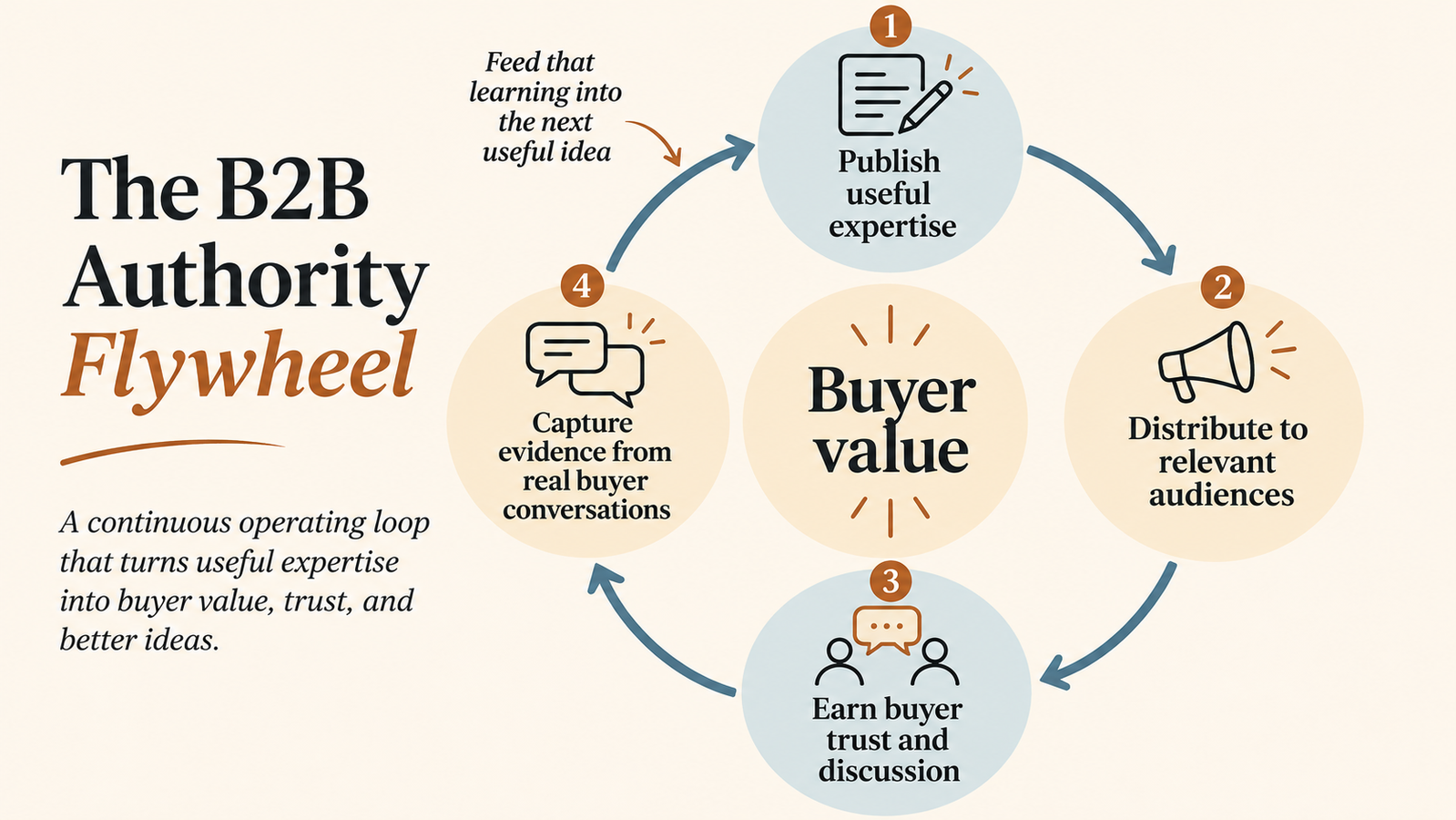
A B2B authority flywheel connects useful expertise, relevant distribution, buyer trust, and evidence from real conversations. Treat it as a learning model, measure each stage separately, and avoid promising that content alone produces pipeline or revenue.
Key Takeaways
- Build the process around a real audience and recurring buyer questions.
- Create useful resources with evidence and clear limitations.
- Adapt distribution to each channel instead of repeating identical copy.
- Capture buyer evidence with context and permission.
- Combine analytics with feedback and avoid unsupported attribution.
Playbooks
Frameworks you can put to work
Growth marketing, LinkedIn presence, and more — delivered as PDFs.
Browse the playbooksA B2B authority flywheel is a repeatable content and customer-learning loop: share useful expertise, distribute it where relevant buyers can find it, earn trust through accurate and helpful work, and capture evidence from real conversations to improve the next piece. It is a planning model, not a promise that publishing automatically produces pipeline or revenue.
This guide explains how to build the loop, where it often breaks, and how to measure it without confusing reach with business impact. It sits within the demand generation and brand authority pillar and connects to founder-led marketing, LinkedIn for B2B authority, and B2B dark social.
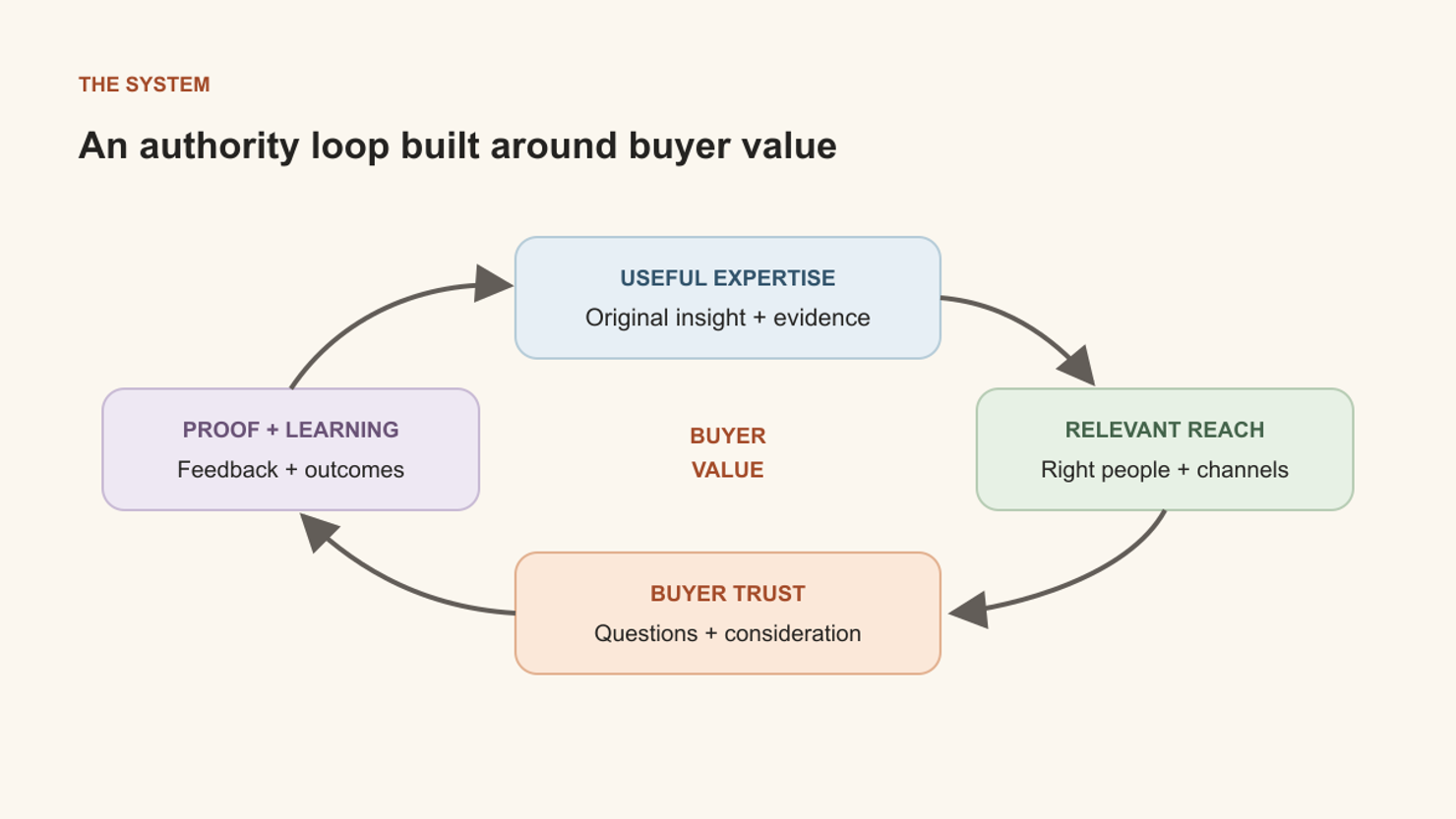
The four stages of an authority flywheel
Useful expertise is the starting point. Choose a buyer question the company can answer with direct knowledge, reliable research, or carefully explained experience. Make the response specific enough to be useful and honest about its limits. A generic article or a polished claim without supporting evidence gives the loop little value to carry forward.
Distribution connects the idea to an audience. Use channels that the intended buyers already use, such as a company website, professional social network, newsletter, event, publication, or community. Adapt the format to the channel and make the source easy to find later. Distribution means helping the right people encounter useful work, not maximizing activity on every platform.
Trust develops when the company consistently helps people understand an issue, backs up claims, and delivers an experience that matches what it says. Trust is earned over time and depends on more than content. A strong point of view cannot compensate for inaccurate claims, poor service, or a product that fails to meet expectations.
Proof and learning come from questions, buyer feedback, customer experience, and outcomes the company can verify and share with permission. Those signals can reveal what readers misunderstood, which evidence helped a buying group, or where the content needs an update. The next piece should reflect what the company learned, so the process improves rather than simply repeats.
Build the loop around a real audience
Define the audience by role, situation, and decision. A content piece for a technical evaluator may need implementation detail, while a finance leader may need cost, risk, or operational implications. One article can serve multiple roles if it explains the shared question and makes role-specific considerations clear. Avoid writing a broad “everyone” piece that offers no one enough detail.
Connect content topics to the questions buyers ask while learning, comparing, and validating a solution. Use interviews, sales notes, support themes, search data, and community questions as inputs. Treat those sources as evidence to investigate, not as automatic proof of market-wide demand. Check that the question recurs and matters to the intended segment before investing in a large content series.
Create material worth sharing
A useful resource gives someone a reason to read, refer a colleague, or return to the page. That may be an original analysis, a practical guide, a transparent case study, a careful comparison, or a clear explanation of a trade-off. Include sources when appropriate, distinguish evidence from opinion, and state when examples are hypothetical.
The 2026 Edelman-LinkedIn B2B Thought Leadership Impact Report draws on more than 1,100 management-level professionals. It reports that 89% of surveyed decision-makers who had shared thought leadership had done so through private channels, compared with 67% who had shared it publicly. Those responses were not mutually exclusive, and the survey finding does not prove that any single resource caused a sale. It does show why public reactions cannot represent the whole distribution path. See the 2026 report.
Make important resources accessible and easy to understand when forwarded without context. Use descriptive titles, stable URLs, accurate summaries, and useful internal links. If a page addresses a common buyer question, keep the answer close to the top, then explain the reasoning and limitations in more detail. Provide the source material in a format the reader can share with colleagues.
Distribution is not the same as repetition
A strong distribution plan identifies where the audience is, who can credibly carry the idea, and what form is helpful in that setting. A long article can be adapted into a short explanation, an event discussion, or a sales resource. Each version should fit the reader’s need rather than copying the exact same text everywhere. Experts should participate in channels where they can answer real questions, while the company’s own site remains the durable source for fuller material.
Measure distribution with context. Record which format, audience, and channel were used. Look at relevant reach, referrals, meaningful reader actions, and the questions that follow. Do not buy artificial mentions, automate comments, use engagement pods, or ask for empty reactions. A tactic that inflates activity without helping the audience does not strengthen the flywheel.
Earn trust through consistent proof
Trust grows when a company makes its expertise and limitations clear. Cite primary sources for research claims, disclose relevant relationships, obtain permission before naming customers, and correct errors. Be careful with claims about rankings, savings, market leadership, or outcomes. The reader should be able to see what is fact, what is interpretation, and what is a recommendation.
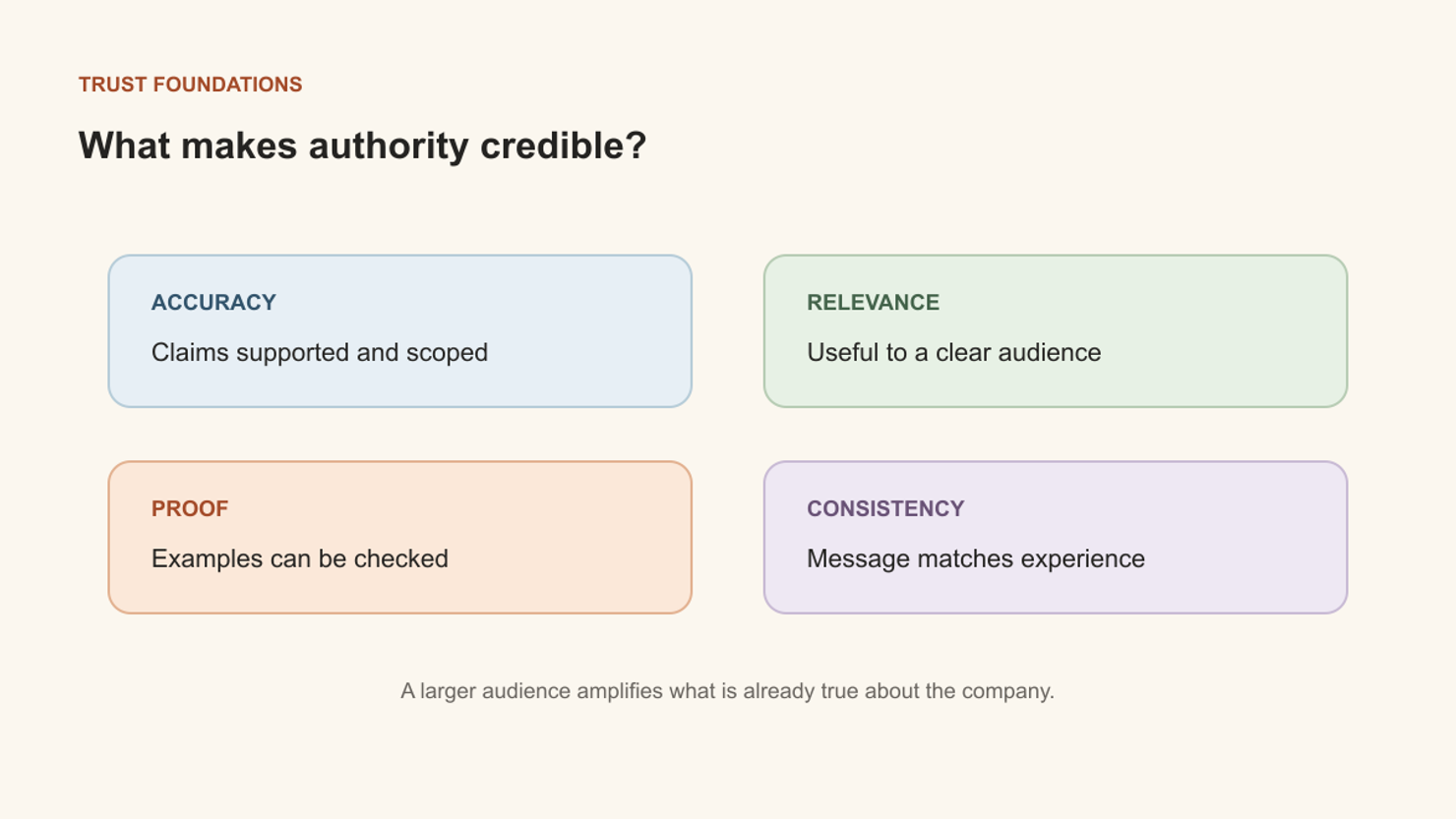
The customer experience also affects what happens after content has generated interest. Sales, onboarding, support, and delivery should use the same clear explanations and evidence as marketing. If the public promise differs from the buying or customer experience, the system creates friction rather than momentum. The flywheel is only as strong as the next interaction a buyer has with the company.
Put this into practice
The Growth Marketing Playbook
A step-by-step guide to planning, running, and optimizing campaigns that drive real revenue — not just clicks and followers.
Capture learning without overstating attribution
Ask customers which materials helped them understand a decision, what they shared with colleagues, and where they still had questions. Record feedback in a consistent way and ask permission before using quotes or names. Sales teams can note which resources were used in conversations, but a salesperson’s recollection does not establish that the content caused a deal to advance.
Use analytics alongside interviews and sales notes. Search referrals, campaign tags, direct visits, downloads, and meeting mentions each reveal different parts of the journey. Private sharing and multi-person B2B decisions are hard to observe completely. Look for repeated patterns, document the limits, and use a causal design if the business needs a causal estimate.
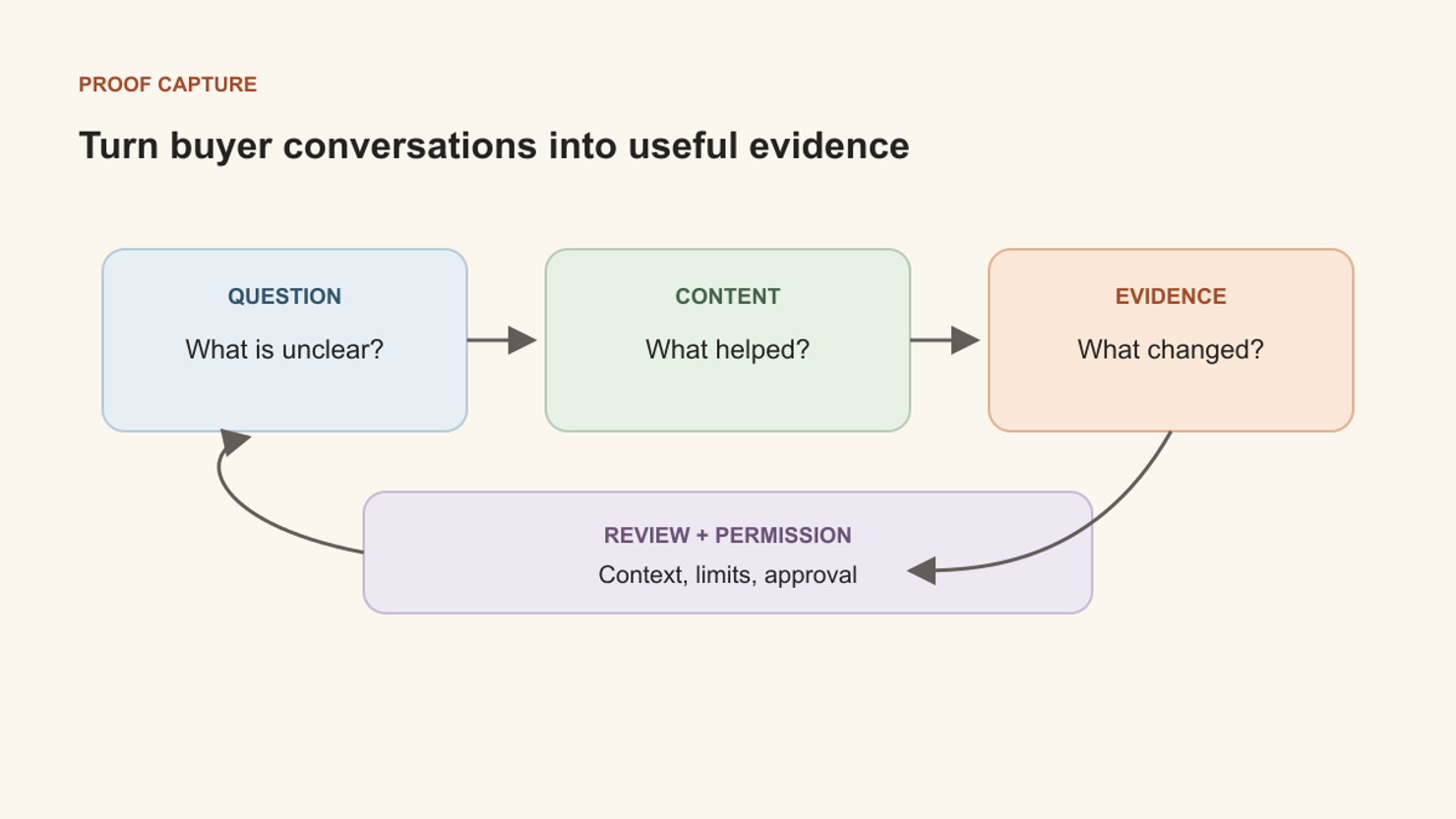
Keep a simple evidence log: the question, the asset shared, the audience, the feedback received, any outcome that can be substantiated, and permission status. Review it at a regular interval. If buyers repeatedly misinterpret a claim, clarify it. If the information is outdated, update it and record what changed. If a customer example is useful, verify the details and get approval before publication.
Measure every stage
At the content stage, assess usefulness, accuracy, and whether the material answers the intended question. At the distribution stage, assess whether relevant people encountered it. At the trust stage, listen for buyer feedback, repeat visits, referrals, and meaningful conversations. At the proof stage, examine how the content was used in evaluation, along with appropriate commercial indicators.
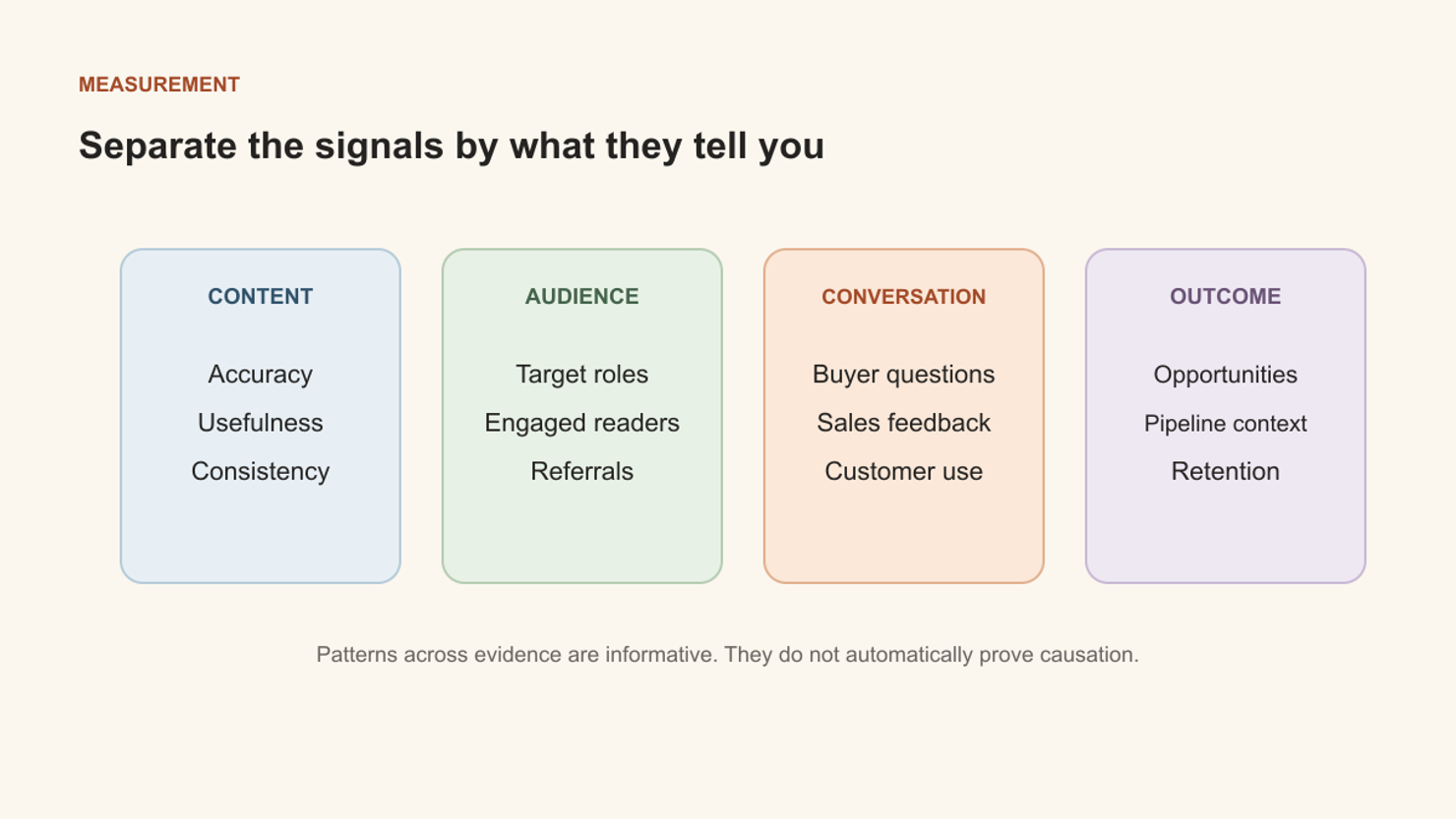
No one measure represents authority. A post can reach many people who are not buyers. A guide can influence a private conversation that analytics never attributes to it. A customer may trust the company for reasons that have little to do with content. Set a purpose, compare similar audiences and periods, and read several signals together before changing the program.
A practical 90-day start
In the first month, identify one audience and a small set of recurring questions. Choose one question the team can answer with evidence and produce a useful resource. In the second month, adapt it for two or three channels the audience already uses, then collect questions and feedback. In the third month, review relevance, usefulness, sharing context, and any buyer or customer evidence. Update the resource and choose the next question based on what the team learned.
Keep the scope small enough to maintain. A flywheel does not require daily posts or a large content library. It requires a reliable cycle in which useful expertise reaches the right people, the company follows through, and learning improves the next contribution.
Frequently asked questions
Frequently Asked Questions
What is a B2B authority flywheel?
How is an authority flywheel different from a funnel?
How do you build a B2B content flywheel?
How long does it take to build authority?
How should a company measure an authority flywheel?
Can content alone create trust and pipeline?
Research and further reading
HubSpot: The Flywheel Model explains its customer-experience-centered model for growth momentum.
Edelman and LinkedIn: 2026 B2B Thought Leadership Impact Report reports how B2B professionals use and share thought leadership.
Put this into practice
The Growth Marketing Playbook
A step-by-step guide to planning, running, and optimizing campaigns that drive real revenue — not just clicks and followers.
Frequently Asked Questions
What is a B2B authority flywheel?
How is an authority flywheel different from a funnel?
How do you build a B2B content flywheel?
How long does it take to build authority?
How should a company measure an authority flywheel?
Can content alone create trust and pipeline?

Swapan Kumar Manna
Go-to-market & AI search strategist
Swapan Kumar Manna is a go-to-market and AI search strategist and Founder & CEO of Oneskai. He has spent 14+ years helping companies get found, get chosen and grow.